




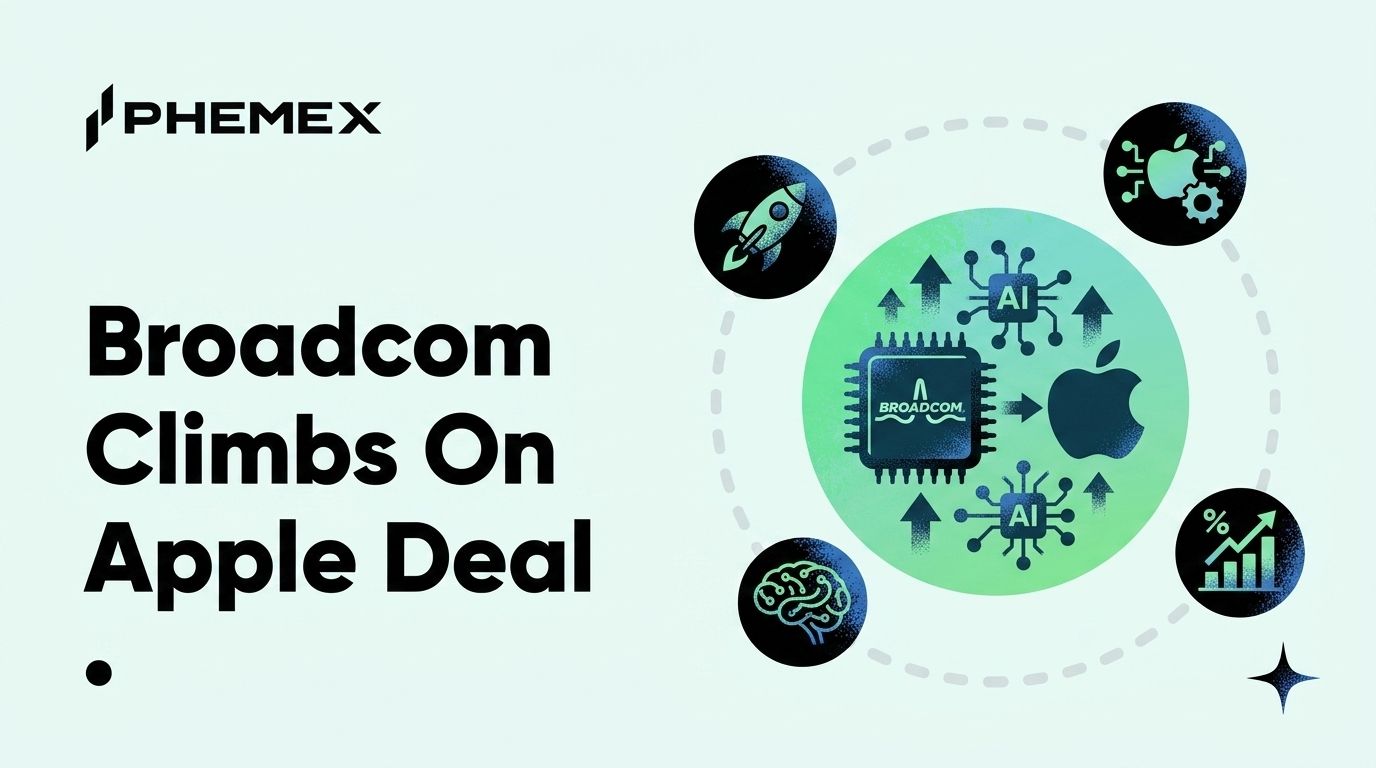
Broadcom stock climbed 4.69% to about $388.71 today, July 9, 2026, as two separate catalysts landed in the same session. The company extended its custom-silicon partnership with Apple through 2031, locking in a customer that already accounts for roughly 20% of Broadcom's annual revenue. On the same day, management guided next-quarter AI chip revenue to about $16 billion, a jump of more than 200% year over year built on hyperscaler design wins with Google, Meta, and OpenAI. Tokenized as AVGO-USDT, Broadcom is one of the equity names traders can access directly through Phemex.
The move is bigger than one stock. AVGO is anchoring an AI-chip rebound this week after last Thursday's selloff, and the read-through touches every name in the custom-silicon trade.
AVGO snapshot as of July 9, 2026
- Price: ~$388.71
- 24h change: +4.69%
- 7-day note: rebounding with the AI-chip complex after last week's Samsung-earnings selloff
- Catalysts: Apple custom-chip deal extended through 2031 plus Q3 AI revenue guided to $16 billion (+200% YoY)
- Key metric: Apple is roughly 20% of Broadcom's annual revenue
Here is what each catalyst actually changes for Broadcom and where AVGO trades from here.
Inside the Apple Custom Chip Deal That Runs Through 2031
The first catalyst is the one Wall Street has wanted confirmation on for months. Broadcom expanded its custom-chip agreement with Apple, extending a supply relationship that now runs through 2031. Apple relies on Broadcom for wireless components and, increasingly, for the custom application-specific chips (XPUs and ASICs) that sit inside its hardware and its own server infrastructure. The extension removes the single biggest overhang on the stock, which was the fear that Apple would eventually design Broadcom out of its supply chain.
That fear was never trivial. Apple is roughly 20% of Broadcom's yearly revenue, so any move by Apple to bring chip design fully in-house would carve a hole in the top line that no other single customer could quickly fill. A multi-year renewal does the opposite. It tells the market that one of the most demanding hardware buyers on earth still needs Broadcom's silicon expertise for the rest of the decade, and it gives Broadcom a revenue floor it can plan around. Traders who want to track the exact contribution can follow it through Broadcom's quarterly results, where the wireless and custom-silicon lines are broken out, and cross-check the customer concentration language in Apple's investor relations disclosures.
The deal also reframes how the market values the relationship. A one-year supply contract is a transaction. A contract that runs to 2031 is a partnership, and partnerships get valued on durability rather than on the next renewal date. That shift in perception is part of why the stock reacted the way it did, even before the AI guidance hit the tape.
Why Broadcom's $16 Billion AI Guide Changes the Growth Story
The second catalyst is the one that moved the multiple. Broadcom guided its Q3 AI chip revenue to about $16 billion, which is more than 200% growth from the same quarter a year ago. That is not a rounding-error beat on an already-large number. It is a step-change in the pace of the AI franchise, and it comes from a specific place: custom accelerators designed for a small group of hyperscale customers who are building their own chips to escape merchant-GPU pricing.
Broadcom CEO Hock Tan has spent the past two years positioning the company as the default partner for hyperscalers that want silicon tuned to their own workloads. The design wins now span Google, Meta, and OpenAI, each of which is spending heavily on training and inference capacity. Custom ASICs let those buyers cut power draw and cost per token on the workloads they run at massive scale, and Broadcom captures the design, the intellectual property, and the high-margin manufacturing coordination.
|
Broadcom AI driver
|
What it means for the $16B guide
|
|
Google custom accelerators
|
Long-running TPU-class program, the anchor tenant of the ASIC franchise
|
|
Meta inference silicon
|
Ramping design wins tied to recommendation and ad-ranking workloads
|
|
OpenAI custom chips
|
Newer program adding a third named hyperscaler to the pipeline
|
|
Networking and switching
|
Broadcom's Ethernet and switch silicon connect the AI clusters those chips sit in
|
The reason this matters for AVGO's valuation is simple. Merchant GPUs are a huge market, but they are also a crowded one. Custom silicon is a narrower, stickier business where the customer co-invests years of engineering into a design and cannot easily switch vendors mid-cycle. A $16 billion quarterly AI run rate built on that kind of lock-in is worth more per dollar than the same revenue earned in a spot market. That is the argument bulls are making, and today's tape agreed with them. Rival custom-silicon designer Marvell trades on a version of the same thesis, which is why the read-through moved beyond a single ticker.
How the AI Chip Sector Snapped Back This Week
AVGO did not rally in a vacuum. Today's move anchors a broader recovery in the AI-chip complex after a rough end to last week. Samsung's disappointing earnings triggered a selloff on Thursday that dragged the whole memory-and-logic group lower, and June had already been unkind, with several leaders giving back 12% to 20% from their highs. Broadcom's dual catalysts flipped the mood, and the rest of the group followed.
|
Ticker
|
Move today (July 9, 2026)
|
Role in the AI trade
|
|
AVGO
|
+4.69%
|
Custom ASIC and networking silicon
|
|
NVDA
|
+3.2%
|
Merchant GPU leader
|
|
CRWV
|
+6.2%
|
AI cloud compute provider
|
|
SMCI
|
+3.6%
|
AI server and rack builder
|
The pattern here is worth noting for anyone trading the sector. When a fundamental catalyst hits the strongest name in a group, the recovery tends to broaden outward through the names that share the same demand driver. Nvidia trades on GPU demand, the cloud and server builders trade on buildout capacity, and Broadcom trades on custom silicon plus the networking that ties the clusters together. All four are green today because the Broadcom guide is evidence that hyperscaler AI spending is still accelerating rather than rolling over. For a longer view on how the two approaches stack up, the Samsung versus Broadcom semiconductor comparison lays out the memory-versus-logic split that defined last week's divergence.
The honest caveat is that sector-wide bounces on a single catalyst can fade if the follow-through data does not arrive. This week's green is a sentiment reset. The next earnings cycle is where the $16 billion guide either gets confirmed or gets trimmed, and that is the number that will decide if the rebound holds. Broader market reaction is tracked in Reuters technology coverage for anyone watching the wire in real time.
What the Two Catalysts Mean for AVGO
Put together, the Apple renewal and the AI guide address the two questions that have capped Broadcom's multiple. The Apple deal answers the durability question by locking a **20%**-of-revenue customer through 2031. The $16 billion guide answers the growth question by showing the AI franchise compounding at more than 200% year over year. One catalyst protects the base, the other extends the ceiling, and getting both in a single session is why the reaction was as clean as it was.
The risk sits on the concentration itself. A business where one customer is a fifth of revenue and three hyperscalers drive the AI upside is a business exposed to a small number of decisions. If Apple's roadmap shifts or a hyperscaler pulls a program in-house, the same concentration that powers the story becomes the source of the drawdown. That two-sided setup is exactly why AVGO tends to move hard in both directions, and it is worth reading current analyst coverage of AVGO on Seeking Alpha alongside AVGO's live quote before sizing a position.
For traders, the takeaway is that AVGO is now a cleaner expression of the custom-silicon AI trade than it was a week ago. The overhang is gone, the growth number is on the table, and the stock is trading like the market believes both. What remains is execution, and that verdict lands with the next print.
Frequently Asked Questions
Is Broadcom stock a buy in 2026?
Broadcom's setup improved today because the Apple extension removes the biggest customer-loss risk and the $16 billion AI guide confirms the growth engine is still accelerating. The main caution is valuation and concentration, since one customer is roughly 20% of revenue and three hyperscalers drive the AI upside. It suits traders comfortable with a high-beta AI name, not those looking for low volatility.
Why did Broadcom stock go up today?
Two catalysts landed in the same session on July 9, 2026. Broadcom extended its custom-chip partnership with Apple through 2031, and management guided Q3 AI chip revenue to about $16 billion, up more than 200% year over year on design wins with Google, Meta, and OpenAI.
How much of Broadcom's revenue comes from Apple?
Apple accounts for roughly 20% of Broadcom's annual revenue, which is why the multi-year renewal mattered so much to the stock. Losing a customer that large would have been difficult to replace quickly, so locking the relationship through 2031 removed a long-standing overhang.
What is driving Broadcom's AI revenue growth?
The AI revenue comes from custom accelerator chips (XPUs and ASICs) that hyperscalers design with Broadcom to run their own workloads at lower cost and power than merchant GPUs. Named customers behind the $16 billion guide include Google, Meta, and OpenAI, plus the networking silicon that connects those AI clusters.
The Bottom Line
Broadcom just answered its two biggest open questions in one session, and AVGO repriced accordingly. The Apple deal through 2031 protects a **20%**-of-revenue base, and the $16 billion AI guide, up more than 200% year over year, extends the growth runway that carried the stock this far. Hold above the pre-news base and the AI-chip rebound has a leader to rally behind. Lose that level on a broad-market pullback and the same customer concentration that powers the story becomes the fastest path lower. The number that settles the debate is next quarter's AI print, and until then AVGO trades as the cleanest read on how far hyperscaler spending keeps accelerating.
This article is for informational purposes only and does not constitute financial or investment advice. Cryptocurrency trading involves substantial risk. Always conduct your own research before making trading decisions.