




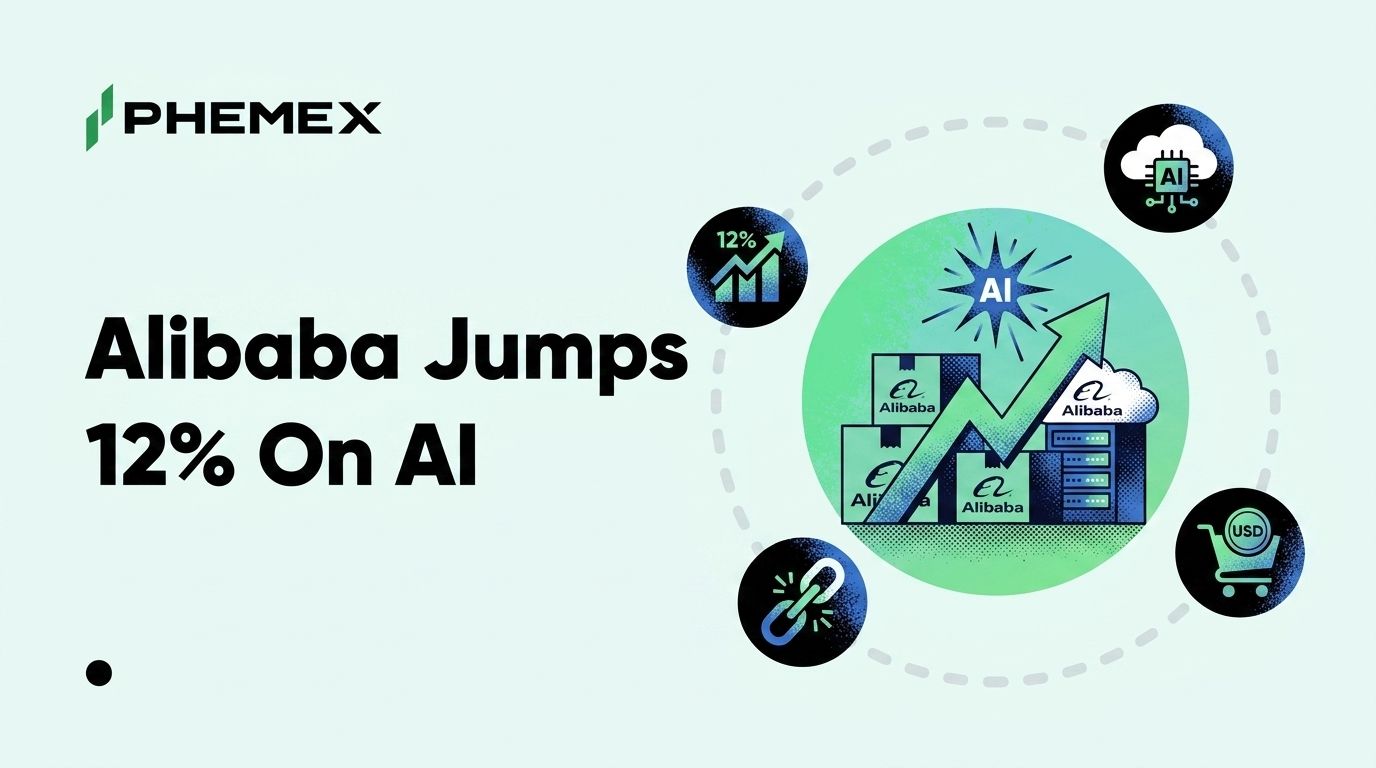
Alibaba stock closed up 11.85% at $112.87 on July 9, 2026, its sharpest single-day gain in about ten months. The move came days before the company reports earnings, and it landed on volume that dwarfed the recent daily average. A stock this size rarely gains almost 12% in one session without a real reason behind it, and this time there were four of them stacked on top of each other. Traders on Phemex can follow the same move through the tokenized BABA-USDTperpetual, which tracks the underlying shares.
- Price: $112.87
- 24h change: +11.85% (biggest single-day jump in about ten months)
- 7d note: the rally accelerated into the print rather than fading, a sign this is positioning and not a one-day spike
- Key catalyst: fiscal first-quarter earnings due in mid-August 2026
- Key metric: Cloud Intelligence Group revenue grew about 38% last quarter
The rally is not one story. It is pre-earnings optimism on cloud and AI, a narrowing of the losses that had been dragging on margins, a settled legal overhang with the US government, and a broad rotation back into cheap Chinese-tech names. Here is what each piece means and which levels matter now.
What Is Driving the Alibaba Rally Today
The single largest force is anticipation ahead of the print. Alibaba reports its fiscal first quarter, which covers calendar April through June 2026, in mid-August, and the market has spent the past week repricing what that report will show. The stock climbed into the event instead of drifting, which is how institutions position when they expect a beat rather than a miss.
Underneath the optimism sits a simple thesis. The part of Alibaba that lost money last quarter is losing less, and the part that is growing fast is growing faster. That combination flips the earnings math from defensive to offensive, and it explains why buyers were willing to pay up almost 12% in a single day.
The setup also rides a wider tape. Money has rotated back into Chinese-tech AI names that trade at a fraction of the multiples on their US peers, and Alibaba is the largest and most liquid way to express that view. When a rotation this broad hits the biggest name in the group, the move tends to be violent on the way up. For readers newer to the AI theme driving all of this, our explainer on AI agents and their role in crypto covers why the compute demand story matters across markets.
Inside the Cloud and AI Growth Story
Cloud is the engine, and the numbers are why. Cloud Intelligence Group revenue grew roughly 38% last quarter, and UBS analysts model closer to 45% cloud growth for the quarter about to be reported. AI-related product revenue now makes up around 30% of external cloud revenue, and it has posted triple-digit year-over-year growth for 11 straight quarters. That is not a one-off. It is a durable demand curve that has compounded for nearly three years.
The reason this matters for the stock is margin mix. Cloud and AI carry far better economics than Alibaba's legacy commerce businesses, so every point of cloud acceleration lifts the quality of the whole company's earnings. This is the same structural story pushing valuations across the AI infrastructure complex, from the chipmakers up through the hyperscalers.
Here is how the pieces of the move stack up.
|
Catalyst
|
Detail
|
Why it matters
|
|
Cloud and AI
|
Cloud grew ~38%, UBS models ~45% next, AI ~30% of external cloud revenue
|
Highest-margin unit is accelerating into the print
|
|
Instant commerce
|
Losses narrowed from the biggest drag on margins
|
Removes the main reason bears shorted the stock
|
|
DOJ settlement
|
$600M deal, $325M in penalties, tighter compliance
|
Clears a legal overhang hanging over the shares
|
|
Sector rotation
|
Broad move into cheap Chinese-tech AI names
|
Alibaba is the most liquid way to play it
|
For context on how the AI hardware cycle feeds this demand, US names like NVIDIA and its 2026 stock outlook and Oracle's cloud positioning are running the same playbook on the American side of the market. Alibaba is the Asian mirror of that trade, and its memory and component supply chain overlaps with what drives Micron's semiconductor cycle.
The $600 Million Deal With the US Justice Department
Legal uncertainty had been a quiet weight on the stock, and part of it just lifted. Alibaba reached a $600 million non-prosecution agreement with the US Department of Justice, which includes $325 million in penalties and a set of tighter compliance commitments across Alibaba.com and AliExpress. You can track the agency's own filings through the Justice Department's Office of Public Affairs.
A non-prosecution agreement is the outcome bulls wanted. It ends the ambiguity, puts a hard number on the cost, and avoids the worst-case scenario of a prolonged prosecution that could have restricted how the company operates in Western markets. Markets hate open-ended legal risk far more than they hate a known bill, and this converts an unknown into a line item.
The compliance tightening is the part worth watching over the next year. Stricter controls across the cross-border marketplaces raise operating costs at the margin, but they also make the platforms cleaner for the institutional partners and payment processors that Alibaba needs. For a company trying to court more Western capital, a resolved case with the US government is closer to an asset than a liability.
Why Narrowing Instant Commerce Losses Matter
Instant commerce had been the single biggest drag on Alibaba's margins, so any improvement there moves the whole profit picture. Losses in the segment narrowed last quarter while overall profitability held, which tells you the company is spending its way toward scale rather than bleeding out. That is the difference between a cash-burning experiment and an investment that is about to turn.
The reason the market cares so much about this line is leverage. When a loss-making segment shrinks its losses, the improvement drops almost straight to the bottom line without needing a single extra dollar of revenue. Pair that with a high-growth cloud unit and you get earnings that can beat on both the top and the profit side at the same time.
There is a real risk to name here. If the next report shows instant-commerce losses widening again, the margin thesis breaks and the rally loses its foundation. The bull case depends on this line continuing to improve rather than merely holding, and that is the number to check first when the earnings drop.
What the Earnings Date Could Mean for BABA
The report is the event the whole rally is built around. Alibaba is expected to post its fiscal first quarter, covering calendar April through June 2026, in mid-August. Because the stock has already run almost 12% into it, the bar is now higher, and a report that merely meets expectations may not be enough to hold these gains.
A genuine beat on cloud growth and a further narrowing of instant-commerce losses would validate the move and likely extend it. UBS modeling 45% cloud growth sets a concrete number to measure against, and the market will treat anything above roughly 40% as confirmation. The AI revenue share climbing past 30% of external cloud sales would be the second signal bulls want.
The main risk is the classic sell-the-news reversal. When a stock rallies this hard into a print, even a solid result can trigger profit-taking as the anticipation trade unwinds. Alibaba is tokenized as BABA-USDT on Phemex, which sits alongside the other tokenized equity names traders use to position around events like this, similar to how the Samsung stock setup trades around its own catalysts. For deeper background on the company itself, its history and structure are documented on Alibaba's Wikipedia entry, and its formal financials are filed as 20-F reports on SEC EDGAR.
Frequently Asked Questions
Why is Alibaba stock up so much today?
Alibaba gained 11.85% to $112.87 on July 9, 2026, driven by pre-earnings optimism on cloud and AI growth, narrowing instant-commerce losses, a settled $600 million deal with the US Justice Department, and a broad rotation into cheap Chinese-tech names. The combination pushed it to its biggest single-day gain in about ten months.
Is Alibaba stock a buy in 2026?
The answer depends heavily on what the upcoming earnings report actually shows. The bull case rests on cloud growth near 45% and instant-commerce losses continuing to shrink, while the main risk is a sell-the-news reversal after a nearly 12% run into the print. Traders should weigh how much good news is already priced in at $112.87 before chasing.
When does Alibaba report earnings?
Alibaba is expected to report its fiscal first quarter, covering calendar April through June 2026, in mid-August 2026. Cloud revenue growth and the instant-commerce loss trend are the two numbers that will decide if the current rally holds.
Can I trade Alibaba on Phemex?
Yes, and it trades as the BABA-USDT perpetual on Phemex, which tracks the underlying shares and lets traders take long or short positions with leverage around events like earnings.
The Bottom Line
Alibaba's 11.85% jump to $112.87 is a real repricing, not a random spike, and it rests on four separate catalysts pointing the same direction. The cloud engine is accelerating, the biggest margin drag is shrinking, the legal overhang is priced and closed, and the money is rotating back into the name. The problem now is that the market already knows all of it, so the mid-August report has to deliver.
Hold above the low $100s into earnings and the setup stays intact, with room toward the mid $120s on a clean cloud beat. Lose that base and the sell-the-news crowd takes over, with the pre-rally levels near the high $90s as the next support. Watch the cloud growth number and the instant-commerce loss line first, because those two decide if this rally was the start of a re-rating or the top of a one-week trade.
This article is for informational purposes only and does not constitute financial or investment advice. Cryptocurrency trading involves substantial risk. Always conduct your own research before making trading decisions.