










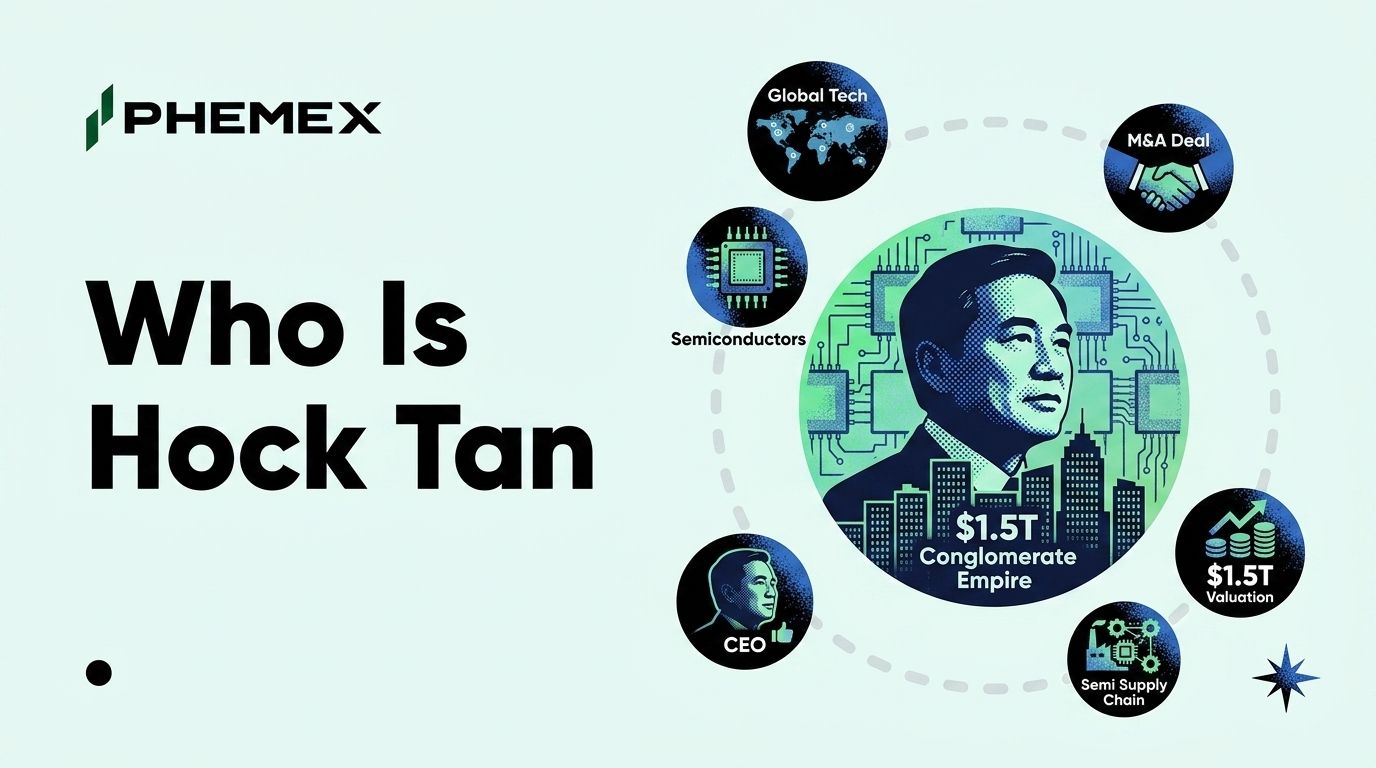
Hock E. Tan has run Broadcom Inc. since 2006, and his stewardship has produced one of the most successful operational rollups in semiconductor history. The company he inherited (a small Singapore-listed Avago spinout with roughly $1.7 billion in revenue) is now a $1.5 trillion market-cap conglomerate that sits second only to NVIDIA in the AI infrastructure stack. Tan is one of the very few public-company CEOs who has credibility on both AI hardware (Tomahawk switches, custom ASIC for hyperscalers, optical interconnect) and AI software (the VMware enterprise virtualization platform).
The combination matters because the AI infrastructure cycle has converged hardware and software in ways that few legacy operators are positioned for. Tan saw the convergence early and built the asset base to capture it. Here is who Tan actually is, the operational style that produced the empire, and why his voice carries weight when he comments on the AI capex cycle.
The Background That Built the Operator
Tan was born in Penang, Malaysia in 1951 and emigrated to the United States for college. He earned a bachelor's and master's degree in mechanical engineering from MIT and an MBA from Harvard Business School. The engineering background matters because it gives him the technical fluency to underwrite semiconductor M&A on first-principles terms rather than relying on the sell-side framing that bigger deals tend to attract. The Harvard MBA gives him the financial and operational fluency to execute the integration playbook at scale.
His early career ran through PepsiCo, General Motors, and Hume Industries (where he was CFO and managing director) before he joined Integrated Device Technology as CEO in 1999. The IDT tenure was where Tan first developed the operating playbook that later defined his Broadcom era. Cut the lower-margin product lines, focus the sales motion on the largest enterprise accounts, run lean on operational expense, and reinvest the savings into the highest-return product categories. The IDT financial profile improved meaningfully under his tenure even in a difficult semiconductor cycle.
The Avago to Broadcom Merger That Reset the Industry
The defining transaction of Tan's career was the 2016 acquisition of the original Broadcom Corporation by Avago Technologies for $37 billion. The merger was filed via the Avago / Broadcom S-4 with the SEC and the merger circular laid out the operating-margin synergy targets Tan committed to. Avago at the time was the smaller company by revenue but had built one of the most disciplined operating models in the semiconductor industry through a series of smaller acquisitions Tan executed between 2008 and 2014. The Broadcom name was kept (better brand recognition, larger customer relationships), but the operating model that ran the combined company was Avago's.
The post-merger integration is the playbook every later Tan deal has followed. The first 12 months focused on rationalizing the combined product portfolio, exiting product lines that did not meet the operating-margin threshold, and consolidating the sales motion around the strategic accounts. The next 18 months ran a price-discipline cycle on the remaining product lines, raising prices on the strategic-account business while letting the price-sensitive segments roll off. By the end of the third year the combined operating margin was several hundred basis points above where either company stood pre-merger.
The Avago to Broadcom playbook is what later got applied to CA Technologies (2018, $18.9 billion), Symantec Enterprise (2019, $10.7 billion), and VMware (2024, $69 billion). The scale of the targets grew at each step. The operating discipline did not change.
The VMware Deal as the Empire-Defining Transaction
The VMware acquisition closed in November 2023 and is the deal that transformed Broadcom from a semiconductor company with software exposure into a true software-and-silicon conglomerate. The acquisition price of $69 billionwas the largest software deal ever consummated at the time, and the integration playbook was the most aggressive Tan had ever run. The lower-margin product lines (Carbon Black, End-User Computing) were divested. The strategic product lines (vSphere, vSAN, NSX, Tanzu) were consolidated into a smaller number of subscription bundles. The pricing on the strategic bundles was raised meaningfully.
The customer reaction was loud. Several large enterprise customers publicly complained about the pricing changes, and a number of cloud providers explored migration paths to competing virtualization platforms. The financial results validated the integration approach despite the noise. VMware's operating margin under Broadcom ran roughly 30 percentage points higher than VMware's standalone operating margin in the year before the close, and customer retention through the first 18 months held above 90%. The renewals cycle running from mid-2026 through mid-2027 will be the real test, but the early read is that the pricing power has held.
The VMware deal is also what gave Tan the platform to comment authoritatively on the AI software stack. Broadcom's silicon side gives the company visibility into hyperscaler ordering patterns. The VMware side gives the company visibility into how enterprises are deploying AI workloads on their internal infrastructure. The combination is unusual. Broadcom's investor materials walk through the integrated product strategy in some detail.
Tan's Operating Style and Why It Works
There are four characteristics that show up repeatedly in Tan's operating record. The first is extreme capital discipline. He does not chase deals at premium multiples and walks away from negotiations when the math does not work (the public 2018 attempt to acquire Qualcomm for $103 billion is the cleanest example, where Tan walked when the regulatory and political dynamics turned against the deal). The second is the willingness to take customer-facing pain in exchange for operating margin. The VMware pricing changes are the textbook example.
The third is communication discipline. Tan rarely provides multi-quarter forward guidance, does not engage with sell-side modeling debates on the earnings calls, and almost never raises a number publicly that he did not already raise in the prior quarter's filings. That style frustrates the short-term traders who want directional setups but produces the consistent quarterly delivery that compounds investor trust. The fourth is the focus on returning capital to shareholders through dividends and buybacks, which has made AVGO one of the most efficient capital-returning large-cap stocks of the past decade.
The combination of those four characteristics is why the market consistently bids up AVGO ahead of major catalysts even when Tan himself has not pre-signaled the direction. His track record is the pre-signal.
Why His Voice Matters in the AI Capex Cycle
Tan is in a small group of CEOs whose forward commentary on AI infrastructure spending is treated as a leading indicator by the buy-side. The group includes Jensen Huang (NVIDIA), Lisa Su (AMD), Satya Nadella (Microsoft), Sundar Pichai (Google), and Andy Jassy (Amazon). Of those, only Tan and Jensen Huang have visibility into both the upstream silicon supply and the downstream customer deployment patterns at the same time. NVIDIA sells GPUs to hyperscalers. Broadcom sells custom ASICs to hyperscalers and runs the virtualization layer where many of the enterprise AI workloads end up landing.
That dual visibility is why Tan's commentary on hyperscaler ordering patterns is read closely on earnings calls. When Tan signals strength in custom ASIC bookings, the market reads through to NVIDIA's hyperscaler demand. When Tan signals VMware deployment strength on AI workloads, the market reads through to broader enterprise AI capex picking up. The cross-read is what makes his quarterly calls the second-most-watched semiconductor earnings event after NVIDIA's.
For broader context on how the AI infrastructure stack ties to crypto-adjacent compute markets, the Phemex AI agents primer walks through the upstream compute substrate.
The Market Cap Path From $5 Billion to $1.5 Trillion
|
Year
|
Milestone
|
Approximate market cap
|
|
2014
|
Pre-Broadcom merger Avago Technologies
|
$5 billion
|
|
2016
|
Post-Broadcom merger close
|
$50 billion
|
|
2018
|
Post-CA Technologies acquisition
|
$100 billion
|
|
2019
|
Post-Symantec Enterprise deal
|
$115 billion
|
|
2022
|
Pre-VMware acquisition announcement
|
$230 billion
|
|
2024
|
Post-VMware close
|
$750 billion
|
|
2026
|
Current
|
$1.5 trillion
|
The ramp from $230 billion in 2022 to $1.5 trillion today reflects two compounding forces. The first is the operational uplift from the VMware integration. The second is the AI infrastructure cycle bidding up the value of Broadcom's silicon business as the custom ASIC opportunity became visible to the public market. Neither force was fully visible in 2022, and the combined trajectory is what makes Tan's recent commentary on the cycle matter so much. He saw both forces coming and built the asset base to capture both.
Frequently Asked Questions
Who is Hock Tan?
Hock E. Tan is the CEO of Broadcom Inc., a position he has held since 2006. He is a Malaysian-American semiconductor industry operator with MIT engineering and Harvard MBA degrees, and he has built Broadcom from a $5 billion Avago Technologies into a $1.5 trillion AI infrastructure conglomerate through a sequence of large acquisitions.
What is Hock Tan's operating style?
Tan's style centers on four characteristics: extreme capital discipline, willingness to take customer-facing pain for operating margin, communication discipline that avoids forward guidance theater, and consistent capital return to shareholders through dividends and buybacks. The combination has produced one of the most consistent compounding records in large-cap technology.
What was the most important acquisition Tan executed?
The 2024 VMware acquisition at $69 billion was the empire-defining transaction because it transformed Broadcom from a semiconductor company with software exposure into a true software-and-silicon conglomerate. The integration playbook produced roughly 30 percentage points of operating margin uplift while holding customer retention above 90% through the first 18 months.
Why does Tan's commentary matter for the AI capex cycle?
Tan and Jensen Huang are the only two CEOs with simultaneous visibility into upstream silicon supply (custom ASIC, networking) and downstream customer deployment (VMware-hosted enterprise AI workloads). The dual visibility makes his commentary on hyperscaler ordering patterns a leading indicator for the broader AI infrastructure cycle.
Bottom Line
Hock Tan built Broadcom from a $5 billion Avago spinout in 2014 into a $1.5 trillion AI infrastructure conglomerate by executing the same operating playbook on progressively larger targets. The four characteristics that produced the compounding (capital discipline, willingness to take customer-facing pain, communication discipline, capital return) are still the operating model today, which means the next round of Broadcom prints should continue delivering the kind of segment-level acceleration the company has been compounding for almost two decades. His voice on the AI capex cycle matters because he is one of two CEOs with simultaneous visibility into the silicon supply and the enterprise software deployment, and that dual read is what makes his quarterly calls the second-most-watched event in semiconductor earnings.
This article is for informational purposes only and does not constitute financial or investment advice. Stock and crypto trading involves substantial risk. Always conduct your own research before making trading decisions.
