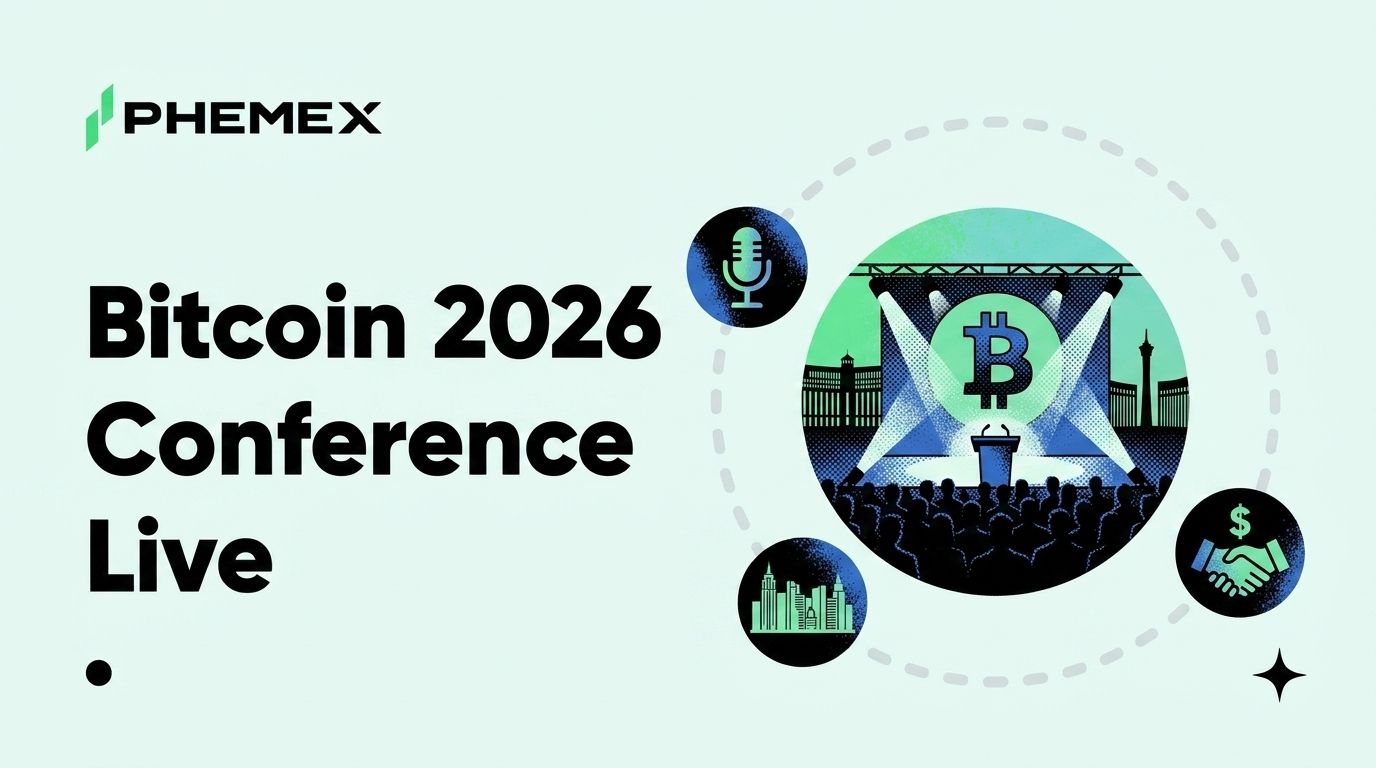
Bitcoin 2026 opened its doors at The Venetian in Las Vegas this morning with more than 40,000 registered attendees, 500-plus speakers, and a lineup that includes the sitting SEC chairman, the FBI director, and the man who has personally bought more Bitcoin than any public company in history. BTC is trading at roughly $79,000 as the conference begins, up from $67,000 three weeks ago and pressing against the $80,000 psychological level that has acted as resistance since mid-March.
Previous Bitcoin conferences have produced announcements that moved markets within hours. In 2024, presidential candidates pledged a Strategic Bitcoin Reserve from the Nashville stage. In 2025, Strategy announced a $500 million BTC purchase live during the event. The speaker roster for this year's three-day program suggests at least five sessions have the potential to generate similar price-moving headlines, and the first one starts at 10:30 AM today.
Here are the five announcements worth watching, why each one matters, and what the market is likely to price in before the closing session on April 29.
SEC Chair Paul Atkins Could Expand the Digital Commodity Framework
Paul Atkins is the first sitting SEC chairman to speak at a Bitcoin conference, a fact that signals how far the regulatory relationship has shifted since Gary Gensler's enforcement-first era. But the real catalyst is what Atkins is expected to say, not the symbolism of his attendance.
Reports from multiple outlets indicate Atkins will outline an expanded classification framework for digital assets and introduce an "innovation exemption" for tokenized securities that would allow on-chain trading without forcing projects onto legacy securities infrastructure. The SEC and CFTC have already signed a memorandum of understanding to coordinate on this framework, and Atkins has been working directly with CFTC Chair Mike Selig on the operational details.
The March 17 joint ruling that classified 16 crypto assets as digital commodities was the foundation. If Atkins announces an expansion of that list, names additional tokens as non-securities, or provides a concrete timeline for the innovation exemption, the market will react. Every token that moves from "potential security" to "confirmed commodity" unlocks ETF eligibility, institutional custody clearance, and CFTC-regulated spot market access.
The specific thing to watch is if Atkins names new tokens beyond the original 16 or announces a formal process for projects to apply for commodity classification, because either development would be immediately tradeable news.
The Code and Country Policy Forum Opens With the AG and FBI Director
The day's programming starts with Code and Country 2026, the conference's policy forum, at 10:30 AM. Acting Attorney General Todd Blanche and FBI Director Kash Patel are both confirmed speakers. Patel's fireside chat is titled "Code is Free Speech. Ending the War on Bitcoin" and will be moderated by Coinbase CLO Paul Grewal.
The title alone tells you the direction. Under previous administrations, the DOJ and FBI treated open-source crypto developers as potential money transmitters and launched criminal cases against wallet developers and privacy protocol contributors. Patel's framing of "ending the war" suggests concrete policy shifts are coming, beyond rhetorical support.
What would actually move the market from this session is any announcement about the DOJ dropping pending cases against Bitcoin developers, formal guidance clarifying that writing open-source code is protected speech, or a commitment to end Operation Chokepoint 2.0-style banking restrictions on crypto companies. Senator Cynthia Lummis is also on the Code and Country roster, and she has been pushing the CLARITY Act through the Senate Banking Committee. If she announces a committee vote date, that gives the market a concrete legislative timeline to price in.
Michael Saylor and the Next Strategy Bitcoin Purchase
Michael Saylor has turned Bitcoin conference appearances into corporate treasury announcements. Strategy (formerly MicroStrategy) now holds 815,061 BTC worth approximately $63.5 billion after purchasing 34,164 BTC for $2.54 billion just last week. The company has surpassed BlackRock's iShares Bitcoin Trust as the largest publicly disclosed Bitcoin holder, second only to the dormant wallets attributed to Satoshi Nakamoto.
Saylor's pattern at conferences is well-established. He takes the stage, delivers a macro thesis, and drops a purchase announcement or a new capital raise plan that demonstrates conviction with real money. The February "Bitcoin for Corporations" summit in Las Vegas, which Strategy hosted, attracted hundreds of corporate executives exploring treasury allocation to BTC. The pipeline of companies considering Bitcoin treasury strategies has tripled since 2024 to roughly 200 public companies worldwide.
The market-moving scenario goes beyond another purchase announcement. Saylor has been hinting at a new equity or preferred stock raise that could fund purchases well into 2027. If he announces a capital raise larger than the $2.18 billion STRF perpetual preferred equity offering from earlier this month, or if he reveals that other Fortune 500 companies are committing to treasury allocation during the conference, that would shift the supply-demand equation for BTC in a measurable way. Strategy alone absorbs more BTC per quarter than miners produce, and any signal that this buyer-of-last-resort is scaling up gets priced immediately.
Paolo Ardoino and Tether's Bitcoin and Payments Expansion
Tether CEO Paolo Ardoino is confirmed as a keynote speaker, and his appearances tend to come with product announcements. At Bitcoin 2025, Ardoino revealed that Tether holds more than 100,000 BTC on its balance sheet alongside over 50 tons of gold, and launched an open-source Bitcoin mining operating system.
Tether is no longer just a stablecoin issuer. The company generated over $13 billion in profit in 2024, making it more profitable than most Wall Street banks, and has been deploying that capital into Bitcoin, AI infrastructure, and emerging-market financial products. Ardoino's confirmed topic is "Bitcoin's role in the global financial system," which is broad enough to cover anything from a new Tether-backed Bitcoin lending product to an expansion of USDT's integration with Bitcoin's Lightning Network.
The market-moving potential depends entirely on specifics rather than broad vision statements. If Ardoino announces that Tether is increasing its BTC reserves significantly, that adds another large institutional buyer to the demand side. If he announces a USDT product that enables Bitcoin-denominated lending or yield at scale, that creates new demand for BTC as collateral. And if Tether launches a consumer payments product that competes with Block's Bitcoin payment infrastructure, that expands the use-case narrative beyond store-of-value at a moment when payment adoption metrics matter for the regulatory argument.
Jack Dorsey and the Bitcoin Payments Tax Push
Jack Dorsey's Block Inc. recently enabled merchants to accept Bitcoin payments through its point-of-sale system with zero service fees, a move that eliminates one of the two major barriers to everyday Bitcoin spending. The second barrier is the tax code, because under current U.S. law every Bitcoin purchase of a coffee or a sandwich is a taxable event that requires calculating capital gains, which makes spending BTC impractical for ordinary people.
A dedicated session titled "Bitcoin as Everyday Money" is scheduled for April 28 and will bring together policy leaders and industry executives to push for a Bitcoin de minimis tax exemption. This would exempt small Bitcoin transactions (likely under $200 or $600) from capital gains reporting, the same treatment that already applies to foreign currency transactions. Dorsey has publicly argued that Bitcoin will fail as a technology if it cannot function as everyday money, and his presence at the conference alongside sympathetic regulators creates the conditions for a coordinated policy push.
The honest answer is that a tax exemption requires congressional action and will not happen at a conference. But a formal industry coalition announcement, combined with endorsement from sympathetic lawmakers like Lummis who are already at the event, would signal that the legislative effort has organized support. For the market, the narrative shift from "Bitcoin as digital gold" to "Bitcoin as spendable money" has historically been bullish because it expands the addressable user base from investors to consumers.
|
Announcement
|
Speaker
|
When
|
Market Impact If Confirmed
|
|
Expanded commodity classification or innovation exemption
|
SEC Chair Paul Atkins
|
April 27
|
New tokens eligible for ETFs, institutional access
|
|
DOJ/FBI policy shift on developer rights and banking access
|
AG Todd Blanche, FBI Dir. Kash Patel
|
April 27, 10:30 AM
|
Reduced regulatory risk premium across crypto
|
|
New Strategy capital raise or corporate treasury coalition
|
Michael Saylor
|
TBD (Day 1-2)
|
Increased BTC demand vs. fixed supply
|
|
Tether BTC reserves increase or Bitcoin lending/payments product
|
Paolo Ardoino
|
TBD
|
New institutional demand, expanded use case
|
|
Bitcoin de minimis tax exemption coalition
|
Jack Dorsey, lawmakers
|
April 28
|
Narrative shift from store-of-value to payments
|
What the $80,000 Level Means Right Now
BTC is sitting at $79,000 as 40,000 people gather in one building to discuss why they think it should be worth more. The $80,000 level has been resistance since the late-March rally, and breaking above it with conference-driven momentum would likely trigger a cascade of short liquidations and algorithmic buying that could push price toward the $83,000-$85,000 range quickly.
ETF inflows have been consistently positive for the past three weeks, with institutional allocators accounting for roughly 38% of total spot Bitcoin ETF holdings. Strategy is buying at a pace that exceeds miner production. And the regulatory backdrop has shifted from adversarial to explicitly supportive in a way that has no historical precedent.
But conferences are also "sell the news" events. The 2024 Nashville conference produced a price spike followed by a 15% pullback within two weeks. The risk is that the market has already priced in a favorable conference and any announcements that fall short of expectations trigger profit-taking. Traders who remember the pattern will be watching for signs of exhaustion above $80,000 rather than chasing breakouts on headline announcements.
The disciplined approach is to track which of these five announcements actually materialize with specifics versus which remain vague promises, and size positions accordingly. Conferences produce noise and signal in roughly equal measure, and the difference between the two usually takes 48 to 72 hours to become clear.
Frequently Asked Questions
When is the Bitcoin 2026 conference and where is it?
Bitcoin 2026 runs April 27 through April 29, 2026, at The Venetian in Las Vegas. The event features six stages, over 100 hours of programming, and more than 500 speakers. The Code and Country policy forum opens on April 27 at 10:30 AM.
Why does it matter that the SEC chair is speaking at a Bitcoin conference?
Paul Atkins is the first sitting SEC chairman to appear at a Bitcoin conference, which signals a fundamental shift in the regulator's posture toward the industry. His predecessor Gary Gensler treated crypto primarily as an enforcement target. Atkins speaking at the event suggests upcoming regulatory actions will be supportive rather than adversarial, and any specific announcements about token classification or innovation exemptions would directly affect which assets can access institutional capital.
Has Bitcoin price historically moved during major conferences?
Yes, but the moves go in both directions and the lasting impact varies. The 2024 Nashville conference produced bullish announcements including Strategic Bitcoin Reserve pledges that initially pushed BTC higher, followed by a pullback as the news got fully priced in. Conference announcements tend to create short-term volatility within 24 to 48 hours, with the lasting price impact depending on if the announcements contain concrete policy changes or remain general optimism.
How many Bitcoin does Strategy (MicroStrategy) own now?
As of April 20, 2026, Strategy holds 815,061 BTC acquired across 107 separate purchases for a total cost of approximately $33.1 billion at an average price of roughly $66,385 per coin. The company surpassed BlackRock's iShares Bitcoin Trust as the largest publicly disclosed Bitcoin holder and has never sold a single coin from its treasury.
Bottom Line
Five sessions across the next three days have the potential to produce headlines that move BTC through $80,000 and beyond. The SEC chairman expanding commodity classifications, the AG and FBI director rolling back the enforcement posture of previous administrations, Saylor announcing another multi-billion-dollar capital raise, Ardoino deploying Tether's profits into new Bitcoin products, and Dorsey rallying a coalition behind tax reform would each independently shift the supply-demand equation or the regulatory risk premium.
The conference opens with BTC at $79,000 and institutional flows running positive. The setup favors a breakout if even two or three of these announcements deliver specifics rather than platitudes. But the sell-the-news pattern is real, and the 48-hour window after the biggest headlines will tell you more than the headlines themselves. Watch what the market does after the applause stops.
This article is for informational purposes only and does not constitute financial or investment advice. Cryptocurrency trading involves substantial risk. Always conduct your own research before making trading decisions.