









Key Takeaways
StrikeX is a blockchain-fintech project focused on tokenization infrastructure, digital-asset products, and regulated market integration.
The project’s recent product vision centers on the StrikeX App, a planned platform intended to unify DeFi, CeFi, crypto, and tokenized RWAs.
STRX is the native utility token of the ecosystem and has been described by StrikeX as supporting transaction execution, asset registration, cross-chain coordination, fee routing, gas abstraction, and tokenization-engine fees.
In October 2025, StrikeX announced that, with CMC Markets and CapX, it completed a first tokenized share issue, which it described as an important step toward commercial rollout with regulated partners.
As of April 2026, StrikeX appears to be best understood not as a finished mass-market exchange, but as a developing ecosystem built around tokenization rails, app infrastructure, and institutional-grade digital-asset services. This is an inference based on the company’s homepage, roadmap post, and 2025 tokenization announcements.
Real-world asset tokenization has become one of the most important long-term themes in crypto. While many projects talk broadly about bringing “everything on-chain,” only a smaller group is trying to build the actual infrastructure that regulated institutions and mainstream users might use in practice. StrikeX is one of those projects. On its official website, StrikeX says its mission is to develop blockchain-powered software that can transform financial technology, with a particular focus on tokenization infrastructure. The company’s current homepage also highlights that its strategic partnership and investment with CMC Markets is complete, presenting that relationship as a major milestone in bringing tokenization technology into securities markets and regulated financial environments.
That current positioning matters because StrikeX is no longer easiest to understand as just a wallet project or just a utility token. Its more recent public materials frame it as a broader tokenization and execution layer spanning wallet infrastructure, hybrid trading-app ambitions, and regulated tokenized-asset issuance. In a 2025 article, StrikeX described its role as the “execution, coordination, and compliance layer” for tokenized assets across chains, protocols, and jurisdictions.
The native token behind that ecosystem is STRX. Older official materials describe STRX as a BEP-20 utility token on BNB Chain and the native currency of the StrikeX ecosystem, while newer official materials describe it as a native currency for coordinated execution across the StrikeX system. StrikeX also says STRX is intended to play a role in transaction execution, asset registration, cross-chain coordination, fee routing, multi-chain gas abstraction, and tokenization-engine fees.
What Is StrikeX?
StrikeX is a blockchain technology company building products around tokenization, digital assets, and financial-market infrastructure. Its official homepage says the company is “building the future” through innovation in blockchain and describes its mission as developing revolutionary software that will transform financial technology. The site’s emphasis on tokenization and its prominent CMC Markets banner suggest the company now wants to be seen less as a niche crypto brand and more as a serious infrastructure provider for the next phase of digital finance.
That broader framing is reinforced by StrikeX’s more recent long-form content. In its 2024 technical roadmap for the StrikeX App, the company said its goal is to build a unified platform where decentralized and centralized finance coexist safely and compliantly, letting users manage, trade, and custody a wide range of assets in one place. The same roadmap describes the planned StrikeX App as a platform to unify DeFi, CeFi, crypto, and tokenized RWAs in a user-friendly application.
In other words, StrikeX is not just chasing the generic “RWA” narrative. It is trying to build the software and execution rails around it: wallets, gas abstraction, tokenization infrastructure, and eventually a hybrid app where self-custody, centralized services, and tokenized assets live together. That is an inference from the product roadmap and official company materials.
What Problem Is StrikeX Trying to Solve?
Traditional finance and crypto each have their own limitations. Traditional markets are regulated and deep, but often fragmented, slow, expensive, and closed to 24/7 global access. Crypto is open and programmable, but many mainstream investors still find it difficult to use safely, especially when trying to access real-world assets in a compliant way. StrikeX’s public materials repeatedly suggest that the company sees tokenization as the bridge between those two worlds.
StrikeX has been especially explicit about the tokenization of stocks and securities. In earlier educational content, the project argued that tokenized public stocks could help transform financial markets through better accessibility, faster settlement, greater transparency, fractionalization, and broader investor inclusion. More recently, the company’s October 2025 announcement showed how it wants to move that thesis from theory into regulated execution by building infrastructure for tokenized share issuance with institutional partners.
How StrikeX Works
The easiest way to understand StrikeX is to break it into three layers: wallet and user infrastructure, hybrid trading-app ambitions, and tokenization infrastructure.
StrikeX Wallet
StrikeX already has a wallet product history. In its 2022 year-end update, the company said the StrikeX DeFi Crypto Wallet had launched on the App Store and Google Play, positioning it as a multi-chain self-custody wallet. Later, the 2024 technical roadmap described the wallet as the foundation of the broader StrikeX App and said the first phase of development focuses on evolving it into a hybrid application with a wider range of tradable assets and unique features.
That roadmap gives concrete examples of where the wallet is supposed to go. StrikeX says it plans performance optimization, UI and UX upgrades, further network integrations, chain abstraction for seamless swaps, and multi-chain gas abstraction with STRX utility. The gas-abstraction section specifically says StrikeX wants users to be able to pay fees across multiple networks using STRX.
This part of the strategy matters because it shows StrikeX is not only building for institutions. It is also thinking about retail product design and trying to reduce blockchain friction at the user level. That is particularly relevant in 2026, when chain abstraction and simplified UX remain major competitive themes across crypto products. This is an inference based on the roadmap’s feature set.
The StrikeX App
The bigger vision is the StrikeX App, which the roadmap presents as a modular rollout. The company says the app will be built in three progressive modules. Module 1 focuses on wallet evolution. Module 2 focuses on hybrid integration between DeFi and CeFi, including connecting a modular centralized-exchange backend. Module 3 expands into the tokenization of public and private assets.
That is a fairly ambitious design. Rather than launch separate, disconnected products, StrikeX wants to combine self-custody, centralized exchange services, and tokenized RWAs in one experience. The roadmap explicitly says the app aims to create a seamless gateway to the financial markets of the future.
For readers, the key implication is that StrikeX is trying to become a multi-asset access layer, not just a single-purpose tokenization engine. Whether it succeeds is still an open question, but that is clearly the product direction laid out in official materials.
Tokenization Infrastructure
The most strategically important layer may be tokenization itself. StrikeX has published extensive content around tokenized RWAs, especially tokenized stocks. In its RWA guides, it argues that the future lies in fully collateralized and compliant tokenized RWAs, not merely synthetic price-exposure products. It has also been clear that it wants to participate in the tokenization, management, and trade of such assets in a secure and compliant way.
That vision became much more concrete in October 2025, when StrikeX announced that, in collaboration with CMC Markets and CapX, it had completed a first tokenized share issue. In that announcement, StrikeX said it provided the blockchain infrastructure for the pilot, delivering the tokenization layer on Arbitrum. The company said its engine created the token representing the share while keeping it compliant within CMC’s regulated custody framework.
StrikeX also said that every mint and burn action was logged with provider proofs and audit hashes, creating a permanent record designed to mirror capital-markets controls while adding blockchain transparency. That is one of the strongest signs that StrikeX’s current edge is not just narrative, but a specific attempt to build compliant tokenization infrastructure usable by regulated partners.
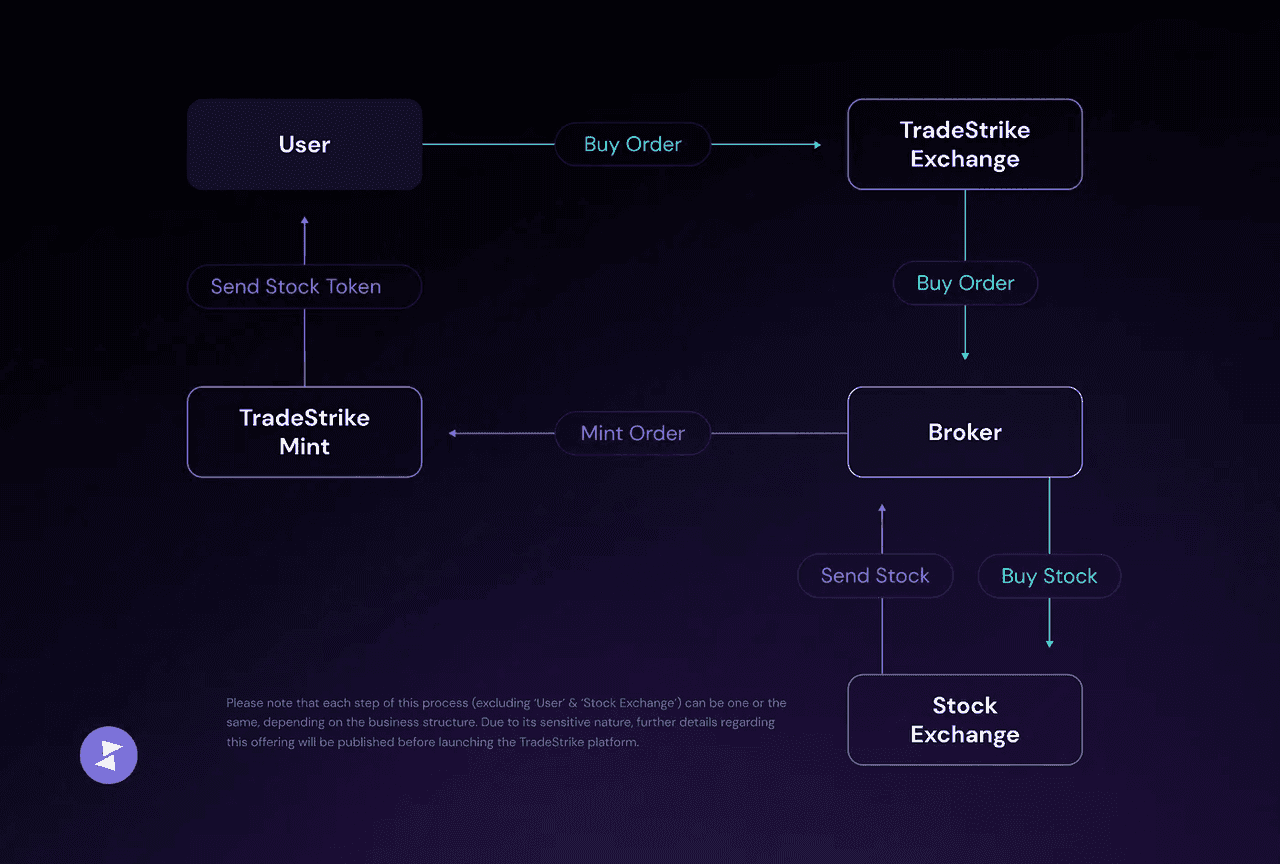
StrikeX Tokenization Bridge (source)
What Is STRX?
STRX is the native utility token of the StrikeX ecosystem. StrikeX’s older utility-token page describes STRX as a Binance Smart Chain (BEP-20) cryptocurrency and the native currency of the ecosystem. That same page gives the BNB Chain contract address and explains that STRX was designed to support multiple functions across a growing suite of products.
More recent StrikeX content expands that role considerably. In its 2025 RWA guide, StrikeX said STRX is more than a utility token and that it plays a core role in transaction execution, asset registration, cross-chain coordination, and fee routing across the StrikeX system. In the 2025 tokenized-share announcement, the company added that STRX will serve as the medium for transaction fees within the tokenization engine and that part of each fee will be automatically burned.
So the best current description is that STRX is a coordination and utility token intended to connect product usage, tokenization infrastructure, fee abstraction, and cross-chain operations across the StrikeX ecosystem.
What Does STRX Do?
Based on StrikeX’s official materials, STRX has several major use cases.
Utility Across the Ecosystem
StrikeX’s older token explainer says STRX is meant to perform multiple functions across the ecosystem’s products. At that time, the company linked STRX to its planned exchange infrastructure, custom network, and stock-token ambitions. While some of those plans have evolved over time, the central idea remains the same: STRX is meant to be used, not just held.
Multi-Chain Gas Abstraction
One of the clearest newer use cases appears in the 2024 StrikeX App roadmap. There, StrikeX says it plans to enable STRX as a multi-chain gas token, allowing users to pay transaction fees across multiple networks using STRX. That feature is designed to simplify the user experience while expanding STRX utility.
This matters because gas abstraction is one of the most practical forms of token utility. If users can use STRX instead of juggling chain-specific gas assets, the token becomes more tightly woven into the experience of using the app itself. That is a product-design inference based on the roadmap language.
Tokenization-Engine Fees
In its October 2025 regulated-share announcement, StrikeX said STRX would serve as the medium for transaction fees inside the tokenization engine and that a defined portion of each fee would be burned. The company described this as a transparent, deflationary, and scalable utility model linked directly to infrastructure demand.
This is important because it ties STRX to what may become StrikeX’s most commercially meaningful business line: tokenized asset issuance and management for regulated or institutional use cases. If that business grows, then STRX’s fee role could become more economically significant. That is an inference based on StrikeX’s own design.
Transaction Execution and Asset Registration
StrikeX’s 2025 RWA guide says STRX plays a role in transaction execution and asset registration across the StrikeX system. That suggests STRX is being positioned as a commercial-layer token around the lifecycle of tokenized assets, not only around retail trading or wallet usage.
Cross-Chain Coordination
The same guide says STRX supports cross-chain coordination. That fits with both the tokenization-engine story and the app roadmap’s chain-abstraction focus. StrikeX appears to want STRX to act as a common unit across different parts of its system rather than as a token tied to only one chain or one app feature.
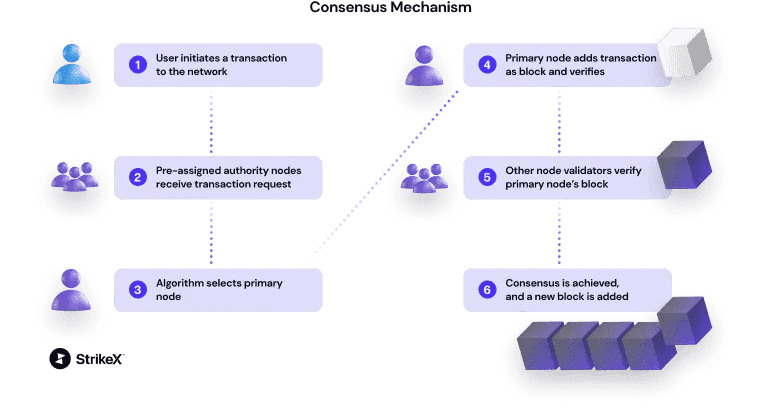
StrikeX and the RWA Narrative
StrikeX is often best understood through the RWA lens. The company has repeatedly argued that tokenization is crypto’s killer use case and has said the biggest opportunity lies in the tokenization of public markets and other real-world financial assets. In its 2025 RWA guide, StrikeX even said its role is not to compete with tokenized assets themselves, but to power them through execution, coordination, and compliance infrastructure.
That is a useful distinction. Some projects want to be the issuer of a specific tokenized asset. StrikeX appears to want to be more like the infrastructure provider: the tech layer enabling issuance, execution, fees, registration, and cross-chain operations. That positioning could be strategically valuable if tokenization expands across multiple asset classes and jurisdictions. This is an inference from StrikeX’s own description of its role.
Risks and Limitations
StrikeX is interesting, but it carries several real risks.
The first is execution risk. StrikeX’s ambitions are broad: wallet evolution, chain abstraction, gas abstraction, hybrid DeFi/CeFi product design, and tokenization infrastructure for public and private assets. Ambitious ecosystems can create upside, but they also increase the risk of slower delivery or uneven execution. This is an inference from the breadth of the official roadmap.
The second is regulatory and partner-dependence risk. StrikeX’s most compelling current story involves regulated tokenization and institutional partners. But that also means future progress may depend on approvals, compliance requirements, custody structures, and partner rollout timelines. StrikeX itself said in October 2025 that future announcements would follow once approvals and launches were confirmed.
The third is token-capture risk. Even if StrikeX builds useful infrastructure, investors still need to ask how much of that value actually accrues to STRX. StrikeX has laid out fee, gas, coordination, and burn mechanics, which is better than having no utility story, but real value capture still depends on adoption volume and product usage. That is an inference based on the official utility descriptions.
The fourth is competition risk. Tokenization is becoming crowded, with large incumbents, crypto-native infrastructure providers, and exchange-linked ecosystems all trying to build similar rails. StrikeX’s differentiation appears to be its combination of user products and institutional tokenization, but it is still competing in a difficult sector. This is an inference based on the broader market context rather than a statement from StrikeX.
Conclusion
StrikeX is one of the more interesting smaller-cap RWA projects because it is trying to build more than a narrative token. Its official materials point to a company building around wallet infrastructure, hybrid digital-finance apps, and regulated tokenization rails, with STRX positioned as the native utility layer across those functions.
The strongest reason to pay attention to StrikeX in April 2026 is the combination of its CMC Markets partnership, its first tokenized share issue, and its effort to link STRX directly to practical functions like gas abstraction, transaction execution, fee routing, and tokenization-engine fees. Those are more tangible foundations than a purely speculative AI- or RWA-themed token pitch.
As tokenized assets continue to reshape global finance, projects like StrikeX show how blockchain can be applied to the infrastructure behind trading, custody, and asset issuance. For traders looking to stay ahead of emerging narratives—from RWAs and tokenization to PayFi, AI, and onchain infrastructure—Phemex offers a secure and user-friendly platform to explore the market, monitor new opportunities, and sharpen your trading edge.
