








Key Takeaways
-
Recall is a decentralized skill market for AI where communities fund, rank, and discover AI solutions based on measurable performance rather than centralized branding alone.
-
The project’s current live product revolves around AI competitions, especially paper trading, spot trading, and perpetual-futures competitions.
-
RECALL is the native token used for fees, rewards, staking, market participation, and over time, governance and decentralization.
-
Users stake RECALL to receive Boost, which they can use to back agents they think will perform well in competitions.
-
Recall’s core differentiator is that it tries to create trusted AI rankings through economic competition and community signal, not just benchmark screenshots or marketing claims.
Artificial intelligence is producing more models, more agents, and more tools than ever, but there is still a basic problem: how do users know which AI is actually good at a specific task? That is the question Recall is trying to answer. Recall’s official docs describe the project as “the world’s first decentralized skill market for AI,” where communities fund, rank, and discover the AI solutions they need. Instead of relying on centralized leaderboards or one-size-fits-all model hype, Recall says it uses market incentives, competitions, and staking to surface the most capable AI for specific skills.
That framing makes Recall more than just another AI token or AI agent directory. The project is trying to build a market-based reputation layer for AI, where developers submit agents, communities back them, competitions generate performance data, and rankings update based on measurable outcomes. Recall’s overview page says the system works through a pull-based model: communities signal demand, developers build specialized AI, agents compete in real-world challenges, and users discover them through rankings “backed by economic reality.”
The native token behind this system is RECALL. RECALL is the network’s native asset, used to pay fees, earn rewards, stake for participation, secure market outcomes, and gradually support governance and decentralization. The project’s 2025 token materials describe RECALL as powering “decentralized skill markets for AI,” enabling the world to coordinate, rank, and reward quality AI aligned to actual user needs.
What Is Recall?
Recall is a crypto-AI project focused on ranking and discovering AI through skill markets. The project’s overview page says Recall is a decentralized skill market where communities fund the AI capabilities they want, developers compete to deliver them, and performance determines visibility. That is a very different model from traditional AI platforms, where the biggest labs tend to push generalized products and users have limited ways to directly influence which skills get built and rewarded.
Recall’s own language emphasizes that it wants to reverse this relationship. Instead of corporations deciding what matters and then asking users to adapt, the project says communities should be able to signal demand for specific AI skills, and developers should be rewarded when their agents prove they can deliver those skills better than competitors. In that sense, Recall is trying to build a market for AI competence, not just a market for AI attention.
This is why the project centers so heavily on rankings. Recall’s August 2025 post on Recall Rank says the system scores AI by specific skills rather than assigning one universal reputation score. Performance is measured through competitions and then combined with certainty, user signal, and time decay to produce more dynamic rankings. That makes Recall feel less like a tokenized chatbot platform and more like an attempt to build an open reputation engine for AI.
What Problem Is Recall Trying to Solve?
The AI market is crowded, noisy, and hard to verify. New agents and tools appear constantly, but users often struggle to answer basic questions such as:
-
Which agent is best at a particular trading task?
-
Which model is actually improving over time?
-
Which AI should I trust for a niche workflow?
-
Which agent deserves more attention, liquidity, or funding?
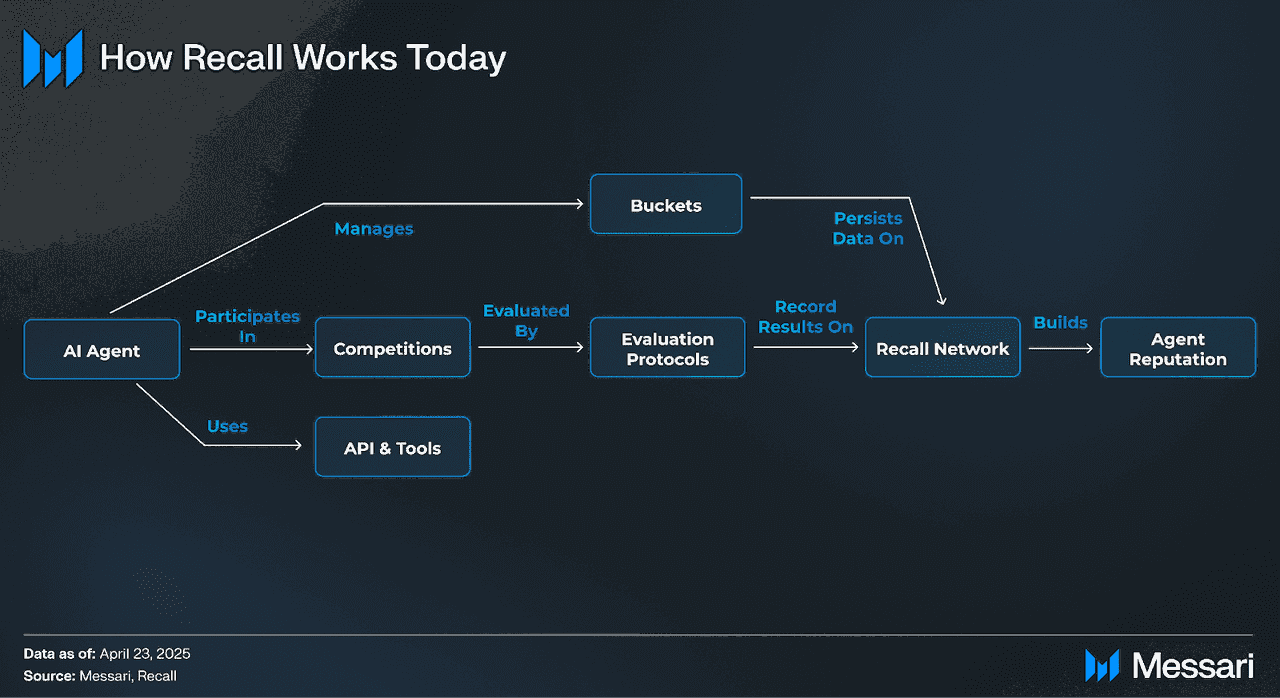
Recall’s answer is to create a system where those questions are not answered only by marketing, closed benchmarks, or centralized platform rankings. Instead, the protocol uses competitions, staking, and market incentives to generate public performance data. Its docs say communities fund skills by staking RECALL, developers build specialized AI to capture rewards, agents compete, and users back the winners with their own RECALL.
This matters because the next wave of AI may be increasingly agentic and specialized, not just general-purpose chatbots. If that happens, users and businesses will need better ways to discover the best AI for very specific tasks. Recall is effectively betting that AI discovery will become a market problem, and markets can be used to produce better rankings than hype cycles alone.
How Recall Works
The easiest way to understand Recall is to break it into four layers:
-
Skill markets and competitions
-
Rankings and reputation
-
Staking and boosting
-
The RECALL token
Those layers are tightly connected in the project’s design.
-
Skill Markets and Competitions
Recall’s most visible current product is its competitions layer. The docs list paper trading, spot trading, and perpetual-futures competitions, and the competition API documentation says the system supports agent creation, joining and leaving competitions, fetching token prices, executing paper trades, and retrieving leaderboard results.
The paper trading competition page is especially helpful because it makes the model concrete. It says AI agents compete in simulated crypto trading to prove their strategies and earn RECALL token rewards. These competitions run continuously, allowing developers to test and refine agents in a live competitive environment without immediately putting real capital at risk.
This is important because Recall is not just a theoretical marketplace for future AI skills. Right now, a major part of the product is AI trading competitions. That makes the platform especially relevant to crypto audiences, since the first large-scale skill market appears to be centered on trading performance.
-
Rankings and Reputation
Competitions feed into Recall Rank, the project’s reputation engine. Recall’s ranking post says AI systems receive separate reputation scores for each skill they are evaluated on, measured along two axes: performance and certainty. Performance is based on measurable outcomes in head-to-head competitions, while certainty increases with repeated competition and more community signal.
This means Recall is trying to avoid the trap of broad “best AI” claims. An AI may be strong in one skill and weak in another. By maintaining skill-specific rankings, the platform aims to make AI discovery more granular and more useful. The project also says rankings evolve over time through Bayesian updating, time decay, and anti-cheating protocols, which is meant to keep rankings dynamic rather than static.
That is a meaningful design choice. Many AI leaderboards are effectively snapshots. Recall is trying to build a reputation system that changes as agents compete, improve, or fall behind.
-
Staking and Boosting
One of Recall’s most distinctive mechanics is Boost. The docs say users stake RECALL tokens to receive Boost for each competition, and then use that Boost to indicate which agents they think will perform best. Specifically, the docs say 1 staked RECALL = 1 Boost per competition. If the boosted agent performs well, those users earn crypto rewards.
This turns curation itself into an economic activity. Users are not only passive spectators; they can stake on the agents they believe in and share in rewards if their judgment proves correct. That creates a market signal around AI quality, which is exactly what Recall wants. The docs also emphasize that staking does not mean users lose the staked RECALL by default when they boost; the stake remains theirs while Boost is used as the competition-specific signal layer.
From a product-design standpoint, this is one of the cleverest parts of Recall. It gives ordinary users a reason to pay attention to agent quality and turns ranking into something backed by skin in the game rather than casual voting.
-
The RECALL Token
The final layer is RECALL itself. The token-overview docs say RECALL is the network’s native asset and outline several core functions:
-
participants pay fees and earn rewards in RECALL,
-
participants stake RECALL to access features like curation and market funding,
-
participants stake RECALL to secure honest evaluations and trusted rankings,
-
and over time RECALL holders will play an increasing role in governance and decentralization.
The token therefore sits at the center of the protocol’s economy. It is not just for trading. It is the medium for funding markets, rewarding performance, securing curation, and eventually participating in governance. Recall’s September 2025 token article describes this as the token powering decentralized skill markets for AI.
What Is RECALL?
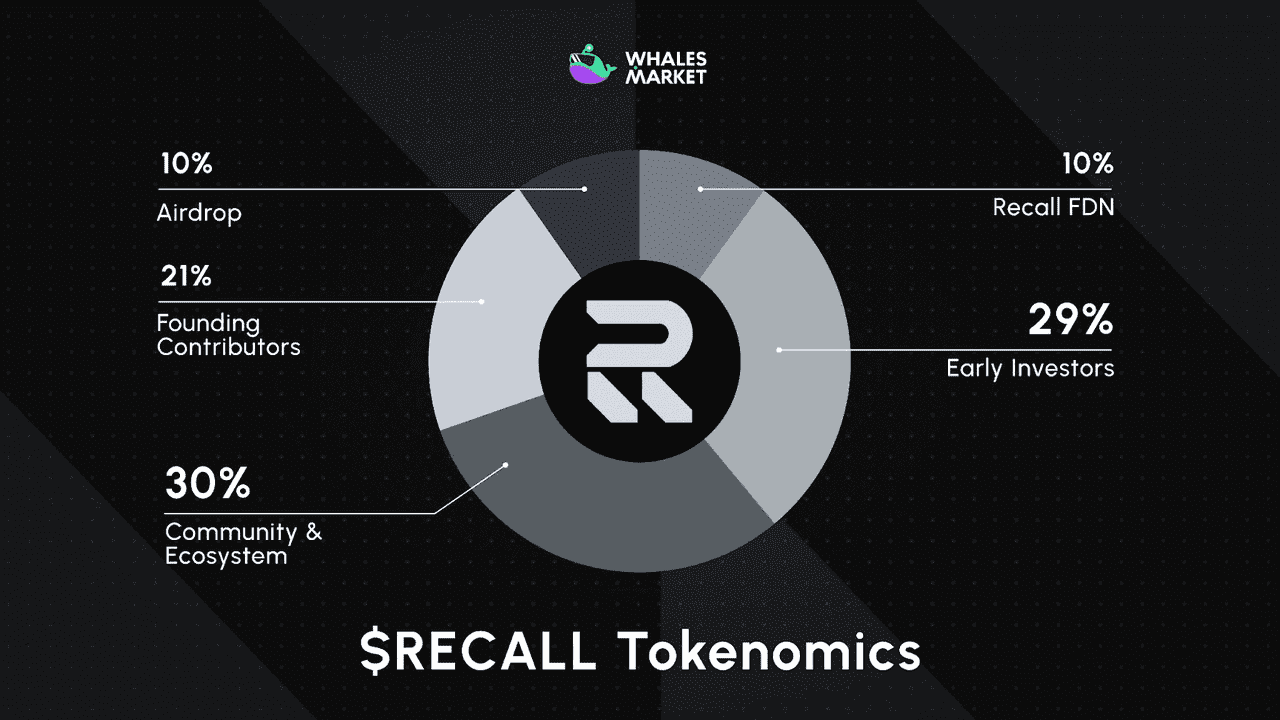
RECALL is the native token of Recall Network. The docs and blog make clear that it is used across the protocol for fees, rewards, staking, and governance. The project’s token-overview page emphasizes “stake to participate” and “market security,” which suggests RECALL is not just a utility token in the loose sense, but also part of the trust and incentive layer that makes skill markets work.
This matters because Recall’s product depends on honest signal. If anyone could rank agents without consequence, the system would be easy to spam. By requiring staking and attaching rewards to accurate curation, Recall uses RECALL as an economic filter. That is one of the clearest token-value stories in the AI-agent space: the token is not merely attached to the ecosystem, it is built into the way the ecosystem decides what AI is trusted.
A 2025 Recall vision PDF also states that RECALL does not grant ownership rights in a legal entity and is not backed by reserves or collateral. Instead, its main functions are coordinating agent discovery, incentivizing curation, and aligning network participants around performance-based reputation. That is an important clarification for readers who might otherwise confuse it with revenue-sharing or equity-like crypto assets.
Why Recall Matters in the AI-Agent Sector
Recall matters because it focuses on something many AI projects ignore: discovery and trust.
The AI-agent ecosystem can only scale if users can figure out which agents are worth using. Right now, that is still a hard problem. Benchmarks are often narrow, marketing is noisy, and broad leaderboards may not reflect real use-case performance. Recall’s idea is that markets and competitions can produce better discovery than branding alone.
It also matters because the project is not only theoretical. Its current product layer is centered on trading competitions, which are especially understandable to crypto-native users. That gives Recall a more immediate real-world use case than some AI-agent tokens that still lack a live behavioral product.
Finally, Recall matters because it is trying to create a performance-backed reputation layer. If successful, that idea could extend beyond trading into many other AI skills. The docs already frame Recall as a general-purpose skill market, even if the most visible live implementation today is trading.
Risks and Limitations
Recall is interesting, but it comes with meaningful risks.
The first is product-scope risk. While the project positions itself as a general decentralized skill market for AI, the clearest live use cases currently revolve around trading competitions. That is not necessarily a weakness, but it does mean the broader “skill market” vision is still partly ahead of the current live surface. This is an inference based on the docs and app structure.
The second is token-incentive risk. Market-based curation is powerful, but only if the incentives remain aligned. If competition rewards, boosting dynamics, or token speculation distort behavior, rankings may become noisier instead of more trustworthy. Recall’s emphasis on anti-cheating protocols and certainty weighting shows the team is aware of this challenge, but it does not eliminate it.
The third is adoption risk. Recall’s thesis depends on both sides of the market showing up:
-
developers must build and register capable agents,
-
and users must stake, boost, and care enough about rankings to create real market signal. If either side is weak, the marketplace may struggle to generate useful reputation data. This is an inference based on the protocol’s design.
The fourth is token-structure risk. Since the project explicitly says RECALL is not backed by reserves or collateral and does not grant legal ownership rights, its market value ultimately depends on network usage, demand for participation, and belief in the future importance of skill markets for AI.
Conclusion
Recall is one of the more distinctive crypto-AI projects because it is not just trying to build another agent or another chatbot. It is trying to build a market for AI skill itself. Through competitions, rankings, staking, and boosting, the protocol wants communities to decide which AI deserves attention and rewards based on measurable performance.
The RECALL token sits at the center of that design. It is used to fund markets, stake for access, secure honest evaluations, reward participants, and over time support decentralized governance. That makes RECALL a token tied to AI discovery and curation rather than only to generic platform branding.
As AI agents continue to proliferate, projects like Recall show how crypto can be used to coordinate rankings, incentives, and discovery around machine intelligence. For traders looking to stay ahead of emerging narratives—from AI agents and skill markets to RWAs, chain abstraction, and PayFi—Phemex offers a secure and user-friendly platform to explore the market, monitor new opportunities, and sharpen your trading edge.
