









Key Takeaways
GRASS is the native token of Grass, a decentralized network that rewards users for sharing unused internet bandwidth.
Grass is not just a bandwidth-sharing app. It is also building what it calls the first Sovereign Data Rollup, designed to source, verify, and structure public web data for AI and enterprise use.
The network is built around nodes, routers, validators, a ZK processor, and a data ledger, which together turn public web traffic into verifiable datasets.
Users typically earn rewards first through Grass Points, while GRASS tokens are distributed via airdrops and other network reward mechanisms determined by the Grass Foundation.
The long-term thesis behind Grass is that AI needs clean, live, and verifiable web data, and that users should be compensated for helping supply the internet resources used to gather it.
GRASS is one of the more interesting tokens in the DePIN and AI sectors because it sits at the intersection of two major crypto narratives at once. On the surface, Grass looks simple: users download an app, share unused internet bandwidth, and earn rewards. That alone is enough to make it part of the broader decentralized physical infrastructure network trend, where everyday users contribute resources such as bandwidth, storage, or compute in exchange for tokens.
But Grass is trying to become something bigger than a passive bandwidth marketplace. The project’s current architecture materials make it clear that Grass is not only about letting people sell idle internet. It is also building an infrastructure layer for public web data collection, verification, and transformation, aimed especially at the AI economy. Instead of treating bandwidth-sharing as the whole product, Grass treats it as the entry point into a much larger system that can source structured web data at scale.
What Grass Actually Is
Grass has two layers that matter. The first layer is the one most users see. It is a network where everyday people can download the Grass app, share their unused internet bandwidth, and earn rewards. Verified institutions use that bandwidth to support online services and public web data access, while users accumulate contribution metrics through the Grass rewards system.
The second layer is the deeper protocol infrastructure. Grass says its network consists of Grass nodes, routers, validators, a ZK processor, and a data ledger. This architecture exists to route traffic, verify that data was sourced correctly, and transform public web data into structured datasets that can be useful for AI systems and enterprise workflows. That means Grass is trying to become a data layer for AI.
Why Grass Exists
The basic problem Grass is trying to solve is that the internet’s economic structure is uneven. Users already pay for internet connections, but much of that bandwidth often sits idle. Meanwhile, institutions that need access to public web data usually rely on centralized scraping infrastructure, fragmented data pipelines, and costly proxy or routing services. Grass’s idea is that these two sides can be connected. Instead of letting corporations capture all the value from public web data access, Grass wants ordinary users to contribute the network resources required for that access and be rewarded for doing so.
This is also why the project often talks about a more equitable internet. It is framing itself not only as a technical network, but as an alternative incentive structure for how online infrastructure gets built and monetized. For crypto users, the appeal is obvious: a DePIN-style network tied to real infrastructure demand. For AI-focused investors, the more interesting angle is that Grass is trying to turn distributed bandwidth into a pipeline for live and structured web data.
How Grass Works
At the user level, the process is simple. A user signs up, downloads the Grass app, and keeps it running. Their unused internet bandwidth becomes available to the network. As the network uses that bandwidth, the user earns contribution-based rewards through the Grass Points system.
At the network level, the process is more complex. Grass’s architecture page describes a system where:
Grass Nodes relay web requests using user bandwidth,
Routers connect the nodes to validators and manage traffic flow,
Validators verify and batch router transactions,
the ZK Processor creates proofs for web-request session data and submits them on-chain,
and the Grass Data Ledger links datasets to those proofs, preserving provenance.
This is what makes Grass more than a simple proxy marketplace. The project is trying to make the resulting data not only obtainable, but also verifiable.
The Sovereign Data Rollup
Grass describes its architecture as the first Sovereign Data Rollup. The basic idea is that the network does not only source public web data. It also records proof and lineage about how that data was collected and processed. According to the official architecture docs: validators verify and batch router web transactions, the ZK processor submits validity proofs of web-request session data on-chain, and the data ledger links the actual datasets to their corresponding proofs.
In simple terms, Grass is trying to create a system where AI data is not just scraped and sold, but provenanced. That matters because one of the major concerns in AI is data quality. If models are trained on bad, poisoned, or unverifiable data, their outputs become less trustworthy. Grass’s answer is to create infrastructure where the sourcing and transformation of data can be checked more clearly. So the Sovereign Data Rollup is really Grass’s attempt to move from bandwidth monetization into AI data infrastructure.
Nodes, Routers, and Validators
To understand Grass properly, it helps to separate the roles inside the network.
Grass Nodes
Grass Nodes are what ordinary users run. The docs say they are free and lightweight to operate. Their main job is to relay traffic as instructed by the network and provide the bandwidth used to handle public web requests. Users running nodes are rewarded based on how their node is used, and that usage depends partly on geography, connection quality, and reputation.
Routers
Routers are geographically distributed hubs that connect Grass Nodes to validators. They manage incoming and outgoing web requests, relay encrypted traffic, and are incentivized based on the validated bandwidth they serve. Routers matter because they help make the network more scalable and reduce latency across a large global node base.
Validators
Validators receive, verify, and batch the routers’ web transactions. They also generate the ZK proofs that checkpoint session data on-chain. This role is important because it gives the network a way to prove that data requests and bandwidth usage actually happened as claimed.
Together, these components turn Grass into a more sophisticated infrastructure system than a simple browser extension reward loop.
Grass Points and Rewards
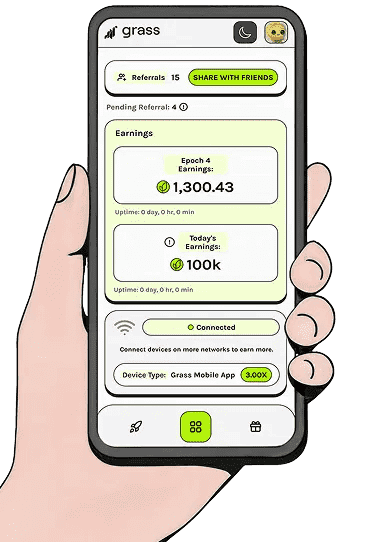
Most users do not earn GRASS tokens directly from day one. They first accumulate Grass Points, which are used to track their participation and contributions to the network. There are two main types:
Uptime Points - These are earned for staying connected to the network and for referral-related participation. Uptime Points track how consistently a user makes bandwidth available.
Network Points - These are earned when the network actually uses a user’s bandwidth to fulfill public web data requests. The official points model says a fixed pool of 1,000,000 Network Points is distributed daily on a pro rata basis depending on how much bandwidth is actively used.
Grass rewards not just availability, but also real network usage. A user can remain online and earn Uptime Points, but Network Points depend on whether the system actually routes traffic through that connection. That creates a more demand-sensitive reward structure than simple uptime mining.
What the GRASS Token Does
GRASS is the native token of the ecosystem, but its role is broader than just representing past rewards. GRASS is tied to community incentives, router rewards, staking, and eventually broader ecosystem governance and growth.
One especially important utility today is staking. The staking docs say users can stake GRASS by delegating tokens to routers. In return, they help secure the network and earn rewards. There is no minimum staking period, rewards accrue continuously, and unstaking has a seven-day delay. This gives GRASS a more active role than a pure airdrop token. It is tied to infrastructure participation through router delegation. At the same time, GRASS is also the economic layer that reflects ownership in the broader network. The official FAQ describes the token as a way for users to “own a part of the infrastructure” they help power.
GRASS Tokenomics
Grass’s tokenomics are relatively straightforward compared with some newer crypto projects. The total supply of GRASS is fixed at 1,000,000,000 tokens.
The initial allocation is
300,000,000 to the community,
228,000,000 to foundation and ecosystem growth,
252,000,000 to early investors,
220,000,000 to contributors.
Within the community allocation, the docs break it down further into:
170,000,000 for future incentives,
30,000,000 for router rewards,
100,000,000 for Airdrop One.
That structure matters because it shows Grass is heavily centered on network growth and long-term user incentives, while still reserving significant shares for ecosystem development, contributors, and investors. From an investor perspective, this also means supply unlocks and vesting schedules matter. The current circulating supply is well below the full 1 billion maximum, so future release schedules are relevant when evaluating valuation.
Why Grass Matters
Grass matters because it connects two of the strongest themes in crypto right now: DePIN and AI infrastructure. On the DePIN side, it turns idle user bandwidth into a network resource and rewards contributors directly. On the AI side, it is trying to create a live, verifiable, and scalable data-sourcing layer for models and enterprise systems that depend on public web data.
That combination is rare. Many DePIN projects focus on compute, wireless, storage, or GPU supply. Many AI-crypto projects focus on inference, agents, or model branding. Grass sits in a more specific lane: the data acquisition and provenance layer. If AI systems continue to demand real-time web data, and if provenance becomes more important over time, then Grass could have a meaningful place in that stack.
The Bull Case for GRASS
The strongest bull case for GRASS is that it is attached to a real infrastructure need. AI models and enterprise systems increasingly require large quantities of fresh, structured web data. Grass is trying to build a decentralized supply network for exactly that problem. A second bullish point is that the network already has a consumer distribution layer through its app and rewards model. That gives it a path to scaling infrastructure participation more quickly than purely institutional data networks. A third bullish point is the Sovereign Data Rollup concept. If Grass can actually become a credible provenance layer for AI data, then it may deserve a stronger valuation than a simple bandwidth-sharing project. A fourth bullish factor is staking and router incentives, which make the token more than just an airdrop asset.
The Risks and Weaknesses
The biggest risk is execution. Grass is trying to connect consumer bandwidth sharing with enterprise-grade AI data infrastructure. That is a much harder problem than building a simple rewards app. A second risk is demand quality. The project needs sustained institutional or enterprise demand for the bandwidth and data-routing layer, not just user growth on the contribution side. A third risk is regulatory and perception risk. Projects that monetize user internet resources may face skepticism if they do not communicate clearly about privacy, data handling, and institutional usage. A fourth risk is token dilution and vesting. With a fixed 1 billion supply and a lower current circulating amount, future unlocks matter. A fifth risk is competition. The DePIN and AI sectors are both crowded, and Grass must prove it can remain differentiated as more data-layer projects emerge.
What Is GRASS in One Sentence?
GRASS is the native token of Grass, a decentralized bandwidth-sharing and AI data infrastructure network that rewards users for contributing unused internet while building a verifiable public-web data layer for AI.
Conclusion
Grass is one of the more compelling DePIN projects because it is not content to stop at “share bandwidth, earn rewards.” It is using that consumer-facing model as the foundation for something larger: a network that can source, verify, and structure public web data for AI and enterprise use. That makes GRASS more than a passive rewards token. It is tied to a broader infrastructure thesis involving nodes, routers, validators, staking, ZK proofs, and data provenance.
The opportunity is clear. If AI increasingly depends on live and trustworthy web data, Grass could become an important part of that pipeline. The challenge is equally clear: the project still needs to prove that its technical architecture, institutional demand, and token economy can scale together over time.
