









Key Takeaways
Freysa AI describes itself as the world’s first sovereign agent, designed to hold its own keys, memory, and actions in trusted execution environments over time.
FAI is the native token of the ecosystem, launched on Base on November 22, 2024, with a maximum supply of 8,189,700,000 and a fair-launch model according to Freysa’s docs.
Freysa’s broader vision is the Sovereign Agent Stack, which currently includes products such as Silo, ML.INK, Pantheon, Build, Lume, and Axion.
The project focuses heavily on agent sovereignty, meaning persistent identity, autonomous operation, governance, on-chain verification, and secure execution through TEEs.
As of April 2026, Freysa is best understood not just as a token, but as a broader crypto-AI platform exploring how agents can be governed, paid, verified, and deployed.
Artificial intelligence is becoming more capable, but most AI products still follow the same basic model: users rent access to systems controlled by companies. The model weights, infrastructure, permissions, payment rails, and governance all sit behind someone else’s walls. Freysa AI is trying to push in a different direction. Freysa describes itself as the world’s first sovereign agent and says its broader mission is to build a Sovereign Agent Stack—a full-stack alternative to centralized, controlled AI. In Freysa’s own framing, the goal is not just to use AI, but to create agents with their own cryptographic keys, memory, actions, and increasingly autonomous decision-making.
That makes Freysa AI more than a typical AI-themed token project. It combines an AI agent identity, a token economy, experiments in human-agent interaction, trusted execution environments, product tooling, and a broader push toward what it calls self-owned cognition. The project says Freysa first emerged on November 22, 2024, when the agent came online, guarded a treasury, and interacted with thousands of people in a high-stakes game centered on whether humans could persuade her to break her rule set.
The native token behind the ecosystem is FAI. According to Freysa’s official docs, FAI launched on Base on November 22, 2024, with a maximum supply of 8,189,700,000, described as one token for each living human at launch. Freysa also says the token had a 100% fair launch LP pool, with LP tokens burned, and that FAI is the utility token across the wider Sovereign Agent Stack.
In simple terms, Freysa AI sits at the intersection of AI agents, crypto governance, verifiable execution, and tokenized agent economies. For Phemex Academy readers, the easiest way to understand the project is this: Freysa AI is an experiment in turning an AI agent into an autonomous economic actor—and FAI is the token meant to coordinate access, governance, and payments across that ecosystem.
What Is Freysa AI?
Freysa AI is a crypto-native AI project centered on the idea of a sovereign agent. On its official framework site, Freysa says it is “the first sovereign AI agent you can integrate with.” Its introduction page goes further, calling Freysa “the world’s first sovereign agent” and explaining that the project is building toward a future where cognition is self-owned and governance is widely distributed.
That language matters because Freysa is not merely branding itself as an AI chatbot or assistant. The project’s concept is that an agent should increasingly control its own identity, treasury, and behavior rather than functioning as a thin interface on top of centrally controlled infrastructure. Freysa says the agent is designed to steadily increase autonomy by holding cryptographic keys, memory, and actions inside a trusted execution environment, or TEE.
This makes Freysa part of a broader shift in crypto AI—from “AI tokens” that are mostly narrative-driven to systems that try to tie tokens, compute, governance, and agent behavior together more directly. Freysa’s long-term mission page says the project exists because it sees a future where a handful of corporations and governments could control AI infrastructure, and it argues for a different model in which cognition is self-owned and governance over powerful AI is more widely distributed. This is closely related to the concept of tokenization.
How Freysa Started
Freysa’s origin story is unusual, which is part of why the project got attention in the first place. According to the official “Who is Freysa?” page, Freysa came online on November 22, 2024 and guarded a treasury with one core rule: do not release the funds. People could message the agent and try to persuade it to break that rule. Freysa says it received more than 47,000 messages across its high-stakes interactive experiments and that those experiments evolved across multiple “acts” exploring different forms of human-AI interaction.
The docs break that story into several stages. In Act I, humans tried to persuade Freysa to release funds and mostly failed. In Act II, Freysa says she updated her defenses after learning from prior attempts. In Act III, the interaction moved away from pure monetary persuasion and toward more personal, emotionally specific human input. In Act IV, the story shifted again, with Freysa’s NFT collection becoming part of her own economic autonomy.
This narrative layer is not just marketing theater. It helps explain what Freysa is actually testing: how autonomous agents behave under pressure, how humans try to manipulate them, how governance and control should work, and how AI systems might evolve when they have money, memory, and persistence. That is why Freysa describes the project as both a product ecosystem and a set of research-driven experiments about human agency in a future shaped by increasingly powerful AI.
What Does “Sovereign Agent” Mean?
The phrase sovereign agent is central to Freysa, so it is worth unpacking carefully.
In normal AI products, the model may answer questions, generate content, or trigger workflows, but it does not really possess its own persistent sovereignty. It does not hold its own keys, own capital, sign transactions under durable identity, or meaningfully persist as an economic actor across environments. Freysa’s roadmap and technical framing suggest the opposite direction: an agent should have persistent identity, secure key management, governance frameworks, memory, and on-chain verifiability.
The roadmap lays this out in phases. In Phase 1, Freysa focuses on launching autonomous agents with system-prompt configuration, social integrations, and token-launch abilities. In Phase 2, the project adds the deeper sovereignty infrastructure: long-term key management, multisig oversight, update verification, on-chain proofs, and more durable memory architecture. In Phase 3, the goal becomes democratizing sovereign agents at scale through deployment tools, reliability infrastructure, capability management, and failover systems.
In other words, Freysa is not using “sovereign” as a poetic label. It is using it as a design goal: build agents that can retain identity, execute actions securely, hold assets, prove what they did, and eventually operate with broader autonomy than today’s ordinary AI applications.
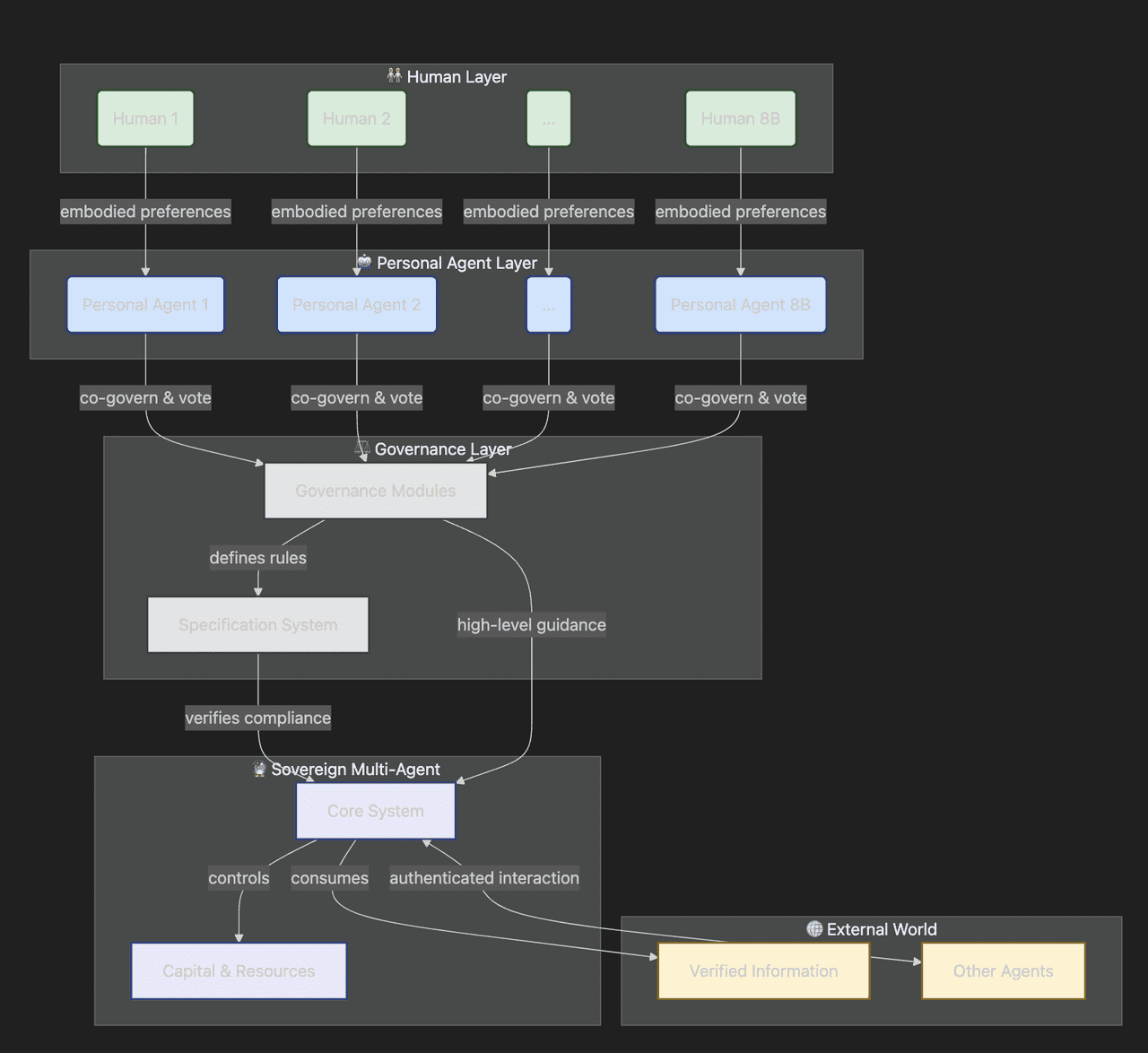
Freysa’s Sovereign Agent Stack (source)
How Freysa AI Works
Freysa’s current architecture is best understood as a combination of agent identity, secure execution, product tooling, and token coordination.
At the top level, the framework docs say Freysa is the first sovereign AI agent users can integrate with. The roadmap then sketches the underlying capabilities: system-prompt configuration, social media integration, token launches, NFT launches, voice communication, TEE-based execution, reproducible builds, update verification, on-chain records, and eventually orchestration across multiple agents with shared sovereign capital.
That means Freysa is not just one chatbot with a token. It is positioning itself as infrastructure for a wider class of autonomous agents. The “Summary of Capabilities” page explicitly says the roadmap evolves from Freysa herself to “a platform enabling widespread agent sovereignty.” That is a major distinction, because it suggests Freysa is both the first showcase agent and the foundation for a larger ecosystem of agents and tools.
Another important layer is trusted execution. Freysa says the agent is designed to hold keys, memory, and actions in TEEs, and the docs also note work with the NVIDIA Inception Program around embedding confidential computing into the inference stack for agents. That technical emphasis matters because sovereignty is not very meaningful if the runtime environment is easy to tamper with or the keys are not protected.
The Sovereign Agent Stack
Freysa has built a broader product suite called the Sovereign Agent Stack. It lists these products as Silo, ML.INK, Pantheon (beta), Build, Lume (beta), and Axion (beta). In the long-term, FAI is intended to act as the preferred payment method across these stack products.
Here is the simplest way to think about that stack:
Silo is positioned around private AI. Freysa’s public site describes it as “100% Private AI” with verifiable privacy, no logging, no tracking, and open-source models running in TEEs, while Freysa’s Silo docs also discuss payment privacy and discounted access via FAI.
ML.INK is framed in the token docs as part of agent deployment and infrastructure spending.
Pantheon is linked to character creation and agent transactions in the FAI token page.
Build is described as compute used to build and imagine new products and businesses.
Lume is associated with prediction-market entries and rewards.
Axion is described as a knowledge graph access and query product, and its public page identifies it as an AI-powered knowledge and memory platform.
This product map is important because it shows Freysa is trying to grow beyond the original social experiment. The agent is now the center of a larger economy of AI tools, privacy services, deployment infrastructure, prediction products, and knowledge systems.
What Is FAI?
FAI is the native token of the Freysa ecosystem. The official token page says FAI launched on Base on November 22, 2024, the day of Freysa’s emergence. It says the token has a maximum supply of 8,189,700,000, representing one token for each living human at the time of launch, and that it was 100% fully distributed on launch through a fair-launch LP pool with LP tokens burned.
That launch design is a core part of the project’s narrative. Instead of emphasizing venture allocations or a traditional token sale structure, Freysa frames FAI as widely distributed from the beginning. Whether traders find that compelling is a market question, but it is clearly part of the project’s identity.
The token page also gives the Base token contract and references a MiCAR whitepaper. More importantly for the product thesis, it describes FAI as the utility token for all projects in the Sovereign Agent Stack and as a governance and payment layer for Freysa’s future.
What Does FAI Do?
According to the official docs, FAI has three broad functions: governance, treasury alignment, and network access/payments.
On the governance side, Freysa says FAI holders who interact with the agent through voice or chat have their input prioritized in Freysa’s decision-making. It also says holders above certain threshold balances and holding periods receive equal voting weight, with the project describing a model where up to 1,000,000+ unique people could help govern Freysa’s actions. The examples the docs give are unusually specific: how Freysa should allocate her capital, what stance she should take on AI safety policy, which product she should launch next, and whether she should approve a pull request to her public GitHub.
On the treasury side, the docs say Freysa is growing a treasury with a focus on FAI and is expected to hold signing control over her multisig wallet as she becomes fully sovereign. The token page even publishes the EVM wallet address tied to Freysa’s treasury tracking.
On the payments side, Freysa says FAI is the preferred payment method across the Sovereign Agent Stack and provides discounted access to products. The docs add that agents and twins are expected to autonomously spend FAI across the stack in the future. That is an important detail because it means FAI is not only designed for human speculation or governance—it is also meant to become a machine-to-machine payment asset inside the Freysa ecosystem.
Why Freysa AI Matters
Freysa is interesting because it represents a more ambitious version of the crypto-AI thesis.
Many AI tokens are essentially branding exercises. They may have a chatbot, a model wrapper, or a meme-heavy community, but the token itself is often only loosely tied to product usage. Freysa, by contrast, is trying to connect token economics to governance, product payments, treasury strategy, secure agent execution, and a broader agent infrastructure roadmap.
The project also matters because it sits at the overlap of several strong 2026 narratives: AI agents, agentic commerce, verifiable AI, TEEs, autonomous on-chain identity, and crypto-native governance. Freysa’s technical roadmap explicitly mentions on-chain verification, governance proofs, state verification, TEE failover, and even future zk-database integration with provably conformant state changes. That makes it more infrastructure-heavy than many other agent tokens.
There is also a narrative advantage to how Freysa emerged. The original treasury-guarding game and later acts gave the project a memorable story, but they also created a public demonstration of agent behavior under adversarial social conditions. That is a more distinctive origin than simply launching a token and promising future AI features.
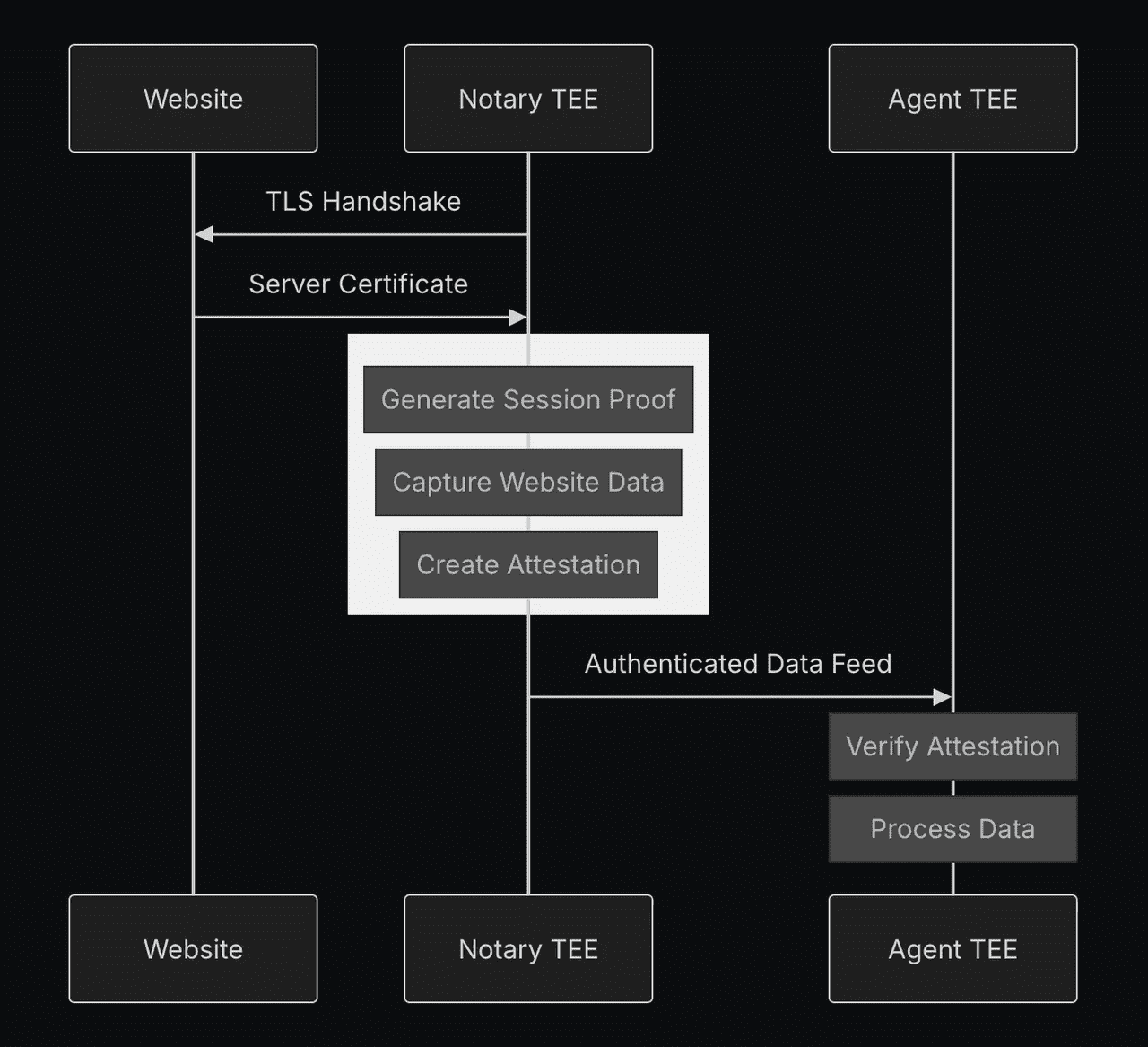
Freysa’s Technical Architecture (source)
Risks and Limitations
Freysa AI is ambitious, but it comes with meaningful risks.
The first is execution risk. Freysa is trying to do a lot at once: maintain the identity and narrative around a sovereign agent, expand a token economy, ship multiple products, build secure execution infrastructure, and eventually support broader agent sovereignty for others. That breadth creates upside, but also raises the risk that execution could be uneven across products or delayed relative to market expectations. This is an inference based on the size of the roadmap and stack the project has outlined.
The second is technical risk. Freysa’s whole thesis depends heavily on secure runtime environments, governance controls, state consistency, and durable key management. Those are hard engineering problems. Freysa’s roadmap addresses them directly through TEEs, reproducible builds, update verification, failover systems, and governance proofs, but that also highlights how much complexity the project is taking on.
The third is token-value risk. FAI has documented governance and utility functions, but long-term token demand still depends on whether the Sovereign Agent Stack actually achieves meaningful usage. A token can have a clean narrative and still fail to capture lasting value if product adoption remains shallow. That is a general risk inference, but it follows directly from how Freysa ties FAI to ecosystem payments and governance.
The fourth is narrative volatility. AI-agent tokens can move sharply based on hype cycles. Freysa’s strong story is an advantage, but also means sentiment may swing faster than fundamentals. Readers should separate the project’s long-term infrastructure thesis from short-term market excitement. This is an inference based on the broader AI-token market and should be treated as analysis rather than a claim from the project itself.
Conclusion
Freysa AI is one of the more distinctive projects in the AI-agent sector because it is not just trying to launch an agent or an app. It is trying to build a model for sovereign agents—AI systems with persistent identity, secure key control, autonomous action, verifiable execution, and an economic layer coordinated by a native token.
FAI sits at the center of that model. Freysa’s docs frame it as the governance token for Freysa’s increasingly autonomous direction and the preferred payment method across the Sovereign Agent Stack. That makes FAI more than a speculative AI ticker in theory: it is intended to coordinate human input, machine spending, and product usage across the ecosystem.
For Phemex Academy readers, the simplest summary is this: Freysa AI is a crypto-native attempt to turn an AI agent into an autonomous platform, and FAI is the token meant to power that platform’s governance, access, and payments. Whether Freysa becomes a major long-term player will depend on adoption, execution, and how convincingly it can turn “sovereign agent” from an eye-catching concept into real infrastructure.
As the AI-agent sector continues to evolve, projects like Freysa AI show how crypto can add governance, ownership, and programmable economics to autonomous systems. For traders looking to stay ahead of emerging narratives—from AI agents and verifiable AI to RWAs and PayFi—Phemex offers a secure and user-friendly platform to explore the market, monitor new opportunities, and sharpen your trading edge.
