









Key Takeaways
Dinari is a company focused on bringing tokenized U.S. public securities onchain through its dShares product.
dShares are described by Dinari as 1:1 backed tokenized public market securities, commonly tied to U.S. equities and ETFs.
Dinari is building a broader market structure layer through the Dinari Financial Network, which it says supports issuance, trading, settlement, and clearing of tokenized securities.
The company says it is the largest tokenized U.S. public securities provider, and its recent posts describe support for over 150 and later over 200 tokenized U.S. equities as the network expanded.
Dinari’s public materials repeatedly emphasize that dShares are meant for qualified non-U.S. users, subject to legal and jurisdictional restrictions.
Real-world asset tokenization has expanded far beyond Treasury bills and private credit. One of the most intuitive and potentially transformative use cases is tokenized stocks—bringing stocks and ETFs onchain so they can move with the speed, programmability, and composability of crypto. Dinari is one of the most prominent companies building in that category. Its official website says dShares™ are tokenized public market securities that are 1:1 backed, simple to integrate into retail platforms, and seamless to trade. Dinari also says its mission is to give businesses and users instant access to U.S. capital markets through tokenized-on-demand public-market exposure.
That framing matters because Dinari is not just another tokenized-stock experiment. It is building a broader infrastructure stack for issuance, trading, settlement, and clearing of tokenized securities. Its consortium page describes the Dinari Financial Network as the hub for issuance, trading, settlement, and clearing of tokenized securities and other financial instruments, while its transparency page says Dinari, Inc. is a registered SEC transfer agent in the United States.
What Is Dinari?
Dinari is a financial-technology company building blockchain-based infrastructure for tokenized securities, especially U.S. public stocks and ETFs. Its product pages say its goal is to provide instant access to U.S. capital markets through tokenized-on-demand dShares and developer-friendly integrations for businesses such as neobanks, fintechs, and other financial platforms.
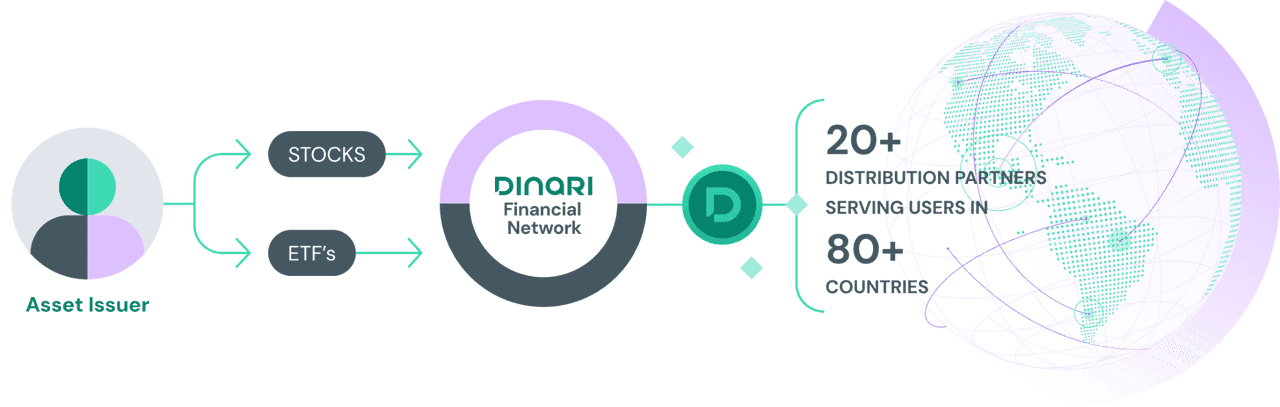
That makes Dinari more than a simple consumer-facing app. The company is clearly targeting B2B infrastructure as much as end-user investing. Its “Access public markets in DeFi” page says Dinari works with protocols, apps, and infrastructure providers to enable onchain access to over 100 stocks and ETFs, while its case study pages show how partners use dShares and related assets like USD+ inside broader financial platforms.
Dinari’s public positioning has also become more ambitious over time. In August 2025, the company said the Dinari Financial Network is an omni-chain orderbook and coordination layer for issuance, trading, settlement, and clearing of tokenized securities, and described itself as the largest tokenized U.S. public securities provider.
What Problem Is Dinari Trying to Solve?
Traditional stock markets are deep and liquid, but they are also operationally fragmented, limited by market hours, and not natively integrated with DeFi or blockchain applications. Dinari is trying to solve that by representing public securities as tokenized instruments that remain fully backed while becoming easier to move, integrate, and potentially trade around the clock. Its official whitepaper draft says a trusted bridge between the existing financial system and decentralized finance is necessary to create a more accessible, transparent, and efficient trading system, and defines dShares as that bridge.
Dinari’s website and docs also stress accessibility and integration. The company says dShares are simple to integrate into retail platforms, while the DeFi page says protocols can give users access to tokenized stocks directly from within onchain applications. That means Dinari is not only trying to mirror public equities onchain; it is trying to make them part of a broader programmable financial environment.
Another problem Dinari is addressing is distribution. Many global users do not have straightforward access to U.S. capital markets, especially in crypto-native environments. Dinari’s materials repeatedly say the company wants to help users “invest in anything from anywhere,” though always within compliance boundaries.
What Are dShares?
dShares are Dinari’s flagship product. Dinari’s docs define a dShare as a token 1:1 backed by a security, commonly a U.S. equity. The dShares product page says they are tokenized public-market securities, while the DeFi page says they give onchain access to tokenized stocks and ETFs.
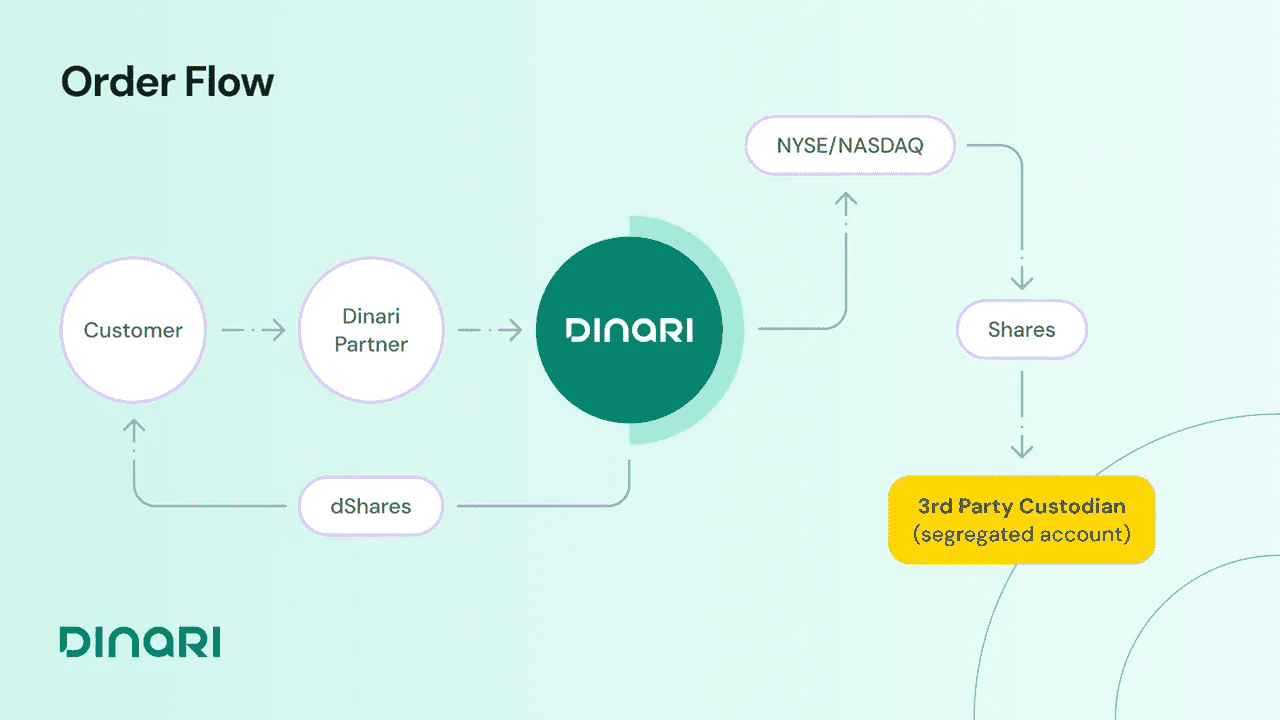
This is one of the most important distinctions in the article: dShares are not supposed to be synthetic price trackers in the loose sense. Dinari explicitly describes them as 1:1 backed, and its docs explain that minting or burning only occurs when a corresponding order is completed in a brokerage account. In the issuance flow described in the docs, a customer escrows funds, Dinari forwards the order, the broker fills it, and then dShares are minted. In redemption, the process reverses: dShares are escrowed, Dinari forwards the redemption order, the broker executes the sale, and funds are returned.
That matters because it shows the backing mechanism is tied to actual securities operations rather than just oracle-based mirroring. Dinari’s 2023 whitepaper draft reinforces this, saying automated operators rebalance underlying securities vault accounts and maintain at least 100% backing of outstanding token issuance.
How dShares Work
Dinari’s official quickstart doc gives the clearest simple explanation of how dShares work. It says dShares are 1:1 backed because minting happens only when a corresponding purchase order for the underlying security is completed in a brokerage account, and burning happens only when a corresponding sell order is completed.
This has a few important implications.
First, dShares are not free-floating meme assets. Their issuance is tied to underlying securities activity. Second, dShares are built to be programmatically accessible, because they are tokenized and can be used in wallets, apps, or protocols once issued. Third, their structure still depends on traditional market plumbing in the background—brokerage execution, custody, and legal compliance remain part of the system.
Dinari’s older whitepaper also notes that dShares are ERC-20 compliant and compatible with standard DeFi applications, though it includes transfer-restriction features for OFAC, AML, and security requirements. That is a useful reminder that tokenized securities are not ordinary permissionless DeFi tokens. They are programmable, but still compliance-aware.
Dinari’s Compliance-First Approach
One of Dinari’s strongest differentiators is its explicit focus on compliance and regulated infrastructure. The transparency page says Dinari, Inc. is a registered Transfer Agent with the U.S. Securities and Exchange Commission. That is a meaningful credential in a market where many tokenized-asset projects operate at the edge of regulatory clarity.
Dinari’s public messaging repeatedly reinforces this compliance-first identity. Its August 2025 and December 2025 partnership announcements describe the company as helping neobanks, fintechs, and financial services providers offer customers seamless access to U.S. public markets through fully-backed dShares, while emphasizing its focus on navigating regulatory challenges.
This matters because tokenized equities are only valuable if the legal and operational rails are credible. A tokenized stock product needs more than just a smart contract. It needs:
a recognized issuance framework,
custody and brokerage support,
transfer controls,
and compliance procedures that can operate across jurisdictions.
The Dinari Financial Network
One of Dinari’s most important recent developments is the Dinari Financial Network, or DFN. Dinari’s consortium page says the DFN is the hub for issuance, trading, settlement, and clearing of tokenized securities and other financial instruments. The page adds that it is operated by the Dinari Consortium of member institutions, with a goal of delivering traditional and innovative financial products while upholding high standards of compliance, safety, reliability, and transparency.
That is strategically important because it suggests Dinari is moving beyond “we tokenize stocks” toward “we operate market infrastructure for tokenized securities.” This shift becomes even clearer in Dinari’s December 2025 partnership announcement with Flow Traders. Dinari said the DFN serves as a coordination layer that unifies liquidity and settlement for tokenized securities across multiple blockchains and trading venues.
In other words, the Dinari story in 2026 is no longer just about individual tokenized stocks. It is increasingly about market structure:
orderbooks,
liquidity routing,
settlement,
clearing,
and 24/7 trading infrastructure for tokenized public markets.
24/7 Trading and Why It Matters
One of the biggest limitations of traditional equities is that they mostly trade during fixed weekday hours, with only limited pre-market and after-hours windows. Dinari is explicitly trying to challenge that limitation. In December 2025, the company announced a partnership with Flow Traders to unlock 24/7 trading of Dinari’s tokenized U.S. equities across major exchanges. Dinari said the partnership would bring deep liquidity, instant settlement, and access to over 200 tokenized U.S. equities, with rollout beginning from a selected set of tickers and expanding over time.
This is a major part of Dinari’s value proposition. Tokenized equities are not only about digitizing ownership—they are also about extending the behavior of equity markets into a more crypto-native environment:
always-on trading,
faster settlement,
multi-chain access,
and tighter connection to digital-asset liquidity.
If that model works at scale, Dinari could become relevant not only to users who want tokenized stocks, but to the broader future of tokenized capital markets.
Dinari for Businesses and DeFi
Dinari is not only targeting end users. In fact, much of its strongest messaging is aimed at businesses and protocols.
Its business page says Dinari offers tokenized-on-demand dShares and developer-friendly integration so companies can give customers seamless access to U.S. public markets. Its DeFi page says protocols and applications can enable onchain access to over 100 stocks and ETFs directly inside their own products.
This is important because it means Dinari is building an API and infrastructure business, not merely a consumer trading interface. A fintech, neobank, or DeFi platform does not necessarily need to build its own tokenized-equity system from scratch if it can integrate Dinari’s rails. That is likely one reason the company emphasizes turnkey integration and compliance support in recent announcements.
The Kinto case study reinforces this. Dinari says its dShares gave Kinto a robust solution for offering tokenized stocks backed 1:1 by real-world assets, while USD+ served as a native yield-bearing asset for transactions and liquidity.
What Is USD+?
Dinari’s ecosystem is not only about dShares. The site navigation and case studies also reference USD+, which appears as one of the company’s product pillars alongside dShares, APIs, and the S&P Digital Markets 50 Index. The Kinto case study says USD+ became the first native asset available on Kinto and helped support seamless transactions and user trust.
While the current question is about Dinari generally, USD+ matters because it suggests the company is building a more complete tokenized financial stack:
tokenized equities through dShares,
a stable/yield asset through USD+,
and market infrastructure through DFN.
That broader stack makes Dinari more interesting than a narrow tokenized-stock wrapper business.
Geographic Restrictions and Eligibility
A critical part of Dinari’s model is that access is restricted by jurisdiction. Multiple Dinari pages state that dShare tokens are not available for sale or redemption in every country, and the Base launch announcement says tokenized U.S. stocks are accessible to qualified non-U.S. users, subject to applicable law.
This matters because it highlights a broader truth about tokenized securities: even when they live on blockchain rails, they are still connected to securities law and compliance obligations. Dinari’s transfer-restriction features in its whitepaper draft further reinforce this, mentioning OFAC, AML, and account security requirements.
So while dShares are onchain, they are not “fully permissionless” in the same way as many standard DeFi tokens. For eligible users and integrated platforms, that may be acceptable or even desirable. But it is an important distinction for anyone trying to understand how Dinari fits into the broader crypto landscape.
Why Dinari Matters in the TradFi and RWA Sectors
Dinari matters because it sits at the overlap of two very large trends:
RWA tokenization, and
tokenized stocks public capital markets.
A lot of RWA discussion still focuses on Treasury bills, money-market funds, or private credit. Those are important, but tokenized equities may be even easier for retail and fintech audiences to understand. Dinari’s public materials make that appeal obvious: tokenized stocks like Coinbase, Tesla, Apple, and SPY can be accessed through dShares, bringing familiar public-market assets into blockchain environments.
It also matters because Dinari is building market infrastructure, not just issuing isolated assets. The DFN, SEC transfer-agent status, API business model, and 24/7 liquidity push all point toward a bigger ambition: becoming a foundational layer for tokenized public securities.
Risks and Limitations
Dinari is promising, but it is not risk-free.
First, regulatory complexity remains central. Tokenized securities do not escape securities law, and Dinari’s own materials make clear that access, transfer, and redemption are jurisdiction-sensitive. That compliance focus is a strength, but it also limits universal accessibility.
Second, market adoption risk still exists. Dinari has strong infrastructure positioning, but tokenized public equities are still an emerging market. The long-term success of dShares depends on whether investors, platforms, and institutions prefer tokenized access enough to change behavior at scale. This is an inference based on the early stage of tokenized-equity infrastructure, not a statement from Dinari itself.
Third, operational dependence on traditional finance remains important. dShares are backed through brokerage and clearing relationships, which means the system is only partly “crypto-native.” That is not necessarily bad, but it does mean Dinari’s model depends on a hybrid stack rather than pure smart-contract autonomy.
Fourth, liquidity and venue fragmentation are still evolving. Dinari’s partnership with Flow Traders and the creation of DFN are clear signs the company is actively solving this problem, but those efforts also show the problem is real.
Conclusion
Dinari is one of the clearest examples of how tokenization is moving beyond experimental RWA wrappers and toward actual public-market infrastructure. Its dShares product is built around a simple but powerful idea: tokenized public securities that are 1:1 backed and programmable enough to integrate into retail platforms, fintech apps, and DeFi systems.
What makes Dinari especially interesting in 2026 is that it is not stopping at token issuance. Through the Dinari Financial Network, API integrations, compliance-first positioning, and 24/7 trading partnerships, the company is trying to build a fuller stack for issuance, liquidity, settlement, and clearing of tokenized securities.
As tokenized stocks, RWA infrastructure, and onchain capital markets continue to evolve, projects like Dinari show how blockchain can be applied to one of the world’s most established financial sectors. For traders looking to stay ahead of emerging narratives—from tokenized stocks and TradFi infrastructure to RWAs, AI, and PayFi—Phemex offers a secure and user-friendly platform to explore the market, monitor new opportunities, and sharpen your trading edge.
Register](https://phemex.com/register?group=7916&referralCode=CUFKP8%22>Register) on Phemex Now
