










Curve DAO Token (CRV) gained roughly 5% on May 12, 2026, while the broader altcoin market traded lower on hot April CPI and a hawkish repricing of Fed expectations. That outperformance came alongside Cronos and TON, the only three large-cap alts that closed green on a day when most of the long tail bled 3-7%. The Altcoin Season Index sits at 50 out of 100, its highest reading since late March, and Curve is one of the names leading the rotation.
CRV is still down roughly 92% from its 2021 all-time high near $6, so the rally has to be read in context. The interesting part is what is happening underneath the price. Stablecoin TVL has been recovering across DeFi, crvUSD supply is climbing again, and liquid restaking pools are driving new emissions demand into Curve gauges. Here is what Curve actually does, how the veCRV flywheel works, and why a quiet 5% candle on a red day matters more than a louder one on a green day.
What Curve Finance Actually Does
Curve is the leading decentralized exchange for stablecoin swaps and similar-priced asset pairs like ETH/stETH, BTC/wBTC, and crvUSD/USDC. It launched in January 2020 under founder Michael Egorov, a Russian-born physicist whose background shows up in the math. Curve's pools use a custom AMM called the StableSwap invariant, designed to keep slippage near zero when assets trade close to parity and only widen the curve when prices diverge. For a trader moving $5 million from USDC to USDT, the difference between Curve and a generic constant-product AMM like Uniswap V2 can be tens of thousands of dollars in execution cost.
Think of Curve as the bond desk of DeFi. Uniswap is the equity floor where everything trades loudly and prices move in clean candles. Curve is the rates desk where size moves quietly and the only number anyone cares about is basis points of slippage. That is why every major stablecoin issuer and every liquid staking protocol ends up routing through Curve liquidity. According to DefiLlama, Curve's TVL has held in the $1.5-2 billion range through 2026, well below the 2022 peak above $24 billion but stable through a brutal stretch for the rest of DeFi.
The veCRV Flywheel and the Curve Wars
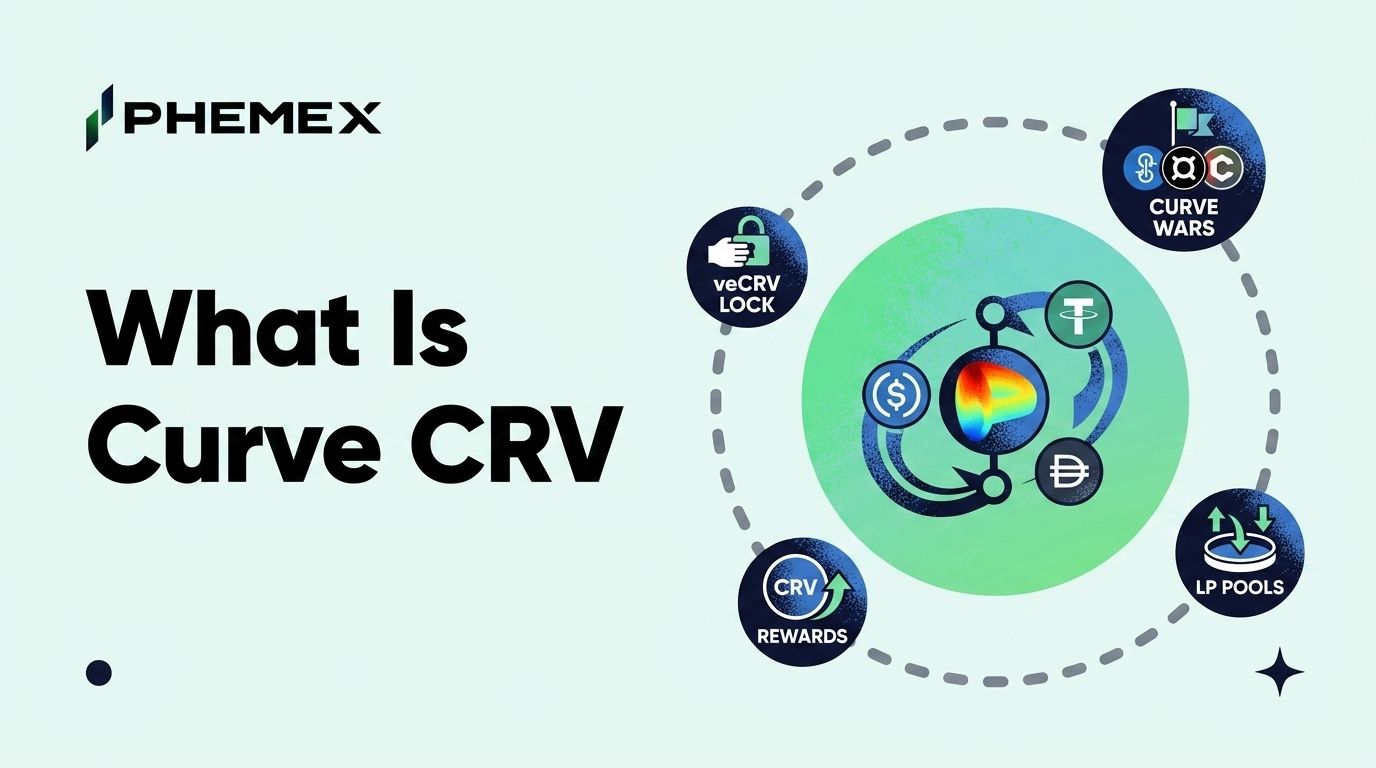
CRV does two jobs. It rewards liquidity providers through emissions, and it can be locked as veCRV (vote-escrowed CRV) for up to four years in exchange for governance power, boosted LP rewards, and a share of protocol fees. That single mechanism is the source of almost everything interesting about Curve's economics, because veCRV holders vote on which pools receive emissions.
Every protocol that depends on cheap, deep liquidity has a reason to accumulate veCRV. Stablecoin issuers want emissions on their pool to attract LPs, liquid staking protocols want their stETH or rETH pair subsidized, and restaking platforms want gauge weight for their LRT pool. That competition is what the market called the Curve Wars, and it spawned an entire layer of bribe markets, vote aggregators, and meta-governance plays. Convex Finance ended up as the biggest single holder of veCRV by routing user CRV into permanent locks in exchange for cvxCRV, which made it the kingmaker for emissions and turned CVX into a leveraged bet on Curve's relevance.
Why CRV Is Trending Right Now
The May 12 move did not come from a single headline. It came from a few quieter trends lining up.
Stablecoin TVL is recovering. Stablecoin supply across DeFi has been climbing as traders rotate out of long-duration risk and into yield-bearing dollar exposure. Curve dominates stablecoin-to-stablecoin liquidity, so a rising stablecoin float mechanically pushes more volume and fees through its pools.
Layer 2 deployments are adding real volume. Curve is live on Arbitrum, Optimism, Base, and several other L2s, and a meaningful share of new pool launches in 2026 has happened on cheaper chains where small LPs can actually compete.
Liquid restaking is the new emissions driver. LRT protocols need deep liquidity for their tokens to trade close to peg with the underlying ETH, and they bid for Curve gauge weight through bribes. That puts a structural floor under demand for veCRV and, indirectly, for CRV. With the Altcoin Season Index at its highest level since March and BTC dominance ticking lower, traders rotating into DeFi tend to start with names that survived 2022 and 2023 intact. Curve is on that short list.
The Bear Case and the Risks
CRV is still down roughly 92% from its November 2021 all-time high near $6, with current price action in the $0.50-0.90 zone depending on the week. Anyone buying here is buying a deep recovery thesis, not a breakout.
The 2023 Egorov loan crisis still casts a shadow. Founder Michael Egorov took out large personal loans against his own CRV holdings, and when CRV fell sharply in mid-2023, his positions came within a few cents of a forced liquidation that would have cascaded through the entire DeFi lending market. He resolved it through OTC sales and partial repayment, but the episode exposed how concentrated CRV ownership was at the top.
Curve Wars dynamics dilute fee revenue. A large share of Curve's economic activity is captured by veCRV bribe markets and meta-governance protocols like Convex, meaning a meaningful portion of value flows to CVX holders rather than directly to CRV holders pricing the token on standalone cash flow. Uniswap V4's hook architecture also allows custom AMM curves that can replicate StableSwap-style invariants, so Curve's moat is real but narrower than it was in 2021.
|
Metric
|
Current state (May 2026)
|
Context
|
|
Price vs ATH
|
Around 92% below the ~$6 peak
|
2021 high, never reclaimed
|
|
TVL
|
$1.5-2 billion range
|
Down from $24B+ peak, stable in 2026
|
|
Biggest veCRV holder
|
Convex Finance
|
Captures most emissions direction
|
|
Native stablecoin
|
crvUSD
|
CDP-style, LLAMMA liquidation engine
|
|
Live chains
|
Ethereum plus major L2s
|
Arbitrum, Optimism, Base, others
|
Frequently Asked Questions
Is CRV a good investment right now?
CRV is a deep-value DeFi bet, not a momentum trade. The thesis only works if stablecoin TVL keeps recovering and if Curve maintains share in the stable swap and LRT pair categories. It belongs in the satellite portion of a portfolio (1-3% allocation) for traders who want DeFi blue-chip exposure without committing to a single staking or restaking protocol.
What is the difference between CRV and veCRV?
CRV is the freely tradable token that earns emissions and can be sold at any time. veCRV is what you get when you lock CRV for up to four years in exchange for governance votes, boosted LP rewards, and a share of trading fees. veCRV cannot be transferred or sold, so locking is a strong directional bet on the protocol.
How does crvUSD differ from other stablecoins?
crvUSD is a CDP-style stablecoin minted against collateral like ETH or staked ETH, similar in spirit to DAI. The difference is its LLAMMA liquidation engine, which uses a special-purpose AMM to gradually rebalance collateral instead of triggering hard liquidations. That design is meant to reduce the cliff risk that hurt MakerDAO borrowers during the 2022 deleveraging.
Where can I trade CRV?
CRV trades on most major exchanges and on Curve itself. On Phemex you can trade CRV through the CRV/USDT futures pair with leverage, which is the most capital-efficient way to take directional exposure if you have a conviction view on the DeFi rotation.
Bottom Line
CRV closing 5% green on a red CPI day is not a breakout, but it is a relative-strength flag worth watching. The setup that matters comes down to three things. Stablecoin TVL must keep climbing, LRT protocols must keep bribing for Curve gauge weight, and the broader Altcoin Season Index needs to push through 50 toward the 60-75 zone that historically marks real DeFi rotations. If all three hold through the next two FOMC cycles, CRV is one of the cleanest large-cap expressions of that thesis.
The downside is straightforward. If macro deteriorates, if Convex's grip on veCRV creates another concentration scare, or if Uniswap V4 hooks pull material stable-pair volume away, the recovery thesis pauses and CRV settles back into the $0.45-0.55 range it spent most of 2024 in. Watching weekly stablecoin TVL and crvUSD circulating supply is a better signal than watching the CRV chart. The token follows the protocol, not the other way around.
This article is for informational purposes only and does not constitute financial or investment advice. Cryptocurrency trading involves substantial risk. Always conduct your own research before making trading decisions.
