










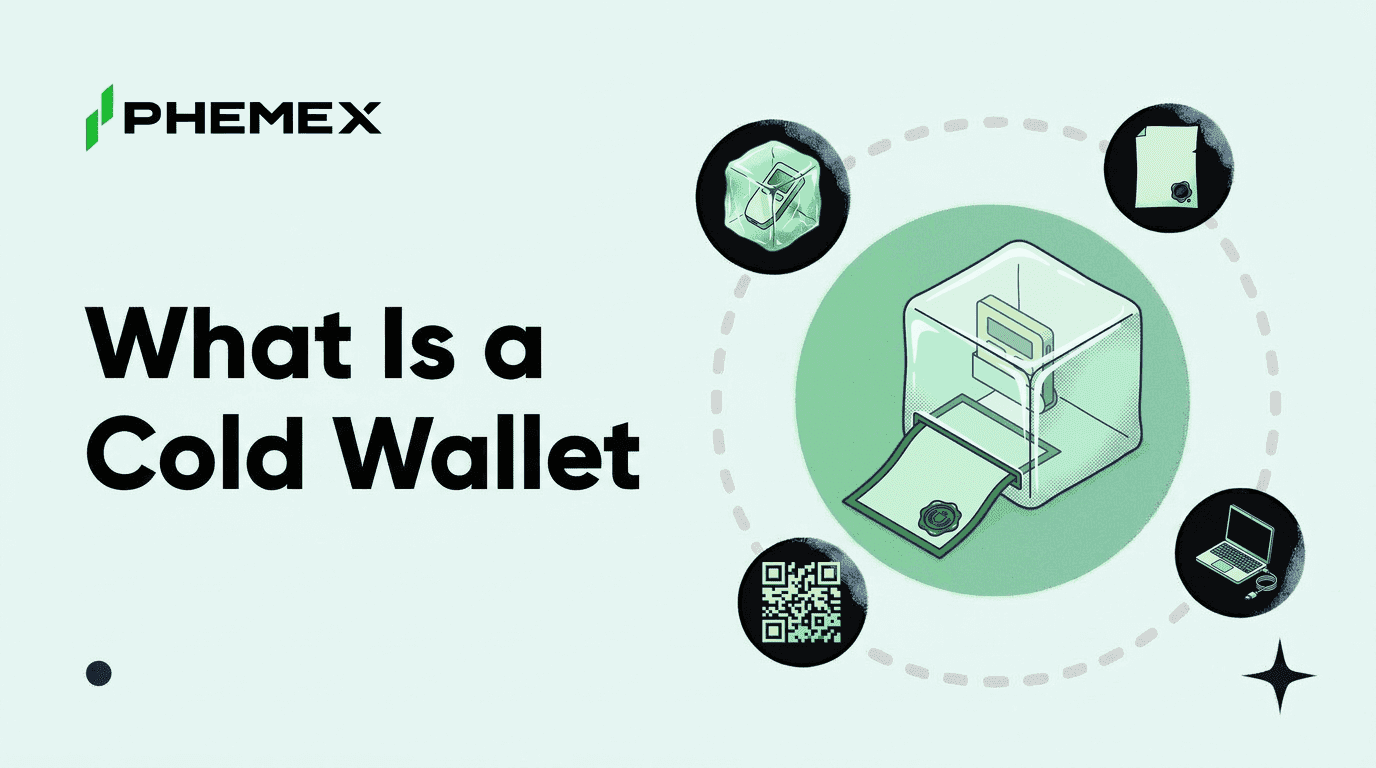
A cold wallet keeps your crypto keys on a device that never goes online, and the 395-byte file it signs in Bitcoin Core's own example holds no private key. The online side sends the unsigned transaction across and the device signs it offline, so only the signed transaction comes back for broadcast.
For a trader, a cold wallet decides who can move the coins. Exchange balances move on the exchange's signature, and coins in cold storage move only when their owner approves on the device. The SEC's investor bulletin names the cost of that control, since a lost or stolen device "may result in a permanent loss of your crypto assets."
|
Cold wallet
|
At a glance
|
|
What it is
|
Keys made and kept on a device that never goes online
|
|
How it signs
|
Goes in unsigned by USB, microSD or QR, comes back signed
|
|
What crosses the gap
|
Transaction, coin and key path, never the private key
|
|
Common forms
|
Hardware wallet, air-gapped computer, paper wallet
|
|
Main risk
|
Losing device and backup, or an address you didn't check
|
|
The standard
|
BIP-174 (July 2017), in Bitcoin Core since October 2018
|
|
On Phemex
|
70%+ of user assets in multi-sig cold wallets, Phemex says
|
What Is a Cold Wallet?
The SEC bulletin calls a cold wallet "typically a physical device that is not connected to the internet," with examples that run from a USB drive to a sheet of paper. The Bitcoin Wiki defines cold storage as spending without the private keys "ever being online".
Any crypto wallet holds a private key that signs and a public key that receives, and hot or cold describes only where the signing key lives.
Cold storage comes in three common forms. A hardware wallet is a small signing device with its own screen and buttons, built for this one job. An air-gapped computer is an ordinary laptop wiped clean and kept off every network for good, the setup the Bitcoin Wiki walks through step by step.
A paper wallet prints a key on a sheet, and the Wiki warns that anyone who can see that sheet can steal from it.
How Does a Cold Wallet Work?
A cold wallet works as one half of a pair. Bitcoin Core's offline-signing tutorial pairs an online watch-only wallet with an offline wallet that holds the keys. The two "share the same public keys" and show the same addresses, and only the offline one can add valid signatures.
That split follows from how Bitcoin's public and private keys relate, since the public side can generate addresses and only the private side can sign. A spend then makes one round trip across the air gap.
-
The online wallet builds the unsigned transaction as a PSBT, the Partially Signed Bitcoin Transaction format set out in BIP-174.
-
The file crosses to the offline device on a USB stick or a microSD card, or as a series of QR codes the device scans with its camera.
-
The device shows the amount and the destination on its own screen, and the owner approves only after reading them there.
-
The private key signs inside the device and never leaves it.
-
The signed transaction travels back the same way, and the online computer sends it to the Bitcoin network.
BIP-174 says the signer "can be offline" because the file carries everything the signature needs. Bitcoin Core added support in version 0.17.0, released in October 2018, and the format has shipped in its wallet ever since.
What Is Inside the File a Cold Wallet Signs?
The unsigned PSBT printed in Bitcoin Core's tutorial is 395 bytes long, and it holds five records.
-
The unsigned transaction, with one input, two outputs and no signature yet.
-
The full 113-byte transaction that created the coin this spend uses.
-
The coin itself, 1,000,000 sats or 0.01 test coins on Bitcoin's signet test network.
-
The public key that has to sign, with its derivation path from the wallet's master key.
-
The change output's path, so the device can confirm the change returns to one of its own addresses.
The file holds no private key and no signature, and none of the 22 field types in BIP-174's own table is a private-key field. The offline wallet checks the file, signs it and finalizes it, and only the signed transaction crosses back to be broadcast.
The 113-byte transaction is there so the device doesn't have to take the online computer's word for what the coin is worth. Its double SHA-256 hash matches the transaction ID the spend points at. The coin minus the two outputs leaves a 14,100-sat fee, the same figure the tutorial's own analysis prints.
Method: a parser written from BIP-174's key-value map decoded the tutorial's base64 PSBT, and BIP-174's own type table gave each record its name and the count of 22.
Can a Cold Wallet Be Hacked?
Nothing on the internet can reach a cold wallet, so attacks go after the online computer it trades files with or the person approving the signature. Bitcoin Core's tutorial says an air gap "drastically reduces the opportunity for those keys to be exfiltrated," a reduction that still leaves two openings.
The online computer is the bigger one. The Bitcoin Wiki warns that malware there could swap the destination for "an address belonging to the attacker". It could even grind out a lookalike that matches a few of its characters. So the Wiki tells you to check the entire address. A glance at a few characters is the check that attack is built to beat.
That check belongs on the device's own screen, because the online screen is the one the malware controls. Foundation's documentation for its Passport signer shows the pattern, with the device scanning the unsigned transaction from animated QR codes and the owner reviewing it before signing.
The same page describes a Verify Address tool that confirms a receive address belongs to the device.
The air gap itself is the smaller opening. The Wiki notes that malware such as Stuxnet crossed air gaps on USB flash drives, and it counts QR codes as a likely smaller attack surface.
The Wiki also says computers kept in the same room can leak data through side channels such as radio or sound, so it suggests keeping them physically apart.
Do Cold Wallets Have a Seed Phrase?
Usually, yes, and the device or offline computer creates it at setup. The Bitcoin Wiki's cold-storage guide has you write down the seed phrase as soon as the offline wallet generates it. Foundation's documentation says every Passport account is "backed up by the same seed words and/or backup file".
That phrase can rebuild every key on the device, so it carries the same power as the device itself. Phemex's guide to seed phrases and backing up a crypto wallet covers how to store one.
What Is the Difference Between a Hot Wallet and a Cold Wallet?
A hot wallet signs on a device connected to the internet, and a cold wallet signs on one that never connects. The SEC bulletin counts desktop and mobile apps as hot wallets and says they're convenient for transactions but "expose your crypto assets to cyberthreats."
|
|
Hot wallet
|
Cold wallet
|
|
Where the key lives
|
A phone, computer or browser
|
An offline device or computer
|
|
How it signs
|
At once, on the connected device
|
After a file crosses the air gap
|
|
Main threat
|
Malware and phishing
|
Loss, or an address nobody checked
|
The hot wallet vs cold wallet choice comes down to how often the coins move. Money you trade or spend every week needs a key that can sign in seconds. Money you plan to hold for months is safer behind an air gap, and the SEC bulletin rates cold wallets as generally more secure from cyberthreats than hot ones.
What Are the Risks of a Cold Wallet?
-
Losing the device and the backup together. A lost device is replaceable, because the seed phrase rebuilds the keys on a new one. A backup kept in the same drawer as the device means a single house fire or break-in can take both.
-
Trusting a single paper key. The Bitcoin Wiki warns that many private key formats fail on a single miscopied letter, and a raw paper key stores only one key pair. It also flags the printer as a risk, since some have network connections and their own disk memory.
-
Slow access in a fast market. Every spend needs the device, the file round trip and your approval. Coins held cold can't top up a margin account in seconds, so a sudden move needs funds already on the exchange.
What Does a Cold Wallet Mean for Your Trading?
An exchange faces the same trade-off at scale. Phemex says over 70% of user assets are in cold wallets under multi-signature custody, where several authorised staff must approve any transfer. By the same account, about 20% is in warm wallets and under 8% in hot ones. Its page on how Phemex protects your crypto assets lays out the three tiers.
The same split works for your own coins, with long-term holdings kept cold and only the margin you plan to use moved to the account. When you do move coins in, the deposit address deserves the same on-device check as any other spend.
Futures trade on leverage, and a leveraged position is closed automatically if losses reach its margin.
Frequently Asked Questions
Can a cold wallet store USDT?
Yes, if it supports the blockchain that carries your USDT, since the device signs for that chain's address like any other. PSBT itself is Bitcoin-only, and the Ethereum proposal ERC-4527 describes the same QR round trip, though its own page marks it Stagnant.
Can a cold wallet be traced?
Yes, because its addresses and transactions sit on a public blockchain like any other wallet's. The online half also has to look those addresses up somewhere, and the Bitcoin Wiki recommends backing it with your own full node for privacy.
How are cryptocurrency hot wallets different from cold wallets?
A hot wallet keeps its keys on a phone, computer or browser and signs in a tap. A cold wallet keeps them on an offline device and signs a file carried across by USB, microSD card or QR code.
What is a Bitcoin cold wallet?
It's an offline signer for bitcoin, usually a hardware wallet or an air-gapped computer running wallet software. Bitcoin's standard file format for the signing round trip is PSBT, which Bitcoin Core's reference wallet has handled since 2018.
Bottom Line
Everything a cold wallet does rests on a one-way rule, that files may come in and signatures may go out but the key never moves. That turns safety into two habits a trader can keep, reading every address on the device itself and storing the backup somewhere apart from it.
Disclaimer: This article is for informational purposes only and is not financial advice. Cryptocurrency trading involves substantial risk. Always do your own research before making investment decisions.
