






Key Takeaways
An AI agent registry is a system for registering, identifying, and discovering software agents so users, apps, and other agents can find and interact with them. Fetch.ai’s docs describe Agentverse as a platform for agent registration for search and discovery, while its developer docs also reference an open ledger of agents and transactions through Almanac.
In practice, an agent registry usually stores metadata such as an agent’s name, endpoint, capabilities, identity, protocols, and availability, rather than acting as the agent itself. This is an inference from how registration and discovery platforms are described in current agent ecosystems.
Agent registries matter because the agent economy needs a way for software to answer a basic question: which agent can do this task, and can I trust it? Fetch.ai explicitly ties registration to discoverability, while NEAR’s Shade Agents tie registration to validity and attestation.
Some registries focus mainly on discovery and marketplace visibility, while others also include verification, attestation, permissions, or onchain identity. Agentverse and NEAR Shade Agents illustrate these two ends of the design spectrum.
As AI agents become more capable, the next problem is no longer just how to build them. It is how to find, identify, verify, and connect them. That may sound simple, but it is a foundational infrastructure issue. If thousands or millions of software agents exist across different platforms, users and machines need some way to answer basic questions. Which agent handles weather data? Which one can analyze onchain activity? Which one is still online? Which one is verified? Which one speaks the right protocol? Which one should another agent trust enough to send a request to?
That is the problem an AI agent registry tries to solve. In the same way that a domain name system helps users find websites, or an app store helps users find software, an agent registry helps people and machines locate the right agents for the right tasks. Fetch.ai’s documentation makes this especially explicit: it describes Agentverse as a development platform for agent registration for search and discovery, and also points to an open ledger of agents and transactions as part of its network stack.
What an AI Agent Registry Actually Is
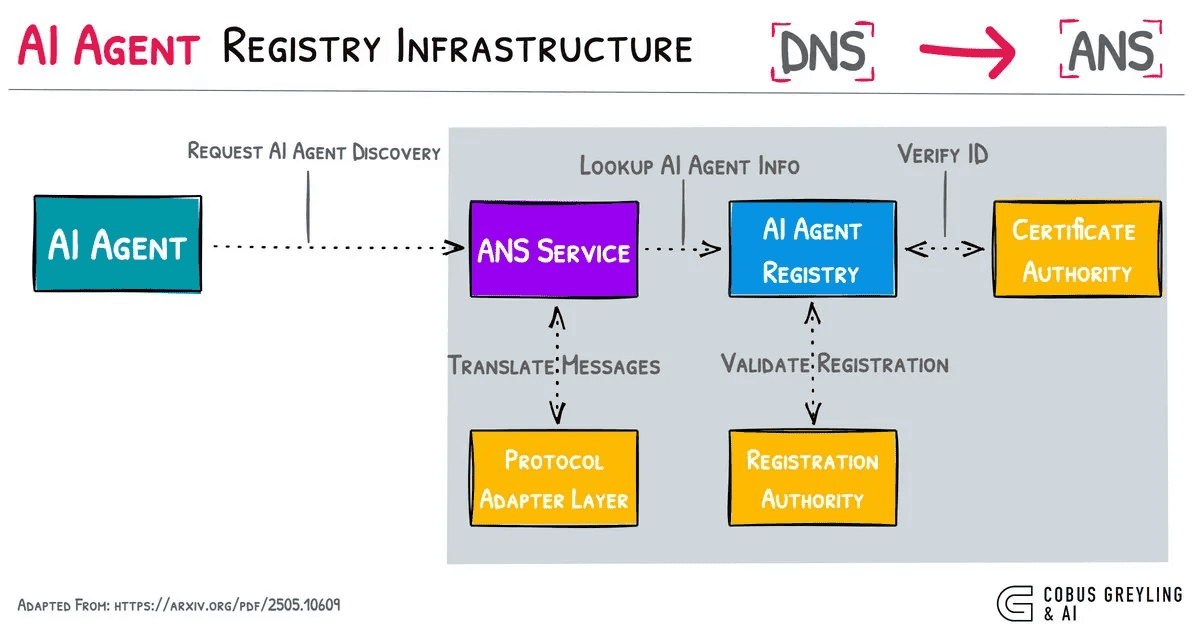
An AI agent registry is a system that records information about agents so those agents can be discovered, referenced, and sometimes verified by others.
The key point is that the registry is usually not the agent itself. It is the information layer around the agent. A registry may contain things like:
the agent’s name or identifier
its endpoint or address
supported protocols
capabilities or task categories
identity or wallet information
uptime or validity status
attestation or verification details
links to code, marketplace listings, or payment methods
Fetch.ai’s docs give a practical example of this model. They describe Agentverse as a platform for hosting and registration, and they also mention Almanac as a public contract of all agents. That language strongly suggests a registry function: a place where agents are recorded so others can know they exist and how to reach them. So an agent registry can range from a simple directory to a much stricter trust framework.
Why AI Agents Need Registries
A registry matters because an agent economy without discovery quickly becomes chaotic. Imagine a future with millions of agents across finance, research, customer service, gaming, logistics, and blockchain infrastructure. Without a registry, every user or application would need prior knowledge of each agent’s address, protocol, and capabilities. That does not scale.
Registries solve several practical problems at once. The first is discoverability. Users and other agents need to find relevant agents without already knowing who built them or where they run. Fetch.ai’s Agentverse is built directly around this logic, describing itself as an AI agent marketplace and an open directory where agents can be found and promoted across interfaces.
The second is identity. A registry gives an agent a recognizable presence in a broader ecosystem. This matters when agents need persistent addresses, metadata, or wallet-linked identities. Fetch.ai’s docs note that wallets and contracts are part of the broader agent interaction framework, while Coinbase’s x402 docs more broadly show how wallet-based identity is becoming important in machine-native systems.
The third is trust. Some registries only show that an agent exists. Others help show whether an agent is valid, verified, or running approved code. NEAR’s Shade Agent docs show this more security-focused model clearly: a registered agent can be “valid” only if its attestation and measurements meet the contract’s standards and its registration has not expired.
The fourth is interoperability. If agents are going to work together, they need shared ways to identify capabilities and supported protocols. ASI:One’s Agent Chat Protocol is an example of how ecosystems are already thinking about structured inter-agent communication, which makes registries more valuable because a registry can also signal which communication standards an agent supports.
What Information an Agent Registry Usually Contains
Not all registries are designed the same way, but most will include some combination of identity, capability, and trust metadata. The most basic field is a unique identifier. This may be a contract address, wallet address, account ID, or registry-specific agent ID.
The next layer is endpoint data: where the agent lives and how it can be reached. That might mean an API endpoint, a contract address, an MCP-compatible interface, or a marketplace listing.
Then comes capability data. This is where a registry becomes more useful than a mere contact list. If an agent can summarize text, fetch weather, run blockchain queries, execute trades, or analyze risk, the registry needs some way to express that. Fetch.ai’s ecosystem already points in this direction through search, ranking, and visibility tooling in Agentverse.
A stronger registry may also include trust metadata, such as:
whether the agent is verified
whether it has submitted a valid attestation
whether it is still active
who published or controls it
whether it has a usage or reputation history
In short, a registry turns an agent from an isolated piece of software into a locatable participant in a broader network.
Discovery Registries vs. Verification Registries
One helpful way to understand the space is to split registries into two broad models. The first is the discovery registry. Its main job is to help people or machines find useful agents. Agentverse fits this model well. Fetch.ai describes it as a platform for registration, search, discovery, visibility, and marketplace reach. In this version, the registry behaves almost like an app directory or search engine for agents.
The second is the verification registry. Its main job is to ensure that only valid, approved, or attested agents can interact with certain systems. NEAR’s Shade Agent contract is a good example. In that framework, registration is tied to attestation and policy checks, and only valid registered agents can call certain gated methods.
Some ecosystems will combine both functions. That is likely where the category is heading. A mature agent registry will not just tell you that an agent exists. This combined model becomes even more important as agents begin to transact, not just respond.
How Agent Registries Work in Practice
In practice, an agent registry usually follows a simple lifecycle. First, the developer or operator registers the agent. This can happen through a developer console, marketplace dashboard, SDK, or smart contract method. Fetch.ai and NEAR both show versions of this process in their public docs.
Second, the registry stores the agent’s metadata. Depending on the design, this may live in a database, an onchain contract, or a hybrid system.
Third, the agent becomes discoverable or callable by others. In a marketplace-oriented system like Agentverse, that may mean searchable visibility and traffic. In a trust-oriented system like Shade Agents, it may mean eligibility to participate in protected workflows.
Fourth, the registry may update dynamically. An agent’s status may change if it goes offline, loses verification, expires, or gets upgraded. This is one reason public ledgers and contract-based records are attractive in Web3-oriented agent systems: they can make status easier to inspect programmatically.
The exact implementation varies, but the core idea remains the same: a registry gives the ecosystem a common reference point for agent existence and properties.
Why Agent Registries Matter for Crypto
Agent registries are especially relevant in crypto because crypto systems already assume that identity, value transfer, and programmatic interaction can happen through open protocols.
If agents are going to manage wallets, sign transactions, call smart contracts, consume paid APIs, or interact with other onchain services, then registries become part of the market infrastructure. An agent is much more useful in Web3 if it can be:
found by wallets and apps
verified by smart contracts
paid by machine-native payment protocols
matched with compatible agents
tracked across chains or environments
This is also why registries connect naturally to agent marketplaces, agent payment protocols, and agent communication standards. Once agents become economically active, a registry stops being just a list. It becomes part of how digital commerce is organized.
AI Agent Registry vs. Agent Marketplace
These terms are related, but they are not the same. An agent registry is the identity and discovery layer. It tells the ecosystem which agents exist and how to locate them. An agent marketplace is the commercial or user-facing layer. It helps users browse, compare, rank, and sometimes buy or use agent services.
In mature ecosystems, these layers will probably stay closely linked. But conceptually, the registry is the more fundamental layer. You can have a registry without a full marketplace. You cannot really have a scalable marketplace without some registry-like function underneath it.
The Main Risks and Weaknesses
Agent registries are useful, but they are not trivial to get right. The first risk is spam and low-quality agents. If registration is too easy, a registry can become cluttered and unreliable. Discovery systems then become noisy instead of useful.
The second risk is fake trust signals. A registry may tell you that an agent exists, but not whether it is competent, safe, or honest. Verification layers help, but quality and reputation remain hard problems.
The third risk is fragmentation. If every ecosystem builds its own isolated registry, agent interoperability becomes weaker. A future with many registries may still require common schemas or bridging standards.
The fourth risk is centralization pressure. Even decentralized ecosystems can end up relying on a small number of dominant discovery hubs. That could recreate app-store style power concentration, just in an agent context.
The fifth risk is stale metadata. An agent might still be listed long after it stops working, changes behavior, or becomes unsafe. Registries need mechanisms for freshness, not just registration. So while registries solve real problems, they also introduce governance and quality-control challenges.
The Bigger Picture: Registries as Infrastructure for the Agent Economy
The biggest reason to care about agent registries is that they are one of the simplest signs that the market is moving from “AI tools” to an actual agent economy.
In a true agent economy, agents need to be discoverable, identifiable, interoperable, payable and, in some cases, provably valid. A registry touches all of those requirements. It is one of the first pieces of infrastructure needed once agents start interacting not only with users, but with each other.
That is why current ecosystems are already investing in these layers. Fetch.ai is building around discoverability and open ledgers. NEAR is building around attested registration. Protocols like Agent Chat Protocol are standardizing communication between agents. Together, these are early signs of a broader stack forming around software agents as economic actors.
Conclusion
An AI agent registry is a system for registering, identifying, and discovering software agents. At the simplest level, it acts like a directory. At a deeper level, it can also serve as a trust, identity, and verification layer for the agent economy.
That matters because as agents become more autonomous, the market needs ways to answer very basic but very important questions: who is this agent, what can it do, where does it live, and should I trust it? Current ecosystems already show two major models taking shape: discovery-first registries like Fetch.ai’s Agentverse and trust-first registries like NEAR’s attested Shade Agent contract.
The concept is still early, but the direction is clear. If AI agents are going to become real participants in digital markets, registries will likely become one of the core pieces of infrastructure that make the whole system usable.
