









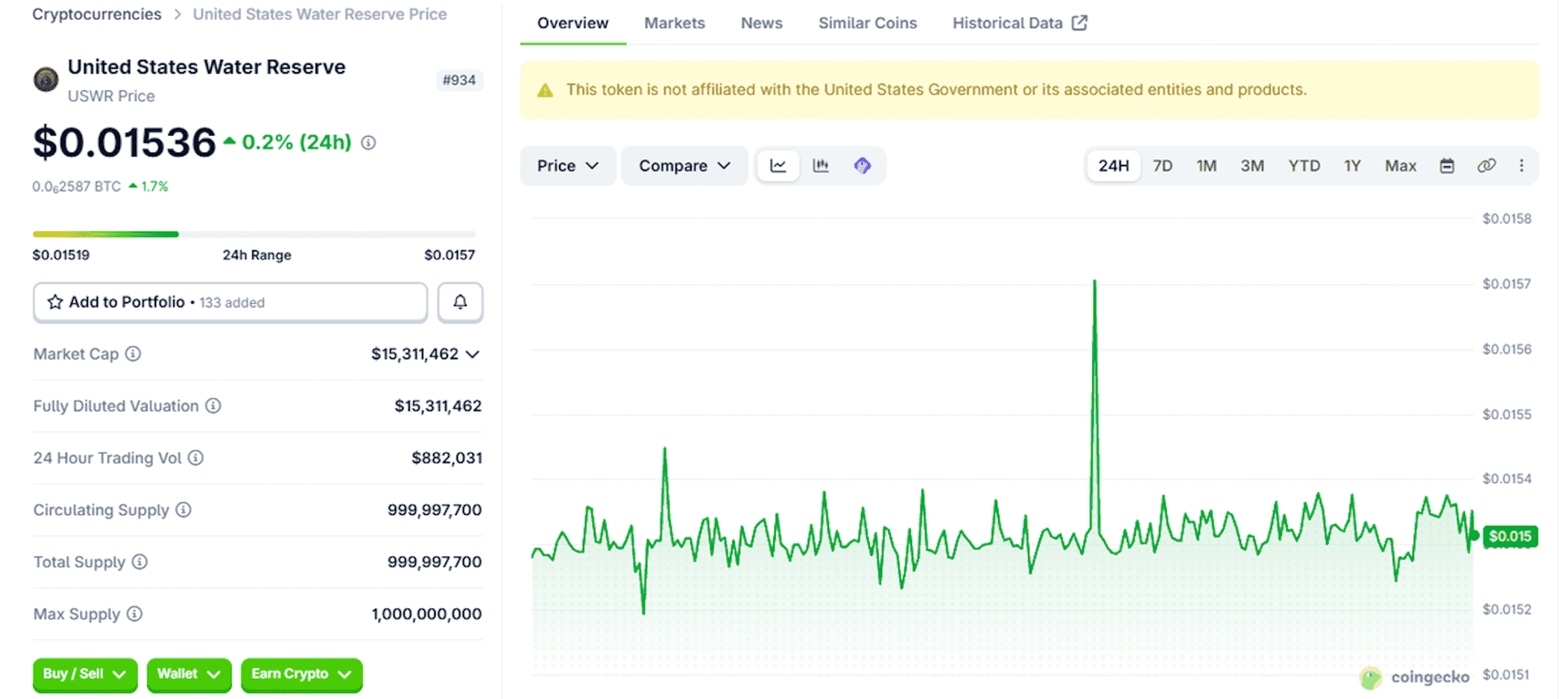
United States Water Reserve trades around $0.015 with a market cap near $15.9 million, and it has pulled attention this week for one reason. It is a Solana token built on the sharpest macro story of 2026, the idea that AI data centers are draining power and water fast enough to turn clean water into a strategic resource. The name sounds official, but it represents no government reserve and no real water at all.
USWR is a speculative memecoin. It gives you exposure to a narrative, not to water rights, reservoirs, utilities, or any commodity that prices off real supply. Here is what the token is, why traders are bidding it, the tokenomics behind the launch, and the risks you need to size before touching it.
What United States Water Reserve Actually Is
USWR is a Solana SPL token, the same fair-launch format that has powered most of the memecoins minted on the network this cycle. Think of it as a wrapper around a theme. You are not buying a slice of water infrastructure when you buy USWR, you are buying a token whose price moves on how much the market wants to bet on the AI-water story at any given hour.
The name leans hard on the impression of something official, and that is the part to read carefully. United States Water Reserve is not affiliated with any US government agency, holds no water rights, owns no reservoirs, and represents no claim on a real commodity. The project's own materials carry that disclaimer. For a memecoin built on a launchpad, this is standard, but the patriotic packaging makes it easy to forget. The value is the story and the liquidity behind it, nothing underneath.
That framing matters before anything else. Every line in this article assumes you understand USWR as a narrative trade, the same way other meme assets on the Solana network trade on attention rather than cash flows.
The AI-Water Narrative and Why USWR Is Trending Now
The story doing the work here is real, even if the token is not tied to it. Training and running large AI models burns enormous amounts of electricity, and the data centers behind them lean on water for cooling. As compute buildouts accelerated through 2025 and into 2026, water consumption at hyperscale facilities moved from a footnote to a headline, and clean water started getting talked about as a strategic input the way energy already is.
That is a clean, marketable hook. It connects a token to one of the few macro themes a retail trader can explain in a sentence, and narrative tokens live or die on exactly that. The clearer the one-line story, the easier the bid. USWR slotted straight into a pattern the market has already rewarded this year with assets like the GDOR oil-reserve token, where a strategic-resource theme drove the attention rather than any underlying asset.
Why now is mostly timing and rotation. Solana memecoin flow has been hunting for the next first-mover narrative, AI-water checked the box, and a low float plus a fresh story is the exact recipe that produces a fast move on this network. None of that is fundamental. It is positioning, and positioning can reverse as quickly as it built.
USWR Tokenomics and the Data Behind the Launch
The token structure follows the now-standard fair-launch template, and the launch mechanics are the part worth checking because they tell you what the team can and cannot do to you. Supply is capped, mint authority is gone, and there is no insider bag waiting to dump. Here is the snapshot.
|
Metric
|
Value
|
|
Price
|
~$0.015
|
|
Market cap
|
~$15.9 million
|
|
Total supply
|
1 billion tokens, fixed
|
|
Mint authority
|
Revoked
|
|
Initial liquidity
|
LP burned at launch
|
|
Team allocation
|
None
|
|
Buy / sell tax
|
0%
|
|
Chain / standard
|
Solana SPL token
|
Read that table as a risk filter, not a green light. Mint authority revoked means no one can print fresh supply to dilute you. Initial LP burned means the starting liquidity cannot be pulled in a classic rug. No team allocation and 0% taxremove two of the most common ways insiders bleed holders. Those are genuine positives, and they are why this launch looks cleaner than the average Solana mint.
But clean mechanics are not the same as a sound investment. A fixed supply and a burned pool protect you from specific contract-level exploits. They do nothing to protect you from the narrative fading, the liquidity thinning, or a few large early wallets deciding to sell into your bid. You can verify the supply, mint status, and holder distribution yourself on the USWR Solana token page and cross-check on-chain on a Solana explorer before you commit a dollar.
Source: Coingecko
The Risk Assessment Before You Trade USWR
Start with the core honest read. USWR has no intrinsic backing. The market cap near $15.9 million is a measure of attention, not of any asset on a balance sheet, and attention is the single most volatile input in crypto. When the AI-water story cools or the next narrative steals the flow, there is nothing underneath to put a floor in.
Liquidity is the practical risk most traders underweight. A token this size moves on thin order books, which means slippage on the way in and worse slippage on the way out. The same low float that produces the fast green candles produces the fast red ones, and exiting a winning position can cost you a chunk of the gain if you are not sizing for it. This is where retail consistently loses money on narrative tokens. They get the thesis right and the position sizing wrong.
Then there is the name itself. United States Water Reserve sounds like a sanctioned entity, and that perceived legitimacy is doing marketing work the fundamentals cannot. Treat the official-sounding branding as a reason for more caution, not less. The honest answer on long-term value is that nobody knows, and anyone quoting you a target is guessing. Size it as the speculative narrative bet it is, with money you can lose without it changing your week.
Frequently Asked Questions
Is United States Water Reserve a good investment?
USWR is a speculative memecoin with no intrinsic backing, so it is a narrative bet rather than an investment in the traditional sense. The clean launch mechanics reduce some contract-level risks, but the price depends entirely on attention to the AI-water story, which can reverse fast. Treat any position as money you are prepared to lose.
Does USWR own real water rights or reservoirs?
No, the token represents no claim on water rights, reservoirs, infrastructure, or any physical commodity, and it is not affiliated with any US government agency. The name borrows the credibility of a strategic-resource theme, but the asset itself is a Solana SPL token that trades on narrative.
Why is the USWR token trending in 2026?
It rode the AI-water narrative, the idea that AI data centers consume so much power and water that clean water becomes a strategic resource. That story is easy to explain and easy to bid, which is exactly what Solana memecoin flow rewards. The low float and fresh first-mover angle did the rest.
Is USWR a scam?
The launch mechanics are unusually clean for a Solana mint, with mint authority revoked, the initial LP burned, no team allocation, and zero tax, which removes the most common rug vectors. That does not make it safe. The bigger risks are the narrative fading and the thin liquidity, not a contract exploit.
Bottom Line
USWR is a narrative trade, full stop. The fair-launch mechanics are genuinely clean, with a fixed 1 billion supply, revoked mint authority, and a burned LP, which is why it screens better than the average Solana memecoin. What it does not have is anything underneath the $15.9 million market cap beyond the strength of the AI-water story and the liquidity backing it that day. Watch two things if you trade it. The first is the AI-water narrative itself, meaning does it keep pulling flow or rotate out to the next theme. The second is on-chain liquidity, meaning is it deep enough to let you exit at size without giving back the move. If both fade at once, a token with no intrinsic backing has nothing to catch it. Trade the narrative if you want the exposure, but size it like the bet it is.
This article is for informational purposes only and does not constitute financial or investment advice. Cryptocurrency trading involves substantial risk. Always conduct your own research before making trading decisions.
