







Most traders blow up their accounts not because they pick the wrong coins but because they let small losers turn into account-ending losers. With Bitcoin trading near $60,141 and the market sitting in Extreme Fear as of June 28, 2026, the cost of sloppy risk control is brutal. A single oversized loss in a market like this can wipe out a week of gains. The risk-reward ratio is the one number that protects you from that, and most people who lose money never use it.
The risk-reward ratio is simple to calculate and ruthless in what it reveals. It tells you, before you enter, whether a trade is even worth taking. Here is what the ratio is, how to calculate it from your entry, stop, and target, why a good ratio lets you stay profitable even when you are wrong more than half the time, and the mistakes that quietly destroy otherwise solid setups.
What the Risk-Reward Ratio Is and How to Calculate It
The risk-reward ratio measures how much you stand to gain on a trade against how much you stand to lose. You calculate it by dividing your potential reward by your potential risk. If a trade can make you $300 and you would lose $100 if it goes wrong, the ratio is 3 to 1, usually written as 1:3. The first number is your risk, the second is your reward.
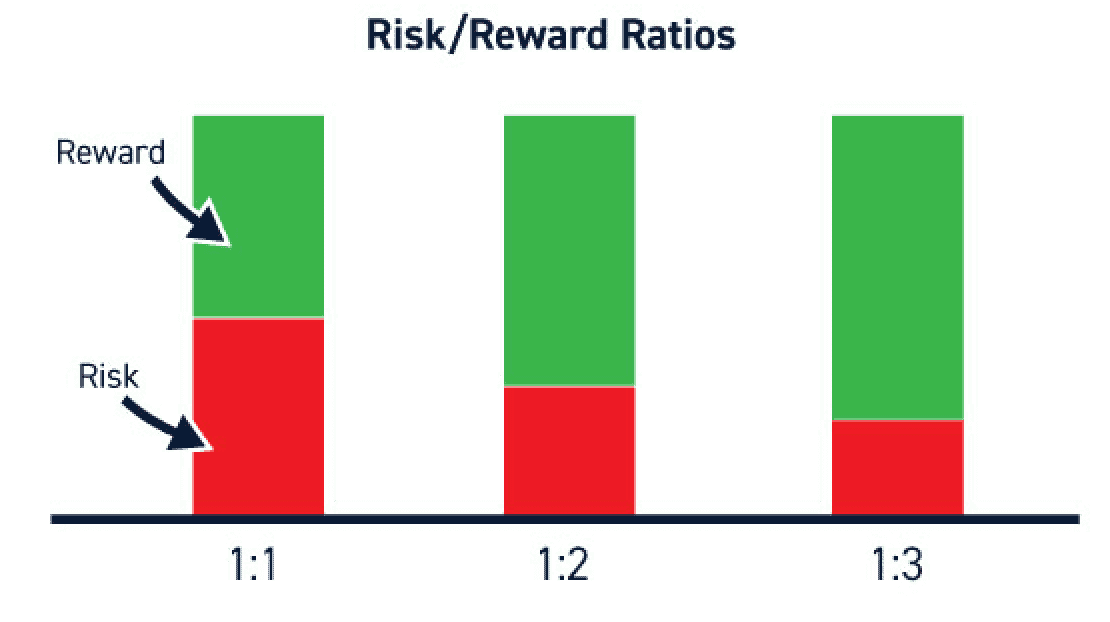
Source: Centerpoint
The three inputs are your entry, your stop-loss, and your target. Risk is the distance from entry to stop. Reward is the distance from entry to target. The ratio is just the second distance divided by the first.
Say you buy Bitcoin at $60,000 with a stop at $58,000 and a target at $66,000. Your risk is $2,000 per coin and your reward is $6,000 per coin. That is a 1:3 ratio. For a clear breakdown of how this term is defined across markets, Investopedia's risk-reward ratio page walks through the same arithmetic with stock examples.
What matters is that you calculate this before you click buy, not after. The ratio is a filter. If a setup only offers 1:1 or worse, you have to ask whether the trade earns its place in your account at all. Knowing how candlestick patterns and reversal candles form helps you spot entries where a tight stop and a wide target line up naturally, which is where the best ratios live.
Why a Good Ratio Lets You Win With a Low Win Rate
Here is the part that changes how people trade once it clicks. Your win rate is not the thing that makes you profitable. The relationship between your win rate and your risk-reward ratio is what determines whether you make money over time. This combined measure is called expectancy, the average amount you can expect to make or lose per trade across many trades.
A trader who wins only 40% of the time can still be solidly profitable if the winners are big enough relative to the losers. The math is unforgiving in both directions. The table below shows what a fixed 1:3 ratio does across 10 trades risking $100 each.
|
Win rate
|
Wins (x $300)
|
Losses (x $100)
|
Net over 10 trades
|
|
30%
|
3 wins = $900
|
7 losses = $700
|
+$200
|
|
40%
|
4 wins = $1,200
|
6 losses = $600
|
+$600
|
|
50%
|
5 wins = $1,500
|
5 losses = $500
|
+$1,000
|
|
60%
|
6 wins = $1,800
|
4 losses = $400
|
+$1,400
|
Notice that even at a 30% win rate, the 1:3 trader still ends up ahead. Compare that to a trader using a 1:1 ratio, who needs to win more than 50% of the time just to break even after fees. This is why professionals obsess over the ratio and treat win rate as secondary. A favorable ratio gives you room to be wrong often and still grow your account. The deeper formula for expectancy and position sizing ties these two numbers together into a single per-trade edge.
The takeaway is direct. Stop chasing a high win rate. Build a process where your winners are two or three times the size of your losers, and the win rate can take care of itself.
Setting Stops and Targets at Structure, Not Round Numbers
A ratio is only useful if the stop and target are placed where the market actually respects them. The most common mistake is setting a stop at an arbitrary dollar amount because it feels comfortable, then watching price tag it and reverse. Stops belong at structure, meaning levels the chart has already shown it cares about.
Place your stop just beyond a recent swing low for a long position, or beyond a swing high for a short. That is the level that, if broken, tells you the setup is wrong. If price trades through a clear support that held three times, your reason for being in the trade is gone, and the stop should already be sitting on the other side of it. Patterns like the double top and double bottom give you natural invalidation points that double as logical stop placement.
Targets follow the same logic. Set them at the next meaningful resistance, prior swing high, or a level where price has reacted before. Do not pick a target just because it produces a pretty ratio. If the only way to reach a 1:3 is to set a target at a level price has never approached, the trade is fiction. The honest move is to take the setup the chart offers, calculate the real ratio, and skip the trade if the number is poor.
This is where a lot of traders quietly cheat themselves. They widen the stop to avoid getting tagged, or they stretch the target to make the ratio look better on paper. Both break the entire purpose of the exercise. The ratio is only meaningful when both ends are anchored to real levels.
Position Sizing and Risking a Fixed Small Percentage
The ratio tells you whether a trade is worth taking. Position sizing tells you how much to bet. These are separate decisions, and confusing them is how accounts die. The rule that keeps professionals in the game is risking a small, fixed percentage of the account on every single trade, usually between 1% and 2%.
Say your account is $10,000 and you risk 1%, which is $100 per trade. Your stop distance then determines your position size, not the other way around. If your stop is 2% away from entry, you size the position so that a 2% move against you equals exactly $100. A tighter stop lets you take a larger position for the same dollar risk. A wider stop means a smaller position. The dollar amount at risk stays fixed.
This single habit does two things. It caps how much any one trade can hurt you, so a string of losers cannot end your account. And it removes emotion from sizing, because the math decides the position, not how confident you feel. A trader risking 1% per trade can lose 10 in a row and still hold 90% of the account, while a trader who bets big on conviction can lose everything in three trades. Fixed-percent sizing controls the downside on every trade, and a strong ratio makes sure your winners more than pay for the inevitable losers.
Common Mistakes That Destroy a Good Ratio
The math only works if you respect it after the trade is live. The most destructive habit is moving your stop further away when price approaches it. The moment you do that, you have abandoned the risk you agreed to and turned a planned $100 loss into something open-ended. If your stop is hit, the trade was wrong. Take the loss and move on.
The second killer is chasing entries. You see price already running and jump in late, which pushes your entry closer to the target and further from a logical stop. That destroys the ratio you would have had if you waited for a proper pullback. A worse entry on the same idea can flip a 1:3 trade into a 1:1 trade.
A few more that quietly erode results:
- Taking profit too early. Cutting winners at 1:1 out of fear while letting losers run to full stop inverts your edge and guarantees a losing system over time.
- Ignoring fees and slippage. On leveraged perpetual positions, trading fees and funding costs eat into the reward side. A real 1:2 can become 1:1.7 after costs, so build a buffer in.
- Over-leveraging into the ratio. Leverage does not change your risk-reward ratio, but it amplifies the dollar consequences of getting your sizing wrong. The percentage rule still governs.
Discipline is the entire game here. The ratio is easy to calculate and easy to abandon the instant a trade goes against you. Traders who survive volatile markets are the ones who treat their original stop and target as fixed commitments, not suggestions. If you want to sanity-check an asset's broader setup before sizing in, a few Bitcoin valuation tools can frame whether the market backdrop supports the trade at all.
Frequently Asked Questions
What is a good risk-reward ratio?
A ratio of 1:2 or better is the common floor for most traders, meaning your target is at least twice your risk. Many professionals will not take a setup under 1:2, and some hold out for 1:3. The right number depends on your win rate, but anything below 1:1 is rarely worth taking because it forces an unrealistically high win rate just to break even.
How do you calculate risk-reward?
Divide your potential reward by your potential risk. Risk is the distance from your entry to your stop-loss, and reward is the distance from your entry to your target. If you risk $100 to make $250, your ratio is 1:2.5. Always calculate it before entering, using stop and target levels placed at real chart structure.
Can you be profitable with a low win rate?
Yes, and this is the most important lesson in risk management. A trader winning only 40% of trades is profitable with a 1:3 ratio, because the winners are large enough to cover the more frequent losers and still net a gain. Win rate alone tells you nothing. The ratio between average win size and average loss size is what decides whether a system makes money.
Does leverage change the risk-reward ratio?
No. Leverage changes the dollar size of both your potential gain and loss equally, so the ratio itself stays the same. What leverage changes is how much a sizing mistake costs you, which is why fixed-percentage position sizing matters even more when trading with leverage.
Bottom Line
The risk-reward ratio is the single discipline that separates traders who last from traders who blow up. Calculate it on every position before you enter by dividing the distance to your target by the distance to your stop, and treat anything under 1:2 with suspicion. Anchor both your stop and your target to real chart structure rather than round numbers, never widen a stop once the trade is live, and risk a fixed 1% to 2% of your account on each trade so no single loss can take you out. Do those things and a sub-50% win rate is still a profitable system. Skip them and even a high win rate eventually gives it all back. In a market sitting in Extreme Fear, the traders who survive are the ones who decided their exits before they ever clicked buy.
This article is for educational purposes only and does not constitute financial or investment advice. Cryptocurrency trading involves substantial risk. Always conduct your own research before making trading decisions.
