









To check AI crypto analysis, look at when its data was read and where each claim comes from, then ask what it left out and when to wait. US regulators tell investors to confirm the underlying sources behind AI-generated information. An answer that was right in the morning can describe a market that's gone by the afternoon.
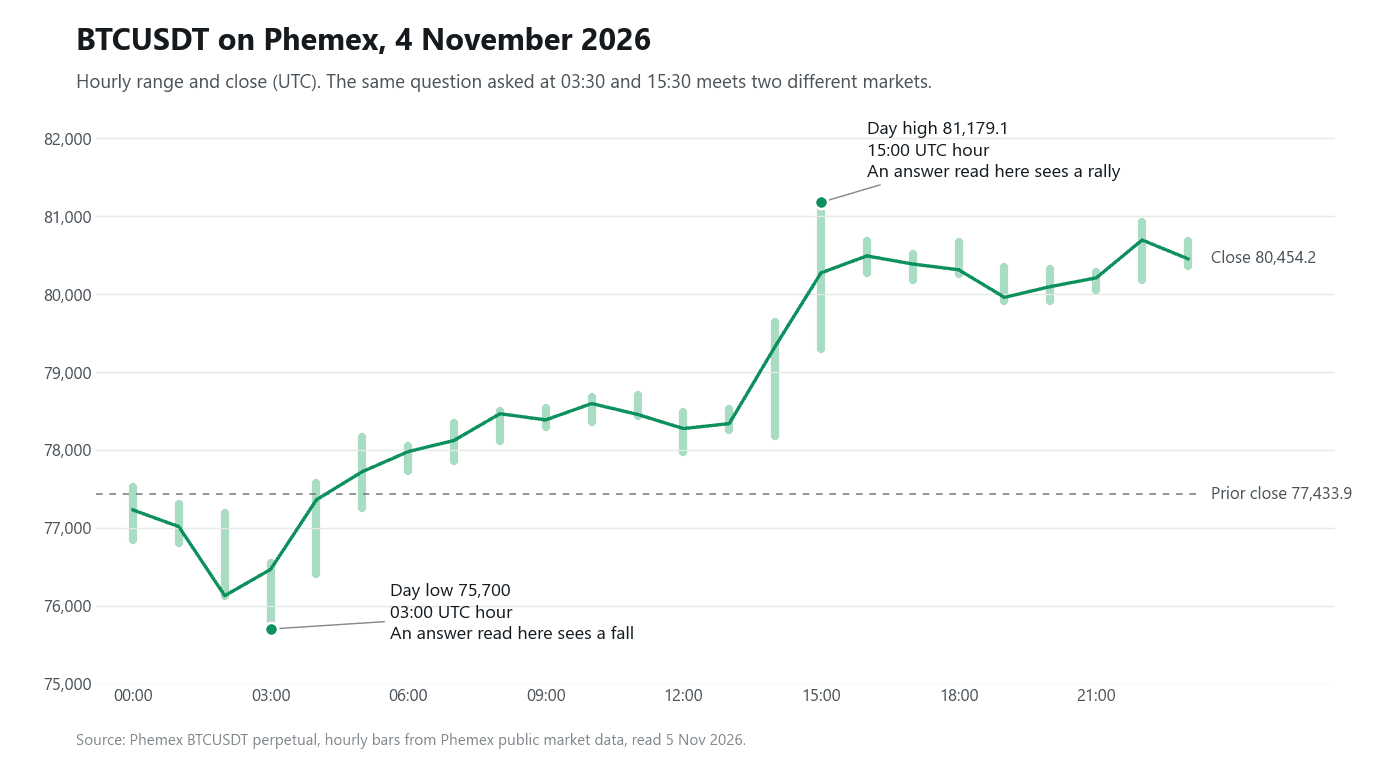
Phemex's own BTCUSDT prices show why the clock comes first. On 4 November 2026 the perpetual fell to 75,700 in the early hours, then climbed to 81,179.1 by mid-afternoon, both in UTC. The same question asked at the low and again at the high would have drawn two opposite answers, and both would have been accurate when they were written.
How Can One BTC Question Get Two Opposite Answers?
Picture asking an AI assistant "Why is Bitcoin moving?" twice on 4 November, once in the early hours and once in the afternoon. Each answer would have been looking at a very different market.
|
Point in the day (UTC), 4 Nov 2026
|
BTCUSDT on Phemex
|
What an answer read then would see
|
|
The open
|
77,450.2
|
A flat start after the 77,433.9 close of 3 November
|
|
The early-hours low
|
75,700
|
A fall of about 2.2% from that close
|
|
The mid-afternoon high
|
81,179.1
|
A rise of about 4.8% from that close
|
|
The close
|
80,454.2
|
A gain of about 3.9% on the day
|
The early answer would talk about selling pressure, while the afternoon answer would talk about a breakout. Each one is right about the market it saw, and wrong about the market you're trading if you read it hours later.
Just over half of the climb from the low came in two hours, as BTC rose about 3.6% from 78,338.2 to the day's high. This one held into the close, but a move that fast can also fade, the pattern Phemex Academy's guide to bull traps and bear traps describes. All of these figures come from Phemex's hourly BTCUSDT bars, read from its public market data.
How Old Is the Data in an AI Crypto Analysis?
Look for a time stamp on every price and headline in the answer. If there isn't one, ask "What time is this price from?" and refresh the answer when it's stale.
Know how the numbers are cut, too. Phemex's daily bars close at midnight UTC, so a "latest daily close" quoted in the afternoon belongs to the day before. An hourly figure can be 59 minutes old by the time you read it.
The joint investor alert from the SEC, FINRA and NASAA warns that AI output can rest on "false or outdated information". Old data isn't a rare glitch. It's what every answer turns into once the market moves on.
Where Does AI Market Analysis Get Its Claims?
An answer should name what it's built on, such as an exchange's price data, an official announcement or a news report. If it names nothing, treat it as an opinion.
Open at least one source and check it says what the answer says. The same alert advises investors to "confirm the authenticity of underlying sources and review multiple sources of information" before making investment decisions.
Sources can be bent, too. The alert notes that AI-generated information could draw on "false or misleading information that was disseminated to try to manipulate" a price. A claim that appears in only one place, with no official confirmation, is the one to doubt.
What Did the Answer Leave Out?
Every answer is a selection. Price and headlines are the easy part to include. Funding rates, open interest and the last few minutes of news are easy to miss, and they often explain a move better than a chart does.
A good answer says what it couldn't get. "No funding data was available" is more useful than a smooth paragraph that hides the gap. If the answer doesn't mention a gap, ask what data it couldn't reach.
Mood is one more input an answer may skip. The Bitcoin Fear and Greed Index gives a quick read on it, as long as you check when it was last updated.
When Should You Wait Instead of Trading?
Waiting is a real answer, and a careful assistant will sometimes give it. Hold off when any of these is true.
-
The data is stale. Refresh first, then read the new answer from the top.
-
The sources disagree. Two reports with different numbers mean the story isn't settled yet.
-
A big event is minutes away. A rate decision or a token unlock can move price faster than any answer updates.
-
The move has already happened. A sharp jump can reverse, so give it time before you chase it.
-
You can't explain the trade in one sentence. If the only reason is "the AI said so", it isn't a reason yet.
How to Use AI for Crypto Trading With Four Checks
The checks take a couple of minutes, and they fit any AI tool you use.
-
Note the time, writing down when the prices in the answer were read, down to the hour.
-
Open one source, and check that the number or headline in the answer matches it.
-
Ask for the gaps, meaning the data the assistant couldn't get, and read that part closely.
-
Decide, or wait, acting only if the plan still makes sense on fresh data. Set its size first with Phemex Academy's guide to position sizing.
Fast markets also add slippage in crypto trading, the gap between the price you expect and the one you get. A plan built on a stale quote can fill worse than it looked.
Futures use leverage, and a leveraged position is closed automatically if losses reach its margin, a forced exit known as liquidation in crypto trading.
Frequently Asked Questions
Can AI analysis be wrong even with live data?
Yes, because live data only fixes the clock. The answer can still misread a source, skip a factor or reach a confident conclusion the data doesn't support, so the source and gap checks still apply.
How often should I refresh an AI market answer?
Refresh it before every decision. In a fast market an answer from an hour ago can be badly out of date, as BTC's swing of about 7% from low to high on 4 November showed.
Is an AI crypto analysis tool giving financial advice?
An AI crypto analysis tool gives you information about markets. It doesn't know your finances, goals or limits, and US regulators advise investors not to rely solely on AI-generated information when they make decisions.
What should I do if an AI assistant says to wait?
Take the wait seriously, because it usually means the data is missing, stale or conflicting. Refresh, read the new answer and run the checks again before you act.
Bottom Line
Good AI analysis saves hours of searching. It can't tell you what the market did after it stopped reading.
Check the clock, the sources and the gaps every time, and treat "wait" as a real answer. On a day like 4 November, that habit separates trading the market in front of you from trading one that has already moved on.
Disclaimer: This article is for informational purposes only and is not financial advice. Cryptocurrency trading involves substantial risk. Always do your own research before making investment decisions. Read the Phemex Risk Disclosurebefore trading.
