








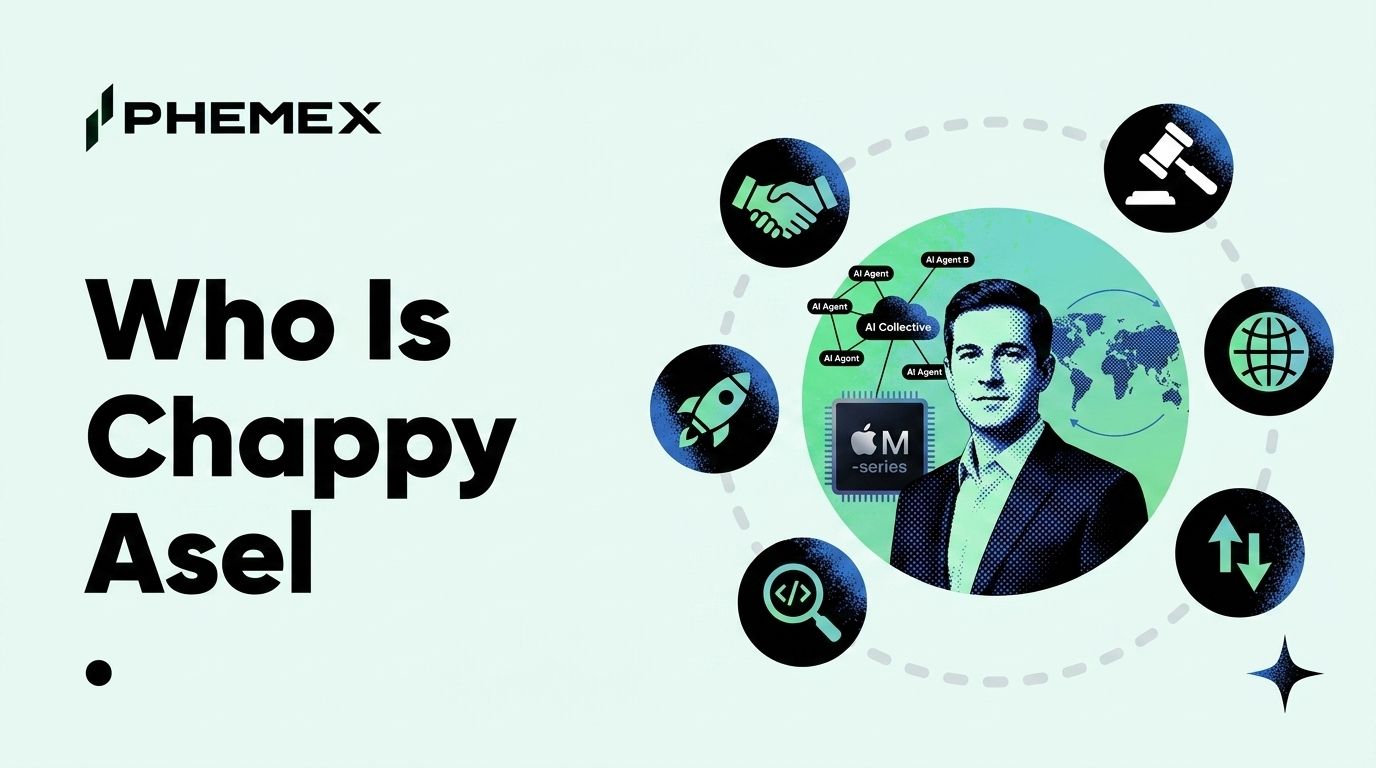
Chappy Asel sat on a CoinDesk panel on May 8, 2026 and made a claim most traders are still catching up to. Autonomous software, he argued, may turn out to be more natural users of crypto wallets and stablecoins than humans ever were. The line landed because the person saying it runs The AI Collective, the largest grassroots AI community in the world, with more than 200,000 members and 150-plus chapters across 50 countries. He is also a former Apple engineer who worked on Vision Pro and the early Apple Intelligence stack before walking away to build a nonprofit.
That combination is unusual, and it is the reason his read on the AI-to-crypto bridge is worth a few minutes of attention right now.
The Self-Taught Coder Who Ended Up Inside Apple's Most Secret Teams
Asel taught himself to code at twelve and shipped a homework planner app in high school that hit number one in its App Store category and sold while he was in college. He has a computer science degree from the University of Washington, did stints at Meta and an automotive software company called Xevo, and then landed at Apple, which is where the resume turns from impressive to specific.
At Apple he worked on the small internal teams that built early Vision Pro prototypes and the foundational Apple Intelligence work that later shipped across iOS. His public bio also lists App Intents and AI/ML eye-tracking, which puts him inside two of the most product-shaping teams Apple has run in the last five years.
He walked away anyway. In early 2023 he started running small AI meetups out of a San Francisco apartment, and by mid-2025 that meetup had turned into a 50-country nonprofit. He left Apple to run it full time as Co-Founder and Executive Director, with his personal site and the Collective Substack now tracking his commentary.
What The AI Collective Actually Is and How It Operates
The AI Collective is not a research lab. It does not train models, sell a product, or take equity in the startups its members build. It is a 501(c)(3) nonprofit whose stated mission is to build the social infrastructure for AGI, which in plainer English means giving the people building, deploying, and policing AI a place to find each other in the real world.
The numbers are the easiest way to understand it. The organization runs 150-plus chapters across 50-plus countries with 400-plus active volunteers and a member base above 200,000. Chapters exist in every major US AI hub including San Francisco, New York, Boston, Seattle, Austin, Los Angeles, Miami, Chicago, Denver, and Washington DC, with international cities running through London, Berlin, Tokyo, Singapore, Dubai, Sao Paulo, and Lagos.
The operating model is deliberately decentralized. Volunteer chapter leads run their own meetups, hackathons, and reading groups under a shared brand, with the central organization providing sponsorship and the connective tissue between cities. The closest crypto comparison is the early Ethereum meetup network before the foundation formalized.
The structure matters because the Collective is not picking sides on which AI stack wins. It is the room where a Solana developer building an agent framework, a Coinbase product manager working on agent payments, and an academic researcher writing the next policy paper end up at the same table.
The AI-to-Crypto Bridge Asel Is Actively Building
This is where the May 8 CoinDesk panel matters. Asel framed the AI-crypto overlap in two layers that are very different in their timing.
The near-term layer is the one nobody on a trading desk needs convinced of. AI's growth is bottlenecked by compute, data centers, and energy, which is the exact stack that overlaps with Bitcoin mining infrastructure, sovereign-scale energy buildouts, and the data-center REITs that the Aschenbrenner-style basket has been long all year.
The longer-term layer is what Asel actually built his pitch around. When autonomous software agents make economic decisions, those decisions need to settle somewhere. Banks close. Card networks have human-scale fraud rules and chargeback windows. Stablecoins on programmable rails do not. The argument is that low-latency, machine-readable payment infrastructure is a better fit for agent-to-agent commerce than anything in TradFi, and that is the lane crypto has spent ten years quietly paving.
The Phemex Academy walks through three of the primitives being built into this thesis. The AI agent wallet primercovers how a programmable account holds and spends crypto under policy constraints. The ERC-8183 standard is the on-chain rail Virtuals Protocol and the Ethereum Foundation shipped so agents can hire, pay, and settle work without a human middleman. The broader primer on AI agents in crypto lays out the trading and DeFi use cases that already work today.
AI Collective chapter hackathons in San Francisco and New York have already produced agent payment demos, on-chain identity tooling for autonomous workers, and a handful of teams that have since raised seed rounds from crypto-native funds. None of this is the Collective taking a position on any token. It is the room where the people writing the next layer are meeting.
Why Asel's Read Matters for Crypto Traders Right Now
Most AI voices pulled into the crypto conversation come from one side of the fence. Either they are crypto-native trying to staple AI onto an existing thesis, or they are AI-native and only show up at crypto events for the speaking slot. Asel is one of a small number of people sitting in the actual overlap, with credibility on both ends and no token on the table.
He is a leading indicator on agent-payment infrastructure. If the AI Collective starts running agent-payment hackathons in a dozen cities next quarter, the protocols those agents use are the ones with native programmable settlement. Track which protocols sponsor those events because that is real revealed-preference data on where the agent stack is actually building. The CoinDesk piece already named Coinbase x402 and a small group of stablecoin issuers as the early movers.
He resets the time horizon on the AI x crypto narrative. Asel was honest on the panel that consumer-facing agent commerce is still largely theoretical. The AI-token rotation we have been watching in May, with derivatives capital flowing into AI agent and AI infrastructure plays, is running ahead of deployed revenue. Knowing the gap between narrative and revenue is the difference between holding through a correction and getting wicked out.
He is a credibility filter. A founder who left Apple to run a nonprofit and refuses to take a token allocation is not a sentiment trade. When he names a specific category as the one that matters in 36 months, the signal-to-noise ratio is higher than the usual VC-on-CT pitch deck.
What Comes Next from Asel and the AI Collective Ecosystem
Three things are worth tracking from here.
The first is the AI Collective's 2026 expansion. The Collective Substack flagged a push into more emerging-market chapters, with Lagos, Buenos Aires, Hanoi, and Bangalore named as priority cities. Those chapters skew more practitioner-heavy and more crypto-adjacent than the US ones, partly because stablecoin rails are already part of the working answer in those economies. That is the demographic where agent-payment use cases get tested first.
The second is who joins the founding member list. The AI Collective founders page lists a rotating set of senior researchers, founders, and policy figures attaching their name to the organization. New additions in 2026 are a leading indicator of which figures are willing to be publicly associated with the agent-economy thesis.
The third is what Asel personally ships. He has been posting on X about specific infrastructure gaps in agent commerce, and the pattern of his earlier career is that he builds the thing rather than writing about it. His profile already carries a Stealth tag worth watching directly.
Frequently Asked Questions
Is Chappy Asel involved in any specific crypto project or token?
No public token allocation and no founder role at a crypto protocol as of May 2026. His public position is The AI Collective Co-Founder and Executive Director, with an undisclosed stealth project tag on some profiles. He has spoken at crypto-industry events as an AI ecosystem voice, not as a token founder, which is part of why his read on the space carries weight.
Why does an AI nonprofit founder show up on a CoinDesk panel?
Because the AI-to-crypto bridge is now a real product conversation, not a narrative one. Agent payments, compute markets, and verifiable AI all touch crypto infrastructure directly. CoinDesk pulled Asel onto the panel as the voice closest to the AI builder community.
What is the AI Collective and how is it different from OpenAI or Anthropic?
The AI Collective is a nonprofit community and chapter network, not a research lab or model developer. OpenAI and Anthropic build frontier AI models commercially. The Collective is the social and educational infrastructure underneath the industry, closer in function to a global meetup network than to a research organization.
Will AI agents really transact in crypto and how soon?
Compute and energy overlap is real today and is what is driving the AI-token and Bitcoin-miner correlation. Consumer-facing autonomous agent payments are still early production, with standards like ERC-8183 just shipping in 2026. A realistic timeline is 12-36 months for meaningful agent-to-agent volume on crypto rails.
Bottom Line
Asel is one of the few credible voices arguing the AI-to-crypto bridge is a payment-rails story, not a token-narrative story. The compute and energy overlap is what is moving today, and that is already priced into the Bitcoin miners and AI-infrastructure names. The agent-payment thesis is the longer-dated leg, and the venues to watch are the protocols that win sponsorship slots at AI Collective hackathons over the next two quarters. When the person closest to 200,000 AI builders tells you where the next layer settles, the cost of ignoring it is higher than the cost of being early.
This article is for informational purposes only and does not constitute financial or investment advice. Cryptocurrency trading involves substantial risk. Always conduct your own research before making trading decisions.
