

XRP trades near $1.37 in early March 2026, down 62% from its $3.65 all-time high set in July 2025 and roughly 28% lower year-to-date. According to Glassnode data, approximately 36.8 billion XRP (about 60% of circulating supply) is currently held at a cost basis above the market price, meaning the majority of holders are sitting on unrealized losses and represent potential sell pressure every time the price rallies toward their break-even zones.
At the same time, whale wallets added 1.3 billion XRP in just 48 hours in early March, and $738 million worth of XRP flowed off exchanges in a single day on March 10, one of the largest cold storage moves of the year. These are not the actions of investors who expect lower prices. The contradiction between what the majority of holders are experiencing and what the largest holders are doing is the defining tension in XRP's market right now, and resolving it in one direction or the other will determine where the price goes next.
The Bullish On-Chain Case
Three data points support the argument that smart money is positioning for a move higher.
The $738 million in single-day exchange outflows on March 10 is significant because tokens leaving centralized exchanges reduce immediately available sell-side liquidity. When large holders move XRP into cold storage, they're signaling they don't intend to sell anytime soon. This was one of the largest net outflow events of 2026 and it came at a time when most retail holders are panicking, not accumulating.
Whale wallets holding between 100 million and 1 billion XRP increased their aggregate position by roughly 1.3 billion tokens in a 48-hour window in early March, according to Santiment data. Since March 5, an additional 140 million XRP (roughly $200 million) has been added by the largest wallet tier. When whales buy into weakness at this scale, it historically precedes a sustained move rather than a temporary bounce.
Seven spot XRP ETFs are now live in the U.S. with approximately $1.1 billion in cumulative net assets. The ETF infrastructure didn't exist a year ago, and while the current weekly inflow pace (roughly $1.9 million per week) is well below the $20-40 million needed to create a meaningful supply squeeze, the structural plumbing for institutional access is now in place and won't be dismantled.
The Bearish On-Chain Case
Three data points argue just as convincingly that the selling isn't done.
Since January 2026, approximately 3.8 billion XRP has flowed from whale wallets into Binance in a steady, systematic pattern that accelerated in February. A single week in late February saw $652 million worth of XRP (roughly 472 million tokens) flow into the exchange, the largest single-week inflow of the year. Exchange reserves had been declining since October 2025, which analysts cited as bullish, but that trend has now reversed. More XRP sitting on exchanges means more ammunition for sellers at any given price level.
XRP ETFs recorded $18.11 million in outflows on March 9, the third consecutive day of net withdrawals. Since XRP's $3.65 peak, whales have cashed out an estimated $6 billion in total. The ETF complex has absorbed roughly $1.1 billion of that. The math doesn't balance.
XRPL payment volumes collapsed 90% from their February 2026 peak. A payment-focused blockchain with declining payment activity raises legitimate questions about what's actually driving demand beyond speculation and whale positioning.
The Regulatory Picture
Ripple received a conditional national trust bank charter from the OCC in December 2025, widely celebrated as a regulatory milestone. But the Bank Policy Institute, representing JPMorgan, Citigroup, and other major banks, is now threatening legal action against the OCC, arguing that crypto firms received lighter regulatory standards than traditional banks. If that lawsuit proceeds and succeeds, it could slow Ripple's expansion into regulated banking services considerably.
On the positive side, Ripple's USD stablecoin (RLUSD) is live and integrated into trading pairs on major exchanges, Arizona's Digital Reserve Bill specifically names XRP as a potential state reserve asset, and the privacy upgrade XLS-0096 (confirmed for H1 2026) would add confidential transfer capabilities to the XRP Ledger that major banks need for institutional B2B settlements. These are real structural wins that strengthen the long-term case, even though none of them directly address the near-term supply overhang from the majority of holders sitting at a loss.
The Technical Setup
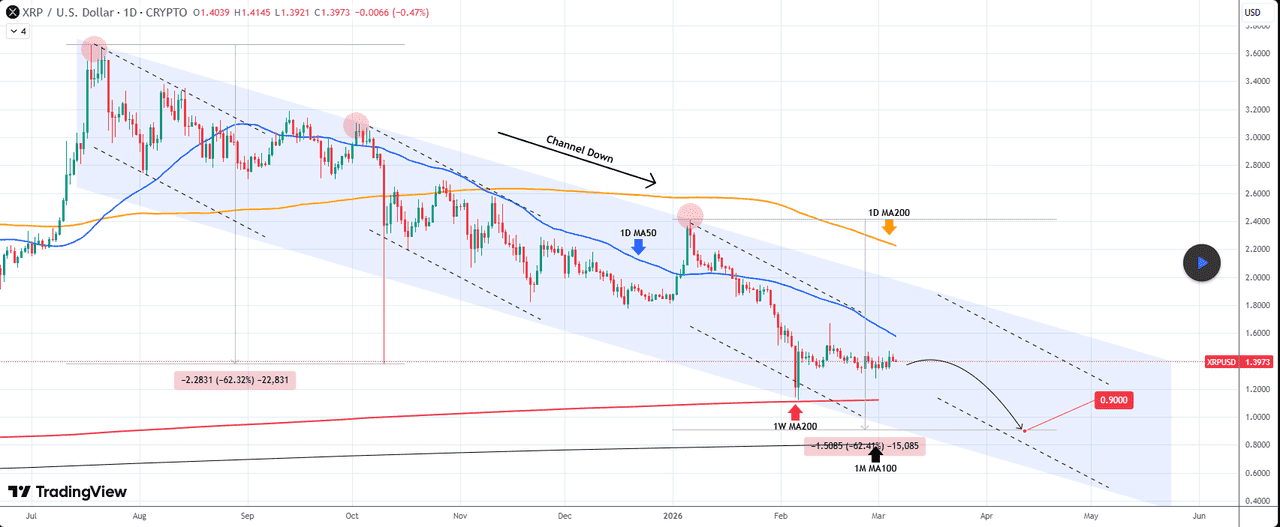
Source: Tradingview
XRP is consolidating within a symmetrical triangle on the 2-hour chart, with support at $1.336 and immediate resistance at $1.375. The 50-EMA has flattened near $1.36 while the 200-EMA sits at $1.42 and continues to press price lower.
The levels that matter for directional conviction are wider than the current range. A breakout above $1.42 with volume would be the first sign that sellers are losing control, and traders should wait for that confirmation before considering long positions. A break below $1.27 would open a deeper retest of the $1.11 year-to-date low and signal that the distribution pressure is overwhelming the whale accumulation.
Between those two levels, XRP is in no-man's land, and forcing a directional bet inside the triangle before it breaks is the kind of trade that bleeds capital in real time.
What the Path Back to $3 Actually Requires
XRP reaching its previous high requires multiple catalysts firing simultaneously. Any one of them in isolation produces a rally that fades.
Bitcoin needs to reclaim $100,000 to unlock the kind of altcoin rotation that historically lifts XRP, because capital flows out of altcoins and into BTC or stablecoins during risk-off periods regardless of token-specific fundamentals. ETF inflows need to accelerate from under $2 million per week to at least $20-40 million to absorb the persistent whale distribution. The CLARITY Act (or equivalent legislation) needs to pass to resolve XRP's commodity-versus-security classification definitively, removing the ambiguity that keeps large institutional allocators on the sideline.
Beyond the catalyst checklist, the chart itself presents a gauntlet of resistance. Every consolidation zone between $1.37 and $3.65 represents a price where large amounts of XRP were bought and where holders will sell to break even when the price returns. The first major wall sits at $1.58-$1.60, where roughly 2 billion XRP was accumulated. Additional clusters of overhead selling pressure exist at each previous consolidation zone all the way up to the all-time high. Absorbing that much break-even selling requires sustained demand far beyond what ETFs, retail, or current whale activity are generating.
FAQ
Is XRP a good buy at $1.37?
The historical data on buying at 60%+ drawdowns is favorable over multi-year timeframes, and whale accumulation suggests sophisticated capital sees value here. But the overhead selling pressure from underwater holders means every rally into the $1.40-$1.60 range faces resistance from people trying to exit at break-even. If you buy here, you need the patience for months of choppy price action and conviction that the institutional catalysts will eventually outweigh the supply overhang.
Why are whales buying while the price keeps falling?
Whales operate on different timeframes than retail traders, positioning for moves they expect to play out over months rather than days. The price can keep falling in the short term because selling pressure from underwater holders and the 3.8 billion XRP that flowed into Binance since January exceeds the whale buying pace. Accumulation and price decline coexist until the distribution exhausts itself.
What would change the outlook from neutral to bullish?
Three signals need to appear roughly at the same time: BTC reclaiming $85,000-$90,000 (unlocking altcoin rotation), XRP breaking above the 200-EMA at $1.42 with sustained volume (confirming the technical reversal), and weekly ETF inflows accelerating above $10 million consistently (showing growing institutional demand). One without the others produces rallies that fail.
Bottom Line
XRP in March 2026 is defined by genuine contradiction. The largest holders are accumulating aggressively while the majority sit underwater and ready to sell. ETFs exist but aren't attracting enough capital to absorb the distribution. The regulatory wins are real but face legal challenges. The privacy upgrade could transform institutional utility, but it hasn't shipped yet.
XRP at $1.37 is neither an obvious buy nor an obvious sell. The long-term structural case is strong (ETF infrastructure, bank charter, stablecoin integration, state-level reserve interest) but the asset is trapped beneath a 60% supply overhang with insufficient demand to clear it. The path to $3 exists, but it requires conditions that mostly haven't triggered yet.
For traders, the approach that protects capital: wait for confirmation at the edges of the range. A break above $1.42 with volume changes the equation. A break below $1.27 tells you the overhang is winning. Between those levels, patience pays more than conviction.
Disclaimer: This article is for informational purposes only and does not constitute financial advice. Cryptocurrency investments carry significant risk. Always conduct your own research before making investment decisions.