

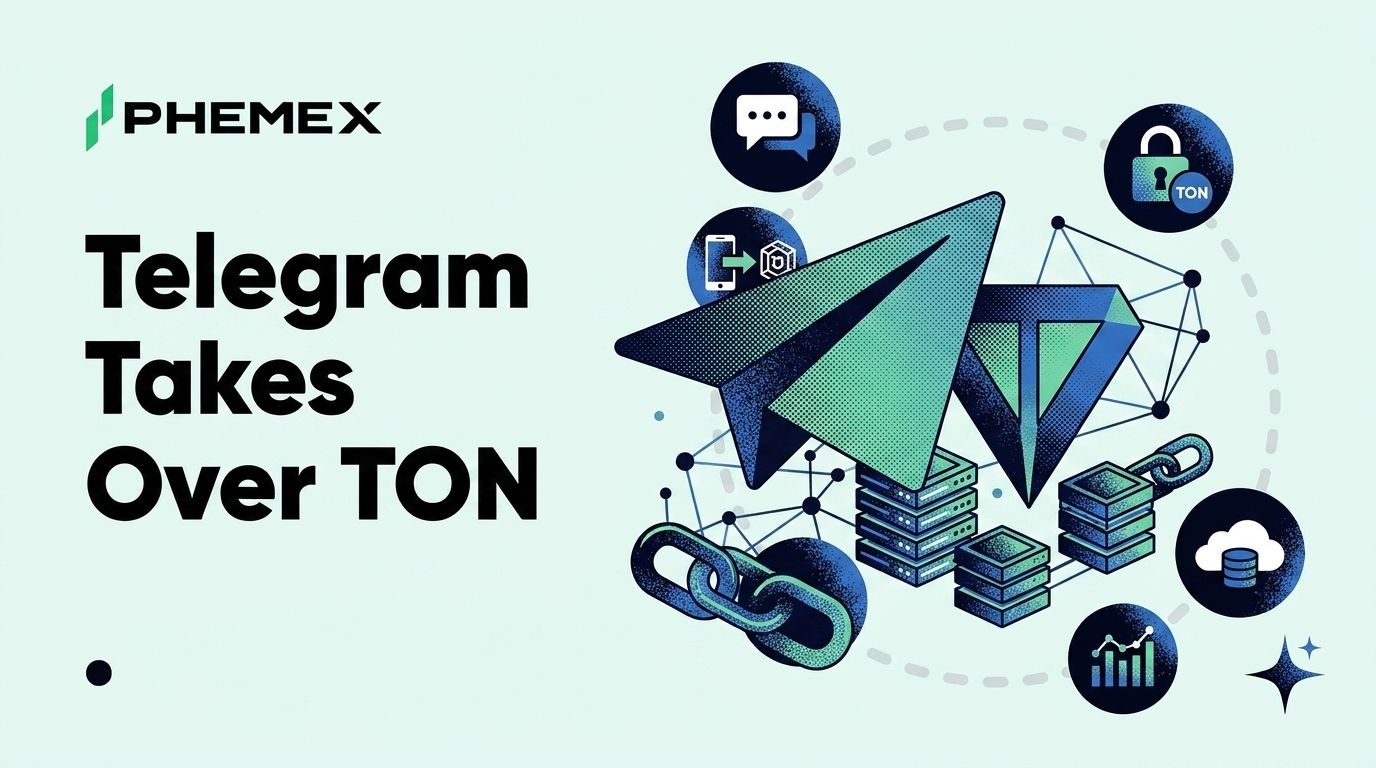
TON jumped 36% in 24 hours and tagged a four-month high around $1.80 after Pavel Durov posted on X that Telegram has formally replaced the TON Foundation as the network's "driving force" and largest validator. The market cap rebounded to roughly $4.79 billion, fees were cut six times over to about $0.0005 per transfer, and ecosystem tokens like Dogs and Notcoin printed double-digit moves alongside the headline coin. Total network staking spiked to $191 million as the rally pulled fresh capital onto the chain.
Telegram is the messaging app with more than one billion users. TON is the layer-1 it originally built and then walked away from after a 2020 SEC settlement. Six years later, the company is back in control, the founder is the single biggest validator, and the roadmap promises a new website, new dev tools, and performance upgrades inside two to three weeks. Here is what actually changed, what it means for traders, and where the centralization risk now sits.
What Durov Actually Said on May 4
The X post from Pavel Durov did three things at once. It declared Telegram the new "driving force" behind The Open Network, confirmed Durov himself is now operating the largest validator on the chain, and committed to a public roadmap with a clock attached to it.
The validator move is the most concrete piece. Telegram staked $2.88 million worth of TON to spin up the validator and seed network security under the new structure, and as the market reacted, total staking across the network climbed to about $191 million. That puts the entity that controls the messaging app, the wallet integration, and the ad network at the top of the consensus stack on day one.
Fees got the headline treatment. Per-transfer cost dropped roughly six times over to around $0.0005, and Durov telegraphed a longer-term ambition of moving TON toward fee-less transfers entirely. For a chain that has spent the past two years pitching itself as the on-ramp for a billion Telegram users, sub-fraction-of-a-cent transfers are not a marketing slogan. They are a product decision aimed directly at the use cases TON has been losing to Tron, Solana, and the various stablecoin layers.
The two-to-three-week roadmap covers a new TON website, new developer tools, and performance upgrades. As reported by CoinDesk, Durov framed the takeover as Telegram formalizing what it had been doing informally for years.
Why TON Pumped 36% in a Day
Toncoin spent most of the spring grinding sideways under $1.40. The Durov post broke that range in a single session. TON tagged $1.80 intraday, marked a four-month high, and printed a market cap around $4.79 billion before settling.
The move makes sense once you separate the catalyst into three layers.
Validator concentration is bullish in the short term, even if it is bearish in the long term. When the parent company of the messaging app announces it is staking real capital and running the largest validator, the implicit signal to the market is that Telegram is no longer treating TON as a side bet. Capital chases that signal first and asks structural questions later.
The fee cut is a direct catalyst for stablecoin flow. TON has been quietly building stablecoin volume through USDt on Telegram. A fee structure under a tenth of a cent flips the chain from "OK for tipping" to "competitive with Tron USDT" for cross-border remittance and creator payouts. Per crypto.news, this was the lever traders priced first.
Ecosystem tokens confirmed the move. Dogs (DOGS) ran 90% on the day while Notcoin (NOT) added 26%. When the layer-1 token leads and the ecosystem tokens lever it on a multiplier, that is the textbook signature of risk-on rotation into a single chain rather than just a headline pop on the largest asset. As Benzinga noted, the cross-asset move is what separated this rally from the noise of typical Durov X posts.
The Backstory Most Traders Forgot
To understand why this is a big deal, rewind to 2018. Telegram raised $1.7 billion in one of the largest ICOs ever conducted, with the proceeds earmarked for a layer-1 chain originally branded the Telegram Open Network. The plan was to ship Gram tokens to ICO participants and integrate the wallet into the messenger.
Then the SEC sued. By 2020, Telegram settled, returned roughly $1.2 billion to investors, paid an $18.5 million civil penalty, and was barred from launching the network. The codebase was open-sourced and handed to the community, which spun up the TON Foundation in Switzerland to run the chain. Telegram itself was legally and operationally walled off.
The new arrangement looks different on paper because the structure is different. Telegram is not relaunching a token sale or soliciting new investors. It is operating infrastructure on a chain that already exists, paying for that infrastructure through validator stake, and integrating product features that benefit its existing user base. That is the carve-out the 2020 settlement allowed, and it is the carve-out the company has been using progressively for the past two years through wallet integration, ad payouts, and Mini Apps.
What changed on May 4 is that the relationship is now explicit. Telegram is no longer pretending to be at arm's length from the network it built. As NewsBTC put it, the foundation phase ended and the operator phase began.
What This Does to TON's Fundamentals
Look at the chain through three lenses and the picture sharpens.
User funnel. Telegram has more than one billion monthly active users. Even single-digit-percent conversion to wallet activity dwarfs the active user count of every other layer-1 outside Bitcoin and Ethereum. The ad payout system, which already pays creators in TON, runs through that funnel. The Mini App ecosystem, where Notcoin and Dogs were born, runs through that funnel. Sub-cent transfers expand what kinds of payments make sense inside that funnel.
Validator economics. A fee cut of six times to under a tenth of a cent is great for users and brutal for validator revenue. The math only works if volume scales to compensate, or if Telegram subsidizes the difference through stake rewards while volume catches up. Durov has effectively committed to the second path until the first arrives. That is a sustainable plan only as long as Telegram has the balance sheet to underwrite it. Durov personally holds hundreds of millions of dollars in Bitcoin, which is one reason the market is not immediately questioning the runway.
Roadmap credibility. The two-to-three-week timeline on a new website, new dev tools, and performance upgrades is unusually fast by crypto standards. It is also a public commitment with a calendar attached. If the upgrades land, the credibility cycle reinforces. If they slip, the move retraces because the rally was partly priced on the assumption that the new operator can ship faster than the old foundation did.
The Centralization Question Nobody Wants to Answer
Here is the part that gets glossed over in the bullish reaction. A network where one company controls the largest validator, the wallet, the user funnel, the ad system, and the public roadmap is not decentralized in any meaningful sense. It is a public chain operated as corporate infrastructure.
For users, that trade-off may be acceptable. Sub-cent transfers and a billion-user funnel beat ideological purity if the goal is to actually move money. For the regulatory file, it is a different conversation. The 2020 settlement constrained Telegram precisely because the SEC argued that Gram holders were investing in Telegram's effort. The new arrangement avoids that specific structure, but it reopens the broader question of how decentralized a chain really is when one entity is the dominant validator, the wallet provider, and the demand-side aggregator.
There is also the precedent angle. Cocoon AI, the decentralized inference network Durov launched on TON in 2025 after his France travel ban was lifted, was built on the assumption that TON is open infrastructure. The validator concentration announcement reframes what "open" means when the operator has product and policy power that no other validator can match.
And the regulatory backdrop matters. The 2025 lifting of Durov's French travel ban removed one specific legal overhang, but it did not remove the broader scrutiny that lands on any platform with one billion users and a payment rail attached. A more concentrated TON is a more obvious target.
What Traders Should Watch Next
Three signals tell you if the rally has legs or fades into a 50% retrace within a month.
First, the two-to-three-week delivery window covering the new TON website, new dev tools, and performance upgrades. If those land on schedule, the price action consolidates above the prior range and the next leg targets the $2.20 to $2.50 zone where TON last traded in late 2025. If they slip, the asset gives back most of the headline gain.
Second, stablecoin volume on TON. The fee cut only matters if it pulls actual transaction flow. Watch USDt on TON daily transfer counts and active addresses. A sustained step-change in daily transfers within four to six weeks confirms the structural thesis. Flat numbers expose the rally as a sentiment trade.
Third, validator distribution, where Telegram currently sits at the top of the stack. If that share grows further, regulatory tail risk rises and the centralization narrative gets louder. If new validators come online and dilute Telegram's share while the network keeps shipping, the bullish case extends without the corporate-infrastructure overhang getting heavier.
Frequently Asked Questions
Why did Toncoin jump 36% on May 4, 2026?
The catalyst was Pavel Durov's X post confirming Telegram has replaced the TON Foundation as the network's primary operator and largest validator. The same post announced a six-times fee cut to about $0.0005 per transfer and a two-to-three-week roadmap for a new website, dev tools, and performance upgrades. Capital priced the structural change first and the fee cut second, with ecosystem tokens like Dogs and Notcoin amplifying the move.
Is TON now centralized under Telegram?
Operationally the answer is yes for now, even though the chain itself remains permissionless. Telegram runs the largest validator, controls the wallet integration, owns the messaging app that drives most user activity, and sets the public roadmap. The chain itself is still permissionless and other validators can participate, but the practical balance of power has shifted toward a single corporate operator, which is the trade-off underlying the rally.
Did the 2020 SEC settlement get reversed?
The 2020 settlement is still in place and has not been reversed. It barred Telegram from launching a Gram token sale and required the company to return ICO proceeds. The new arrangement does not involve a token sale or new investors. Telegram is operating infrastructure on a chain that already exists, which is a structurally different activity from the one the settlement addressed.
What is the biggest risk to the TON thesis from here?
Two things. Execution risk on the two-to-three-week roadmap, since the rally is partly priced on the assumption that Telegram can ship faster than the foundation did. And renewed regulatory attention, since a more concentrated TON with a more visible corporate operator is a more obvious target for global regulators looking at platforms with payment rails attached to a billion-user app.
Bottom Line
Telegram took control of TON in public, cut fees six times over, and put Pavel Durov at the top of the validator stack with $2.88 million staked on day one. The market answered with a 36% rally, a four-month high near $1.80, and a $191 million spike in network staking that pulled ecosystem tokens like Dogs and Notcoin along for the ride.
The next two to three weeks decide if this is a structural re-rating or a sentiment pop. Watch the roadmap delivery, the stablecoin transfer counts, and the validator distribution numbers. If the new website, the dev tools, and the performance upgrades land on schedule and stablecoin flow steps higher, the asset has a path to the $2.20 to $2.50 range where it last traded before the foundation phase ended. If the roadmap slips or validator concentration tightens further without volume catching up, the centralization tax shows up in the price.
The asymmetry is straightforward. The catalyst is real, the funnel is the largest in crypto outside Bitcoin and Ethereum, and the operator finally has the title to match the responsibility. The risk is that one company controlling validation, distribution, and the roadmap is exactly the structure regulators wrote rules to discourage.
This article is for informational purposes only and does not constitute financial or investment advice. Cryptocurrency trading involves substantial risk. Always conduct your own research before making trading decisions.