

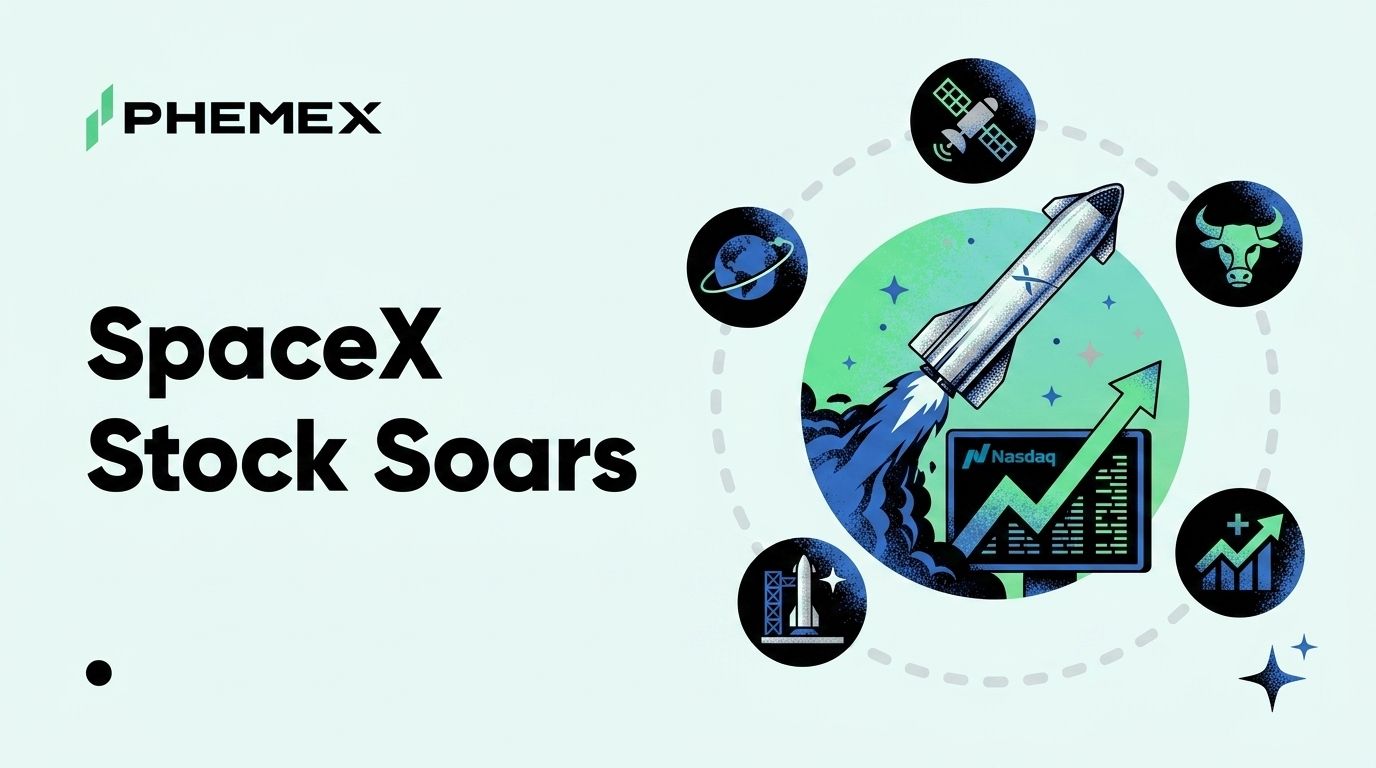
SpaceX priced its IPO at $135 per share on June 12, 2026, raised roughly $85.7 billion with the full over-allotment exercised, and turned the long-anticipated debut into the largest stock-market IPO in history. The stock opened at $150, closed day one at $161 for a 19% gain, and now changes hands near $172 as of June 15, putting Elon Musk's space-and-satellite company at a roughly $2.1 trillion valuation. Retail bought it harder than any other name on debut day, net buying that ran 3.5x NVIDIA's per VandaTrack.
- SPCX price: ~$172 (June 15)
- IPO price / day-1 close: $135 / $161 (+19%)
- Valuation: ~$2.1 trillion
- Raise: ~$85.7 billion (largest IPO ever)
- Catalyst: record Nasdaq debut June 12
The IPO that traders waited years for is now live, and the question has shifted from "how do I get in" to "what is this thing actually worth." Here is the breakdown.
What Happened in the SpaceX IPO and Which Records It Broke
SpaceX listed on the Nasdaq under the ticker SPCX on June 12, and the offering blew past its own targets. The company initially marketed the deal around a $75 billion raise, then upsized as institutional demand swamped the book, ultimately pricing at $135 and pulling in roughly $85.7 billion once underwriters exercised the full over-allotment. That figure clears every prior IPO on record, including the previous benchmarks set by Saudi Aramco and Alibaba.
The order book told the story before the tape did. SpaceX is the most closely watched private company of the decade, and years of secondary-market trading had already established a reference valuation north of a trillion dollars. When the roadshow opened the door to public buyers for the first time, the demand that had been bottled up in pre-IPO markets finally had somewhere to go.
For context on how locked-down access used to be, Phemex's SpaceX pre-IPO guide walked through the special-purpose vehicles and accredited-investor hoops retail traders had to clear for any synthetic exposure before June 12. That backdrop is now history. The shares trade openly, which is exactly why the debut drew the crowd it did.
How SPCX Traded on Day One and Where the Stock Sits Now
The open set the tone. SPCX printed its first public trade at $150, an 11% pop over the $135 offer price, then ground higher through the session to close at $161, up 19% on the day. The follow-through mattered more than the open. Plenty of hyped IPOs gap up and then fade into the close as flippers take profit. SPCX did the opposite, finishing near its highs and carrying momentum into the next two sessions, where it has pushed to roughly $172 by June 15.
The standout detail is who was buying. According to VandaTrack retail-flow data, SPCX was the most-bought stock by retail investors on its debut, with net retail buying running about 3.5 times the same-day figure for NVIDIA. That is an unusual signature. Most mega-cap IPOs are dominated by institutions on day one while retail waits for the dust to settle. SPCX flipped that script, which tells you the space-economy trade has a genuine retail base behind it rather than desk allocation alone.
Here is the tape in one place.
|
Marker
|
Level
|
Move
|
|
IPO price
|
$135
|
offer
|
|
Day-1 open
|
$150
|
+11%
|
|
Day-1 close
|
$161
|
+19%
|
|
June 15 price
|
~$172
|
+27% from offer
|
The risk in any debut this hot is that early strength is borrowed from future demand. When everyone who wanted in has bought, the marginal buyer thins out and the stock has to grow into its price. That is the real debate now, and it runs straight through the valuation.
The $2.1 Trillion Valuation Debate
At $172, SPCX carries a valuation near $2.1 trillion, which slots it among the largest companies on the planet on its first week as a public stock. Bulls and bears are arguing over the same three revenue engines, and where you land depends on how you weight them.
Starlink is the cash story. The satellite-internet unit is the part of SpaceX that looks most like a conventional high-growth subscription business, with millions of subscribers across consumer, maritime, aviation, and government accounts. Bulls treat Starlink as a recurring-revenue machine that justifies a large slice of the valuation on its own, and the persistent chatter about a separate Starlink spin-out only feeds that view. Phemex's Starlink stock and space-economy guide breaks down how that unit is valued and why a standalone listing keeps coming up.
Launch is the moat, not the multiple. SpaceX dominates global orbital launch and reusability, which is the hardest-to-replicate part of the business. But launch revenue, however dominant, is lumpy and capital-heavy, and it does not carry the kind of margin that software-style investors pay up for. It anchors the bull case structurally without doing the heavy lifting on the valuation math.
AI compute is the new wildcard. This is the part the market is still digesting. SpaceX has signed a 32-month Google cloud deal worth roughly $920 million per month and a three-year Anthropic "Colossus" compute-rental agreement at about $1.2 billion per month. Those contracts fold AI-infrastructure revenue into the SpaceX story, turning a space company into a partial play on the compute buildout that is driving names like NVIDIA. If that revenue earns an AI-infrastructure multiple rather than a services discount, the upside is large, and that single question is the biggest swing factor in the bull-bear gap.
The bear case is simpler to state. At $2.1 trillion, a lot of Starlink growth and a lot of AI-compute optionality is already in the price, and any of those three engines stumbling leaves limited cushion.
How SPCX Stacks Up Against Other Space Stocks
SPCX is now the gravity well of the space trade, but it is not the only way to play the theme, and the smaller names tend to move with the narrative SpaceX sets. Rocket Lab (RKLB) is the closest pure-play launch comparison, a company that has built a real cadence in the small-and-medium launch segment. AST SpaceMobile (ASTS) plays the direct-to-cell satellite angle that overlaps with where Starlink is heading. Both have traded in roughly the $110 to $130range around recent space catalysts and tend to catch a bid when SpaceX headlines dominate.
The older retail favorite in the sector is Virgin Galactic (SPCE), which sits at the speculative end of the space trade. Phemex's Virgin Galactic 2026 outlook and its SPCE vs MRVL comparison frame how that name trades against both space peers and AI-semiconductor alternatives. For the launch-focused side, the Rocket Lab how-to-buy walkthroughcovers the tokenized-stock route.
The honest read is that SPCX changes the sector's gravity. A liquid, mega-cap space stock gives institutions a way to express the theme without reaching for thin small-caps, which can pull flow toward SPCX and away from the smaller names on quiet days. On big space news, though, the whole basket tends to move together, and the small-caps carry more beta in both directions.
What SPCX Traders Should Watch Next
Three calendar events define the next few months, and each one is a known catalyst rather than a guess.
The lock-up expiry is the first overhang. IPO insiders and early backers are typically restricted from selling for a set window after listing, and when that window opens, a wave of supply can hit the tape regardless of fundamentals. Mark the date and size positions around it, because lock-up expiries on hot IPOs are a recurring spot where early momentum stalls.
The first earnings report as a public company is the second. This is where the market finally gets audited numbers on Starlink subscriber growth, launch cadence, and crucially the new AI-compute contracts. Guidance on those Google and Anthropic deals will do more to settle the valuation debate than any analyst note.
The third is Starlink IPO speculation. Any concrete move toward a separate Starlink listing would force the market to re-rate SPCX, since a spin-out changes how the satellite cash flows are valued relative to the parent. For the broader company picture, the SpaceX corporate site and its Wikipedia profile track the business lines, and the live quote sits on the Nasdaq SPCX page. Traders who want the offering documents can pull the registration filings through SEC EDGAR.
On the chart, the levels are still forming this early, but the early structure is readable. The $161 day-one close is the first real support, the level that separates a healthy consolidation from a failed breakout. Above, the round $180 zone is the next psychological test, and reclaiming and holding it would signal the post-IPO base is building rather than topping.
Frequently Asked Questions
Is SpaceX stock a buy?
SPCX is a high-conviction, high-valuation name. At a roughly $2.1 trillion market cap, a lot of Starlink growth and AI-compute optionality is already priced in, so the upside depends on those engines delivering. It suits traders who want direct exposure to the space-and-compute theme and can stomach IPO volatility, ideally sized as a satellite position rather than a core holding until the first earnings report and the lock-up expiry pass.
What is the SPCX ticker?
SPCX is the Nasdaq ticker for SpaceX, which began trading on June 12, 2026. It is the first time SpaceX equity has been available to public investors, replacing the pre-IPO special-purpose vehicles that previously offered only indirect, accredited-only access.
How much is SpaceX worth?
At a price near $172 as of June 15, 2026, SpaceX carries a valuation of roughly $2.1 trillion. That figure rests on three revenue engines. They are Starlink satellite internet, the dominant launch business, and the newer AI-compute rental deals with Google and Anthropic.
Bottom Line
SpaceX completed the largest IPO in history and the market answered with a 19% day-one close and a follow-through to $172, so the debut itself is no longer the question. The valuation is. Hold above the $161 day-one close and the post-IPO base is intact, with $180 the next level that confirms buyers still control the tape. Lose $161 on volume and the move starts to look like early froth unwinding ahead of the first lock-up supply. The two catalysts that decide the $2.1 trillion debate are the first public earnings report and any concrete Starlink spin-out news, so size for those events rather than chasing the post-IPO momentum.
Disclaimer: This article is for educational purposes only and does not constitute financial advice. Cryptocurrency and stock trading carries significant risk. Always do your own research and consult a qualified advisor.