

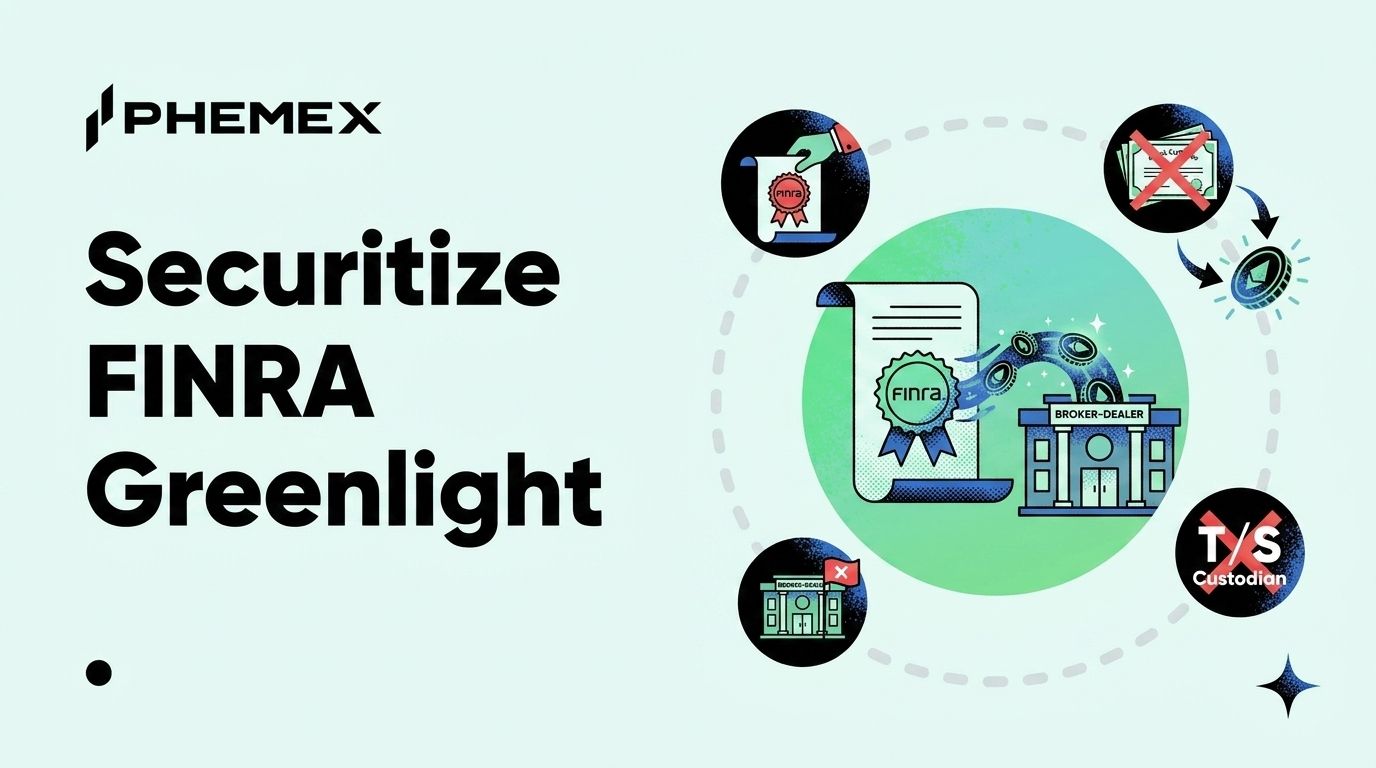
On May 4, 2026, Securitize Markets LLC quietly received the most important regulatory clearance in tokenized capital markets to date. FINRA approved its expanded Continuing Membership Application, making the broker-dealer subsidiary the first ever cleared to custody tokenized securities and to act as underwriter and selling-group participant for tokenized IPOs across both initial and secondary offerings. Inside its Alternative Trading System, Securitize can now run atomic settlement between tokenized securities and cash equivalents, collapsing T+1 plumbing into something that clears in seconds. The same firm that issues BlackRock's BUIDL fund, Apollo's diversified credit product, and Hamilton Lane's tokenized exposure now has the regulatory stack to take a private company public on-chain end to end.
This is the regulated half of the on-chain capital markets buildout. The Coinbase-Centrifuge deal announced May 5 covers the public-chain rails, and Securitize just locked in the broker-dealer side that institutional money actually requires.
What Securitize Actually Got Approved to Do
The FINRA approval came through the Continuing Membership Application process, which is the formal regulatory pipeline a broker-dealer uses to expand its permitted activities. Securitize Markets already had broker-dealer registration and operated an Alternative Trading System for digital asset securities. What it did not have, until May 4, was the ability to take principal risk on tokenized issuance, hold the underlying securities in custody, and settle the cash leg atomically inside its own venue.
All three were approved at once. Per the official Securitize announcement, the firm can now serve as underwriter and selling-group participant for tokenized IPOs covering both initial offerings and secondary follow-ons. It is the first FINRA-registered broker-dealer permitted to custody tokenized securities directly. And inside its ATS, it can match a tokenized share trade and settle the security and cash legs in the same transaction, with no external clearing house in the loop.
That last point is the one institutional desks care about most. Today's tokenized RWA market is a hybrid where the security lives on-chain but the cash leg often still moves through banking rails on T+1 or T+2. Atomic settlement closes that gap by forcing the trade to either fully clear or fully fail in a single step. There is no window where one side has handed over the asset and the other still owes the money.
Why Atomic Settlement Inside a Broker-Dealer ATS Is the Real Headline
The phrase "atomic settlement" gets thrown around loosely in crypto. Here it has a specific regulatory meaning. Inside the Securitize ATS, a tokenized security trade between two qualified counterparties can settle in seconds, with the security and the cash equivalent moving in the same transactional unit. If either side fails, neither side moves.
Compare that against how a traditional IPO actually settles today. A new issue prices in the evening, allocations clear overnight, the cash leg moves through DTCC the next day, and the record of ownership lives in centralized depository accounts. The whole pipeline assumes T+1 as a hard floor. Tokenized issuance breaks that floor down to seconds because everything is on the same ledger.
For institutional allocators, this is the part that actually changes capital efficiency. A pension fund or RIA holding a tokenized treasury fund like BUIDL does not need to lock up redemption capital for a settlement window. Hedge funds rebalancing a tokenized credit portfolio from Apollo or Hamilton Lane can rotate within minutes. The cost of capital sitting in flight, which is the silent tax on every fixed-income allocator, drops toward zero.
And the legal status of the assets does not change. They are still securities, still custodied by a FINRA-registered broker-dealer, and still living inside the regulatory perimeter that institutional compliance departments require. The blockchain just replaces the parts of the back office that were never adding value to begin with.
Securitize Is Already the Issuer Behind the Biggest Names in Tokenized Finance
This approval matters because of who Securitize is. The firm is not a startup chasing the RWA narrative. It is the technical issuer behind most of the tokenized assets institutions actually hold today.
|
Tokenized Product
|
Issuer / Sponsor
|
Securitize Role
|
Approximate AUM
|
|
BUIDL
|
BlackRock
|
Tokenization platform and transfer agent
|
$2.5B+
|
|
ACRED
|
Apollo Global Management
|
Tokenization platform
|
$100M+
|
|
Tokenized credit exposure
|
Hamilton Lane
|
Tokenization platform
|
Multiple funds
|
|
Other private credit and PE
|
Various sponsors
|
Tokenization platform
|
Combined $1B+
|
That installed base is what makes the FINRA approval more than a paper expansion. The pipes already carry billions in tokenized assets from the largest asset managers in the world. What changed on May 4 is that the same pipes can now originate new offerings, custody them, and clear secondary trading inside one regulated venue. The infrastructure is the same. The legal scope just expanded to cover the full lifecycle.
Per Ledger Insights coverage, this makes Securitize the only firm in the US with regulatory authority across primary issuance, custody, and atomic-settled secondary trading for tokenized securities. Competitors operate parts of the stack. None operate the whole thing under one FINRA-registered roof.
What This Means for Tokenized IPOs
The ability to act as underwriter and selling-group participant is the part that opens up an entirely new product category. Right now, tokenized securities are mostly secondary representations of existing fund products. BUIDL holds treasuries that already exist. Apollo's tokenized credit fund is a wrapper around a private credit pool that already exists. The token is a more efficient distribution layer, not a new issuance.
An on-chain IPO is different. It is a primary offering where the security is born tokenized and trades exclusively as a tokenized security from day one. That requires a registered underwriter willing to take principal risk on the issuance, a venue that can list the security for secondary trading, and a custodian that can hold it. Until May 4, no single firm had all three permissions in the United States. Securitize now does.
For a private company looking to go public, the implications are practical. The 24-month, $20-50 million traditional IPO process compresses dramatically when the security itself, the secondary market, and the settlement layer all live on the same blockchain. Allocations become programmatic and lockups get enforced directly in smart contract code. Cap table management replaces the transfer agent layer, and secondary trading begins immediately on the Securitize ATS rather than waiting for a Nasdaq or NYSE listing.
This does not mean Coinbase, Stripe, or any other large pre-IPO name will skip a traditional listing tomorrow. Liquidity is still concentrated in legacy venues. But for a mid-cap private company that wants institutional capital without the full Nasdaq overhead, the on-chain path is now structurally available for the first time.
The SPAC Merger Going Public on Nasdaq as CEPT
Securitize itself is going public, which is the part that ties the whole story together. The firm announced a SPAC merger with Cantor Equity Partners II that will list on Nasdaq under the ticker CEPT, expected to close in the first half of 2026. Per the SEC filing summary, the deal gives public-market investors direct exposure to the tokenization infrastructure layer rather than to the assets being tokenized.
The strategic logic is straightforward. Securitize gets a public currency for acquisitions and a balance sheet capable of supporting underwriter capital requirements. Cantor's involvement signals that traditional finance views tokenization as the operational future of capital markets, not a parallel niche. And the timing of the FINRA approval, weeks before the expected SPAC closing, materially strengthens the equity story for CEPT investors.
For traders watching the listing, the read is fairly clean. CEPT is the only direct way to own a piece of the regulated US tokenized securities pipeline. There are public crypto miners, exchanges, and stablecoin issuers, but Securitize is the first firm with full broker-dealer scope across tokenized issuance and custody. The closest comparable in equity markets is the role that DTCC plays in traditional securities, which is structurally too central to ever be a public stock.
How This Connects to the Coinbase-Centrifuge Deal on May 5
The timing matters. One day after the Securitize approval, Coinbase announced its acquisition of Centrifuge to anchor the on-chain side of the same buildout. The two stories together describe the full capital markets stack now under construction.
Securitize handles the regulated, broker-dealer side of the stack. The assets are securities, the custodian is a FINRA member, and the settlement is atomic but happens inside a US ATS under existing securities law. Compliance, KYC, and accredited-investor gating live at the platform level.
Coinbase plus Centrifuge handles the public-chain side. Tokenized RWAs that need to plug into DeFi protocols, serve as collateral on lending platforms, or trade on permissionless venues now have a Coinbase-backed issuance and distribution layer. The two stacks meet in the middle. A tokenized treasury fund issued through Securitize can flow into a Coinbase-Centrifuge wrapper for DeFi composability without leaving the regulatory perimeter.
This is the institutional on-chain map that has been missing for three years. The asset originators (BlackRock, Apollo, Hamilton Lane), the regulated issuance and custody layer (Securitize), the public-chain distribution layer (Coinbase-Centrifuge), and the on-chain composability layer (DeFi protocols) now all have a defined relationship. Per coverage from The Block and News Bitcoin, the May 4 and May 5 announcements are not coincidental. Both sides of the stack moved into place in the same 24-hour window.
For traders, that means RWA tokens with direct exposure to tokenization infrastructure are likely to get repriced as the news settles. The narrative is no longer "RWA is coming." It is "the regulated US capital markets stack just turned on." If you want exposure to that thesis without buying the SPAC ticker, established tokenization-adjacent assets and the broader RWA tokenization category are the cleanest beta.
Frequently Asked Questions
What did Securitize get approval to do on May 4, 2026?
FINRA approved Securitize Markets LLC, the firm's broker-dealer subsidiary, to act as underwriter and selling-group participant for tokenized IPOs covering both initial and secondary offerings, custody tokenized securities directly, and run atomic settlement between tokenized securities and cash equivalents inside its Alternative Trading System. It is the first FINRA-registered broker-dealer cleared for tokenized securities custody.
Why does atomic settlement inside a broker-dealer matter?
Atomic settlement collapses the T+1 settlement window that defines traditional securities markets. A tokenized share trade between two counterparties on the Securitize ATS can clear in seconds, with the security and cash legs moving as a single transaction. That eliminates settlement risk and frees up capital that would otherwise be locked in flight, which is the practical efficiency gain institutional allocators have been waiting on.
Is Securitize the same firm behind BlackRock's BUIDL fund?
Yes. Securitize is the tokenization platform and transfer agent for BlackRock's BUIDL tokenized treasury fund, which holds approximately $2.5 billion in assets, as well as Apollo's tokenized diversified credit product and tokenized exposure from Hamilton Lane. The May 4 FINRA approval expanded the regulatory scope of the firm that already operates the largest tokenized fund pipeline in the US.
How can investors get exposure to Securitize itself?
Securitize is going public via SPAC merger with Cantor Equity Partners II, which will trade on Nasdaq under the ticker CEPT. The deal is expected to close in the first half of 2026 per the filed SEC documents. CEPT is currently the only public-market vehicle for direct exposure to the regulated US tokenized securities infrastructure layer.
Bottom Line
The on-chain capital markets stack just got its broker-dealer. Securitize now owns the only regulatory authority in the United States that covers tokenized IPO underwriting, tokenized securities custody, and atomic settlement inside a single FINRA-registered venue. The same firm already issues the largest tokenized fund products from BlackRock, Apollo, and Hamilton Lane, which means the pipeline is operational on day one rather than theoretical. The CEPT SPAC listing in H1 2026 turns that infrastructure into a public equity.
What to watch next is the first tokenized IPO that uses the full Securitize stack as a primary offering rather than a secondary tokenization. That will be the proof point that the on-chain IPO category is real rather than a regulatory possibility. The Coinbase-Centrifuge acquisition on May 5 provides the public-chain distribution layer the regulated side needs to plug into DeFi without leaving the legal perimeter. Both sides moved in the same week, and the implication is the same. Tokenized capital markets stopped being a 2027 thesis and became a 2026 product line.
This article is for informational purposes only and does not constitute financial or investment advice. Cryptocurrency trading involves substantial risk. Always conduct your own research before making trading decisions.