
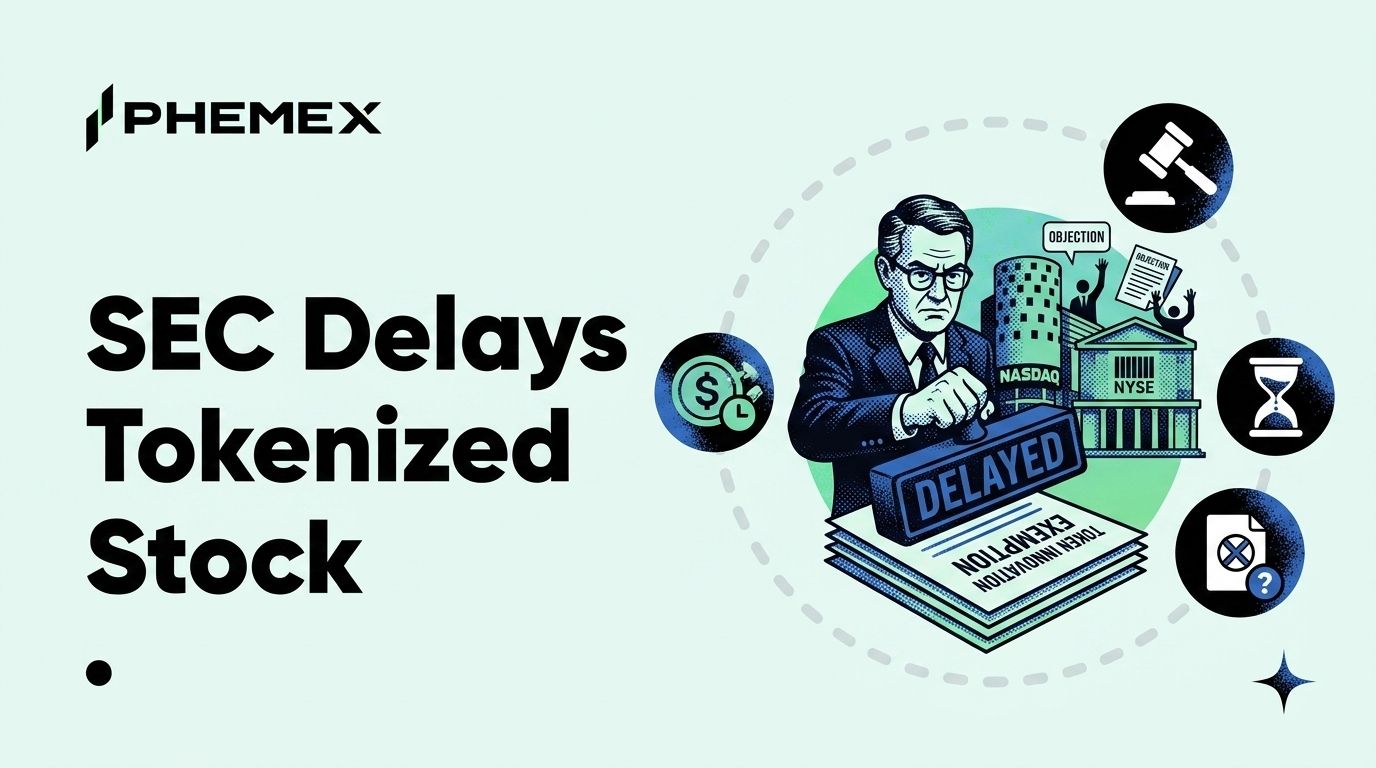
The SEC abruptly delayed the release of its long-previewed "innovation exemption" this week after closed-door meetings in which Nasdaq, NYSE, and Cboe leadership pushed back hard on the proposed framework. The exemption would have created a 12 to 36 month sandbox letting US firms issue and trade tokenized securities, including tokenized US stocks, without full SEC registration. SEC Chair Paul Atkins had previewed the rollout as "imminent" just weeks earlier, with multiple outlets reporting a late-May target. As of May 26, 2026, there is no new timeline.
What changed is not the policy direction but the assumption that the agency could ship the framework over the objections of the exchanges that run the regulated equity market. Here is what the exemption was supposed to do, who pushed back, and what the delay means for the Robinhood, Coinbase, Bitwise, Ondo, Securitize, and Backed pipeline that has been building against it.
What the Innovation Exemption Was Supposed to Do
The innovation exemption was the keystone of Atkins's first-year agenda. It would have offered domestic crypto firms a conditional exemption from full Securities Act and Exchange Act registration for the issuance, custody, and secondary trading of tokenized securities, covering tokenized US equities, money-market funds, Treasuries, and certain on-chain bond products. The conditional period was 12 to 36 months, with mandatory disclosures, blockchain-level transaction reporting, and a tiered eligibility ladder scaled to assets under issuance.
Tokenized equities currently exist almost entirely offshore. Backed Finance's bSTOCK products trade on Solana with non-US issuers, and Bitfinex Securities lists tokenized stock products out of El Salvador. The Atkins SEC argued that without a domestic exemption, US issuers would keep the activity offshore and US retail would access tokenized equities only through foreign wrappers. The exemption was the attempt to pull that activity onshore under conditional oversight.
Robinhood, Coinbase, Bitwise, Ondo Finance, Securitize, and dWallet had all built product roadmaps assuming the exemption would ship in 2026. Robinhood's June 2025 launch of tokenized US stocks in the EU was widely read as the test bed for a US rollout under exactly this framework, and Bitwise had filed paperwork for a tokenized equity ETF wrapper.
Who Pushed Back This Week and Why
The objections did not come from the usual crypto critics but from the institutions that run the US equity market itself.
According to multiple reports, leadership from Nasdaq, the New York Stock Exchange, and Cboe Global Markets met with senior SEC staff in the days before the planned rollout. The exchanges argued that the exemption, as drafted, would carve a parallel trading venue for tokenized equities that bypassed the National Market System rules every other equity venue must follow. That includes Regulation NMS order-protection rules, Consolidated Audit Trail reporting, FINRA member oversight, and the trade-through obligations that route retail orders to the best displayed price.
The exchange-side argument is not that tokenized equities should not exist, but that tokenized versions of the same underlying stock cannot trade under a lighter rulebook than the listed shares without fragmenting liquidity and creating arbitrage that retail traders lose. If Apple stock trades on Nasdaq under NMS rules and a tokenized Apple share trades on a blockchain venue under the exemption, the two prices diverge during fast markets and retail orders get routed to the worse side at the moment of execution. The exchanges call this the "two-tier market" problem.
JPMorgan, Citadel Securities, and SIFMA had raised parallel concerns earlier in the rollout. The Citadel letter argued that tokenized equities should be brought into the existing equity market structure, not exempted from it, and SIFMA's submission asked the SEC to require any tokenized equity venue to register as a national securities exchange or as an alternative trading system before quoting prices to US persons. The combination of exchange CEOs raising the issue directly in late May and the absence of a worked-out market-structure annex inside the draft was what moved the timeline.
The Market Structure Concerns in Detail
Four specific concerns drove this week's delay, each touching a different layer of the equity market that the exemption did not cleanly address.
Fragmented liquidity. The exchanges argued that any meaningful tokenized-equity volume would split the order book between the regulated NMS venues and the blockchain venue, widening spreads and degrading the National Best Bid and Offer as a reference.
Surveillance gaps. NMS venues feed every trade and quote into the Consolidated Audit Trail, the cross-venue surveillance system the SEC uses to detect manipulation, and a blockchain venue operating under the exemption would not have a comparable obligation in the current draft. Front-running, spoofing, and cross-venue manipulation become harder to detect when half the activity sits outside the CAT.
Retail protections. The NMS framework includes order-protection rules, best-execution obligations, and a payment-for-order-flow disclosure regime that tokenized-equity venues under a 12 to 36 month exemption would not automatically inherit. The exchanges argued that retail trading tokenized Apple on a permissionless DEX has none of the protections retail gets buying the same share through a registered broker.
Off-hours execution. Listed equities trade roughly 9:30 AM to 4:00 PM ET with regulated pre-market and after-hours sessions, while tokenized equities on a blockchain clear 24/7. The exchanges flagged this as a price-discovery problem because the reference price on the listed market is unavailable for 16 hours of the tokenized trading day, and retail orders executed overnight have no NBBO to be checked against.
The exchanges did not propose killing the framework, only bolting it onto the existing NMS plumbing by requiring tokenized-equity venues to register as exchanges or ATSs, or by extending CAT reporting and order-protection rules to anything quoting a tokenized version of a listed US security. That is a heavier lift than the draft contemplated, which is why the rollout moved.
What This Means for the Tokenized Equity Issuer Pipeline
The delay hits the pipeline unevenly. Companies built against the exemption absorb a quarter or two of extra runway, while offshore issuers keep running.
Robinhood is the cleanest case because the EU tokenized-stock launch in mid-2025 generated material volume and the company had publicly framed the US version as gated by exactly this framework. The delay pushes any US rollout into 2027 in the base case. Coinbase's tokenized-equity work was earlier-stage with more diversified revenue behind it, while Bitwise's tokenized equity ETF filing sits on a different regulatory path (the Investment Company Act wrapper) and is less directly exposed.
Ondo, Securitize, and dWallet sit in the middle. Ondo's tokenized Treasury products do not need the exemption because Treasuries are not equities, but the planned expansion into tokenized equities does. Securitize runs a registered transfer-agent business that would have been the natural pipe for issuing tokenized US equities under the framework. Both companies keep their existing tokenized-Treasury and tokenized-private-credit revenue while the equity pipeline waits.
Backed Finance and the offshore issuers are the interesting case because Backed's bSTOCK tokens trade on Solana with a Swiss issuer and EU distribution that explicitly does not solicit US persons, which is exactly the activity the exemption was supposed to bring onshore. The delay does the opposite. As long as the US framework is unfinished, the offshore product captures global on-chain demand for tokenized equities without competition from a regulated US alternative. Phemex covered the exchange angle in its earlier piece on Nasdaq's SEC plan for tokenized stocks, and the broader sandbox mechanics in the SEC tokenization sandbox explained.
What Comes Next Without a New Timeline
The SEC has not released a revised target date. Based on public statements from Atkins and SEC staff comments to industry counsel, three things appear to be happening in parallel.
The exemption draft is being rewritten to incorporate a market-structure annex. The most-discussed version would require any tokenized-equity venue quoting prices to US persons to either register as an ATS, route through an NMS-registered exchange for price discovery during regular trading hours, or both. That is closer to what Nasdaq, NYSE, and Cboe asked for, and a significantly heavier framework than the original 12 to 36 month sandbox, which slows the timeline regardless.
The agency is also broadening the consultation. The original rollout leaned on industry counsel for the crypto-native issuers, while the redraft pulls in more direct input from the listed exchanges and from the equity-market market makers (Citadel, Virtu, Jane Street, Susquehanna) who would be unwound first if the two-tier market problem materialized.
The political clock matters. The Atkins SEC has roughly two full years to ship marquee policy before midterm-cycle constraints, and a delay of three or four quarters starts to compete with CLARITY Act implementation, the spot ETF expansion calendar, and the staking-related rulemaking the agency has previewed. The risk is not that the exemption never ships, but that it ships in a form so revised it no longer serves what the issuers were building for.
Frequently Asked Questions
Why did the SEC delay the innovation exemption now after previewing it as imminent?
The trigger was direct pushback from Nasdaq, NYSE, and Cboe leadership in late May meetings with SEC staff. The exchanges argued the draft framework would carve a parallel trading venue that bypassed Regulation NMS, CAT reporting, and the retail-protection rules governing every other US equity venue, and the agency moved the timeline rather than ship over their objection.
Does this kill tokenized US stocks in the US?
No, it only delays the regulated US version. Tokenized US stocks already trade offshore through issuers like Backed Finance, with non-US distribution and a structure that does not solicit US persons. The exemption was the path to pull that activity onshore under conditional SEC oversight. While the framework is unfinished, US retail access to tokenized equities through domestic platforms is on hold and the offshore product keeps the segment.
How does the delay affect Robinhood, Coinbase, and Backed Finance specifically?
Robinhood and Coinbase had built US tokenized-equity product roadmaps assuming the exemption would ship in 2026, so their US launches push into 2027 in the base case. Bitwise has a tokenized-equity ETF filing on a different regulatory path and is less directly exposed. Backed Finance and the offshore issuers benefit because their Solana-based bSTOCK products keep running without a regulated US competitor for at least another two to three quarters.
When will the SEC release a new timeline?
The agency has not committed to one publicly as of May 26, 2026. The most likely path is a redrafted framework that incorporates a market-structure annex (ATS registration, NMS routing, CAT reporting for tokenized-equity venues) over the next one to two quarters, followed by a fresh comment period. Atkins's next major public speech is the most likely place a revised target month will surface.
Bottom Line
The innovation exemption was supposed to be the framework that pulled tokenized US equities onshore under conditional SEC oversight. This week the listed exchanges argued, successfully, that the draft as written would carve a parallel equity venue without the market-structure plumbing the rest of the system runs on. The framework is not dead, but it is being rewritten to either route tokenized-equity venues through the existing NMS rails or require them to register as ATSs, which is a heavier lift than the original sandbox.
The next concrete signals are a revised target month from Atkins in a public speech, a follow-up comment letter from Nasdaq, NYSE, and Cboe that softens the original objection, and any language shift from Robinhood and Coinbase on the tokenized-equity timeline during their next earnings calls. Until one of those moves, the practical state of the market is unchanged. Tokenized US equities trade offshore, the domestic pipeline sits on hold, and Backed Finance keeps the only product actually shipping retail volume.
This article is for informational purposes only and does not constitute financial or investment advice. Cryptocurrency trading involves substantial risk. Always conduct your own research before making trading decisions.