


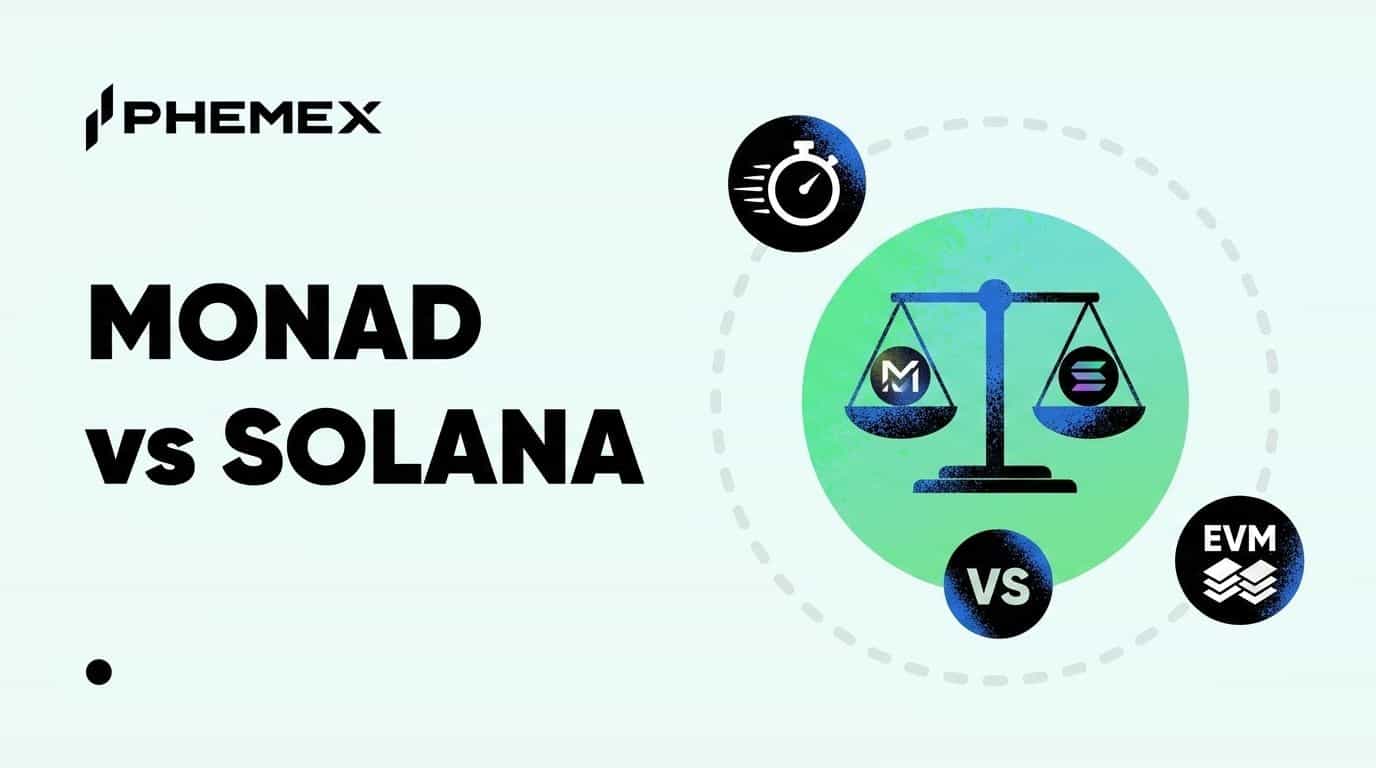
Monad's mainnet launched in November 2025 and has already crossed $355 million in total value locked with daily transactions running between 1.7 million and 2.1 million through March 2026. Solana, meanwhile, has been live since 2020, sits at roughly $5.8 billion in TVL, and just shipped Firedancer, the validator client that demonstrated over 1 million transactions per second in controlled testing and is now running on 26% of mainnet validators. These are two very different chains at very different stages, and comparing them straight across misses most of what matters.
The real question is not which chain is faster on paper. It is which one offers more upside from here, given where each stands today, what each has shipping over the next six to twelve months, and what you actually give up by choosing one over the other.
The Numbers Side by Side
Before getting into the nuance, here is what the raw specs look like as of mid-April 2026.
|
Category
|
Monad (MON)
|
Solana (SOL)
|
|
Real-World TPS
|
~2,000-3,000 (ramping)
|
~5,500 (with Firedancer)
|
|
Theoretical Max TPS
|
10,000
|
1,000,000+ (Firedancer testnet)
|
|
Block Time
|
400ms
|
390ms
|
|
Finality
|
~800ms (single-slot)
|
~12.8s (150ms target with Alpenglow)
|
|
EVM Compatible
|
Yes, full bytecode compatibility
|
No, uses Rust/SVM
|
|
Consensus
|
MonadBFT (pipelined HotStuff variant)
|
Tower BFT + Proof of History
|
|
Total Funding
|
$248M (top-tier VCs, Dragonfly)
|
$335M+ (a16z, Polychain, Multicoin)
|
|
TVL
|
~$355M
|
~$5.8B
|
|
Token Price
|
~$0.036
|
~$82
|
|
Market Cap
|
~$360M (FDV ~$3.5B)
|
~$38B
|
|
Mainnet Age
|
~5 months
|
~5.5 years
|
|
Active Developers
|
Growing (early stage)
|
17,700+
|
|
Notable dApps
|
Uniswap, Curve, Kuru, PerplTrade
|
Jupiter, Raydium, Marinade, Phoenix
|
The table tells you what the numbers already suggest. Solana is the incumbent with proven infrastructure and deep liquidity. Monad is the challenger with faster finality today but a fraction of the ecosystem.
Monad's Parallel EVM vs Solana's Firedancer
This is where the technical comparison gets interesting, because these two chains are solving the same problem from opposite directions.
Monad takes the Ethereum Virtual Machine, the execution environment that powers roughly 70% of all DeFi activity, and makes it fast. Its core innovation is optimistic parallel execution. Transactions are still ordered linearly, but the engine identifies which ones can run simultaneously without conflicting, then executes them in parallel across CPU cores. The result is 10,000 TPS with full Ethereum bytecode compatibility, meaning any Solidity smart contract deployed on Ethereum can run on Monad with zero code changes.
Solana took the opposite approach from day one. Instead of making the EVM faster, Anatoly Yakovenko built a completely new runtime (the Solana Virtual Machine) and a new programming model (Sealevel) optimized for parallelism from the ground up. Firedancer, built by Jump Crypto over three years, rewrites the validator client in C/C++ with kernel-bypass networking that pushes throughput to the hardware limit.
The practical difference for developers is significant. If you have an existing Ethereum project, deploying on Monad takes hours. Deploying on Solana means rewriting everything in Rust and adapting to a fundamentally different state model. But if you are building from scratch and want maximum performance, Solana's architecture gives you lower-level control and a five-year head start on tooling, libraries, and battle-tested infrastructure.
For traders, the question is simpler. Monad's EVM compatibility means Ethereum's $85 billion DeFi ecosystem has a low-friction migration path. Solana's performance ceiling is higher, but it requires developers to commit to its specific stack.
Ecosystem Maturity and Where the Capital Is Flowing
Solana has 2,100+ active dApps, $5.8 billion in TVL, and 167 million monthly active wallets. It generates meaningful on-chain revenue. Jupiter alone processes billions in swap volume monthly, and the Solana DeFi stack (Raydium, Marinade, Phoenix, Drift) has survived multiple stress tests including network outages, FTX collapse fallout, and the 2024 bear market.
Monad at five months old has a different story. Uniswap and Curve deployed on mainnet, which gives it credible DeFi primitives out of the gate. Kuru, an on-chain order book DEX purpose-built for Monad's speed, raised a seed round. PerplTrade is live for perpetual futures. And the Monad Momentum incentive program is driving the $355 million in TVL, with Wave 2 targeting user retention and revenue-generating protocols in Q2 2026.
The venture capital signal matters here. The $225 million Series A was led at a $3 billion valuation by one of crypto's largest venture funds, and ecosystem projects are attracting VC interest at a pace that mirrors early Solana in 2021. That does not mean Monad will follow the same trajectory, but it does mean smart money is betting the EVM compatibility angle opens a market Solana cannot easily capture.
Who Has More Upside From Here
This is where the comparison shifts from technical specs to risk-reward math.
The case for Monad. MON is trading at roughly $0.036 with a fully diluted valuation around $3.5 billion. If Monad captures even 10-15% of the EVM DeFi market that currently sits on Ethereum L2s, the TVL growth alone could drive a 3-5x revaluation. The MONAD_NINE upgrade in February 2026 already improved execution efficiency, and the roadmap through Q3-Q4 targets further throughput gains. The risk is that five months of mainnet history is not enough to prove long-term reliability, and roughly 46.7 billion MON tokens allocated to team and investors begin vesting in November 2026.
The case for Solana. SOL at $82 is down 35% from its January high of $127 and more than 70% below its all-time high near $293. Standard Chartered has a $250 price target for 2026. With Firedancer pushing real-world TPS above 5,500 and Alpenglow targeting 150-millisecond finality, Solana is shipping upgrades that could eliminate its last remaining technical criticism (the outage history). The last major network outage was February 2024, over 14 months of uninterrupted uptime. And its $38 billion market cap, while large, still represents a discount to Ethereum's $250 billion+ valuation despite comparable or superior on-chain metrics in several categories.
The risk profiles are completely different. Monad is an early-stage bet with higher potential multiples but token vesting risk, unproven infrastructure under peak load, and an ecosystem that needs 12-18 months to mature. Solana is a mid-stage bet with lower potential multiples but proven infrastructure, deep ecosystem moats, institutional adoption (Visa, Stripe, Shopify integrations), and macro headwinds as the primary drag on price.
Who Should Hold Which
The honest framework depends on your portfolio size and risk tolerance, not on which chain has better tech specs.
If you are building a core crypto portfolio and want Layer-1 exposure with lower relative risk, SOL at $82 with $5.8 billion in TVL and institutional adoption is the more defensible position. The downside is better understood, the upside to $150-250 represents a solid 2-3x from current levels, and the ecosystem generates real economic activity.
If you already hold BTC and ETH as your core positions and are looking for a satellite allocation (2-5% of portfolio) with asymmetric upside, MON offers a fundamentally different risk-reward curve. A $360 million market cap for a chain with $355 million TVL, $248 million in top-tier VC backing, and full EVM compatibility is the kind of early pricing that either looks brilliant in 18 months or gets crushed by token dilution and ecosystem competition.
And there is no rule that says you have to pick one. A 5% SOL / 2% MON split gives you exposure to both the incumbent and the challenger without overweighting the higher-risk position.
Frequently Asked Questions
Is Monad faster than Solana?
Monad has faster finality today at roughly 800 milliseconds compared to Solana's 12.8 seconds, and that gap matters for DeFi applications where execution speed affects liquidation accuracy and arbitrage efficiency. However, Solana's Alpenglow upgrade targets 150-millisecond finality, and its raw throughput at 5,500+ real-world TPS currently exceeds Monad's live numbers. The answer depends on which metric you weight most heavily in your own evaluation.
Can Ethereum dApps run on Monad without changes?
Yes, Monad maintains full EVM bytecode compatibility, meaning any smart contract written in Solidity or Vyper for Ethereum can deploy on Monad without modifying a single line of code. That is the core differentiator versus Solana, which requires developers to rewrite applications in Rust using the Solana Virtual Machine. Uniswap and Curve already deployed on Monad as proof of this compatibility.
Is MON or SOL a better investment in 2026?
They are fundamentally different risk profiles. SOL is a large-cap Layer-1 with proven infrastructure, institutional backing, and a $38 billion market cap where a move to $150-250 represents a 2-3x return. MON is an early-stage token with a $360 million market cap where the upside could be significantly higher but comes with token vesting risk starting November 2026 and an unproven track record under peak network stress.
Why does EVM compatibility matter for Monad's growth?
Roughly 70% of all DeFi total value locked sits on EVM-compatible chains. Developers who have spent years building Solidity tooling, auditing frameworks, and smart contract libraries can migrate to Monad without learning a new language or rewriting their codebase. That reduces the friction of ecosystem growth from years to months, which is exactly what Monad's $355 million TVL in five months demonstrates.
Bottom Line
Solana at $82 with Firedancer live, 14 months of unbroken uptime, and institutional integrations from Visa to Stripe is the safer Layer-1 bet with a clear path to $150+ if macro conditions improve and Alpenglow ships on schedule. Monad at $0.036 with $355 million TVL five months after launch and full EVM compatibility is the higher-variance bet where the payoff depends on ecosystem growth outpacing the token vesting schedule that begins releasing in November 2026. The levels to watch are $75 support and $100 resistance for SOL, and $0.02 support with $0.05-0.06 as the breakout zone for MON. If you are forced to pick one, your time horizon answers the question. Under twelve months, SOL has the more predictable setup. Over two years, Monad's EVM compatibility thesis has the potential to reshape how capital flows between Ethereum and alternative Layer-1s.
This article is for informational purposes only and does not constitute financial or investment advice. Cryptocurrency trading involves substantial risk. Always conduct your own research before making trading decisions.