


HYPE closed Monday 31 August 2026 at $84.248, sitting 0.8% under the all-time closing high of $84.691 that the token printed four sessions earlier on Thursday 27 August. That is where the asset stands after Hyperliquid has retired roughly $1.3 billion of its own token since December 2024, through a mechanism that routes about 99% of eligible fee revenue straight into buying HYPE and destroying it. The number worth studying is not the price itself but the tension around it, because the token is holding within a percentage point of its record while a scheduled release of 9.92 million HYPE sits on the calendar for Sunday 6 September 2026.
Forecasting HYPE off a chart pattern is guesswork. Forecasting it off the burn rate, the vesting schedule and the dated levels that already exist is checkable, which is what the rest of this article does.
What the Monday 31 August Close Actually Shows
Across the 627 daily sessions since Thursday 12 December 2024, that Monday ranks 114th by size of move. It was an ordinary session by this token's standards, and anyone framing it as a breakout is selling you a story the data does not support. The structural fact is quieter and more useful, because HYPE is absorbing scheduled supply and still trading a fraction under its own record close.
|
Marker
|
Level
|
Date
|
|
All-time closing high
|
$84.691
|
Thursday 27 August 2026
|
|
Reference close used throughout
|
$84.248
|
Monday 31 August 2026
|
|
52-week closing low
|
$20.973
|
Tuesday 20 January 2026
|
|
All-time closing low
|
$10.217
|
Sunday 6 April 2025
|
That Monday close sits 300.7% above the January low, a range expansion that usually leaves a token exhausted and drifting. HYPE is not drifting, and the reason is mechanical rather than sentimental. The full daily series behind those markers is public on CoinGecko's Hyperliquid price history.
How the Buyback Flywheel Actually Works
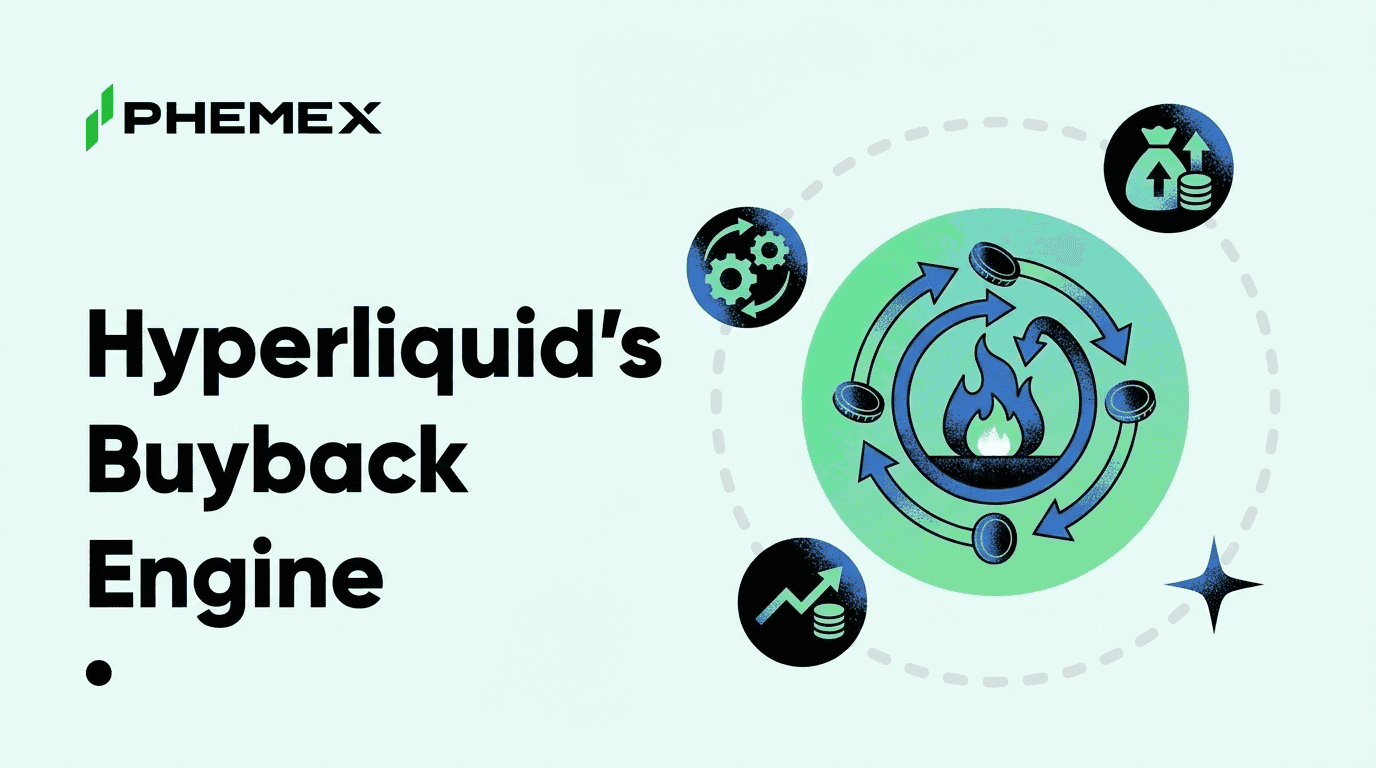
Hyperliquid runs a perpetual futures venue on its own chain, and the fees that venue generates do not sit in a treasury waiting for a governance vote. Roughly 99% of eligible fee revenue is automatically used to buy HYPE on the open market and burn it, and the fee and revenue series for the venue is tracked publicly rather than self-reported. Think of it as a company running a permanent share repurchase funded straight out of the till, except the shares are destroyed the moment they arrive rather than parked as treasury stock.
The quarterly numbers show how tightly revenue and burn are coupled. In the second quarter of 2026, covering 1 April to 30 June, Hyperliquid generated $169 million of revenue and sent $141 million of it into repurchases, reported on Thursday 6 August 2026. That is a payout ratio no listed company would attempt, and it is the single most important input to any HYPE forecast, because the token's demand floor becomes a direct function of how much perpetual futuresvolume the venue clears.
What that does to float is easier to see with the arithmetic in front of you. At the $84.248 reference close, a quarter of repurchases running at the second-quarter rate of $141 million would retire roughly 1.67 million HYPE. Set that against the vesting side, where the core-contributor schedule makes 9.92 million tokens claimable every month, or close to 29.8 million across a quarter, and the burn covers a little under 6% of the scheduled release. Stated that way the mechanism sounds weak, and on notional terms it is.
The reason it has not behaved weakly is the claim rate, which a later section takes apart. Roughly 1.75% of a tranche was claimed in March, so the tokens that genuinely reached circulation from that month's release were nearer 174,000 than 9.92 million. Measured against that number the burn is not a rounding error but a multiple, retiring roughly three times what an equivalent stretch of claims delivers. The float math works only while both halves of that sentence hold.
And the second half is where the mechanism weakens. Revenue is the only input the buyback has, so a quarter arriving materially below $169 million shrinks the retired quantity in direct proportion, with no announcement, no vote and no warning beyond the fee data itself. A protocol funding repurchases out of a treasury can keep buying through a slow quarter because the money is already sitting there. Hyperliquid cannot, because it never holds the money in the first place. The same design that makes the burn credible in a strong quarter makes it evaporate in a weak one, and any forecast treating that bid as a constant has misread the mechanism it depends on.
The scale is what separates this from the dozens of protocols that announce a buyback and quietly do very little. Of the $638 million of crypto token buybacks executed across the market in 2026 through Tuesday 25 August, Hyperliquid accounts for roughly $370 million, or about 58% of the total, according to Allium Labs data reported by the Financial Times. Add Pump.fun and the two protocols together make up close to 90% of every token buyback dollar spent during the year.
Were an automated buyback a normal feature of token design, that $638 million would be spread thinly across dozens of names in amounts that individually change nothing. Instead two protocols account for close to nine dollars in every ten, which tells you that most of the market announcing a repurchase is either doing it at a size incapable of moving its own float or is not meaningfully doing it at all. The model remains rare, and that rarity is why HYPE trades on a mechanism story rather than on sector beta.
The same concentration is a fragility, and it cuts against the token as easily as for it. A market statistic carried by two participants is not a trend, and reading $638 million as evidence that crypto has collectively discovered shareholder returns would be reading two companies as an economy.
This is where the forecast becomes checkable rather than speculative. If venue volume holds, the burn holds, and if volume falls the burn falls with it and the supply side of the equation stops being offset. Traders watching funding rateson the venue are effectively watching the leading indicator for the buyback, since funding activity and open interest track the same fee base that pays for it. The design thinking behind that choice is covered in more depth in our profile of Jeff Yan and how he built Hyperliquid.
The Control Says This Is About HYPE and Not About Crypto
One session in isolation proves nothing, so the useful test is what everything else did across the same Monday. GMX is the closest perpetual-DEX comparable without a buyback flywheel operating at anything near this scale, and it moved in the opposite direction while the majors moved modestly higher.
|
Asset
|
Monday 31 August 2026 session
|
|
GMX
|
−0.94%
|
|
ETH
|
+2.02%
|
|
XRP
|
+1.63%
|
|
SOL
|
+1.26%
|
|
BTC
|
+1.14%
|
HYPE's position near its record close is not a beta trade on a strong crypto tape, because the tape was mildly positive and the nearest structural peer went down. Whatever is supporting the token is specific to Hyperliquid.
A control exists to answer one question, which is what the asset would have done anyway. Without one, every explanation stays available and none can be ruled out, because a token holding near its high on a green tape may simply be doing what the tape did. That ordinary explanation does not fit here, which is the whole value of running the check.
What the control does not do is prove causation. One session is one observation, and GMX differs from Hyperliquid in venue design, listed markets and holder base as well as in buyback policy, so the two could diverge for reasons unrelated to burns. The control narrows the field of explanations without picking the winner, and anyone presenting a single green session as proof of a mechanism is selling more certainty than the data contains.
The 6 September Unlock and Why the Headline Number Misleads
On Sunday 6 September 2026, a core-contributor tranche of 9.92 million HYPE becomes claimable. At the Monday 31 August close that tranche is worth roughly $797 million, and that is the figure most coverage will lead with. It is also the figure most likely to mislead you.
The tranche is one of 24 monthly linear releases carved out of a core-contributor allocation of about 238 million HYPE, so this is a scheduled drip rather than a cliff. And the historic claim rate on these tranches has been low. In March, roughly 1.75% of the available tranche was actually claimed. A claim is not a sale either, so the $797 million headline describes tokens that become eligible to move rather than tokens arriving on an order book.
Treating the full notional as a sell wall has been the wrong read at every tranche since the schedule began. That does not make it permanently wrong, and the claim rate is the specific thing to watch on the day, because a jump from under 2% toward double digits would signal a real change in contributor behaviour rather than a repeat of the pattern. For the general mechanics of how vesting schedules pressure altcoin prices, our guide to token inflation covers the framework, and ASXN's HYPE unlock dashboard tracks the tranche calendar itself.
The lesson is portable to the next token that puts a nine-figure release on its calendar. Four questions separate a supply event that matters from one that only reads as though it does.
Is it a cliff or a drip?
A single dated release of an entire allocation and a linear monthly schedule produce completely different behaviour, and most coverage does not bother distinguishing them. Hyperliquid's core-contributor allocation of roughly 238 million HYPE is cut into 24 even monthly slices, so the event repeats on a known cadence instead of arriving once as a surprise. Markets price repetition far better than they price novelty.
Who is holding the tokens?
Contributor allocations, early-investor allocations and foundation reserves behave nothing alike. Contributors still working on a protocol generating nine figures of annual revenue have weaker reasons to sell than a fund closing out a vintage, and holder identity tells you more about likely behaviour than tranche size does.
Is the release claimable or automatic?
An automatic distribution puts tokens into wallets regardless of what anyone does. A claimable release requires a deliberate action, and every action carries a participation rate. That distinction is the entire reason a figure like 1.75% exists to be measured.
What sits on the other side of it?
An unlock into a protocol with no revenue is pure dilution with nothing opposing it. An unlock into a protocol retiring supply continuously is a race between two measurable flows, and you can size both sides before the date arrives rather than reacting after it.
TVL Fell While the Token Held Near Its Record
A burn-only story leaves out the uncomfortable half of the picture. DeFi total value locked on the Hyperliquid chain fell from $1.5549 billion at the Sunday 30 August close to $1.4675 billion at the Monday 31 August close, a drop of roughly $87 million, or 5.6%, in a single session. You can verify the daily series yourself on DefiLlama's Hyperliquid chain page.
Capital leaving the chain while the token holds within a percentage point of its all-time close is not a contradiction, but it is a warning worth taking seriously. TVL measures deposited capital, and the buyback is funded by trading fees rather than by deposits, so the two can diverge for a while. They cannot diverge forever, because the applications holding that capital are part of what brings traders to the venue in the first place. The permissionless-market standard that lets builders deploy their own order books, covered in our piece on HIP-3 and Hyperliquid's permissionless markets, is the mechanism meant to keep that flywheel fed.
The two measures answer different questions, which is how they can point opposite ways without either being wrong. TVL counts capital parked in lending markets, vaults and liquidity on the chain, and it moves when depositors reprice risk or chase yield somewhere else. Fee revenue counts activity on the venue, and it moves when traders open and close positions. A trader can generate fees all session without depositing a dollar into a lending market, and a depositor can sit in a vault for months generating none.
The link between them is slower and runs through what the chain is for. Applications holding deposited capital are part of why traders route to the venue rather than elsewhere, so a sustained deposit exodus eventually shows up as thinner activity, then as smaller fees, then as a smaller burn. That takes months rather than sessions, which is why one reading carries almost no information and a trend carries a great deal.
The divergence is a clock rather than a contradiction waiting to be resolved, and which measure moves first across the next several weekly readings is observable rather than forecastable. A single session of TVL decline is noise. A month of it, running alongside a flat or falling fee base, would be the first genuine crack in the buyback thesis.
What Would Actually Change the Forecast
No credible price target exists for HYPE that is not somebody's guess dressed up in a chart, so this section names conditions instead. There are three, and each resolves on a date you can put in a calendar.
The claim rate on Sunday 6 September. Under 2% and the pattern holds, which is what has happened every month to date. Meaningfully above that and the supply side of the equation changes for the first time.
The next quarterly revenue print against the $169 million second-quarter figure. Revenue direction is burn direction, and the adjustment happens silently.
A rebuild in chain TVL from the $1.4675 billion level, or a continued slide. Deposits are the earliest signal that the fee base is about to follow them out.
On the upside there is exactly one level carrying information, and that is the $84.691 all-time close from Thursday 27 August 2026. Until a daily close prints above it, every move underneath is range behaviour regardless of how it feels intraday. The reason most traders lose money on tokens like this is that they treat proximity to a record as confirmation of a new one, when proximity is simply where price happens to be.
Frequently Asked Questions
Does the HYPE buyback guarantee the price goes up?
No. A buyback removes supply, but it cannot outrun selling that exceeds the burn rate, and the burn itself shrinks whenever venue revenue shrinks. It changes the odds rather than the outcome.
How much HYPE has the protocol burned in total since December 2024?
Roughly $1.3 billion worth, funded by around 99% of eligible fee revenue. The burn runs continuously rather than in scheduled batches, so there is no single announcement to trade around.
Why does the September tranche look so large compared with earlier ones?
In token terms it does not. The 9.92 million release is one of 24 evenly sized monthly slices, and the dollar figure looks bigger only because HYPE is priced far higher than when the schedule started.
Is falling TVL a reason to avoid HYPE?
Falling deposits are a reason to check the fee base before assuming the buyback continues at pace. TVL and revenue measure different things, and one session of decline in either is not a trend.
Bottom Line
HYPE finished Monday 31 August 2026 fractionally under its own record close while the protocol behind it accounted for roughly 58% of every token buyback dollar spent across crypto in 2026. A token absorbing scheduled supply without surrendering its highs is unusual enough to be tracked on specific dates rather than on sentiment. Sunday 6 September gives you the claim rate on a 9.92 million token tranche, the next quarterly revenue figure gives you the burn trajectory against the $169 million second-quarter benchmark, and the $1.4675 billion TVL reading gives you an early warning if deposits keep leaving the chain. The $84.691 close from Thursday 27 August is the only upside level that means anything until a daily close clears it. Everything else is a story, and this token has never needed one.
This article is for informational purposes only and does not constitute financial or investment advice. Cryptocurrency trading involves substantial risk. Always conduct your own research before making trading decisions.