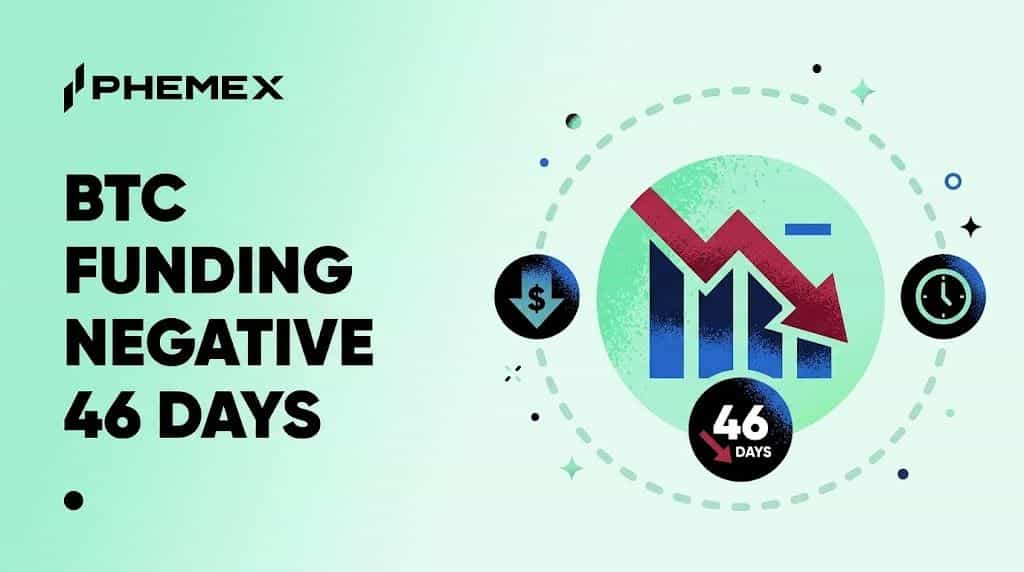
BTC perpetuals have posted a negative 30-day average funding rate for 46 consecutive days as of April 15, 2026. That is the longest sustained negative funding streak since November 2022, when BTC was grinding through the post-FTX wreckage below $16,000. Open interest across major exchanges is not falling alongside funding. It is rising, which means new short positions are actively being added at current levels. The combination of rising open interest and negative funding creates what derivatives traders call a "crowded short" regime, and that regime has a specific historical track record.
The last two times this exact setup appeared, both resolved with violent upside moves that liquidated the short side within weeks. BTC is sitting at $74,287 today, and the short side of the market is betting heavily that lower prices are coming.
What Negative Funding Actually Tells You
Perpetual futures contracts have no expiry date, so exchanges use a funding rate mechanism to keep the contract price tethered to spot. When longs outnumber shorts, longs pay shorts every eight hours. When shorts outnumber longs, shorts pay longs. The direction of the payment tells you which side of the trade is more crowded.
A negative funding rate means shorts are dominant. They are paying a fee to maintain their positions, which signals conviction that prices are heading lower. A single day of negative funding means nothing on its own because intraday swings and arbitrage can flip funding temporarily. But 46 consecutive days of negative 30-day average funding is not noise. That kind of sustained directional pressure reflects a structural positioning bias across the derivatives market.
The CoinGlass funding rate dashboard shows the Binance BTC/USDT perpetual 30-day average has been below zero since approximately March 1, 2026. Bybit and OKX perpetuals show similar readings, confirming this is not exchange-specific. The entire BTC perpetual market is short-biased and has been for over six weeks.
Source: Coinglass
Why Rising Open Interest Makes This Signal Stronger
Negative funding alone does not guarantee anything. The signal sharpens when you pair it with open interest data, and right now that pairing is telling a very specific story.
Open interest across BTC perpetuals has climbed roughly 12% over the past month even as funding stayed negative. In plain terms, traders are actively opening new short positions rather than simply holding existing ones. Fresh capital is flowing into the short side of the trade at $74,000, adding to an already crowded position.
This matters because of how liquidations work. Every short position has a liquidation price above the entry point. As more shorts pile in at similar levels, the liquidation density above current price increases. If BTC rallies through that cluster, forced buybacks from liquidated shorts accelerate the move, which triggers more liquidations above, which accelerates the move further. Derivatives traders call this a short squeeze, and crowded short regimes are where squeezes originate.
The opposite scenario, where open interest drops alongside negative funding, would tell a different story. That would mean shorts are closing their positions and taking profit, which reduces squeeze risk. But open interest rising while funding stays negative is the aggressive setup. The short side is adding, not covering.
The Two Times This Happened Before
The current 46-day streak has two direct historical parallels in BTC perpetual futures data, and both resolved in the same direction.
|
Episode
|
Negative Funding Duration
|
BTC Price at Start
|
BTC Price 60 Days After
|
Move
|
|
Nov-Dec 2022 (FTX collapse)
|
~50 days
|
~$15,500
|
~$23,000
|
+48%
|
|
Jun-Jul 2021 (China mining ban)
|
~40 days
|
~$29,000
|
~$48,000
|
+65%
|
|
Apr 2026 (current)
|
46 days and counting
|
$74,287
|
Developing
|
Developing
|
November 2022. FTX collapsed on November 11, and the entire market panicked. Funding flipped deeply negative as traders piled into shorts expecting further contagion. Open interest initially dropped during the acute liquidation phase but then rebuilt on the short side as traders positioned for a leg to $10,000 that never came. BTC bottomed near $15,500 and spent about 50 days in negative funding territory before the short side capitulated and price ripped to $23,000 by late January 2023.
June 2021. China announced a full ban on crypto mining, triggering a wave of forced selling from miners and a broader panic. BTC fell from $40,000 to below $30,000, and funding turned negative as the market priced in further downside from hashrate migration uncertainty. Funding stayed negative for roughly 40 days. BTC then rallied from $29,000 to $48,000 by October as the mining capacity relocated and the short thesis unwound.
The sample size is small. Two prior instances is not a statistically significant dataset, and anyone who tells you otherwise is overselling the signal. But the pattern makes mechanical sense because crowded shorts create exactly the fuel a squeeze needs to ignite. When the catalyst arrives, the forced buying from short liquidations amplifies the move well beyond what organic demand alone would produce.
What Could Trigger the Unwind
A crowded short regime tells you the fuel is loaded. It does not tell you when the spark arrives. In the two prior episodes, the catalyst was different each time. The FTX bottom formed when contagion fears failed to produce another major exchange collapse and buyers stepped in at historically cheap levels. The China mining ban bottom formed when hashrate data showed miners were relocating rather than shutting down permanently.
For the current setup, several potential catalysts are on the table within the next 30-60 days. The May FOMC meeting could shift rate expectations if the Fed signals cuts are closer than the market currently prices. BTC ETF flow data has been mixed but any sustained week of net inflows above $500 million would pressure the short thesis directly. And geopolitical de-escalation in any of the three active conflict zones would reduce the macro fear premium that has kept risk assets suppressed.
But the catalyst does not need to be dramatic. In crowded short regimes, sometimes the trigger is simply time. Shorts pay funding every eight hours. At current rates, maintaining a leveraged short position costs roughly 0.5-1% per week in funding fees. If BTC refuses to break down and just consolidates sideways for another few weeks, the cost of holding those shorts accumulates until positions are closed out of attrition rather than conviction. Death by a thousand funding payments is a real phenomenon in perpetual markets.
What the Bears Are Seeing
The short side is not positioning recklessly. They have a thesis, and it deserves examination because understanding both sides of a trade is how you avoid getting caught on either one.
Global risk appetite is genuinely weak. The S&P 500 is down roughly 8% from its February highs, and the correlation between BTC and equities has tightened over the past quarter. If equities roll over further, BTC has historically followed, and shorts are betting that the macro environment deteriorates before any bullish catalyst materializes.
BTC also failed to reclaim $80,000 on three separate attempts in March and early April. Each rejection was lower than the previous one, forming a descending resistance pattern that technical traders interpret as weakening demand. The argument is straightforward. If buyers cannot push through $80,000 with three tries, the next move is more likely down toward the $65,000-$68,000 support zone than up through resistance.
And the on-chain data shows long-term holders have been distributing into this range. Glassnode's Spent Output Profit Ratio for long-term holders has been above 1.0 consistently, meaning experienced holders are selling at a profit into the current price range rather than accumulating. When the "smart money" is selling and the leveraged market is short, the bearish case has a logical foundation.
The question is if the shorts are right about the direction or if they are right about the risks but wrong about the timing, which is what happened in both prior episodes.
How to Read This If You Are Positioning
The funding rate signal is not a timing tool. It tells you the market is leaning heavily in one direction, which historically has preceded a move in the opposite direction, but the gap between "the signal appears" and "the move happens" can be weeks to months.
For traders considering a long entry against the crowded short, the risk management framework matters more than the entry price. The key support level is the $65,000-$68,000 zone where BTC found buyers in late February and early March. A sustained daily close below $65,000 would invalidate the "crowded short leads to squeeze" thesis and suggest the shorts are right about the direction rather than simply early.
On the upside, the first confirmation that the squeeze is underway would be a daily close above $80,000 on elevated volume, which would start triggering the short liquidation cluster that has built up between $80,000 and $85,000. The move from $80,000 to $85,000 could happen fast if the liquidation cascade activates.
Position sizing is everything in a setup like this. The signal says the probability favors the long side, but the timing is uncertain and the downside scenario of a break below $65,000 is a real possibility rather than a theoretical footnote. Small positions with defined stops allow you to be on the right side of the probability without getting wiped if the bears are right first.
Frequently Asked Questions
What does a negative funding rate mean for Bitcoin?
A negative funding rate means short sellers are dominant in the BTC perpetual futures market and are paying a fee to longs every eight hours to maintain their positions. It signals that the leveraged market expects lower prices. Sustained negative funding for weeks, rather than a single day, reflects genuine structural bearish positioning.
Has negative funding always led to a Bitcoin rally?
Not immediately, and not always. Short periods of negative funding (a few days) are common and carry no predictive value. Extended streaks of 40+ days have only occurred twice before in BTC perpetual history, and both preceded major rallies, but two data points do not make a guaranteed pattern. The mechanical logic is sound, but timing remains uncertain.
What is a short squeeze in crypto?
A short squeeze happens when a rising price forces short sellers to buy back their positions to limit losses or meet margin requirements. Those forced buybacks push the price higher, which triggers more short liquidations, creating a feedback loop. Squeezes are most powerful when open interest is high and short positions are concentrated at similar price levels.
Is $74,000 a good entry point for Bitcoin?
The crowded short data suggests the risk/reward tilts bullish at current levels, but that is a probability assessment, not a guarantee. If you enter here, define your risk clearly. A stop below $65,000 limits downside to roughly 12% if the thesis fails, while the upside in prior crowded-short resolutions was 48-65% over 60 days. The asymmetry is attractive, but only if you can survive the volatility between now and the resolution.
Bottom Line
Forty-six consecutive days of negative BTC funding with rising open interest is a rare signal. It has appeared twice before, and both times the market was pricing in disaster that turned out to be the bottom. The FTX collapse regime produced a 48% rally over two months. The China mining ban regime produced a 65% rally over a similar window. Neither bottom was obvious at the time, and both were aggressively shorted right up until the reversal began.
The current setup has BTC at $74,287 with a dense cluster of short liquidations stacked between $80,000 and $85,000. If any catalyst pushes price through that zone, the forced buying could produce the fastest leg up since the ETF approval rally of early 2024. If macro conditions deteriorate and $65,000 breaks instead, the shorts win and the pattern comparison breaks down. The market is positioned for one of those outcomes and paying 0.5-1% per week in funding fees to bet on it. History says that is an expensive bet to hold.
This article is for informational purposes only and does not constitute financial or investment advice. Cryptocurrency trading involves substantial risk. Always conduct your own research before making trading decisions.