


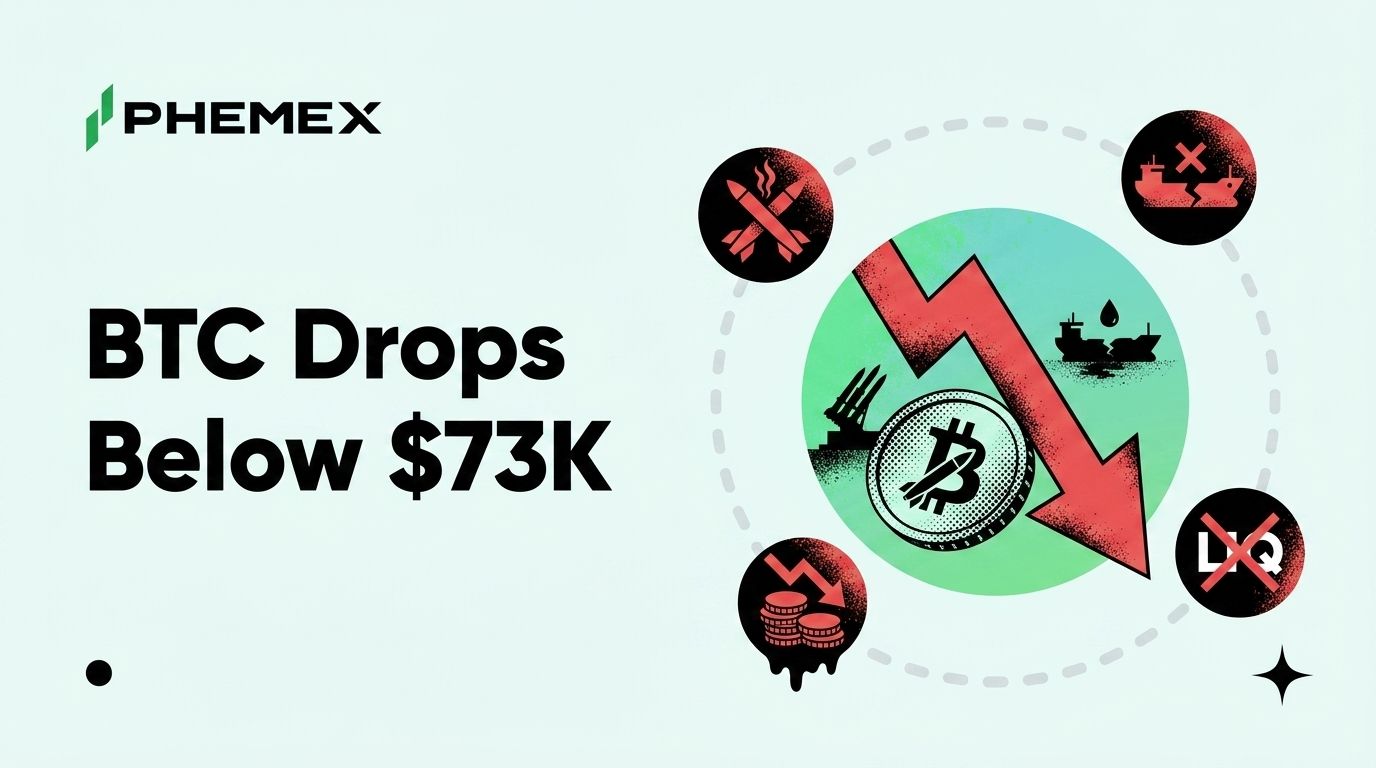
Bitcoin fell below $73,000 in the early hours of June 1, 2026, after a US strike package targeting Iranian air-defense radar between May 25 and 28 triggered roughly $1 billion in total crypto liquidations across centralized venues. BTC printed an intraday low of $72,840 before clawing back toward $74,000 after President Trump posted that the naval blockade in the Strait of Hormuz is "lifting." Iran's IRGC retaliated within hours, launching missile strikes on Kuwait's Ali Al Salem airbase on June 1.
The takeaway is not the dollar size of the wipeout. It is that macro desks now treat geopolitical headlines with the same weight they used to reserve for FOMC prints, and the algorithmic systems that route around those headlines do not wait for confirmation.
What the $1 Billion Liquidation Cascade Actually Looked Like
The aggregate number, roughly $958 million to $1.01 billion depending on which dataset you pull, masks how the cascade unfolded. The first leg started in the Asian session as Reuters carried confirmation of US strikes on Iranian S-300 radar batteries near Bandar Abbas. BTC dropped from $77,200 to $74,800 in 90 minutes, taking out about $340 million in long positions. The second leg arrived three hours later when Tehran state TV ran footage of the damage, and BTC punched through $74,000 to print $72,840. That second move triggered roughly $480 million in additional liquidations and another $180 million on ETH.
The cascade was not a leverage flush in the classic sense. Funding rates entering the move were already mildly negative across major venues, which usually limits forced selling on the long side. The bulk of the liquidations came from spot-margin positions and isolated-margin futures rather than cross-margin, and that distribution tells you the seller was retail.
Where the Next BTC Support Sits
The chart now has four levels that matter. The $72,800 intraday low is the line in the sand for the daily candle. A close back below it on volume would invalidate the early-June recovery and open the path to $69,400, the gap that formed when ETF inflows turned positive in late April. Below $69,400, the next real demand zone is the $66,800 to $67,200 cluster that absorbed the May correction and aligns with the 200-day moving average.
To the upside, $74,500 to $75,000 is the immediate resistance and the level BTC needs to reclaim on a daily close to keep the recovery thesis alive. Above that, $77,200 is the pre-strike high and the level where pre-conflict positioning will look to exit.
What ETF Flows Did During the Move
Spot Bitcoin ETF flows actually told a more constructive story than the price action. Net flows across the eleven US spot Bitcoin ETFs were minus $142 million on May 29, the first session of the move, but turned modestly positive at plus $38 million on May 30 and plus $61 million on June 1 even as price was still grinding lower. That divergence is the kind of signal that has historically marked tradeable bottoms during 2025 and into the first half of 2026.
The story is different on the futures side. CME open interest dropped roughly 8.2% from May 28 to June 1, which is the largest three-session deleveraging since the late-March correction. Open interest dropping into a price decline is healthier than open interest rising into one, because it tells you the speculative positioning that was vulnerable has already been cleared. Reviewing the broader DeFi liquidation mechanics and the crypto-security baseline is the operator-side check during volatility windows like this one.
Why Algorithmic Desks Now Treat Geopolitics Like FOMC
Two years ago, a missile strike in the Persian Gulf would have moved oil and equities for an hour and then faded out of crypto's risk model. That window has closed. The trigger language in modern execution algos now flags any Reuters, AP, or AFP headline that contains specific cluster terms (Iran, IRGC, Hormuz, Houthi, Saudi, Israel, Lebanon) and routes orders defensively for the next 90 to 120 minutes regardless of what the spot price is doing.
The practical consequence for retail traders is that you cannot fade these moves the way you could in 2023. The selling is not panic, it is mechanical, and it is being executed by systems that do not care where the bid is.
What the Volatility Tells Us About Market Structure
Realized volatility on BTC has spent most of 2026 compressed below 40, well below the 60-plus prints that defined late 2024. That compression is partly a function of ETF demand absorbing organic supply and partly a function of corporate treasuries (Strategy and the smaller cohort of imitators) refusing to sell on weakness. The strike-driven move pushed one-day realized vol to 58, the highest reading since the early-February correction.
The implied side moved too. One-week at-the-money implied vol on Deribit jumped from 38 to 71 in the 12 hours around the strike news, the kind of spike that historically resolves in five to seven sessions as the conflict either escalates or settles into a recognizable pattern. If you trade options, the bid-side opportunity arrives during the de-escalation phase, not during the spike itself.
What to Watch Next
Three things will define the next 72 hours. The first is the IRGC follow-up question on Kuwait: does it stay limited to base infrastructure or expand to oil-export targets. The second is the Strait of Hormuz crypto-toll system Iran has been quietly operating since late May, which is now the single most-watched onchain corridor for institutional desks tracking the conflict. The third is the question of US-listed spot ETF flows printing positive numbers through the volatility, because the inflow data is the cleanest signal that institutional positioning has not capitulated.
Frequently Asked Questions
How much did Bitcoin actually drop on the Iran strike news?
BTC fell from around $77,200 to an intraday low of $72,840 between May 29 and June 1, a peak-to-trough decline of roughly 5.6%. The move recovered most of the way back toward $74,000 within 24 hours after President Trump posted about the naval blockade lifting.
Why did the liquidations cluster on retail accounts instead of large funds?
Funding rates entering the move were already negative, which means cross-margin leveraged long positioning was lighter than usual. The bulk of the forced selling came from isolated-margin and spot-margin retail accounts that were operating on tighter buffers, exactly the structure that produces large nominal liquidation prints from relatively contained price moves.
Is the Strait of Hormuz crypto-toll story real or rumor?
It is real but reporting is fragmented. Multiple onchain analytics desks have flagged sustained USDT TRC-20 flows from Iranian-linked wallets to corridor-shipping intermediaries since late May, with stablecoin-denominated transit fees roughly tracking the $1 per barrel figure Iranian officials floated publicly.
Does this change the broader 2026 BTC outlook?
Not on its own at this point in the cycle. The structural drivers (ETF inflows, treasury accumulation, the post-halving supply squeeze) have not changed. What has changed is that geopolitical headlines now produce 5% intraday moves where they would have produced 1% to 2% moves a year ago, and that vol regime is sticky until the conflict deescalates.
Bottom Line
The $1 billion liquidation cascade is the new baseline for what a geopolitical headline can do to a crypto book that thinks it is hedged. BTC bottomed at $72,840 on June 1 and reclaimed $74,000 within 24 hours, but the move exposed how compressed positioning had become and how algorithmic execution amplifies the first 90 minutes of any conflict-linked headline. The next 72 hours will be defined by the IRGC follow-up, the Hormuz corridor, and ETF flow direction. If $72,800 holds on a closing basis and ETF flows stay positive through this week, the post-strike low is the buyable one. If that level breaks, $69,400 is the next stop.
This article is for informational purposes only and does not constitute financial or investment advice. Cryptocurrency trading involves substantial risk. Always conduct your own research before making trading decisions.