




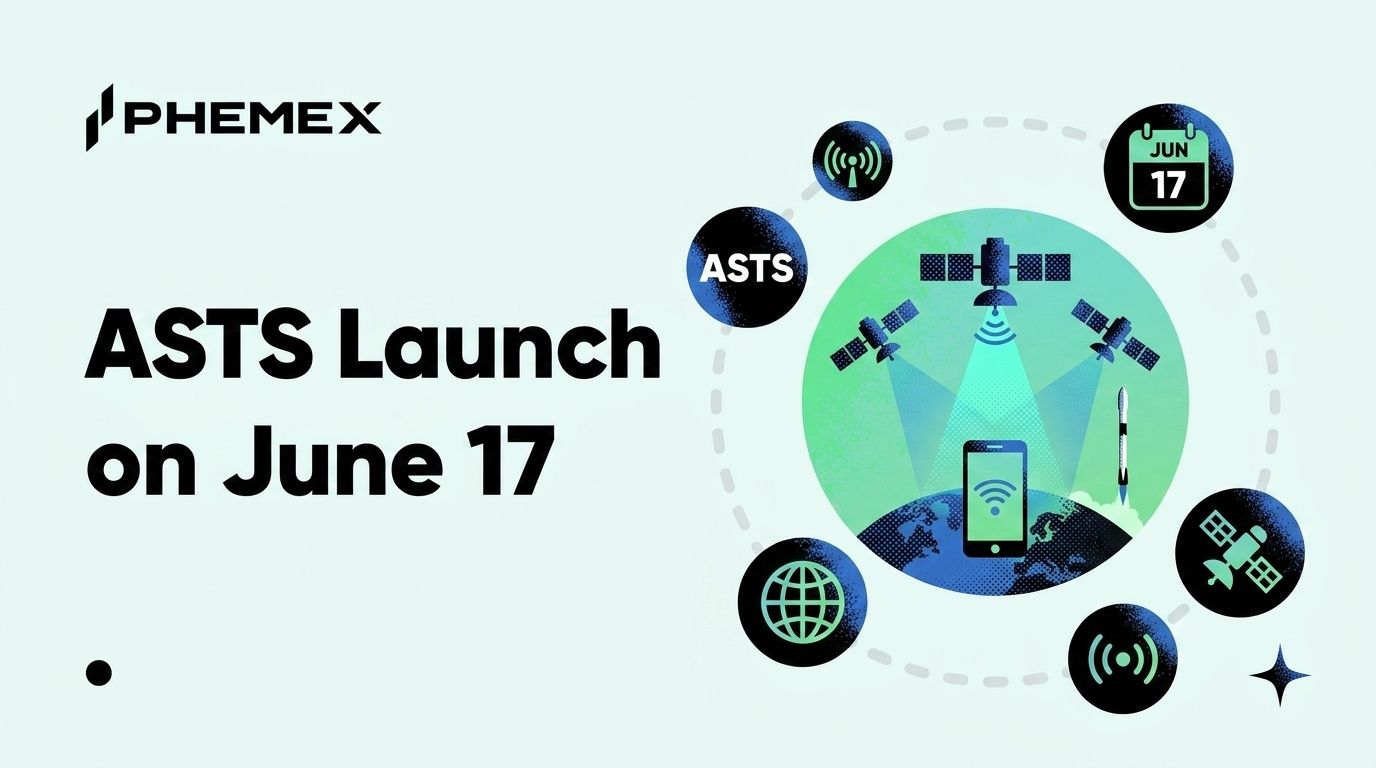
AST SpaceMobile has a Falcon 9 sitting on a Cape Canaveral pad waiting for a 2:39 a.m. EDT window on June 17, and the three satellites on top of it are the difference between a $60 price target and a $130 one. BlueBird 8, 9, and 10 take the in-orbit constellation past the threshold where commercial direct-to-cell service stops being a demo and starts being a product. ASTS is trading near $110 after a 6.39% move on June 9, sitting roughly 18% below the $133.86 all-time high it printed on May 28. The launch is the most concentrated risk event the stock has faced this cycle.
This is the kind of catalyst that does not split the difference. Either the spacecraft deploy and the FCC's recent Supplemental Coverage from Space authorization gets pointed at real orbiting hardware, or the timeline slips again and the bear case from Barclays gets another month of oxygen. Here is the breakdown.
What Is Actually Launching on June 17
The payload is three BlueBird Block 2 satellites, numbered 8, 9, and 10, riding a SpaceX Falcon 9 out of Cape Canaveral. The instantaneous window opens at 2:39 a.m. EDT on June 17, 2026, with backup opportunities the following morning if weather or vehicle holds force a scrub. AST's own mission overview frames this as the first launch of the constellation's commercial-class hardware, with each BlueBird Block 2 satellite carrying roughly 10x the bandwidth of the Block 1 prototypes that have been on orbit since 2024.
The size of these things matters for what they can do. Each BlueBird Block 2 unfolds a phased-array antenna roughly the area of a tennis court once deployed, which is the physical reason a standard 5G smartphone with no special antenna or modem can connect to one from the ground. The previous BlueBird 1 through 5 satellites already demonstrated peak in-orbit data speeds of 98.9 Mbps to an unmodified handset, which puts AST's per-satellite throughput in the same band as a healthy terrestrial 5G mid-band cell.
This is not a remote-area-only product. The pitch the company has been making to its strategic partners is that the satellites fill the gap inside existing AT&T, Verizon, and Vodafone footprints, which is roughly 500,000 square miles of dead zone inside the continental US alone. Three more Block 2 birds take the constellation closer to the 25 to 30 satellites the company has previously cited as the rough threshold for continuous commercial coverage in priority markets.
The FCC SCS Authorization Is the Quiet Headline
The piece that was missing for years got delivered in the spring. AST received Supplemental Coverage from Space authorization, which is the regulatory framework the FCC built specifically for letting satellite operators reuse terrestrial mobile spectrum that their carrier partners already hold. The FCC's SCS docket walks through the architecture, but the short version is that without SCS, every satellite-to-phone connection had to negotiate a separate spectrum carve-out per country and per band, which made commercial rollout effectively impossible at scale.
With SCS in hand, AT&T's 850 MHz spectrum in a Nevada dead zone is, from a regulatory standpoint, the same spectrum on the ground or 700 km up. That is the difference between a one-off science project and a service AT&T can sell tomorrow. The June 17 launch is the first one where the regulatory framework, the hardware, and the partner agreements are all in place at the same time.
The competing US satellite-direct-to-cell network is Starlink's Direct to Cell service, which has been signing up partners through T-Mobile. A useful frame for retail traders trying to size the SpaceX-vs-AST race is in Phemex's Starlink stock and space economy primer, which breaks down how the constellation business model layers consumer broadband on top of SCS-style mobile services. The Roth Capital thesis, summarized below, is that AST has both a hardware edge and a two-year head start on the SCS regulatory work that Starlink is only now catching up to.
Why Wall Street Is Not on the Same Page
This is the most useful split on the sell-side AST has had in months. Barclays cut its price target on June 5 to $60 from $65, citing further-than-expected launch slippage and execution risk on the Block 2 hardware ramp. Roth Capital sits at the other end, telling clients that AST has the better mousetrap and a two-year lead over the leading low-Earth-orbit broadband constellation on the specific SCS-to-handset use case.
The underlying financials make both views defensible. ASTS has $70.9 million in trailing 12-month revenue and a profit margin in the neighborhood of -574%, which is what a pre-commercial buildout looks like when the launches and the spectrum agreements precede the customer billing. The bull view is that the revenue line inflects sharply once the SCS service goes commercial and AT&T starts paying per-subscriber wholesale rates. The bear view is that every quarter of launch delay pushes the inflection further out while the cash burn keeps grinding.
|
Analyst stance
|
Price target
|
Core thesis
|
|
Roth Capital bull
|
$130+ implied
|
Better hardware than competition, SCS lead, partner moat
|
|
Street consensus
|
~$95 mid
|
Recognizes catalyst, discounts execution risk
|
|
Barclays bear
|
$60
|
Launch delays compound, cash burn outruns revenue inflection
|
For traders, the dispersion itself is the signal. A stock with a $60-to-$130 sell-side range moves the most on any data point that pulls those targets closer together. A clean BlueBird 8/9/10 deploy collapses the range upward. A scrub-to-delay-to-redesign sequence collapses it downward.
The Partner Stack Is the Moat
The strategic investor and partner list reads like the global mobile operator phone book. AT&T and Verizon cover the US. Vodafone covers most of Western Europe and significant Africa exposure. Rakuten brings Japan and a large global IoT footprint. Bell and Telus cover Canada. stc Group anchors the Gulf. American Tower owns the terrestrial passive infrastructure that AT&T and Verizon already lease, which makes the SCS network operationally compatible with the ground network from day one. Google sits as both a strategic and a distribution partner through Android device integration.
This is the part of the story that does not show up on the income statement yet. Each of those partners has a commercial framework in place that converts to revenue once enough satellites are on orbit to guarantee a service-level agreement in their territories. The June 17 launch is one of the gating events that pulls those contracts from MOU status into actual billing. The follow-on launches scheduled through the back half of 2026 are what take the constellation to the coverage threshold each partner has individually demanded.
How to Think About the June 17 Trade Setup
ASTS goes into the launch sitting near $110 after a 6.39% rally on June 9. The 52-week range tops out at the $133.86 all-time high from May 28 and runs back to the high-$30s on the low end. That is a wide enough band that position sizing matters more than directional conviction. The Barclays $60 target is roughly 45% below current and the Roth bull case sits 18%-plus above the ATH.
The cleanest way to frame the catalyst is in three scenarios. A successful launch with on-orbit deployment confirmation typically prints in the same session, since SpaceX provides live telemetry through fairing separation and deploy. That removes the largest individual risk on the stock and historically retests the prior high inside two weeks. A scrub with a same-week recycle is the base case for any Falcon 9 mission and tends to produce a modest fade that recovers on the next attempt. A multi-week slip, hardware anomaly, or deploy failure is the scenario that puts the Barclays $60 PT back in the conversation.
The other piece to pair with this is the broader pre-IPO space-stock setup, since AST is the closest publicly traded analog to the constellations still inside SpaceX. Phemex's SpaceX pre-IPO guide gives a useful frame for how the public market has been pricing space-economy exposure that retail investors otherwise cannot access directly. A clean BlueBird launch tightens that comp meaningfully.
FAQ
What time is the AST SpaceMobile BlueBird launch on June 17?
The instantaneous window opens at 2:39 a.m. EDT on June 17, 2026, from Cape Canaveral on a SpaceX Falcon 9. Backup attempts on June 18 or later are standard for any Falcon 9 mission if the primary window scrubs for weather or a vehicle issue.
What is FCC Supplemental Coverage from Space and why does it matter for ASTS?
SCS is the FCC's framework that lets satellite operators use terrestrial mobile spectrum that their carrier partners already hold. For AST, it removes the per-country, per-band spectrum negotiation that previously blocked any large-scale commercial rollout of satellite-to-phone service. With SCS in place plus enough satellites on orbit, AT&T and Verizon can sell coverage in dead zones using standard 5G handsets.
How fast are the AST SpaceMobile satellites?
The earlier BlueBird Block 1 satellites already demonstrated 98.9 Mbps peak in-orbit data speeds to a standard unmodified smartphone. The Block 2 satellites launching June 17 are sized for roughly 10x the bandwidth per spacecraft, which is the throughput needed for the carrier partners to sell SCS as a real product rather than an emergency-only backstop.
Is ASTS profitable and how does that compare to the catalyst?
ASTS has roughly $70.9 million in trailing 12-month revenue against a profit margin near -574%, which is the typical pre-commercial financial profile for a satellite buildout. The bull case is that this inflects sharply once SCS service goes live and partners begin per-subscriber wholesale payments. The bear case, currently held by Barclays at a $60 target, is that further launch slippage delays the inflection while cash burn continues.
Bottom Line
June 17 is the most concentrated single-day risk-on event ASTS has on its calendar for the rest of the year. A clean BlueBird 8/9/10 deploy validates the Block 2 hardware, pulls forward the commercial SCS timeline with AT&T and Verizon, and gives Roth Capital's bull case a real piece of orbital evidence to point to. A delay or anomaly hands Barclays another month to defend the $60 target while the cash burn keeps running. The reference levels to watch into and out of the launch are the $133.86 ATH on the upside, the $108-to-$115 current zone as the pivot, and the high-$80s as the line where a failed catalyst starts pricing in the Barclays scenario.
This is also one of the cleanest examples in the public market of a single hardware event being able to reprice a stock by 30% in either direction inside a session. Position sizing into June 17 should reflect that asymmetry, not fight it.
Disclaimer: This article is for educational purposes only and does not constitute financial advice. Cryptocurrency and stock trading carries significant risk. Always do your own research and consult a qualified advisor.