

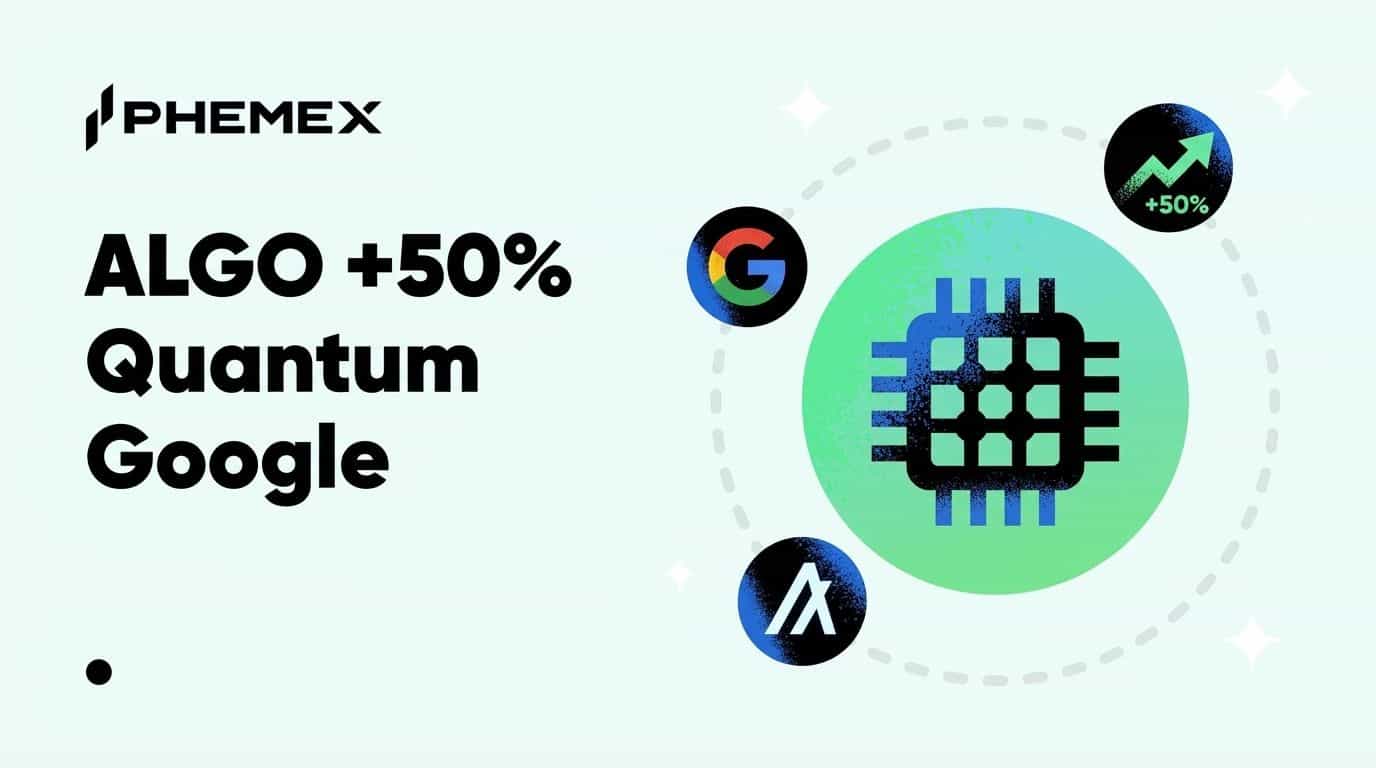
ALGO traded at $0.079 on March 29 and hit $0.126 by April 4, a 57% move in six days. The catalyst was a Google Quantum AI research paper titled "Securing Elliptic Curve Cryptocurrencies against Quantum Vulnerabilities," published March 31, that cited Algorand 32 times and named its FALCON post-quantum signature scheme as the leading real-world deployment of quantum-resistant blockchain cryptography. Market cap crossed $1 billion again, open interest doubled from $38 million to $81 million, and ALGO reclaimed a top-55 ranking on CoinMarketCap.
The rally happened against a backdrop of growing anxiety about what quantum computing means for crypto. Google's own research suggests breaking Bitcoin's elliptic curve cryptography may require fewer than 500,000 physical qubits, well below earlier estimates in the millions. Algorand is the only major chain that has already deployed NIST-standardized post-quantum signatures on its live mainnet, and Google just told the world that matters.
What the Google Quantum AI Paper Actually Said
Google Quantum AI's research team published the paper through its quantum computing division on March 31, 2026. The paper analyzed cryptographic vulnerabilities across major blockchain networks and evaluated which protocols have taken concrete steps toward quantum resistance. Algorand appeared 32 times in the paper, more than any other blockchain except Bitcoin and Ethereum, both of which were primarily discussed as examples of vulnerable systems.
The core finding was direct. Algorand's implementation of FALCON digital signatures and its state proof system represent what the researchers called "the most complete deployment of post-quantum cryptographic primitives on a production blockchain." That phrasing matters because it draws a line between theoretical quantum resistance (whitepapers and roadmaps) and actual deployment (live transactions on mainnet).
Algorand executed the first post-quantum transaction on a public blockchain mainnet in November 2025 using NIST-selected FALCON signatures. Google's paper validated that this was a technically sound implementation, not a marketing claim, and one that other chains should study.
Why Quantum Computing Threatens Crypto
Most blockchains, including Bitcoin and Ethereum, rely on elliptic curve cryptography (ECC) to generate private keys from public keys. The security assumption is simple. Deriving a private key from a public key using classical computers would take billions of years. A sufficiently powerful quantum computer running Shor's algorithm could do it in minutes.
Google researchers warned that a future quantum computer could theoretically derive a Bitcoin private key from its public key in approximately nine minutes, potentially hijacking in-flight transactions before they confirm. An estimated 6.9 million BTC sit in addresses with exposed public keys, representing roughly $480 billion in vulnerable assets at current prices.
Ethereum faces a similar problem. Every Ethereum account directly associates with a visible public key, making it inherently targetable. Solana is even more exposed, with 100% of its wallets vulnerable since public keys are always accessible on-chain.
The timeline is the key question. Google has set a 2029 internal deadline to migrate its own authentication services to post-quantum cryptography. Most researchers estimate cryptographically relevant quantum computers are 5-15 years away, but the "harvest now, decrypt later" threat is already real. Attackers can record encrypted blockchain data today and decrypt it once quantum hardware matures.
What FALCON Signatures Are and Why They Matter
FALCON stands for Fast Fourier Lattice-based Compact Signatures over NTRU. NIST selected it in 2022 as one of three official post-quantum cryptographic standards after a multi-year evaluation process involving dozens of candidate algorithms. The underlying math relies on lattice-based problems, specifically the short integer solution problem over NTRU lattices, which no known algorithm can solve efficiently, even with quantum computers.
What makes FALCON particularly suited for blockchain is a performance asymmetry that works in the protocol's favor. Signing is computationally intensive due to a Gaussian sampling step, but verification is exceptionally fast, typically under 100 microseconds on modern hardware. In a blockchain context, transactions are signed once but verified thousands of times across the network. FALCON's compact signature size (roughly 1,280 bytes for FALCON-1024) also keeps on-chain data manageable compared to other post-quantum schemes that produce signatures several kilobytes in size.
Algorand integrated FALCON into two critical layers. Transaction signatures protect individual transfers and smart contract calls from quantum attacks. State proofs, which are cryptographic certificates that allow external systems to verify Algorand's blockchain state without trusting a single node, also use FALCON. This means both the transaction layer and the cross-chain verification layer are quantum-hardened.
How Other Chains Are Responding to the Quantum Threat
Algorand is ahead, but it is not operating in a vacuum. The quantum threat has forced every major protocol to at least acknowledge the problem, though the responses vary dramatically in maturity.
|
Chain
|
Quantum Readiness
|
Current Status
|
|
Bitcoin
|
No post-quantum signatures deployed
|
Community proposals exist but no consensus on implementation timeline
|
|
Ethereum
|
Research phase
|
[Ethereum Foundation published quantum-resilience roadmap](https://www.coindesk.com/tech/2026/03/28/here-s-how-bitcoin-ethereum-and-other-networks-are-preparing-for-the-looming-quantum-threat) with 8 years of research, but no mainnet deployment
|
|
Solana
|
Early exploration
|
100% of wallets currently exposed, speed vs. security tradeoff under debate
|
|
Algorand
|
FALCON deployed on mainnet
|
First post-quantum transaction executed November 2025, state proofs quantum-hardened
|
|
Naoris Protocol
|
Purpose-built quantum-resistant chain
|
[Launched in April 2026](https://www.coindesk.com/markets/2026/04/03/naoris-protocol-s-quantum-resistance-blockchain-goes-live-as-bitcoin-and-ethereum-face-q-day-threats) as a new Layer-1
|
The gap between Algorand and the larger chains is technical and philosophical. Bitcoin's development culture moves slowly by design, prioritizing stability over rapid upgrades. Ethereum's roadmap includes post-quantum migration but treats it as a future milestone rather than a current priority. Algorand treated quantum resistance as a present-tense engineering problem and shipped a solution before most chains finished writing their proposals.
What Else Drove the Rally Beyond the Paper
Google's paper was the primary catalyst, but the 50% move had additional fuel.
Revolut launched ALGO staking for its 70+ million users in early April, creating a new access point for retail investors who may never use a crypto-native exchange. Swiss institution Post Finance also added ALGO trading and custody services around the same time. And in the background, the joint SEC/CFTC guidance from March 2026 classified ALGO as a digital commodity, removing the securities overhang that had kept some institutional capital on the sidelines.
The technical setup also helped. ALGO had been trading near multi-year lows at $0.079, meaning the asset was severely compressed before the catalyst hit. Open interest surging from $38 million to $81 million indicates that derivatives traders rapidly built new positions rather than simply closing shorts. But the overbought readings after a 50% vertical move in less than a week suggest that a pullback or consolidation is likely before the next leg.
The broader context adds another layer. The $286 million Drift Protocol hack on Solana on April 1, attributed to a North Korean-linked group, reminded the market that blockchain security vulnerabilities are not theoretical. Money flowing out of Solana DeFi after the exploit partially rotated into chains perceived as more secure, and Algorand's quantum-resistance narrative positioned it as a direct beneficiary.
Frequently Asked Questions
Is Algorand actually quantum-proof right now?
Algorand has deployed NIST-standardized FALCON signatures on its mainnet for transactions and state proofs, making it the most quantum-hardened major blockchain in production today. "Quantum-proof" is too strong a term since no system is guaranteed safe against future attacks, but Algorand is the only chain where real assets are protected by post-quantum cryptography right now rather than on a roadmap.
Will Bitcoin and Ethereum upgrade before quantum computers become a real threat?
Most estimates place cryptographically relevant quantum computers 5-15 years out, which theoretically gives both chains time. The Ethereum Foundation has published an eight-year quantum-resilience research roadmap, while Bitcoin's upgrade path remains undefined. The risk is not that quantum computers arrive tomorrow but that the migration process for chains with hundreds of billions in value is slow and contentious.
Why did ALGO surge so much on an academic paper?
Academic papers do not normally move markets, but this one came from Google Quantum AI, one of the most credible quantum computing research groups in the world, and it named Algorand's implementation as the model for the entire industry. Combined with ALGO trading near historic lows, commodity classification from regulators, and Revolut staking going live, the paper became the tipping point for a move that had multiple catalysts stacked underneath it.
Is it too late to buy ALGO after the 50% rally?
ALGO is trading in overbought territory after moving from $0.079 to $0.126 in six days, and short-term pullbacks after vertical moves of this magnitude are common. The quantum-resistance narrative is a long-term structural advantage, not a one-week trade. Traders who missed the initial move are generally better served waiting for a pullback to support levels than chasing a parabolic chart.
Bottom Line
Google Quantum AI did more than cite Algorand in a research paper. It told the industry that one chain has already solved a problem everyone else is still debating. ALGO's 50% rally from $0.079 to $0.126 priced in the headline, but the structural advantage of being the only major blockchain with production-grade post-quantum signatures is a multi-year thesis, not a single-week trade.
The levels to watch from here are $0.10-$0.105 as near-term support if the overbought conditions trigger a pullback, and $0.15 as the next resistance that would confirm the rally has legs beyond the initial hype. The quantum computing timeline is measured in years, not months, and Algorand's head start compounds with every quarter that passes while other chains remain in the research phase. If you believe quantum risk will become a material factor in how institutional capital evaluates blockchain infrastructure, the question is not if Algorand's positioning matters but if $1 billion in market cap adequately prices it.
This article is for informational purposes only and does not constitute financial or investment advice. Cryptocurrency trading involves substantial risk. Always conduct your own research before making trading decisions.