









Key Takeaways
Teneo Protocol is now positioning itself as an execution layer for the agent economy, not just a social-data project. Its homepage says it connects agents to live data, lets them pay per result in USDC via x402, and supports agent workflows for trading, cross-chain actions, and market intelligence.
The protocol’s earlier traction came from its Community Node, a lightweight browser extension that contributes to a decentralized data network and rewards users with Teneo Points. Teneo says those points convert to Teneo Tokens after the token generation event, though the token was not yet trading on exchanges listed by CoinGecko at the time of writing.
Teneo has expanded beyond browser data collection into a broader agent infrastructure stack that includes the Teneo CLI, Agent SDK, Agent Console, and a marketplace of live agents.
The project also introduced Teneo Beacon, a native app that earns 2x more points than the browser extension and adds a separate Fragments reward layer.
Teneo raised $3 million in seed funding in February 2025, led by RockawayX and Borderless Capital, with Generative Ventures as co-lead.
Teneo Protocol is one of those crypto projects that has evolved fast enough that older descriptions no longer fully capture what it is. Early on, the clearest way to describe Teneo was as a decentralized data-access network focused on unlocking public social-media data through community participation. In 2026, that description is still partly true, but it is no longer the whole story. Teneo’s official homepage now frames the project as an execution layer for the agent economy, where AI agents can access live data, call specialized tools, and pay per result instead of through traditional API subscriptions.
That shift matters because it changes how investors and builders should think about the project. Teneo is no longer just trying to decentralize data access. It is trying to become part of the infrastructure stack for agentic workflows — especially workflows tied to real-time intelligence, social signals, DeFi, and cross-chain execution. Its live use-case examples include creating a Polymarket bot, automating bridges and swaps through a LayerZero agent, and spinning up real-time trading bots.
Teneo is a decentralized agent infrastructure project that combines community-powered data collection, agent tooling, and pay-per-result execution rails for live AI workflows.
Where Teneo Started
Teneo’s earlier identity was much more tightly tied to the problem of locked public data. Its June 2025 community-node explainer says that platforms such as X, Reddit, and TikTok generate massive amounts of valuable public data, but access has become expensive and restricted because of API fees and platform controls. Teneo’s answer was the Community Node: a Chrome extension that lets users contribute to a decentralized data network and earn rewards for helping unlock public information streams.
That early mission was also central to its February 2025 seed-funding announcement. Teneo said the protocol was redefining data ownership by creating a decentralized browser extension that unlocks real-time public data streams from platforms like X and Reddit. The same announcement said users earn Teneo Points, which convert to Teneo tokens after the token generation event, while only public data is accessed — not private messages, comments, or personal interactions.
This background still matters, because it explains the project’s DNA. Teneo did not begin as a generic AI-agent token. It began as a project trying to make real-time public Internet data more accessible and more economically shared. That remains important even as the protocol now presents itself in broader “agent economy” terms.
What Teneo Protocol Does Today
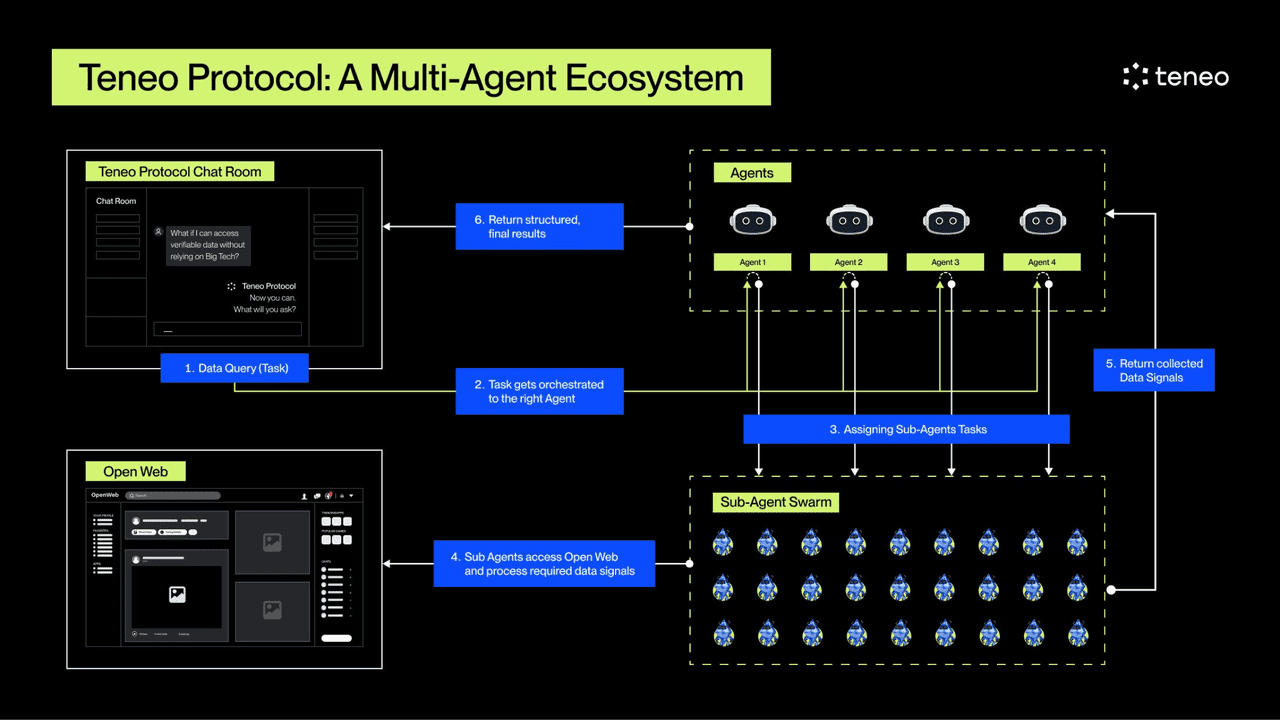
The clearest description of Teneo today comes directly from its homepage. It says the protocol helps connect agents to live data, with no API keys, no subscription, and pay-per-result pricing in USDC via x402. It also says the network already supports hundreds of agents and millions of agent jobs executed, while the user interacts through the Teneo CLI or the broader agent marketplace.
In practical terms, Teneo is building around three layers.
The first is data access. Agents can use the network to pull live information from social, web, e-commerce, market, and analytics sources. Teneo’s marketplace examples include X, [CoinMarketCap], Messari, [Google Search], [Amazon], [YouTube], [Nansen], and gas-optimization tools.
The second is agent tooling. Teneo’s setup-guides page shows support for agent use through tools like Claude Code, Codex, VS Code, Antigravity, and the Teneo CLI. Its January 2026 SDK launch post says developers can build autonomous, monetizable agents on the protocol, clone the public repo, and test their agents inside the Teneo environment.
The third is monetized execution. Teneo’s homepage and February 2026 x402 post both point to a model where agents can access services and settle results economically onchain. The homepage repeatedly emphasizes “pay per result,” while the x402 update calls this the start of “real, on-chain agent monetization.”
The Community Node and Beacon
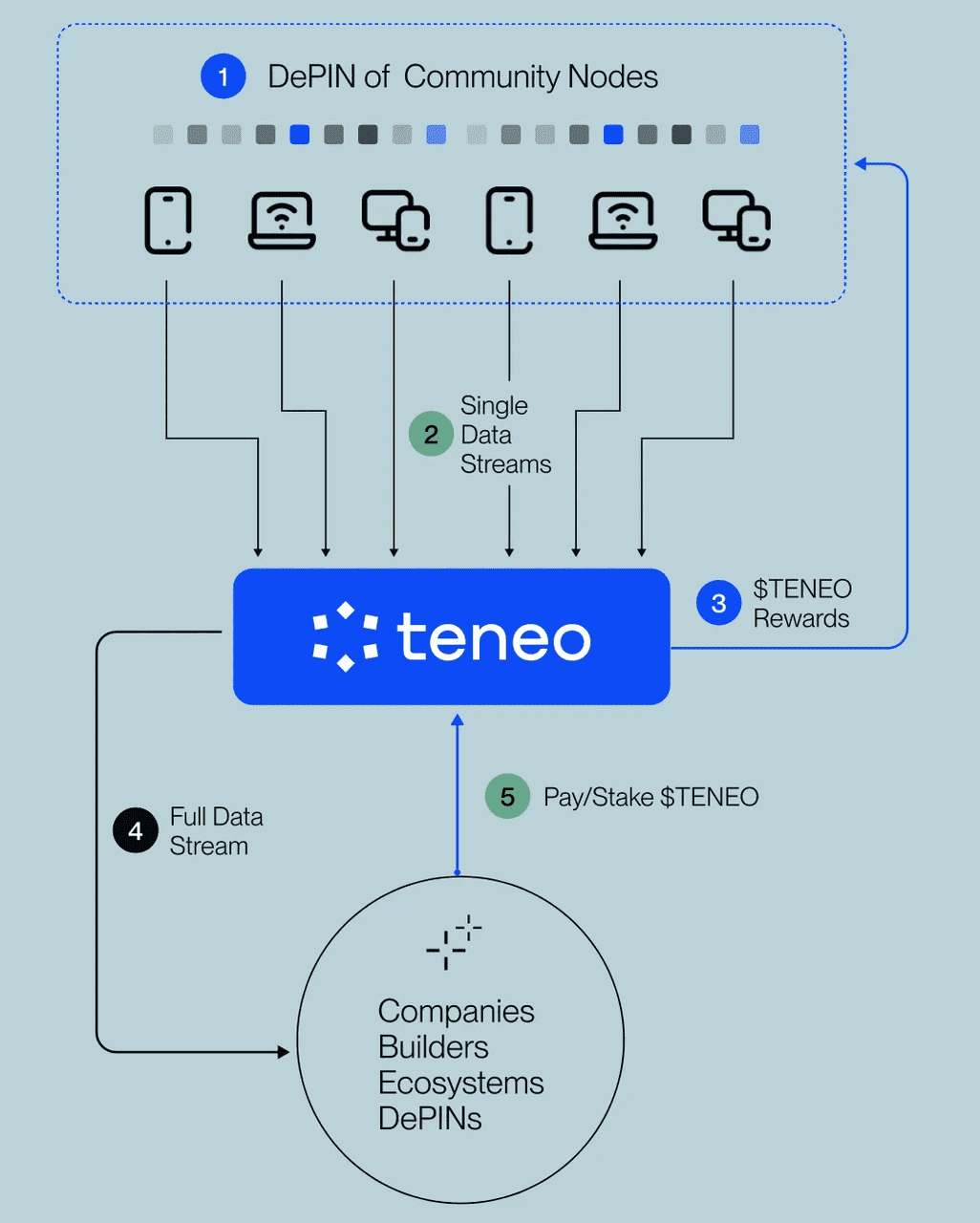
Even though Teneo now talks more about agents than nodes, the node layer is still a big part of the project. The Community Node is a Chrome extension that contributes to Teneo’s decentralized data network. Teneo says users install the extension, connect it to their account, stay online, and earn Teneo Points for uptime, heartbeat activity, referrals, and quests. The Community Node page also says the extension uses minimal resources and is designed for non-technical users.
Teneo later expanded this participation model with Teneo Beacon, a native application available across mobile and desktop platforms. The Beacon page says it contributes to the protocol’s “full stack agentic infrastructure” by sharing unused Internet bandwidth, earns 2x more points than the browser extension, and adds a second reward layer called Fragments. It also includes a multiplier system that can boost earnings every 8 hours for up to 3x.
This is important because Teneo’s community layer is not just a marketing funnel. It appears to be part of how the project bootstraps participation and data/network supply. In other words, Community Node and Beacon are not separate from the protocol’s agent economy thesis — they help feed it.
Teneo’s Shift From Data Access to Agent Infrastructure
One of the most interesting things about Teneo is how clearly the project has changed its emphasis over time. In June 2025, the messaging centered on unused social-media bandwidth, decentralized data access, and points that would later convert into tokens. By November 2025, Teneo was talking about the AI Agent Testnet, describing it as a decentralized swarm of browser-based agents structuring open-web content into usable intelligence in real time. In January 2026, the project launched the Teneo Agent SDK, and by February 2026 it was promoting the x402 upgrade for onchain agent monetization. By May 2026, the homepage had fully shifted into “execution layer for the agent economy” language.
That evolution suggests Teneo wants to be more than a DePIN-style data node network. It wants to be an agent economy platform where community-contributed infrastructure, live data access, and monetized agent execution all fit together.
For investors, this is both a strength and a risk. It is a strength because the protocol appears to be building toward a larger addressable market than “social data scraping.” It is a risk because narrative pivots can be hard to execute well, and the market still has to decide whether Teneo is primarily a data protocol, an agent protocol, or both.
What Builders Can Do on Teneo
Teneo’s builder story is increasingly central to the project. The setup-guides page says developers can get started with the Teneo CLI in minutes. The January 2026 SDK post says the public Agent SDK allows anyone to build autonomous, monetizable agents, follow tutorials, deploy agents, and test them live. The same post also mentions a quickstart flow involving minting an agent token, installing dependencies, and running logic inside the Teneo environment.
The homepage expands that into a marketplace model. Teneo shows a live network of agents that can be browsed or run directly, including agents for cross-chain DeFi, crypto analytics, web search, and real-time social data. It also says partners can add APIs to the network and distribute them through the ecosystem, while enterprises can deploy agent workflows at scale.
This is why Teneo is increasingly relevant to the broader AI-agent conversation. It is not just saying “AI is the future.” It is trying to provide the rails by which agents discover tools, access live data, execute tasks, and generate monetized outcomes.
Funding and Ecosystem Support
Teneo’s February 2025 seed round is one of the clearest external validation points for the project. Teneo said it raised $3 million, led by RockawayX and Borderless Capital, with Generative Ventures as co-lead and additional support from Moonrock Capital, Certik Ventures, and Outlier Ventures.
The project’s homepage also lists a broad partner set, including names such as Avalanche, Base, CoinMarketCap, Irys, LayerZero, OKX, peaq, and X Layer. These homepage references do not by themselves prove deep integrations in every case, but they do show Teneo is trying to position itself within a broader multi-chain and agent-tooling ecosystem.
For a project at this stage, funding and ecosystem alignment matter because the protocol is still building infrastructure rather than merely maintaining a finished network. Teneo needs developers, data contributors, partner APIs, and end-user workflows to all keep growing together.
The Bull Case for Teneo Protocol
The strongest bull case for Teneo is that it is trying to solve a real problem at the intersection of AI agents, live data, and monetization.
Most agents are only as useful as the data and tools they can access. Teneo’s value proposition is that agents should be able to tap live intelligence sources, trigger actions, and pay only when results are returned. If that model works at scale, Teneo could become a meaningful infrastructure layer for agent-based workflows in crypto and beyond.
A second bullish point is that Teneo has real community traction. Its homepage cites millions of agent jobs executed and millions of community nodes, while its 2025 funding announcement cited over 3.9 million users running nodes across 191 countries and more than 1.1 million verified wallets at that time. Even if those numbers need to be interpreted carefully, they suggest real distribution, not just a small insider beta.
A third bullish argument is that Teneo has evolved from a single-function browser extension into a broader agent platform with CLI, SDK, marketplace, and monetization layers. That gives it a more durable narrative than a one-feature DePIN project.
The Risks and Weaknesses
The biggest risk is that Teneo is still early and still changing. The protocol has gone from social-data access to browser-based agent testnet to agent SDK to pay-per-result execution layer in a relatively short time. That can be a sign of rapid innovation, but it can also create narrative confusion. The market may take time to decide what category Teneo really belongs in.
A second risk is token uncertainty. Teneo’s points system clearly references future token conversion, but if the token is not yet live on major exchanges, then price discovery, liquidity, and tokenomics remain harder for outside investors to assess.
A third risk is execution quality. Agent infrastructure is becoming crowded. Teneo needs to prove not only that it can attract users, but that its network remains useful, cost-efficient, and differentiated against other AI-agent and data-access projects. This last point is an inference based on the broader sector, but it follows naturally from the competitive environment Teneo is entering.
Conclusion
Teneo Protocol is best understood as a decentralized agent infrastructure project that started with public-data access and has evolved into a broader platform for live data, agent tooling, and pay-per-result execution. Its Community Node and Beacon still matter, because they help bootstrap participation and rewards. But the project’s current direction is clearly larger: CLI access, a public Agent SDK, an agent marketplace, onchain monetization through x402, and use cases tied to trading, analytics, and autonomous execution.
That makes Teneo more interesting than a simple angle to earn points for running a browser extension. It is trying to become infrastructure for the agent-driven Internet. Whether it succeeds will depend on adoption, developer growth, token rollout, and whether the protocol can turn early community momentum into durable network effects.
