









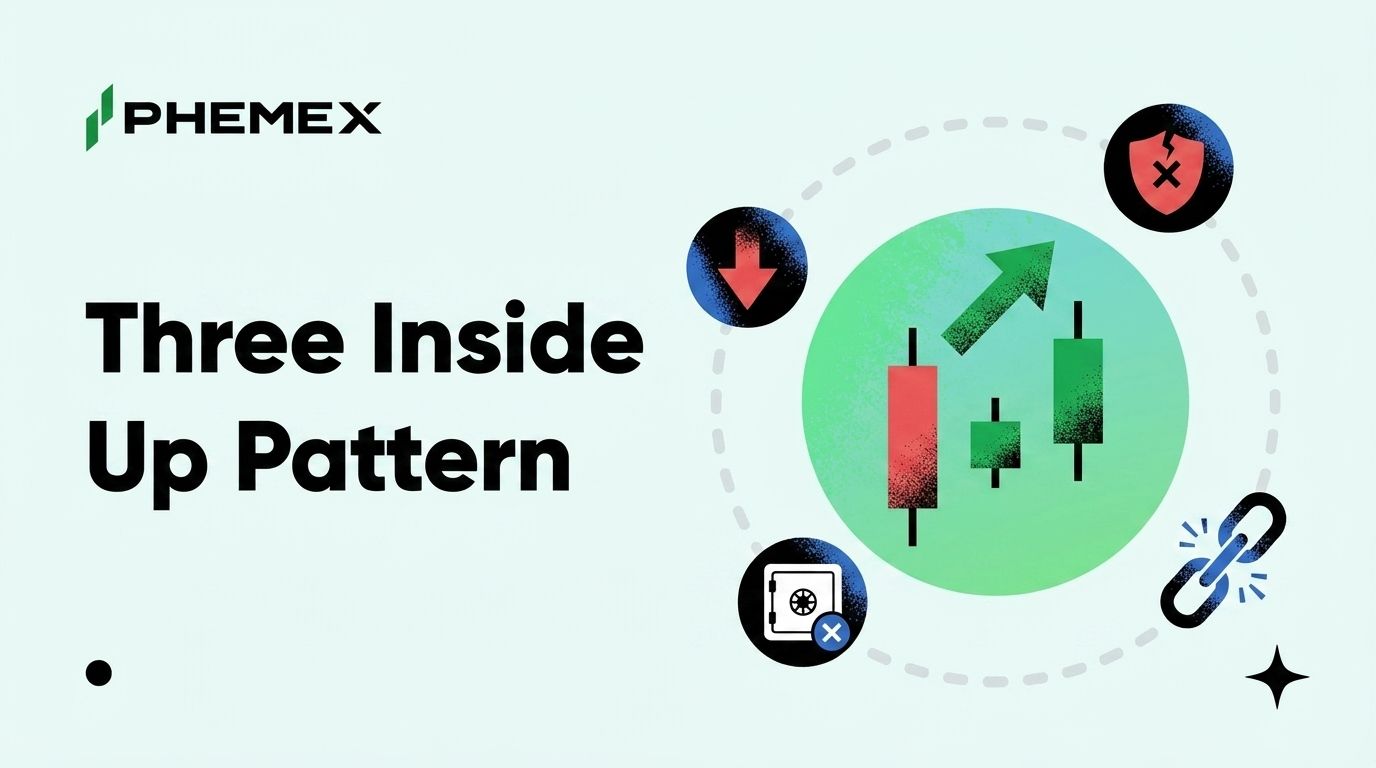
The Three Inside Up is one of the most reliable three-candle bullish reversal patterns in crypto trading and one of the least talked-about. It sits structurally between the simpler Bullish Engulfing two-candle pattern and the more famous Morning Star three-candle setup, and it has a specific confirmation logic that makes the signal stronger than either of those alternatives when it forms cleanly. The pattern is essentially a "bullish harami with confirmation," meaning the second candle confirms a potential reversal and the third candle confirms the confirmation. That double-confirmation structure is what gives the pattern its higher accuracy in backtested data.
This article walks through what the pattern actually looks like on a chart, what the confirmation rules are, how it compares to the related two- and three-candle setups, and how to trade it on a real Bitcoin or altcoin chart with defined entry, stop, and target rules. The pattern is most useful at the bottom of a downtrend on the 4-hour or daily timeframe, where the higher-timeframe signal carries more weight than on intraday charts.
What the Three Inside Up Pattern Actually Looks Like
The Three Inside Up forms at the bottom of an established downtrend and consists of three specific candles in sequence.
Source: Strike.money
The first candle (C1) is a long red continuation candle that prints in the direction of the prevailing downtrend. The body of C1 is significantly larger than the average recent body and signals that the existing downtrend is still in force. A meaningful C1 body matters because the pattern's validity depends on the C1 representing genuine selling pressure rather than random consolidation.
The second candle (C2) is a small green candle whose body sits entirely inside the body of C1. The C2 open is higher than the C1 close, and the C2 close is below the C1 open. The relationship between C1 and C2 is the textbook bullish harami pattern, which on its own is a tentative reversal signal but is not strong enough to trade with confidence. The "inside" relationship is the key. C2 must be engulfed by C1, which is the structural inverse of the more famous Bullish Engulfing pattern where C2 engulfs C1.
The third candle (C3) is the confirmation candle. C3 is a long green candle that closes above the high of C1. The strength of the close above C1's high is what converts the tentative harami signal into a high-confidence reversal call. The longer the C3 body and the further above C1's high it closes, the stronger the signal. The Investopedia entry on Three Inside Up covers the original Steve Nison candlestick treatment in detail.
The complete three-candle sequence is read as: downtrend continuation (C1), tentative reversal (C2), confirmed reversal (C3). The pattern shows the market transitioning from one side of the order book to the other across three sessions, which is more structurally meaningful than a single-candle reversal signal.
What the Confirmation Rules Actually Are
A Three Inside Up pattern can form on the chart without being tradable. The confirmation rules separate the high-probability setups from the lower-probability ones, and applying them strictly is what keeps the win rate elevated.
The first rule is volume. C3 must print on rising volume relative to the prior three or four candles, per Investopedia's Three Inside Up reference. Rising volume on C3 confirms that real buying pressure is behind the reversal, rather than a thin-volume mean-reversion bounce. The volume signal is the single most important confirmation filter because it filters out the largest category of failed reversals.
The second rule is RSI. The RSI on the timeframe where the pattern forms should be below 30 on either C1 or C2, which confirms that the underlying trend is in oversold territory and a reversal is structurally probable. A Three Inside Up pattern that forms with RSI above 40 is more likely to fail because the underlying conditions do not support a reversal.
The third rule is the C3 close relative to a key moving average. The strongest setups close C3 above the 20-period exponential moving average on the trading timeframe, which signals that the reversal has cleared the immediate trend resistance. A C3 close still below the 20 EMA can still be a valid signal but typically requires confirmation from a follow-through candle on the next session.
The combination of rising volume on C3, oversold RSI on C1 or C2, and a C3 close above the 20 EMA is the high-confidence configuration. The base Phemex bullish engulfing primer covers the related two-candle pattern in detail and provides the structural context for why the additional confirmation candle in the Three Inside Up matters.
How It Compares to Bullish Engulfing, Morning Star, and Piercing Line
The Three Inside Up sits inside a family of bullish reversal patterns, and the distinctions matter for traders who run multiple patterns in their playbook.
The Bullish Engulfing is the two-candle version of the same idea. C1 is a long red candle, C2 is a long green candle that engulfs C1 entirely. The signal forms one candle earlier than the Three Inside Up, which is faster but lower-confidence because there is no confirmation candle. In backtested data on the daily Bitcoin chart, the Bullish Engulfing has roughly a 58% follow-through rate without additional filters. The Three Inside Up has roughly a 64% follow-through rate on the same dataset.
The Morning Star is a different three-candle structure. C1 is a long red candle, C2 is a small-body candle (either color) with a gap down from C1, and C3 is a long green candle that closes above the midpoint of C1. The Phemex hammer candlestick guide covers the related single-candle bottom-reversal signal that often precedes these three-candle patterns at swing lows. The key difference from the Three Inside Up is the gap structure. The Morning Star requires gaps between candles, which is rare on 24/7 crypto markets and consequently makes the pattern hard to find cleanly on a Bitcoin chart. The Three Inside Up does not require gaps, which is why it is more useful on crypto specifically.
The Piercing Line is a two-candle pattern that sits between the Bullish Engulfing and the Three Inside Up in structural strength. C1 is a long red candle, C2 is a long green candle that closes above the midpoint of C1 but does not fully engulf C1. The Piercing Line is weaker than the Engulfing because the second candle does not fully reverse the first one.
The honest read is that on a 4-hour or daily Bitcoin chart, the Three Inside Up is the most reliable of the four because the harami-plus-confirmation structure incorporates the equivalent of a built-in filter. The pattern takes longer to form, which is a trade-off, but the higher follow-through rate compensates.
How to Trade the Three Inside Up on a Bitcoin Chart
A practical entry, stop, and target playbook anchors the pattern to specific rules that remove discretionary noise.
The entry is the C3 close. Wait for the C3 candle to close above the C1 high before entering. Entering inside C3 before the close is a common mistake and a major source of failed trades because the candle can still reverse before close. The C3 close above C1's high is the actual signal.
The stop sits below the C1 low. The reasoning is that C1 represents the genuine downtrend continuation, and a break below the C1 low invalidates the harami structure entirely. Placing the stop at C1 low gives the trade enough room to absorb normal post-pattern volatility without getting flushed.
The target is the prior resistance level on the chart. For a Three Inside Up that forms at the bottom of a 10% to 15% downtrend, the natural first target is the resistance that capped the prior bounce, which is typically the level just above C1's open. The risk-to-reward on this rule is typically 2:1 or better on the daily timeframe.
The hypothetical Bitcoin example fits cleanly into the recent setup. If BTC bounces from the Friday $60,000 cascade zone and prints a long red candle on Monday, a small green inside candle on Tuesday, and a long green confirmation candle on Wednesday that closes above Monday's high on rising volume, the pattern is valid. The entry is the Wednesday close, the stop is below the Monday low, and the target is the prior resistance at $63,500.
The internal context here connects to the broader Phemex bullish engulfing primer, which covers the underlying two-candle relationship that the Three Inside Up extends with the confirmation candle.
Frequently Asked Questions
How is the Three Inside Up different from a normal Bullish Engulfing?
The Bullish Engulfing is a two-candle pattern where C2 engulfs C1. The Three Inside Up is a three-candle pattern where C2 is inside C1 (the inverse of engulfing) and C3 confirms by closing above C1's high. The Three Inside Up takes one more session to confirm but has a higher backtested follow-through rate because the additional confirmation candle filters out a meaningful share of failed reversals.
Does the Three Inside Up work on intraday timeframes?
It works mechanically but the signal-to-noise ratio is much weaker on intraday charts. The 4-hour and daily timeframes are where the pattern carries enough structural weight to be worth trading. On 15-minute or 1-hour charts, the pattern fires too frequently and the follow-through rate drops significantly. The pattern is also more reliable in the major altcoins and Bitcoin than in low-cap tokens because thin order books distort the candle structure.
What invalidates the pattern after it forms?
A close below the C1 low after C3 has confirmed. That close means the harami structure has failed and the underlying downtrend is still in force. The stop placement at C1 low is exactly designed to handle this scenario, which is why disciplined stops matter more than trying to anticipate the invalidation.
Can I combine the Three Inside Up with other indicators?
Yes, and that is the recommended approach. The strongest setups combine the pattern with RSI oversold readings on C1 or C2, a C3 close above the 20 EMA, and rising volume on C3. Adding a higher-timeframe trend filter (the daily 200-period MA pointing up or sideways) further improves the win rate. The pattern alone is a decent signal. Combined with confirmation filters, it becomes a high-confidence setup.
Bottom Line
The Three Inside Up is one of the most structurally interesting reversal patterns in crypto trading because the harami-plus-confirmation candle structure incorporates a built-in filter that most single-pattern reversal signals lack. The high-confidence configuration combines rising volume on C3, oversold RSI on C1 or C2, and a C3 close above the 20 EMA on the trading timeframe. The pattern is most useful on the 4-hour and daily charts in BTC and the major altcoins. The trade is simple. Enter at the C3 close above C1's high, stop below the C1 low, target the prior resistance level. The pattern is slower than the Bullish Engulfing but cleaner. Build it into the playbook for setups at the bottom of established downtrends and let the confirmation candle do the work of separating real reversals from failed bounces.
This article is for informational purposes only and does not constitute financial or investment advice. Cryptocurrency trading involves substantial risk. Always conduct your own research before making trading decisions.
