









Key Takeaways
The Phemex VIP Program lowers trading fees based on either 30-day trading volume, 30-day average asset balance, or vePT balance, and traders only need to meet one qualifying criterion to unlock the corresponding tier.
VIP tiers are shared across Spot trading and Futures trading, so if a user qualifies for a higher level through one route, that level’s benefits apply across both product lines.
For contract trading, Phemex’s standard fee starts at 0.0100% maker / 0.0600% taker, while higher tiers reduce fees meaningfully; at Star VIP, contract fees reach 0.0000% maker / 0.0300% taker.
API-heavy traders are handled differently: if API trading volume exceeds 20%, Phemex routes eligibility to its Institutional Program / Pro tiers rather than the standard VIP-to-Star-VIP path.
Phemex’s Market Maker Incentive Program can provide up to a 0.005% maker rebate, which is how fee economics can move from merely “low” to effectively near-zero or better for certain high-volume institutional-style traders.
For institutional traders, fees are never a minor detail. They are part of the strategy itself.
A desk trading tens of millions of dollars a month does not experience exchange fees as a background nuisance. It experiences them as a direct drag on alpha, market-making margins, execution quality, and portfolio turnover. A basis trader can be right on structure and still underperform if fee friction is too high. A high-frequency desk can have a strong model and still lose edge if maker economics are not competitive. That is why professional traders do not ask only whether an exchange is liquid or feature-rich. They ask whether the fee schedule scales properly as volume rises.
That is exactly where the Phemex VIP Program becomes relevant. Phemex positions the program around a simple idea: trade more, pay less. Users can qualify through trading volume, asset balance, or vePT balance, and whichever route gets them to the higher level unlocks that level’s benefits across Spot and Futures.
For institutional and professional-style traders, the appeal is obvious. The deeper you move into the tier system, the closer the platform gets to what serious desks actually care about: lower taker costs, zero maker fees on top tiers, priority service, and a pathway toward market-maker-style economics.
Why Fee Structure Matters So Much to Institutional Traders
Retail users often think about fees in isolation: 0.06% versus 0.04%, or 0.1% versus 0.07%. Institutions think differently. They multiply those percentages by monthly turnover, leverage usage, execution frequency, and strategy type.
For example, a discretionary trader who trades occasionally can live with a standard fee schedule more easily than a desk running large futures books, frequent hedges, or systematic execution. In those cases, even small fee differences can materially change net performance. This is especially true in derivatives, where spreads, funding, and execution costs all interact. Phemex’s fee structure reflects that distinction by sharply reducing rates as users move from baseline tiers into VIP, Star VIP, and Pro levels.
On Phemex, contract maker fees fall from 0.0100% at VIP 0 to 0.0000% at Star VIP and across the Pro tiers shown in the help-center fee schedule. On top of that, Phemex’s Market Maker Incentive Program can provide up to 0.005% maker rebate.
In practical terms, that means professional traders are not merely chasing a discount. They are trying to reshape the economics of execution itself.
How the Phemex VIP Program Works
Phemex’s VIP logic is built around flexibility. A user’s VIP level is determined by either asset balance or last 30-day trading volume, and the user needs to satisfy only one criterion to unlock the fee discount for that level. The VIP page also highlights vePT balance and asset balance as qualifying routes, alongside Spot and Futures volume.
This matters because institutional traders are not all alike. Some have very high turnover but do not want to warehouse large balances on-exchange. Others maintain larger capital balances and want the fee benefits even if monthly turnover fluctuates. Phemex’s framework lets both types of user qualify.
The platform also states that VIP tiers are shared across Spot and Futures, which is especially valuable for desks that operate across multiple products. Rather than managing fragmented fee statuses, the trader gets the benefits of the higher qualified level across both product categories.
Phemex updates VIP levels daily, counts both main-account and subaccount trading volume, and applies the main account’s fee rate to subaccounts. That makes the program more relevant for larger trading organizations rather than just single-account retail participants.
The Fee Ladder: From Standard Rates to Near-Zero Execution
The easiest way to understand the program is to look at the fee progression.
Phemex’s Help Center shows the following contract trading fee schedule:
VIP 0: 0.0600% taker / 0.0100% maker
VIP 1: 0.0550% taker / 0.0080% maker
VIP 2: 0.0500% taker / 0.0060% maker
VIP 3: 0.0450% taker / 0.0040% maker
VIP 4: 0.0375% taker / 0.0020% maker
VIP 5: 0.0350% taker / 0.0010% maker
Star VIP: 0.0300% taker / 0.0000% maker
That progression is the heart of the story. A futures desk that starts at standard pricing and climbs toward VIP 5 or Star VIP is not making a cosmetic improvement. It is fundamentally lowering execution drag.
Spot fees also become increasingly competitive as traders move up the ladder. Phemex lists Star VIP at 0.0400% taker / 0.0000% maker for spot trading, while Pro 4 reaches 0.0450% taker / 0.0000% maker on spot.
On top tiers, the maker side is already zero according to the published schedule. And for qualifying market makers, the economics can go even further through rebate structures.
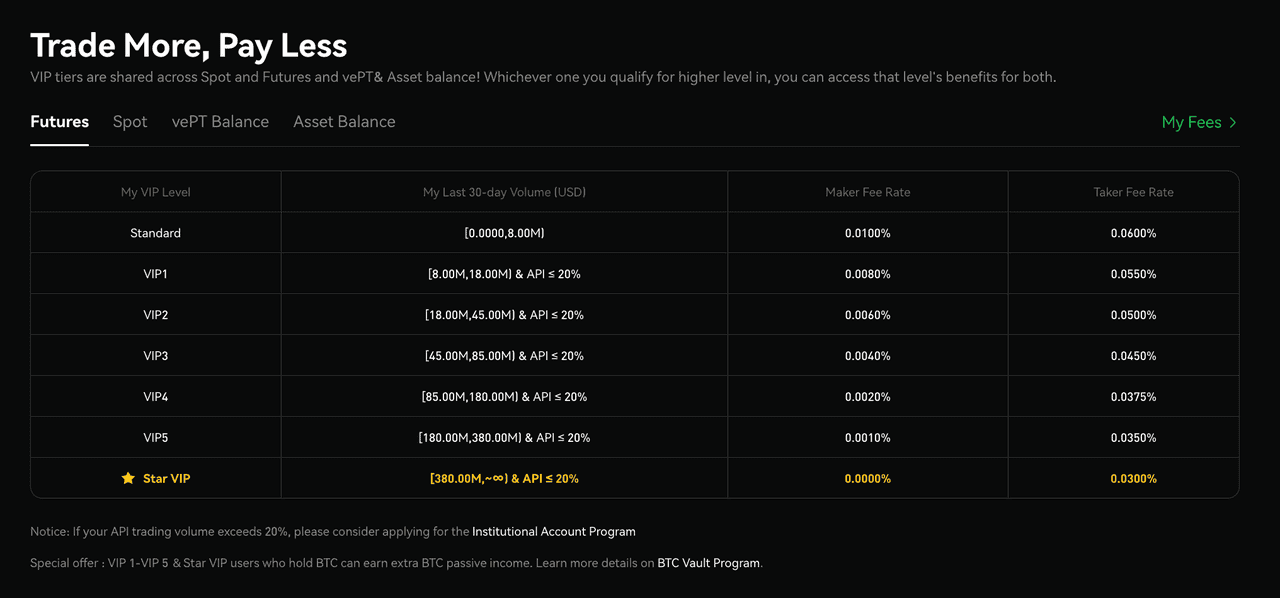
Phemex VIP Fee Tiers (source)
The Institutional Twist: API Usage Changes the Path
One of the most important details for the Phemex VIP program is the API usage rule.
Phemex states on its VIP page that the VIP Program applies only to users whose API trading volume occupies equal to or less than 20%. If trading volume from API trading or spot trading volume exceeds 20%, the associated benefits shift to the Institutional Program, and institutional clients are not eligible for the benefits outlined in the Standard-to-Star-VIP rules.
This is not a drawback so much as a segmentation choice. It means Phemex is distinguishing between two types of advanced users:
traders who are high volume but still fit the standard VIP framework
more institutional or API-driven participants who belong in the Pro / Institutional structure
That matters because many true institutional desks are API-heavy by design. They care less about the branding of “VIP” and more about whether the exchange has a fee track built for automated, professional execution. Phemex’s structure suggests that it does.
Where the Real Edge Appears
The headline attraction for institutional traders is that Phemex reaches 0.0000% maker fees at the upper levels. But the more interesting detail is that Phemex also says it offers a Market Maker Incentive Program with up to 0.005% maker fee rebate.
For a passive liquidity provider, zero maker fees already reduce friction dramatically. But a rebate structure can go further by turning displayed liquidity into an additional source of execution advantage. The exact net result depends on the desk’s trading style, qualification, and application status for the market-maker program, but the published framework clearly shows that Phemex is not stopping at ordinary fee discounts. It is building a path toward market-maker economics.
For institutions, that changes behavior. A desk that expects to quote more passively may see the exchange differently from one that expects to cross the spread frequently. On Phemex, the spread between maker and taker economics becomes increasingly meaningful as traders move up the tiers.
Additional Benefits Beyond Fee Discounts
The VIP Program is not only about headline fee rates. Phemex also attaches operational perks that matter more as account size grows.
Its VIP page lists benefits including:
Withdrawal Quickpass from VIP 4
1-on-1 account manager service from VIP 4
exclusive rewards and priority benefits
priority consideration for product suggestions
branded merchandise and future VIP privileges
For a retail trader, some of these may sound secondary. For an institutional or professional desk, they are more meaningful. Priority service reduces friction. Faster operational handling matters when capital is moving. Dedicated support becomes more valuable as complexity rises. In other words, the VIP structure is also an operational framework, not just a fee table.
Phemex also states that in the event of a downgrade, a VIP level is preserved for 14 days, which can help smooth transitions if volume temporarily falls below a threshold.
Why This Matters for Different Types of Professional Traders
Not every professional trader uses a VIP program the same way.
A high-frequency futures trader will care most about maker/taker economics and whether the path to zero maker fees is realistic at their turnover level. A basis trader may care about both fee reduction and balance-sheet qualification, especially if holding larger balances is easier than endlessly pushing turnover. A market-making desk will look more closely at the relationship between the standard tier schedule and the Market Maker Incentive Program. And a multi-account firm will care about whether subaccounts inherit main-account rates and whether group volume is counted efficiently. Phemex’s published framework addresses all of those points in one way or another.
How Traders Can Accelerate Qualification
Phemex gives users more than one way to climb the ladder.
First, traders can qualify naturally through rolling 30-day trading volume, and Phemex says that if volume reaches a threshold, lower fees and other benefits can be enjoyed instantly without a separate application. Second, traders can qualify through asset balance or vePT balance. Third, Phemex’s VIP page says traders from other exchanges can provide screenshots or screen recordings to prove trading volume and, if approved, receive the corresponding Phemex VIP level and discounts immediately.
That last point is especially important for institutions considering migration. It means a desk does not necessarily need to “start from zero” just because it is new to Phemex. If it already has demonstrated trading scale elsewhere, Phemex offers a transfer path into lower fees faster.
Conclusion
The Phemex VIP Program is best understood as a scaling framework for serious traders.
At the lower tiers, it looks like a straightforward volume-discount system. But as traders move deeper into the structure, it becomes something more valuable: a route toward zero maker fees, lower taker costs, priority service, and, for some participants, even market-maker-style fee economics through rebates.
That is why the program matters to institutional traders. The real win is not simply paying a bit less than retail users. The real win is turning execution costs into a smaller part of the strategy, and in some cases reshaping them so aggressively that the exchange becomes materially more competitive for active flow. Phemex’s combination of volume thresholds, balance-based qualification, shared Spot/Futures tiers, Pro segmentation for API-heavy users, and maker-incentive pathways is clearly built with that outcome in mind.
