









When you deposit $10,000 on a crypto exchange, you are trusting that the exchange actually holds $10,000 on your behalf. Before FTX collapsed in November 2022, most traders assumed this was guaranteed. It was not. FTX had been secretly lending out customer deposits, and when the exchange failed, users lost access to an estimated $8 billion in assets that simply were not there.
Merkle tree Proof of Reserves exists to make that kind of fraud mathematically detectable. It is a cryptographic system that lets an exchange prove it holds enough assets to cover every user deposit, and lets any individual user verify that their specific balance is included in that proof, without exposing anyone else's private account information. Phemex publishes Merkle tree Proof of Reserves every month, and the April 2026 report shows 131% overcollateralization across all major assets.
This article explains what a Merkle tree is, how Proof of Reserves uses it, and how to check that your own funds are backed on Phemex.
What Is a Merkle Tree?
A Merkle tree is a data structure that lets you verify the integrity of a large dataset by checking a single value at the top. It was invented by computer scientist Ralph Merkle in 1979 and is one of the foundational building blocks of blockchain technology. Every Bitcoin block uses a Merkle tree to organize its transactions.
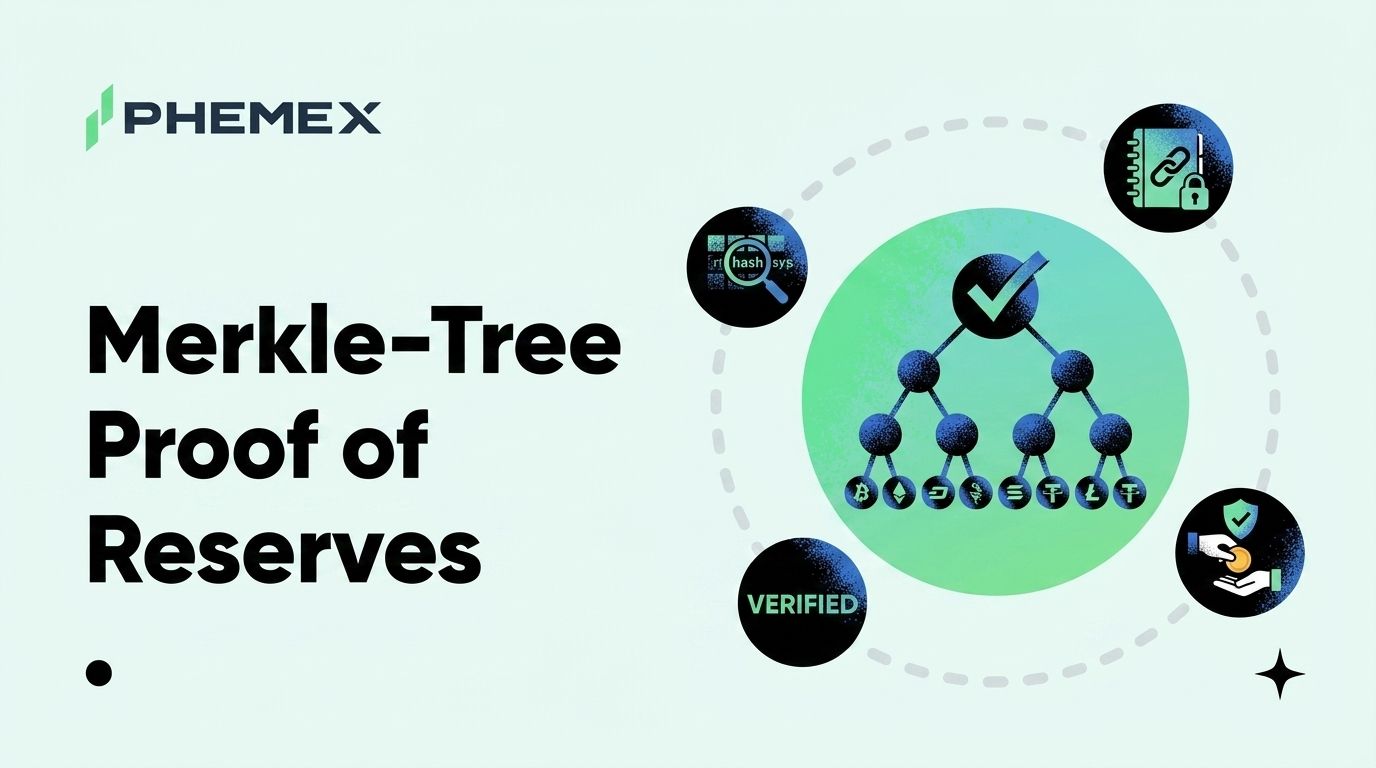
Here is how it works in plain language. Imagine you have eight pieces of data, each representing a user's account balance. You run each one through a cryptographic hash function, which converts each balance into a fixed-length string of characters called a hash. These eight hashes become the "leaves" at the bottom of the tree.
Next, you take pairs of adjacent leaves and combine them, then hash the result to produce a new value one level up. Eight leaves become four hashes. Those four hashes get paired and hashed again to produce two. Those two get combined and hashed into one final value at the top of the tree, called the Merkle root.
The Merkle root is a single cryptographic fingerprint that represents every piece of data in the tree. If even one digit in one user's balance changes anywhere in the dataset, the hashes cascade upward and the Merkle root changes entirely. Tampering with any single balance is mathematically impossible to hide because it alters the root that everyone can see.
How Proof of Reserves Uses Merkle Trees
Proof of Reserves takes this data structure and applies it to exchange solvency. The process works in three steps.
Step 1: Snapshot all user balances. The exchange takes a point-in-time snapshot of every user account balance. Each balance is combined with a unique user identifier and run through a hash function to create the leaf nodes at the bottom of the Merkle tree. The hashing means individual balance amounts are not publicly visible, preserving user privacy.
Step 2: Build the tree and publish the root. The exchange constructs the Merkle tree from all hashed user balances, layer by layer, until it produces a single Merkle root. This root is published. It represents the total of all user liabilities (everything the exchange owes to depositors) in a single verifiable value.
Step 3: Prove the assets exist. The exchange then demonstrates that it controls on-chain wallets holding assets equal to or greater than the total user liabilities represented by the Merkle root. This is typically done by publishing wallet addresses and signing transactions that prove ownership of those addresses, or through third-party verification.
When all three steps are complete, the exchange has cryptographic proof that it holds enough assets to cover what it owes, and any user can independently verify that their balance was included in the calculation.
Why a Merkle Root Cannot Be Faked
The security of the system rests on one mathematical property: changing any input changes the output. If an exchange tried to exclude a user's balance from the tree (to make its liabilities look smaller than they actually are), the resulting Merkle root would be different. Any user who checks their balance against the published root would detect the discrepancy.
This works because each user receives a verification path, which is the specific sequence of hashes they need to recalculate from their leaf node up to the root. If the root they calculate matches the published root, their balance is included. If it does not match, something has been altered. The exchange cannot selectively exclude users or inflate its reported reserves without producing a root that fails verification for the affected accounts.
The same property protects against inflated balances. If an exchange tried to claim it held more than it actually does, the on-chain wallet verification in Step 3 would fail because the blockchain is a public ledger and anyone can check the actual balance of any published wallet address.
How Phemex Implements Proof of Reserves
Phemex publishes Merkle tree Proof of Reserves on a monthly basis, with snapshots taken around the 25th of each month. The April 2026 report, published via PR Newswire and verified by Morningstar, shows overcollateralized reserves across every major asset.
| Asset | Reserve Ratio |
| BTC | 133.11% |
| ETH | 141.61% |
| USDT | 103.61% |
| SOL | 155.62% |
| Total (all assets) | 131% |
A 131% total reserve ratio means Phemex holds $1.31 for every $1 in user deposits. This is not 1:1 backing. It is 1.31:1 backing, with the excess providing a buffer against market volatility and operational contingencies.
Covered assets include BTC, ETH, USDT, USDC, USD, TRON, BNB, XRP, SOL, SUI, and AVAX. Phemex CEO Federico Variola has stated that the exchange "has not borrowed funds or have any outstanding corporate loans" and does not lend, borrow, or rehypothecate customer funds. This means the reserves reported in the Merkle tree are not offset by hidden liabilities on the other side of the balance sheet.
How to Verify Your Balance on Phemex: Step by Step
Checking that your specific balance is included in the Proof of Reserves takes about two minutes.
Step 1: Find your Hashed Client ID. Log into your Phemex account and navigate to your account dashboard. Your Hashed Client ID is a unique cryptographic identifier tied to your account. It is different from your username or email address.
Step 2: Go to the Proof of Reserves page. Visit phemex.com/proof-of-reserves. This page displays the latest Merkle tree snapshot, including the total reserve ratio and the date of the most recent audit.
Step 3: Enter your Hashed Client ID. Input your ID into the verification tool. The system will locate your leaf node in the Merkle tree and show you your balance as recorded in the snapshot.
Step 4: Verify the path to the root. The tool shows you your verification path through the tree. If the hashes along your path combine correctly to produce the published Merkle root, your balance is confirmed as part of the total liabilities. This is the mathematical proof that your funds are accounted for.
If the verification fails, it would mean your balance was not included in the tree or the data has been altered, which would be immediately visible and publicly detectable. As of every monthly snapshot published to date, Phemex has maintained reserve ratios above 100% across all covered assets.
What Proof of Reserves Does Not Tell You
Merkle tree Proof of Reserves is the best verification tool available to exchange users today, but it has limitations worth understanding.
It is a point-in-time snapshot, not real-time monitoring. The reserves are verified at the time of the snapshot (around the 25th of each month for Phemex). In theory, an exchange could move assets after the snapshot and before the next one. Monthly publishing cadence reduces this risk substantially, but it is not continuous verification.
Basic PoR does not capture hidden liabilities. An exchange could hold 131% reserves but also owe 200% in corporate loans to a counterparty. Basic Proof of Reserves proves assets exist but does not prove the exchange is free of off-balance-sheet obligations. This is why Proof of Solvency (Proof of Reserves plus Proof of Liabilities) is the more complete standard. Phemex addresses this by publishing both and by publicly stating it carries no corporate loans or outstanding debt.
It does not replace regulatory compliance. PoR is a voluntary transparency measure, not a regulatory requirement. It demonstrates good faith and operational integrity, but it is not a substitute for full regulatory oversight. The exchanges that publish PoR are choosing to hold themselves to a higher standard than the industry requires.
Understanding these limitations does not weaken the case for PoR. It strengthens it, because an informed user knows exactly what the proof covers and what questions to ask beyond it.
Why 131% Matters More Than 100%
A reserve ratio of exactly 100% means the exchange holds precisely enough to cover withdrawals under normal conditions. But crypto is not a normal-conditions business. Flash crashes, sudden withdrawal spikes during market panic, and operational costs all create scenarios where 100% backing could be temporarily insufficient.
Phemex's 131% ratio provides a 31% buffer above full backing. This overcollateralization means the exchange can absorb significant market volatility, cover operational costs, and handle withdrawal surges without dipping below 1:1 backing for any covered asset. Some individual assets carry even larger buffers than the aggregate, as the reserve table above shows.
The overcollateralization also signals something about business practice. An exchange that holds 131% in reserves is not maximizing yield on customer deposits, because those excess reserves are sitting in wallets rather than being deployed for profit. The choice to overcollateralize rather than optimize is a direct cost to the exchange and a direct benefit to users.
Frequently Asked Questions
What happens if I never verify my balance?
Nothing changes about how your funds are stored. The verification tool is optional and does not affect your account or your ability to trade and withdraw. But verification is what gives the system its power. The more users who independently check their balances against the Merkle root, the harder it becomes for any exchange to manipulate the data without detection. Checking takes two minutes and costs nothing.
How often does Phemex publish Proof of Reserves?
Monthly, with snapshots taken around the 25th of each month. Each report is published publicly and distributed through third-party channels including PR Newswire. Any Phemex user can verify their balance inclusion using their Hashed Client ID at any time after the snapshot is published.
Can other exchanges fake their Proof of Reserves?
The cryptographic structure of a Merkle tree makes selective falsification extremely difficult. If an exchange excludes or alters any user balance, the Merkle root changes and verification fails for affected users. The more users who independently verify their balances, the harder it becomes for any exchange to manipulate the data without detection. This is why user participation in verification matters.
Bottom Line
Proof of Reserves is not about trusting an exchange's word. It is about replacing trust with math. A Merkle tree takes every user balance on the platform, hashes them into a structure where changing a single digit alters the entire output, and produces a root that anyone can verify against. Phemex publishes this proof monthly with a 131% total reserve ratio, covers 11 major assets, and backs the cryptographic verification with a public commitment to zero lending, zero rehypothecation, and zero corporate debt against customer deposits.
You do not need to take anyone's word for it. Go to phemex.com/proof-of-reserves, enter your Hashed Client ID, and check.
This article is for educational purposes only and does not constitute financial or investment advice. While Proof of Reserves provides cryptographic verification of exchange solvency, it does not eliminate all risks associated with centralized exchanges. Users should evaluate the full security profile of any platform before depositing funds.
