










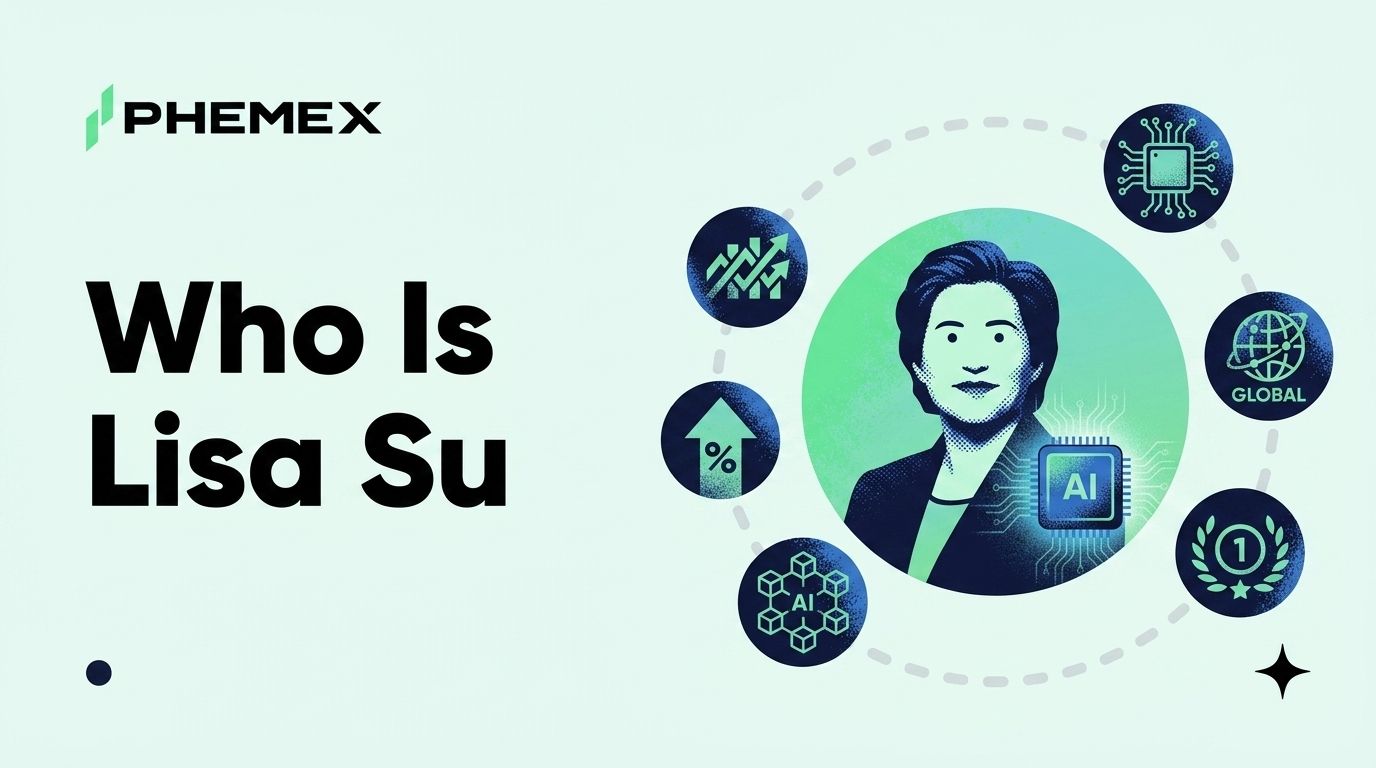
Lisa Su took over AMD on October 8, 2014, when the company was trading near a dollar and staring at bankruptcy. In July 2026 the stock printed a record high around $577, and AMD sits among the handful of names driving the current AI-chip rally alongside Nvidia. The distance between those two facts is the entire Lisa Su story, and it is one of the most complete corporate turnarounds in the history of the semiconductor industry.
For traders watching AMD futures move on every AI headline, the person running the company matters as much as the roadmap. Su is an engineer who bet the company on a single architecture when it had no margin for error, and that bet is why AMD competes at the top of the AI accelerator market today. Here is her background, how she rebuilt AMD from the silicon up, and why her track record still moves the stock.
From Tainan to Three MIT Degrees
Lisa Su was born on November 7, 1969, in Tainan, Taiwan, and immigrated to New York City with her family at age three. Her father was a statistician and her mother an accountant who later became an entrepreneur, and both pushed math early. By the time she was in high school at the Bronx High School of Science, she had already gravitated toward engineering rather than the medicine her parents initially imagined for her.
She went to the Massachusetts Institute of Technology and never really left the discipline. Su earned three degrees from MIT, all in electrical engineering: a bachelor's, a master's, and a doctorate she completed in 1994. Her doctoral work focused on silicon-on-insulator technology, a then-obscure method of building transistors on a layer of insulating material to make them faster and more efficient. That specialty would define the first half of her career and, arguably, the chips inside most of the devices you use today.
The detail that matters for understanding her as a CEO is that she is a genuine technologist, not a finance executive who happened to land in tech. When she talks about AMD's products, she is talking about work she can do herself. That credibility inside a company full of engineers is part of why the turnaround held.
The IBM and Freescale Years
Su joined Texas Instruments briefly before moving to IBM in 1995, where she spent nearly a decade doing the kind of deep semiconductor research that reshaped the industry. At IBM she led the team that pioneered commercial silicon-on-insulator manufacturing, a technique the industry doubted at the time. The gamble paid off. The technology improved chip speed by roughly 20 to 30 percent without shrinking transistors further, and it became standard across the sector.
She also ran IBM's "emerging products" division and worked directly on the copper interconnect processes that replaced aluminum wiring inside chips. This is the unglamorous, foundational engineering that most CEOs never touch. Su spent years in it, which is why she reads a chip roadmap the way a portfolio manager reads a balance sheet.
In 2007 she moved to Freescale Semiconductor as chief technology officer and later ran its networking and multimedia business, giving her profit-and-loss responsibility for the first time. That combination, deep technical fluency plus operational ownership, is exactly the profile AMD needed when it came looking in 2012.
Taking Over a Company Near Bankruptcy
Su joined AMD in 2012 as senior vice president and general manager, and on October 8, 2014, she became chief executive officer, replacing Rory Read, as detailed on the company's own AMD leadership page. What she inherited was not a healthy business. AMD had lost most of its server market share, its PC chip business was collapsing as the laptop market shrank, and the stock traded around two dollars with a market capitalization of roughly $3 billion. Analysts openly discussed bankruptcy scenarios for a chipmaker that had been left behind on nearly every front.
Her first moves were about survival rather than ambition. She stabilized cash flow by leaning on the semi-custom business, the division that supplied chips for the PlayStation and Xbox consoles, which gave AMD steady revenue while she rebuilt everything else. Then she made the decision that defined her tenure. She concentrated the company's shrunken engineering budget on a single new CPU architecture called Zen, built from scratch, and staked AMD's future on it landing.
There was no plan B. If Zen failed, AMD did not have the resources to try again.
The Ryzen Turnaround
Zen shipped as the Ryzen processor line in 2017, and it changed the trajectory of the entire company. Ryzen delivered a roughly 52 percent improvement in instructions per clock over AMD's previous generation, closing a performance gap that had existed for years and undercutting competing chips on price. For the first time in over a decade, AMD had a product that competed on merit at the high end rather than only in the budget tier.
The follow-through is what separated this from a one-quarter pop. AMD pushed into data center CPUs with its EPYCline, which steadily took server market share from a low single-digit base to well above 30 percent. It rebuilt its graphics business. Then, as the AI wave arrived, it positioned its Instinct MI-series accelerators as the primary alternative to Nvidia for training and running large models, winning deployments at major cloud providers.
The financial result is the number that gets quoted in every profile. AMD's market capitalization grew from around $3 billion when Su took over to more than $700 billion in 2026, a gain of more than 200x. Here is the arc of her tenure in one view.
|
Year
|
Milestone
|
AMD context
|
|
2014
|
Su becomes CEO on October 8
|
Market cap ~$3 billion, near bankruptcy
|
|
2017
|
Ryzen (Zen) launches
|
First competitive high-end CPU in a decade
|
|
2019
|
EPYC server chips gain share
|
Data center revenue accelerates
|
|
2022
|
Xilinx acquisition closes ($49B)
|
Expands into adaptive and FPGA computing
|
|
2025
|
Named to Time's "Architects of AI"
|
Instinct accelerators scale for AI workloads
|
|
2026
|
Record high near $577
|
Market cap above $700 billion
|
Recognition and Net Worth
The engineering community recognized Su before Wall Street fully did. In 2021 she received the IEEE Robert N. Noyce Medal, one of the highest honors in the semiconductor field, and she was the first woman ever to receive it, a milestone documented in her Wikipedia biography. She has appeared repeatedly on the Forbes 100 Most Powerful Women list, was named to Time's list of "Architects of AI" in 2025, and has collected honors ranging from the Semiconductor Industry Association's top award to a National Medal of Technology and Innovation.
Her wealth is a direct function of the turnaround. Su's net worth reached approximately $1.3 billion in 2026 according to her Forbes profile, and the vast majority of it is AMD equity rather than cash or outside investments. That structure matters for how you read her. Her incentives are tied almost entirely to AMD's long-term share price, which is why her compensation packages, disclosed in AMD's annual SEC proxy filings, have historically been weighted toward performance stock that only pays out if the company hits aggressive targets.
She also holds board and advisory roles beyond AMD, including a seat on major technology and policy boards, and she has become one of the most visible voices in the US semiconductor and AI supply-chain debate. When she speaks about chip demand, institutional investors listen, because her forecasts have been closer to right than most.
Why AMD Traders Care Right Now
The July 2026 AI-chip rally is not an abstract macro story for AMD holders. It is a direct bet on how much AI compute spending AMD's Instinct accelerators keep taking from a market that one competitor captured almost entirely until recently. Every major cloud order, every new MI-series benchmark, and every hyperscaler capex update moves the stock, and Su is the executive whose credibility underwrites those expectations.
That is also the risk. AMD now trades at a valuation that already prices in years of AI-driven growth, which means the stock is sensitive to any sign that accelerator demand is slowing or that its lead competitor is pulling further ahead. The same execution track record that justifies the premium is what the market is trusting to deliver it. If you want to understand AMD's price action, you have to understand that a large part of it is the market pricing confidence in one person's ability to keep executing.
For traders, this is why a leadership profile is not filler. Semiconductor stocks like AMD, and to a similar degree names like Nvidia and Micron, move on the same AI-infrastructure narrative, and the CEO's guidance is often the single biggest catalyst on the calendar. It is the same reason profiles of figures like Broadcom's Hock Tan or AI researcher Leopold Aschenbrenner matter to anyone positioning around the AI trade.
Frequently Asked Questions
How much is Lisa Su worth?
Lisa Su's net worth is approximately $1.3 billion as of 2026, according to Forbes estimates, and the large majority of it is held in AMD stock and equity awards rather than cash. Because her wealth is tied so directly to AMD's share price, it has risen and fallen sharply with the stock during the AI rally.
When did Lisa Su become CEO of AMD?
She became CEO on October 8, 2014, replacing Rory Read, at a point when AMD's market capitalization sat around $3 billion and analysts were openly discussing bankruptcy. She had joined the company in 2012 and moved up through general manager and chief operating officer roles before taking the top job.
Is Lisa Su related to Nvidia's Jensen Huang?
Yes, the two are distant relatives who both happen to run the companies at the center of the AI chip market. Both were born in Taiwan and are reportedly cousins through their family lines, though they run direct competitors. The relationship is a piece of semiconductor trivia rather than anything that affects how AMD and its main rival compete for AI market share.
What did Lisa Su do at IBM?
At IBM she led the team that commercialized silicon-on-insulator transistor technology, which improved chip performance by roughly 20 to 30 percent and became an industry standard. She spent nearly a decade there doing foundational semiconductor research before moving to Freescale and later AMD.
Bottom Line
Lisa Su turned a company worth $3 billion into one worth more than $700 billion by making a single high-conviction engineering bet and then executing on it for a decade without a misstep large enough to break the story. That is the record priced into AMD near $577, and it is why the stock behaves like a proxy for how much AI compute the market thinks AMD can capture from its main rival. Watch the hyperscaler capex commentary and the next MI-series accelerator benchmarks, because those are the data points that either validate the premium or crack it. As long as AMD keeps winning AI deployments, Su's turnaround narrative keeps compounding, and the moment those wins slow is the moment the valuation gets tested.
This article is for informational purposes only and does not constitute financial or investment advice. Cryptocurrency trading involves substantial risk. Always conduct your own research before making trading decisions.
