










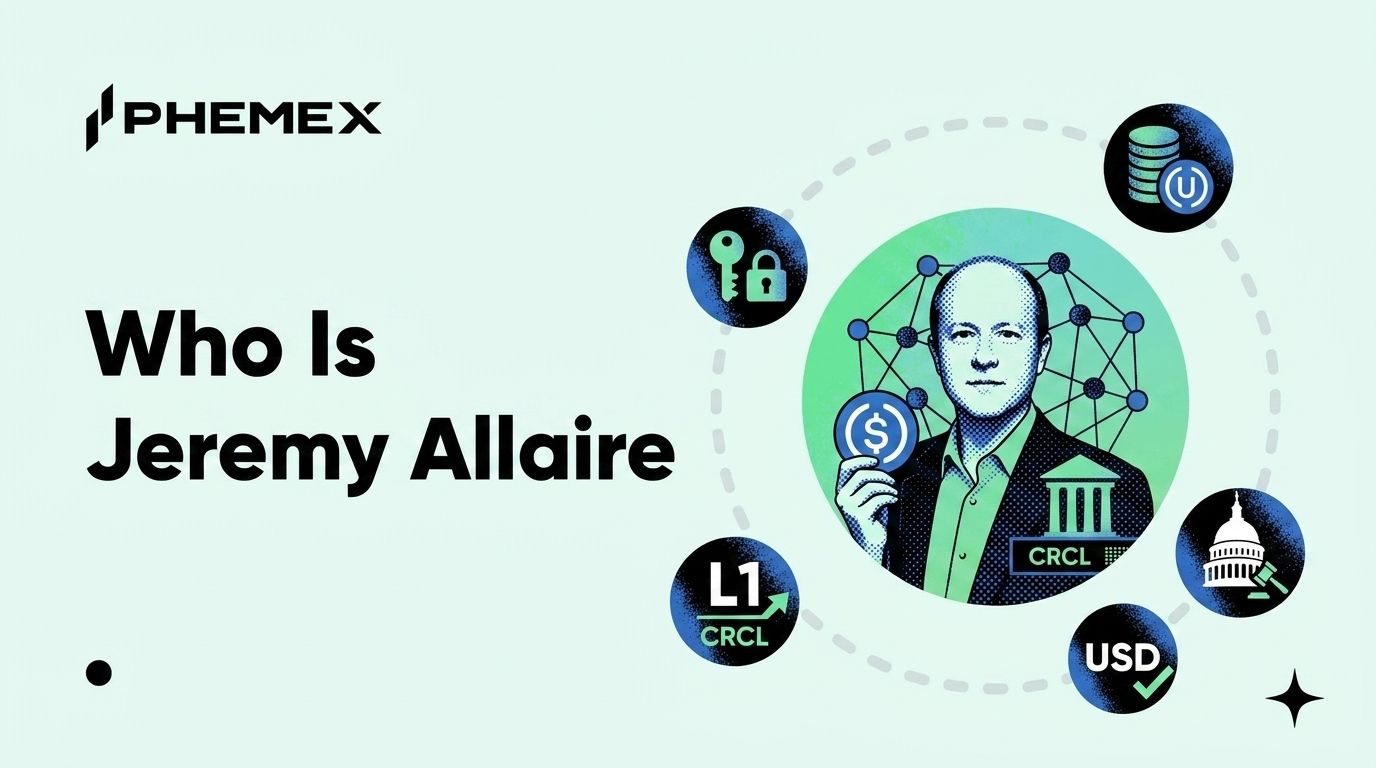
Jeremy Allaire is the co-founder and CEO of Circle, and on May 11, 2026, the company he has run for nearly thirteen years closed a $222 million presale for its own Layer 1 blockchain at a $3 billion fully diluted valuation. The investor list reads like a TradFi roll call. a16z crypto led the round with $75 million, and the syndicate included BlackRock, Apollo Funds, Intercontinental Exchange (the parent of the New York Stock Exchange), SBI Group, Standard Chartered Ventures, Janus Henderson, ARK Invest, and Bullish. Arc is Allaire's bet that the next phase of stablecoin growth is not about issuing more USDC but about owning the rails that USDC runs on.
Here is how a Macalester philosophy graduate ended up running one of the largest stablecoin operations in the world, the three companies he built before Circle, the years when USDC nearly lost to Tether, and why the man who used to insist Circle was a stablecoin company is now telling investors he wants to run the economy itself.
From Minneapolis to Macalester to ColdFusion in 1995
Allaire was born on May 13, 1971, and grew up in Minneapolis. He attended Macalester College in Saint Paul, graduating in 1993 with a degree in political science and philosophy and a concentration in economics. Most technical co-founders of crypto's largest infrastructure companies came out of engineering programs, and Allaire did not. His training was in political theory, and he has said in multiple interviews that the Montessori schools he attended as a kid shaped how he thinks about decentralization, self-direction, and what governance is supposed to do.
The first company came two years out of college. In 1995, Jeremy and his brother JJ Allaire founded Allaire Corporation in Minneapolis to commercialize a product his brother had written called ColdFusion, the first database-driven web content server. ColdFusion shipped in July 1995, three months before Windows 95, and it became one of the early standard tools for building dynamic websites. Allaire Corporation went public on the Nasdaq in January 1999 and was acquired by Macromedia on March 20, 2001, for approximately $360 million on a fully diluted basis. Allaire stayed on as chief technology officer of Macromedia from 2001 to 2003, then left to join General Catalyst as a technologist and executive-in-residence.
Two patterns from that first company are worth flagging because they show up in everything Allaire has done since. He commercializes infrastructure rather than apps, building plumbing that other companies use to build their own products, and he picks a market the moment it is about to scale and ships a product before the standards are set. ColdFusion got distribution because the web was a new category, USDC got distribution because stablecoins were a new category, and Arc, if it works, will get distribution because institutional onchain finance is now becoming one.
Brightcove and the Online Video Bet That Came Too Early
Allaire's second company was Brightcove, founded in 2004 with funding from General Catalyst, Accel, and AOL. Brightcove was an early online video platform built for media and marketing organizations at a moment when YouTube did not yet exist and most websites still struggled to embed a single video. The pitch was that every brand and publisher would need a professional-grade video infrastructure layer, and Brightcove would be the AWS for that workload. The thesis was correct in shape and badly mistimed in execution.
Brightcove had a successful IPO on the Nasdaq in February 2012 at $11 per share. By 2013, the consumer video market had been captured by YouTube and Facebook, and the enterprise market Brightcove targeted turned out smaller than the founders had hoped. Allaire announced on January 31, 2013, that he was stepping down as CEO to become chairman, with then-COO David Mendels taking over. The transition freed him up to start his third company nine months later, and that company was Circle.
Why Circle Existed Before USDC Did
Most people who read about Circle in 2026 know it as the issuer of USDC, the second-largest stablecoin and the only one that is both publicly traded and MiCA-compliant. The original Circle, founded in October 2013 with Sean Neville and $9 million in Series A funding from Jim Breyer, Accel, and General Catalyst, looked nothing like that. Circle's first product was a consumer Bitcoin wallet aimed at competing with Coinbase for retail users, with the long-term thesis that digital currency would replace bank-issued payment rails.
The wallet did not work. Circle pivoted hard in 2016 to a social-payments app, then pivoted again to over-the-counter trading desks, then sold its OTC business to Kraken in 2018. The first five years of Circle were a tour of every adjacent crypto business that ultimately did not become Circle's franchise, and the decision that made Circle was the one that came in 2018.
In May 2018, Allaire and Neville announced at Consensus that Circle would co-found a consortium called Centre with Coinbase to issue a dollar-backed stablecoin. USDC went live on September 26, 2018, on Ethereum, launching into a market dominated by Tether, which had a four-year head start and a reputation for opacity that Circle planned to use as a wedge. The Circle pitch was that USDC would be backed one-to-one by cash and short-term US Treasury securities, audited monthly, and issued by a US-licensed money transmitter that was happy to talk to regulators. Tether had none of that.
The Years When Circle Almost Lost
The USDC growth story between 2018 and 2022 looked like a clean compound. USDC supply went from zero to over $50 billion across four years, briefly closing the gap with Tether and reaching parity with the leader on regulated venues. Then March 2023 happened. Silicon Valley Bank failed on March 10, taking with it roughly $3.3 billion of Circle's USDC reserves, and USDC depegged to around $0.87 over the weekend before the FDIC made depositors whole. The temporary depeg sent over $10 billion of redemptions out the door in days. By the time the dust cleared, Circle had lost roughly half its supply, and Tether had reopened a gap that took two years to close again.
Allaire's response is the part of the Circle story most relevant to what Arc is trying to do. The Centre Consortium with Coinbase was dissolved in August 2023, with Coinbase taking an equity stake in Circle and Circle becoming the sole governor of USDC. Reserves were moved out of regional banks and concentrated in money-market funds managed by BlackRock, Circle pursued banking relationships in Europe and Asia, secured an EMI license in France for MiCA compliance, and rebuilt the redemption infrastructure to handle a multi-billion-dollar weekend without breaking.
By the time Circle filed to go public in 2024, USDC was back at parity with Tether on regulated dollar volume and growing again. Circle's June 2024 IPO on the NYSE under the ticker CRCL priced at $31 per share and raised roughly $1.05 billion at an $8 billion valuation, and the stock traded as high as $298 in the months that followed before the volatility set in. Phemex covered one of the steeper drawdowns in the company's explainer on the CRCL stock drop tied to the stablecoin yield ban.
What Allaire Said in 2024 and What He Is Saying Now
For most of the post-IPO period, Allaire told investors that Circle was a stablecoin company and that the business model was the spread between USDC reserves and short-term Treasury yields. That framing was accurate and also limiting, because it put a ceiling on the multiple the public market would pay for CRCL. Investors saw Circle as a leveraged bet on US interest rates rather than as a piece of financial infrastructure.
Allaire began changing the language in late 2025, and the pivot accelerated in early 2026 alongside the GENIUS Act stablecoin framework, which formally banned interest on stablecoin balances and forced Circle to articulate a growth story that did not depend on the issuance spread. The story Allaire landed on is that Circle should issue the dollar and also operate the rails the dollar moves through. That story is what Arc is.
What Arc Actually Is and What It Changes for Circle
Arc is a Layer 1 blockchain. It uses USDC as its native gas token, runs on EVM-compatible smart contracts, ships sub-second finality and opt-in privacy, and was designed for institutional finance rather than consumer apps. The presale that closed on May 11 sold 740 million ARC tokens at $0.30 each for $222 million of capital, putting the network at a $3 billion fully diluted valuation before a single block has been produced. Mainnet is expected in 2026.
|
Circle phase
|
Years
|
Role
|
Business model
|
|
Consumer wallet
|
2013-2016
|
App
|
Retail crypto exchange
|
|
Payments and OTC
|
2016-2018
|
App
|
Consumer + institutional trading
|
|
USDC issuer
|
2018-2025
|
Infrastructure
|
Reserve spread + redemption fees
|
|
Onchain finance operator
|
2026 onward
|
Infrastructure + protocol
|
Stablecoin issuance + Arc gas, sequencing, and onchain services
|
The bet is that if institutional finance moves onchain, the chain that gets the volume is the one designed for compliance, sub-second settlement, and USDC as native gas. Allaire framed the thesis this week by saying Arc can "run the actual economy," noting that the economy includes every contract and every system of governance that backs financial relationships, far beyond simple representations of value. That framing is what makes Arc different from another EVM chain, and it is the part where Allaire returns to the political-theory roots of his Macalester degree and starts talking about governance again.
The risk sits in the same place. Circle has never operated a blockchain before, and the competitive set already includes Ethereum, Solana, Base, and a wave of institutional chains from Stripe and Coinbase. ARC tokens are not yet tradeable, mainnet has not shipped, and the regulatory posture around a publicly traded company selling a presale token is genuinely new ground.
The Profile That Sits Behind All of It
Allaire is in his mid-fifties, married, and based in Boston. He has been a public-facing crypto executive longer than almost anyone in the industry, and his testimony in front of US Congress and EU regulators across a decade is part of why the GENIUS Act and MiCA both contain provisions Circle helped draft. He retained roughly 23.7% of CRCL voting power after the IPO, and his net worth has been estimated above $2 billion based on the remaining stake. He is also one of the few founders in this industry who has built three companies that hit a meaningful exit. Allaire Corporation sold to Macromedia for $360 million, Brightcove went public on the Nasdaq in 2012, and Circle went public on the NYSE in 2024. Arc is the fourth swing, and the pattern is what BlackRock and Apollo just wrote $222 million of checks against.
Frequently Asked Questions
Is Jeremy Allaire still the CEO of Circle?
Yes. Allaire has been the CEO of Circle since he co-founded it in October 2013 and continues to lead the company as both CEO and chairman of the board. His co-founder Sean Neville stepped back from the co-CEO role in late 2019 and remains a board member.
How much of Circle does Jeremy Allaire own?
Allaire retained roughly 23.7% of Circle's voting power immediately after the June 2024 IPO. He sold approximately 1.5 million shares in the IPO and additional stock in a secondary offering two months later. His remaining stake in CRCL has been valued at roughly $2 billion at recent price levels, though the figure moves with the stock.
What is Arc and how is it different from Ethereum or Solana?
Arc is Circle's own Layer 1 blockchain, designed specifically for institutional finance rather than consumer applications. It uses USDC as its native gas token, ships sub-second finality, supports EVM-compatible smart contracts, and offers opt-in transaction privacy. The key differentiator is that Arc treats compliance and stablecoin-native settlement as first-class features rather than retrofits, which Ethereum and Solana cannot do at the protocol level.
Why did Allaire shift Circle from being a stablecoin issuer to building a full blockchain?
The GENIUS Act stablecoin framework banned interest on stablecoin balances, which compressed Circle's traditional issuance-spread business model. Allaire reframed Circle as an onchain finance operator rather than just a dollar issuer, and Arc is the infrastructure layer for that pivot. The strategy moves Circle from competing on stablecoin market share to competing on which chain captures institutional onchain volume.
Bottom Line
Allaire just took the largest bet of his thirty-year career as a founder, and he took it with the largest balance sheet TradFi has ever put behind a single chain. The $222 million is small relative to what BlackRock, Apollo, and a16z manage, but the signal is bigger than the dollar amount, because every name on the Arc cap table is a firm that does not write checks on conviction alone.
Three things to watch through the back half of 2026. The Arc mainnet ship date is the first, because every day mainnet slips is a day Stripe Bridge and Coinbase's Base capture the volume Arc was built for. CRCL stock relative to Tether's market share is the second, because Circle has to grow the USDC franchise while building Arc on top of it. Allaire's testimony in front of Congress is the third, because the regulatory framework for a publicly traded issuer running its own L1 has not been written yet, and he is one of the only people in the room who will help write it.
He spent thirty years building infrastructure that other people used to do real work. Arc is the version where Circle does the real work itself.
This article is for informational purposes only and does not constitute financial or investment advice. Cryptocurrency trading involves substantial risk. Always conduct your own research before making trading decisions.
