







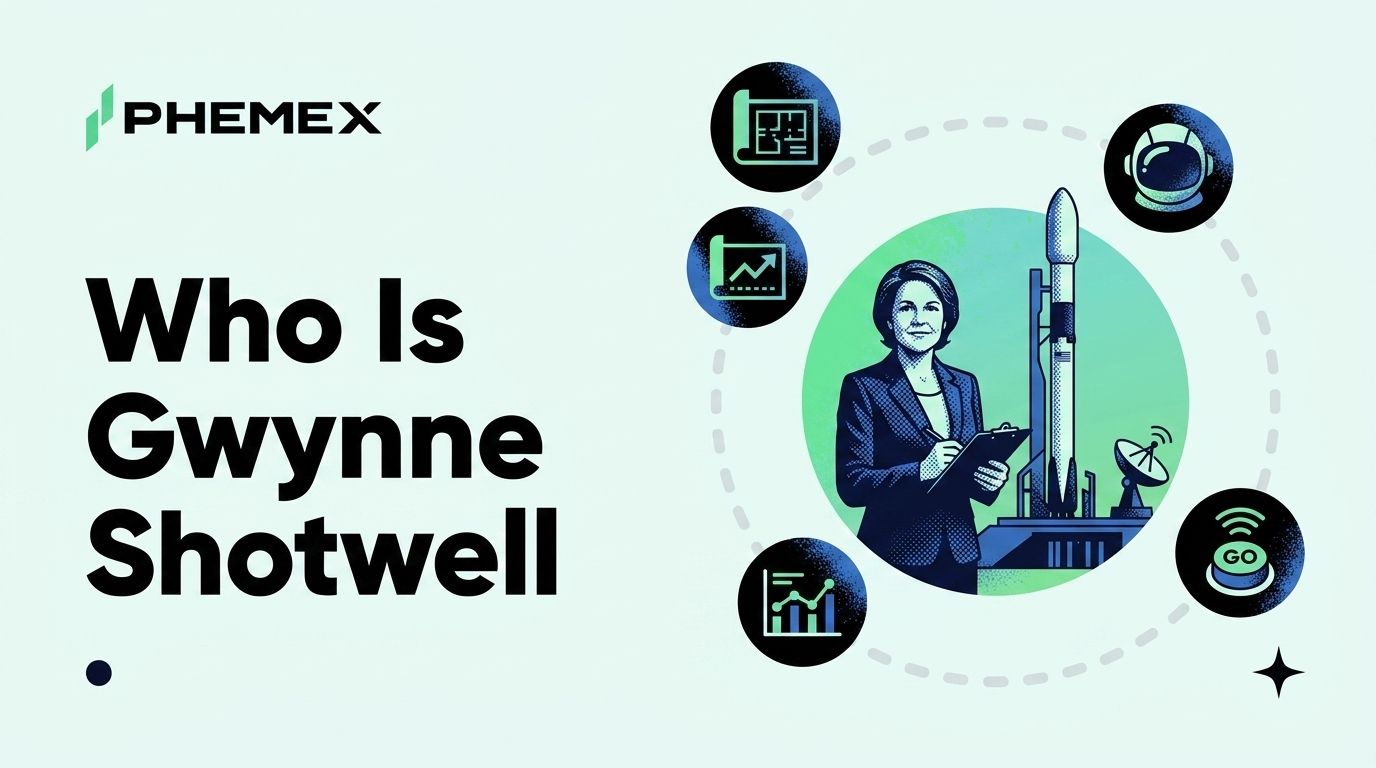
Elon Musk gets the headlines, but the person who signed the contracts, ran the factory floor, and steered SpaceX through the largest IPO in market history is Gwynne Shotwell. She is the President and Chief Operating Officer, employee number 11, the operator who walked into a rocket startup in 2002 with zero revenue and turned it into a $2.1 trillion company. SPCX debuted at $135 on June 12, 2026, opened at $150, and closed its first session near $161. Most traders know the founder. Few know the woman who made the company actually work.
- SPCX price: ~$172 (June 15, up from the $135 IPO price)
- IPO date: June 12, 2026, the largest in history
- Valuation: roughly $2.1 trillion
- Shotwell's role: President and COO since 2008, day-to-day operator
This is the story of how she did it, and why she is the name SPCX traders should actually be tracking. Here is the breakdown.
Northwestern, Chrysler, and a Decade Building Space Systems
Shotwell did not come out of a software garage. She earned bachelor's and master's degrees in mechanical engineering and applied mathematics from Northwestern University, graduating with honors, and her first job was on the management training program at Chrysler. The automotive detour mattered more than it looks. She learned manufacturing at scale, supply chains, and how a physical product moves from a drawing to a unit shipping out the door. That is the discipline that later separated SpaceX from every space startup that could design a rocket but could not build one repeatedly.
She left Detroit and joined El Segundo's Aerospace Corporation, the federally funded research center that advises the US government on space programs. She spent roughly ten years there in space-systems engineering, technical assessment, and project management. This is where she learned the customer side of the launch business cold. She understood how the Air Force, NASA, and commercial satellite operators actually bought launch services, what they worried about, and what made them sign. That buyer's-eye view becomes the single most valuable asset she brings to SpaceX a few years later.
From Aerospace Corporation she moved to Microcosm, a small El Segundo space-technology firm, where she ran business development and space-systems work. It was a smaller stage, but it put her directly in the orbit of the people building new launch vehicles in Southern California in the late 1990s and early 2000s. That network is what put her in the room with Elon Musk.
Joining SpaceX as Employee Number 11
Musk recruited Shotwell to SpaceX in 2002 as Vice President of Business Development. She was employee number 11 at a company that had no rocket, no flight history, and no customers. Her job was to go sell launches for a vehicle that did not yet exist, built by a team most established aerospace buyers had never heard of.
She built the commercial sales engine from nothing. Over the following years she assembled the Falcon launch manifest into a backlog worth billions of dollars and more than 70 missions, signing commercial satellite operators, foreign space agencies, and eventually the US government. The early SpaceX story everyone tells is about Musk's rockets exploding and the company nearly running out of cash in 2008. The story nobody tells is that the contracts Shotwell signed are what gave the company something worth saving.
Most people assume the hard part of a rocket company is the engineering. At SpaceX in the early years, the hard part was convincing serious customers to bet real money on an unproven launcher. That was Shotwell's job, and she closed it. You can trace her full arc through the Gwynne Shotwell Wikipedia profile and the company's own history on the SpaceX homepage.
The NASA Contracts That Saved the Company
In 2008 Shotwell was named President and COO, taking control of day-to-day operations and customer relationships while Musk remained CEO and chief engineer. The timing was brutal. The company was burning cash, the first three Falcon 1 launches had failed, and a fourth failure would likely have ended it.
What pulled SpaceX out was the relationship with NASA, and that relationship ran through Shotwell. Late in 2008 SpaceX won a Commercial Resupply Services contract worth roughly $1.6 billion to fly cargo to the International Space Station. That contract did more than bring revenue. It validated SpaceX as a credible government supplier and opened the path to the much larger Commercial Crew program, which eventually had SpaceX flying NASA astronauts on Crew Dragon. Shotwell ran the customer side of every one of those deals.
The pattern here is worth naming because it repeats. Musk took the engineering risk. Shotwell converted that risk into signed, funded, recurring revenue. A visionary who cannot close contracts builds a museum piece. A company that can do both becomes the dominant launch provider on Earth.
Scaling Falcon 9 Reusability and Starlink Into Real Cash Flow
The technical breakthrough that changed the economics was Falcon 9 reusability. Landing and reflying boosters dropped the marginal cost of access to orbit by an order of magnitude. But a cost breakthrough is only worth something if you have the operational machine to fly often, manifest densely, and turn boosters around fast. Building and running that machine was the COO's job.
Under Shotwell's operational leadership, SpaceX went from a few launches a year to a cadence no other provider on the planet comes close to matching. That cadence is what made Starlink physically possible. Deploying a constellation of thousands of satellites requires launching constantly, and only a reusable, high-cadence Falcon 9 fleet could do it economically. Starlink then flipped SpaceX from a lumpy contract-revenue business into a company with a fast-growing consumer and enterprise subscription line.
That shift is the entire investment thesis behind SPCX. A pure launch business is cyclical and contract-driven. A launch business plus a recurring connectivity business with millions of subscribers is a far more valuable, far more predictable cash machine. The Nasdaq SPCX listing reflects a market pricing in both halves of that story, the cyclical launch line and the recurring connectivity revenue that gives SPCX its premium.
Steering the Largest IPO in History
The June 12, 2026 IPO did not happen by accident, and it did not happen because Musk woke up wanting to ring a bell. Taking a roughly $2.1 trillion private company public is an operational and relationship exercise that runs for years before the first share trades. It means cleaning up the corporate structure, building the financial reporting machine a public company needs, courting institutional anchors, and managing the regulatory process end to end. That is COO territory, and it is Shotwell's.
The numbers tell the story of how the market received it. SPCX priced at $135, opened at $150, and closed day one near $161, then traded up to roughly $172 by June 15. A debut that holds a gain like that into the second and third sessions signals real institutional demand rather than a pure retail pop. The operational credibility behind those numbers, the consistent launch cadence, the Starlink revenue ramp, the government contracts, is what gave underwriters something concrete to sell.
The comparison to other space-sector public debuts is instructive. The early movers in the listed space economy traded on narrative for years before fundamentals caught up.
|
Company
|
Path to public market
|
What it traded on at debut
|
|
Virgin Galactic
|
2019 SPAC
|
Tourism narrative, no scaled revenue
|
|
Rocket Lab
|
2021 SPAC
|
Small-launch cadence, growing backlog
|
|
SpaceX
|
2026 traditional IPO
|
Launch dominance plus Starlink cash flow
|
The difference is that SpaceX came public with the operating machine already built. For a view on how the earlier space names are positioned now, see the Virgin Galactic 2026 outlook and the Rocket Lab how-to-buy guide.
Why Shotwell Is the Name SPCX Traders Should Track
There is a reason "key person risk" shows up in every space-stock thesis, and for SPCX it cuts in an unusual direction. Musk is the visionary and the lightning rod. His attention is split across multiple companies, his public behavior moves markets, and his risk appetite is the engine of the upside and a source of the volatility. Shotwell is the counterweight. She is the operator who keeps the trains running, signs the revenue, and manages the customers regardless of what is happening on social media.
For a public-market investor, that operational continuity is the asset. As long as Shotwell is running day-to-day operations, the machine that generates SPCX's cash flow keeps running on its own logic. Her continued leadership is, in practical terms, the single most important non-financial variable in the stock. If she stays, the operating story stays intact. If she ever steps back, that is the headline a serious SPCX holder should treat as a material event.
This is also why the pre-IPO history matters for sizing the position. Anyone who wanted exposure before June 12 had to go through the secondary market, a process the Phemex pre-IPO SpaceX guide walks through. Now SPCX trades as a tokenized stock you can size and trade directly.
Frequently Asked Questions
Who runs SpaceX?
SpaceX is run jointly by Elon Musk, who serves as CEO and Chief Engineer, and Gwynne Shotwell, who is President and Chief Operating Officer. Musk owns the company and drives the long-term engineering vision, while Shotwell manages day-to-day operations, customer contracts, and the business as a functioning enterprise. In practice, Shotwell is the executive who keeps the company operating on a daily basis.
Who is the president of SpaceX?
Gwynne Shotwell is the President of SpaceX, a role she has held alongside Chief Operating Officer since 2008. She joined the company in 2002 as employee number 11 and Vice President of Business Development, building its commercial sales engine from zero. She is widely regarded as the operator who turned Musk's vision into a working, revenue-generating company.
Is Gwynne Shotwell the CEO of SpaceX?
No. Elon Musk is the CEO and Chief Engineer of SpaceX. Shotwell is President and COO, which makes her the highest-ranking operational executive below Musk and the person responsible for running the company day to day. The distinction matters because Musk sets direction while Shotwell executes and manages the business.
What is Gwynne Shotwell's background?
Shotwell holds bachelor's and master's degrees in mechanical engineering and applied mathematics from Northwestern University. Before SpaceX she spent roughly a decade at the Aerospace Corporation in space-systems engineering and project management, with earlier stints at Chrysler and Microcosm. That combination of manufacturing, engineering, and commercial experience is what equipped her to scale SpaceX.
Bottom Line
Gwynne Shotwell is the operator behind the largest IPO in history, and her continued leadership is the variable that matters most for SPCX over the next several years. The day-one numbers point to real demand. SPCX priced at $135, opened at $150, closed near $161, and held above the IPO price into the following sessions at roughly $172. The read on the position is straightforward. As long as SPCX holds above its $150 open and Shotwell remains in operational control, the structural thesis of launch dominance plus Starlink cash flow stays intact. Lose the IPO-week support and the story turns into a valuation debate about if a $2.1 trillion price tag is justified by current revenue. Track the operator, not only the founder.
This article is for educational purposes only and does not constitute financial advice. Cryptocurrency and stock trading carries significant risk. Always do your own research and consult a qualified advisor.
