










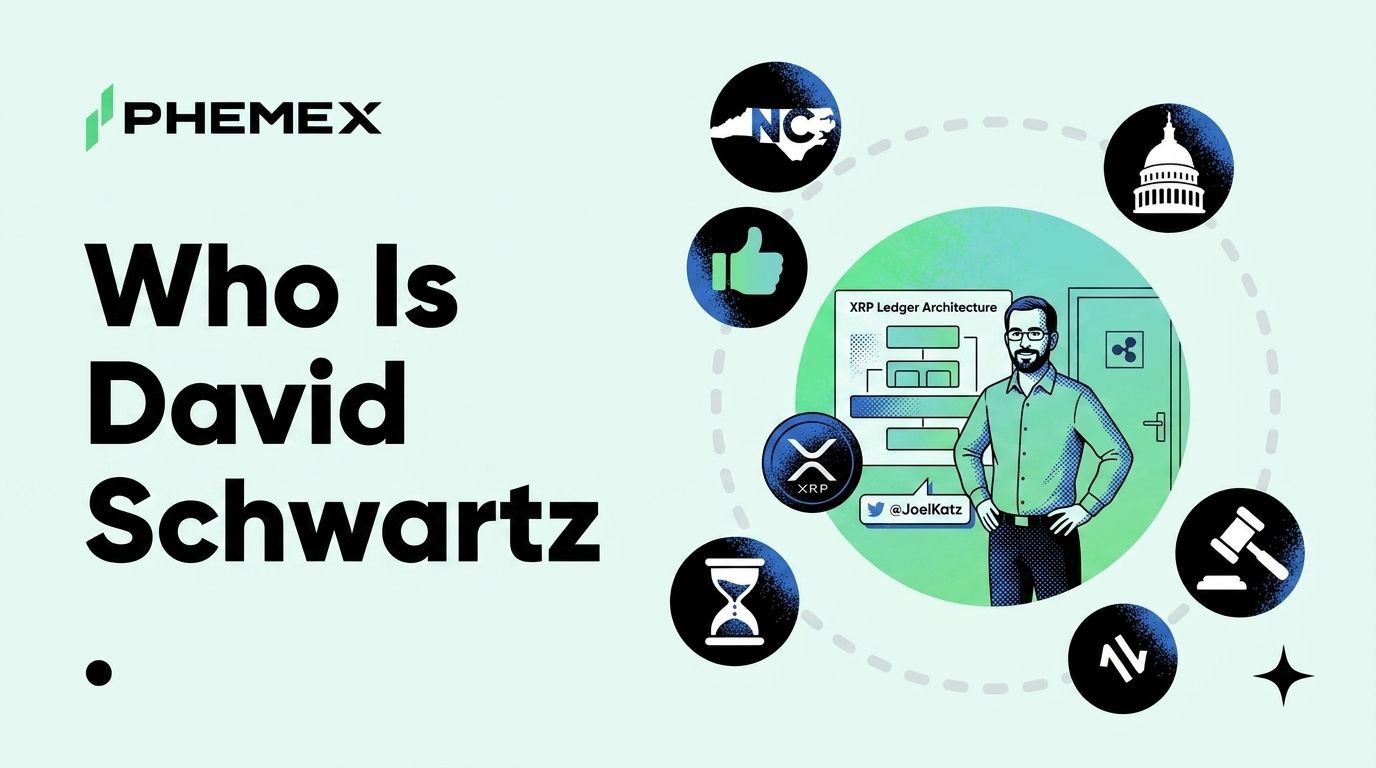
David Schwartz disclosed on May 4, 2026, that he once held 26 million XRP personally, then sold most of it for Bitcoin between 2012 and 2020 at prices that often started around 10 cents. The admission came on X, in a casual reply, and it lit up the XRP community for two weeks because it reframed how the most public engineer in crypto thinks about his own bag. Schwartz co-designed the XRP Ledger in 2011, served as Ripple's CTO through every legal and product chapter since, and stepped back from daily operations at the end of 2025 to become CTO Emeritus and a board member.
The reason traders still parse every Schwartz post is that nobody else inside Ripple speaks publicly with the same mix of technical authority and unvarnished opinion. He pushes back on $10K XRP price targets, calls Bitcoin a "technological dead end," admits Ripple should have prioritized smart contracts earlier, and refutes XRPL centralization claims line by line. The 26M disclosure was the first time he gave the market a clean number for the personal exposure behind those views.
The Early Years and the XRPL Design Choice
Schwartz spent the 2000s as a cryptographer and distributed systems engineer, including a stretch at WebMaster Incorporated working on encrypted communication products. He was already a fixture on cypherpunk mailing lists and the Bitcoin forums under the handle JoelKatz long before Ripple existed, which is the reason most XRP holders still know him by that name on X, Reddit, and Stack Exchange. By 2011 he had concluded that proof-of-work was the wrong tool for a payments network.
That conclusion is what produced the XRP Ledger. Schwartz, along with Arthur Britto and Jed McCaleb, designed XRPL around a Federated Byzantine Agreement style consensus model where validators run a Unique Node List and confirm transactions in three to five seconds without mining. The trade-off was explicit. XRPL gives up the trust-no-one purity of Nakamoto consensus in exchange for settlement speed, sub-cent fees, and 100 billion pre-mined units that route through banks the way SWIFT messages do. The Phemex breakdown of how XRP and Ripple actually work has the full architecture rundown.
Schwartz joined Ripple as chief cryptographer in 2011 and was elevated to CTO in 2018. Across that stretch he sat on virtually every major technical decision, including the escrow lockup of the founder allocation, the XLS amendment process that governs protocol upgrades, and the long-running debate over native smart-contract support on XRPL.
What CTO Emeritus Actually Means
Schwartz announced in October 2025 that he would step back from daily operational duties at the end of the year. The new title is CTO Emeritus. He joined Ripple's board of directors, kept his shares, and handed technical operations to Dennis Jarosch, who now runs the engineering org as Ripple pivots from being purely a payments company into a stack that touches custody, stablecoins, programmability, and bank-grade infrastructure.
The change is real but easy to misread, because Schwartz is not retiring from public crypto life. His final on-stage appearance as Ripple's sitting CTO was December 19, 2025, and within weeks of that he was back to posting daily on X, running X Spaces, and showing up in the protocol governance discussions. The board seat plus the emeritus title plus the personal X account means he is still the most public engineering voice at Ripple, just without the calendar load of running an org. Traders watching for signals should treat his account as a primary source, not a retired-executive footnote.
He has been transparent about the reason for the step back. The XRPL roadmap for 2026 covers programmability, institutional DeFi integration, and tokenized real-world assets, and that work needs a full-time operator running engineering, while Schwartz's value to Ripple now sits closer to a chief scientist role than a CTO seat. The Phemex coverage of the 2026 XRPL roadmap announcement is the cleanest summary of what the new technical team is actually shipping.
The Public Engineer Persona and the Centralization Pushback
Almost nobody in crypto with Schwartz's technical credibility posts as often as he does. He has spent more than a decade replying to retail XRP holders on X under @JoelKatz, writing long-form Stack Exchange answers about consensus design, and walking developers through XRPL specifics in podcast appearances. That footprint is why his pronouncements move markets, and why a technical breakdown from him in a centralization thread lands harder than the same argument from any other Ripple insider.
The clearest recent example is the February 2026 exchange with Bitcoin advocate Bram Kanstein on XRPL decentralization. Schwartz dismissed the claim that Ripple controls the ledger as "objectively nonsensical" and walked through the math, pointing out that Ripple operates a small fraction of the validators on the default UNL and that any node operator can swap their UNL for a different set at any time. The Phemex write-up of his XRPL centralization response collects the receipts, and the back and forth gave the XRP community its strongest technical defense of the validator architecture in years.
He uses the same playbook for every contested topic. Someone posts a maximalist claim, Schwartz drops a paragraph of distributed systems analysis, and the thread gets quoted into a price-action discussion within an hour. The pattern is so consistent that several quant desks now track his X account as a sentiment input alongside the usual data feeds.
The Controversial Calls and Why They Stick
Three Schwartz takes in particular have generated headlines across 2026.
The $10,000 XRP rebuttal. Schwartz publicly dismissed the $10K XRP price target that circulates in the YouTube prediction crowd. His argument is microeconomic. If even a small number of rational wealthy investors believed XRP had a one percent chance of hitting $10K within ten years, they would bid the token to $20 today as a rational option position, and the price is not $20. He extended the same logic to $100 and $50 XRP targets earlier in the year. The honest reading is that the chief architect of the network thinks the loudest price calls in his own community do not survive a real expected-value check, and he is willing to say so on the record.
The Bitcoin "technological dead end" comment. In February 2026, during a heated decentralization exchange, Schwartz wrote that he thinks "bitcoin is largely a technological dead end for the same reason the dollar is." His point was that once an asset is widely accepted, network effects override technical progress, and Bitcoin's blockchain only needs to do one thing well, which it already does. Bitcoin maxis read it as a swipe, while Schwartz framed it as a network effect observation, and both readings are technically valid. The comment is now part of every XRP versus BTC argument on crypto X.
The smart-contract delay admission. In November 2025, in an X Spaces session on XRPL programmability, Schwartz conceded that Ripple should have prioritized smart contracts on the ledger years earlier. The internal stance had been that the feature needed to be industry-leading on day one to justify shipping, and in hindsight that bar slowed XRPL's developer ecosystem versus chains that shipped imperfect tooling and iterated. The Phemex brief on the smart-contract admission captures the timing, which matters because XRPL's AlphaNet smart-contract testing went live weeks after that comment.
Put together, the three calls form a coherent worldview where Schwartz is willing to disagree with his own community on price, with Bitcoin holders on roadmap direction, and with his own company on past strategic choices. That kind of public candor from a sitting or former CTO is rare, which is why every one of those posts gets repackaged as a news story for a week.
The 26 Million XRP Disclosure
On May 4, 2026, in a casual X exchange about personal portfolios, Schwartz wrote that he once held 26 million XRP. He sold most of the position in waves between 2012 and 2020, often when XRP was trading around 10 cents, and rotated the proceeds into Bitcoin to cut his concentration risk. He has since said his current XRP holdings sit above one million tokens, with most of his crypto-related net worth now running through Ripple equity rather than the token itself. The Phemex summary of the 26M XRP disclosure has the full timeline.
The disclosure mattered because it gave the market a concrete number for the personal exposure behind years of public commentary, and it explained why Schwartz has always been comfortable saying "I do not know where XRP price is going" while still defending the protocol. He de-risked his personal bag a decade ago, which is exactly why his protocol commentary carries weight that promoter accounts cannot replicate.
The community reaction split. One camp called it a vindication of his consistency, while another camp asked why he sold so early if the long-term thesis was as strong as Ripple has always argued. Schwartz's answer was essentially that diversification is rational and that selling early is the cost of not knowing the future, which is the same position he takes on price predictions today.
What Comes Next for Schwartz and the Ledger
Two things are worth watching across 2026 and 2027.
The first is the XRPL programmability rollout and how fast it closes the developer gap with Ethereum and Solana. AlphaNet smart contracts are now live for testing, and Schwartz's admission that Ripple should have shipped this earlier signals that the team is willing to release imperfect-but-iterating tooling rather than wait for a perfect launch, which is what XRPL needs if it wants to host serious DeFi or RWA volume. The pivot toward institutional XRP exposure is also visible in the Phemex guide to live XRP ETFs and inflows, which now sits alongside the programmability push as part of the same institutional story.
The second is the steady flow of Schwartz commentary itself, which markets respond to in real time. His pushback against AI-generated price predictions earlier this year stopped a viral meme cycle in its tracks, and his XRPL roadmap pushback on critics shaped the narrative around the Q1 amendment vote. If he posts a long technical thread about validator economics, expect a quote-tweet from a quant desk to follow within hours, because nobody else in the XRP ecosystem speaks with the same combination of authority and willingness to disagree publicly.
He is also one of the few founders whose retirement-adjacent move came without a token sale. He kept his Ripple equity, kept his XRPL validator influence through reputation rather than control, and kept his X account active. The result is that the man who designed XRPL in 2011 is still the most quoted XRP voice in 2026, just without the operational title.
Frequently Asked Questions
Is David Schwartz still Ripple's CTO?
No. Schwartz transitioned to CTO Emeritus at the end of 2025 and joined Ripple's board. Dennis Jarosch now runs technical operations day to day, but Schwartz remains a public-facing voice for XRPL and a board-level participant in strategy.
How much XRP does David Schwartz hold today?
Schwartz has confirmed his current XRP position sits above one million tokens, down from a peak of 26 million he sold off in waves between 2012 and 2020. Most of his crypto-related exposure now runs through Ripple equity rather than direct token holdings.
Did David Schwartz really call Bitcoin a "technological dead end"?
Yes, on X in February 2026, in the context of a network-effects argument. His point was that once an asset is widely accepted, network effects override technical progress, not that Bitcoin's price is doomed. The comment was widely framed as an attack by Bitcoin holders, but Schwartz has stood by it as a technical observation.
Why does Schwartz reject $10,000 XRP price predictions?
He frames the question as an expected-value problem rather than a sentiment one. If a meaningful number of rational wealthy investors believed XRP had even a one percent chance of hitting $10K in ten years, the price would already trade at $20 today as a rational option position. The fact that it does not is, in his view, the market telling you the implied probability of those targets is much lower than retail YouTube channels claim.
Bottom Line
Schwartz is the rare crypto founder who matters more for what he says than for what he sells, and the 26 million XRP disclosure removed the last piece of asymmetric information between him and the community. Watch his X account for three specific catalysts across the rest of 2026. First, commentary on XRPL smart-contract mainnet timing, because his admission about the past delay means he is now aligned with shipping fast rather than perfect. Second, his response to the next round of centralization criticism, because the framing he uses tends to set the community's defensive posture. Third, any further personal-portfolio disclosures, because the 26M reveal opened a door that nobody else inside Ripple has walked through. The protocol architect is no longer the operator, and that is exactly what makes his voice more useful to traders than it has been in years.
This article is for informational purposes only and does not constitute financial or investment advice. Cryptocurrency trading involves substantial risk. Always conduct your own research before making trading decisions.
