









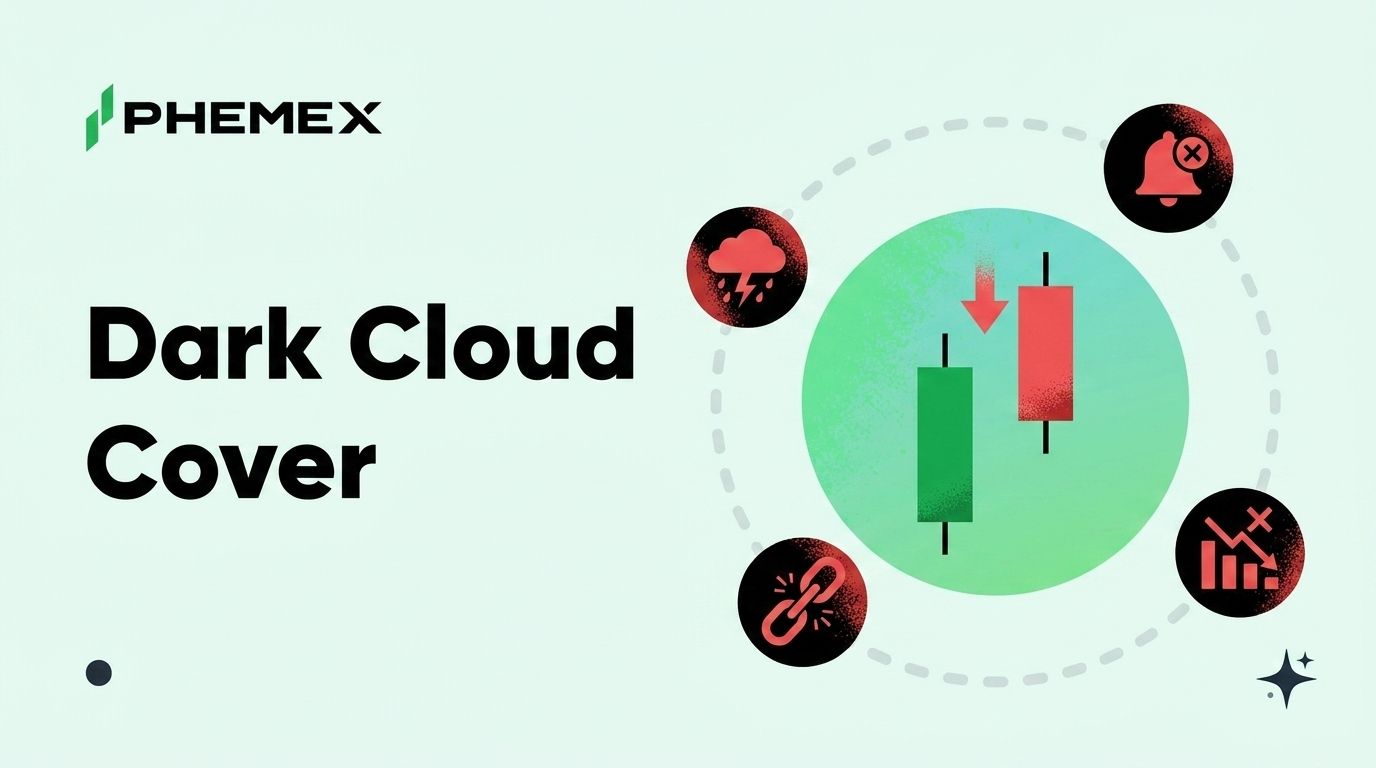
The Dark Cloud Cover is a two-candle bearish reversal pattern that signals the end of an uptrend and the start of a meaningful pullback. It is the bearish mirror of the Piercing Line pattern, which marks the bottom of a downtrend. In crypto markets where short-term moves can travel 8% to 15% in a single session, recognizing the pattern in real time is a meaningful edge. The Bitcoin chart printed a textbook Dark Cloud Cover at the $82,000 zone on May 6 of this year, and the resulting move pulled BTC down 12% over the following two weeks.
The pattern works because it captures a specific moment of buyer exhaustion followed by seller reclaim. The first candle continues the trend higher with confidence. The second candle opens above the prior high with apparent confirmation of the breakout, then reverses sharply through the prior session's body to close near the open. The reversal signals that the buyers who pushed the gap up could not hold the level, and the sellers were strong enough to walk the price back through 50% or more of the prior candle's body.
The Anatomy of the Pattern
The Dark Cloud Cover has three required components and two optional confirmation signals. The first required component is the prior uptrend, which has to be visible and meaningful (typically at least three to five sessions of higher highs and higher lows). Without the uptrend the pattern is just a two-candle sequence with no reversal context.
Source:appreciatewealth
The second required component is candle one, which has to be a long green continuation candle that closes near its high with little to no upper wick. The body has to be at least as large as the average body of the preceding three to five sessions, which signals that the buyers are still in control through the close of the session.
The third required component is candle two. It has to open above candle one's high (a clear gap up that visually confirms breakout strength), then sell off through the session to close below the midpoint of candle one's body. The midpoint rule is what distinguishes the Dark Cloud Cover from weaker pullback patterns. If the close is at exactly the midpoint or higher, the signal is not valid. If the close is below the midpoint, the pattern is valid. If the close is below candle one's open (engulfing the body), the pattern technically transitions into a Bearish Engulfing, which is a stronger signal.
The two optional confirmation signals are volume and RSI. Volume should be rising on candle two, ideally to at least 1.5x the prior session's volume. RSI should be in overbought territory (above 70) on either candle one or candle two, signaling that the underlying momentum was already stretched before the reversal printed. Investopedia's Dark Cloud Cover reference walks through the historical statistical baselines for the pattern's reversal-success rate across equity markets, which is broadly consistent with the crypto behavior.
How It Differs From Bearish Engulfing and Three Black Crows
|
Pattern
|
Candle count
|
Required close
|
Reversal strength
|
|
Dark Cloud Cover
|
2
|
Below candle 1 midpoint
|
Medium
|
|
Bearish Engulfing
|
2
|
Below candle 1 open (full body)
|
Strong
|
|
Three Black Crows
|
3
|
Three consecutive lower closes
|
Very strong
|
|
Evening Star
|
3
|
Doji/small candle 2, strong red candle 3
|
Strong
|
The distinction matters because the price reaction tends to scale with the pattern strength. A clean Dark Cloud Cover at a meaningful resistance level produces a typical follow-through pullback of 3% to 6% in crypto markets, while a Bearish Engulfing at the same level tends to produce 5% to 10%, and a Three Black Crows sequence tends to produce 8% to 15% over the next 3 to 5 sessions.
The pattern hierarchy is useful when planning trade entries and exits. A Dark Cloud Cover at the start of a session sequence may transition into a stronger pattern over the next one or two sessions, which is one of the reasons confirmation on the third candle (a close below candle two's low) is often used by more disciplined traders before committing to the trade. For the broader context on how candlestick reversal patterns fit into a trading framework, the Phemex reversal candles guide covers the full pattern family.
The BTC May 6 Example as the Textbook Setup
The Bitcoin chart on May 6 produced the cleanest Dark Cloud Cover of 2026 to date. The prior week had run a strong uptrend from $76,000 to $81,500 with five consecutive higher highs and higher lows. The May 5 session printed a long green continuation candle that closed at $81,900 near the session high with minimal upper wick and volume in line with the prior week's average. RSI on the daily chart sat at 71, which put the underlying momentum into overbought territory.
The May 6 session opened at $82,400, a clear gap up above the prior session's $81,950 high. The price moved up to $82,580 in the first three hours of the session, then reversed and traded down to close at $80,200. The close was below the midpoint of the May 5 body, confirming the Dark Cloud Cover pattern. Volume on the May 6 session printed at roughly 1.7x the prior week's average, satisfying the volume confirmation signal.
The follow-through was textbook. May 7 opened at $80,150 and closed at $78,400, transitioning the two-candle pattern into a three-candle sequence consistent with a Three Black Crows confirmation. By May 13 BTC had traded down to $72,000, a 12% decline from the Dark Cloud Cover close. The trade setup that respected the pattern (short entry on May 6 close, stop above the May 6 high at $82,580, target the prior support at $73,000) produced an approximately 8% gain with a 3% stop.
How to Actually Trade the Pattern
The trade construction has three components. The entry is at the close of candle two, which is when the pattern is officially confirmed. The stop loss is above the candle two high, which is the level that invalidates the bearish thesis. The target is the prior support level or moving average that the uptrend had previously bounced from, which is the most likely first stop on the way down.
The risk-reward math typically favors the trade when the pattern prints at a meaningful resistance level (prior high, round number, key moving average). A clean Dark Cloud Cover at a confluence resistance tends to produce a 2:1 or better risk-reward setup, which is the kind of asymmetric setup that justifies committing risk capital. A Dark Cloud Cover in the middle of a range without a clear resistance reference produces a much weaker setup and should usually be passed.
The second consideration is position sizing relative to the pattern's reliability. Historical backtest data on the Dark Cloud Cover in crypto markets shows roughly a 58% follow-through rate when all three required components plus both optional confirmations are present. That is meaningfully better than coin flip but not high enough to justify outsized position sizing. The disciplined approach is to size the trade at the same risk allocation as any other technical setup and to take partial profits at the first target rather than holding for the full move.
For broader context on how candlestick patterns connect to the bullish counterparts, the Phemex bullish engulfing candle explainer walks through the inverse pattern that signals trend reversal at the bottom.
Common Mistakes Traders Make With the Pattern
There are four common errors that show up repeatedly in retail trader use of the Dark Cloud Cover. The first is treating any two-candle bearish sequence as a Dark Cloud Cover even when the gap-up requirement is not met. Without the gap up, the pattern is just a bearish reversal candle, not a Dark Cloud Cover, and the historical follow-through statistics do not apply.
The second is taking the trade without the prior uptrend context. A Dark Cloud Cover that prints inside a sideways range is not a reversal signal because there is no trend to reverse. The pattern requires the uptrend as the setup, and without it the trade is just a directional bet on a single candle.
The third is ignoring the midpoint rule. A two-candle sequence where candle two opens above candle one's high but closes at exactly the midpoint (or higher) of candle one's body is not a valid Dark Cloud Cover. The midpoint requirement is what separates the pattern from a weaker pullback, and traders who relax the rule end up taking lower-probability trades.
The fourth is failing to use confirmation on the third candle. The clean trade setup is to wait for the third candle to close below the candle two low before committing to the short, which filters out the false signals where the pattern prints and then immediately reverses higher.
Frequently Asked Questions
What is a Dark Cloud Cover pattern?
The Dark Cloud Cover is a two-candle bearish reversal pattern at the top of an uptrend. Candle one is a long green continuation candle, candle two opens above candle one's high but closes below the midpoint of candle one's body. The pattern signals buyer exhaustion followed by seller reclaim and tends to produce a 3% to 6% follow-through pullback in crypto markets.
How is the Dark Cloud Cover different from a Bearish Engulfing?
A Bearish Engulfing requires candle two to close below candle one's open, completely engulfing the body. A Dark Cloud Cover only requires the close to fall below the midpoint of candle one's body. The Bearish Engulfing is the stronger signal and tends to produce a deeper follow-through pullback, while the Dark Cloud Cover is a medium-strength reversal that may transition into a stronger pattern over the next session.
What is the historical reliability of the Dark Cloud Cover in crypto?
When all three required components (prior uptrend, long green candle one, candle two opens above candle one's high and closes below the midpoint) plus both optional confirmations (rising volume on candle two, RSI above 70) are present, the historical follow-through rate is roughly 58% in crypto markets. That is better than coin flip but not high enough to justify outsized position sizing.
How should the Dark Cloud Cover be traded?
Entry at the close of candle two, stop loss above the candle two high, target the prior support level or moving average. The trade construction favors patterns that print at meaningful resistance levels (prior high, round number, key moving average) where the risk-reward setup is 2:1 or better. Confirmation on the third candle (close below the candle two low) filters out false signals.
Bottom Line
The Dark Cloud Cover is a medium-strength two-candle bearish reversal pattern that captures buyer exhaustion and seller reclaim at the top of an uptrend. The required components are the prior uptrend, a long green candle one, and a candle two that opens above candle one's high but closes below the midpoint of candle one's body. The optional confirmations are rising volume on candle two and overbought RSI on either candle. The BTC May 6 setup at $82,000 was a textbook example that produced a 12% follow-through over two weeks. The disciplined approach is to wait for third-candle confirmation, size the trade at standard risk allocation, and take partial profits at the first technical target.
This article is for educational purposes only and does not constitute financial or investment advice. Cryptocurrency trading involves substantial risk. Always conduct your own research before making trading decisions.
