









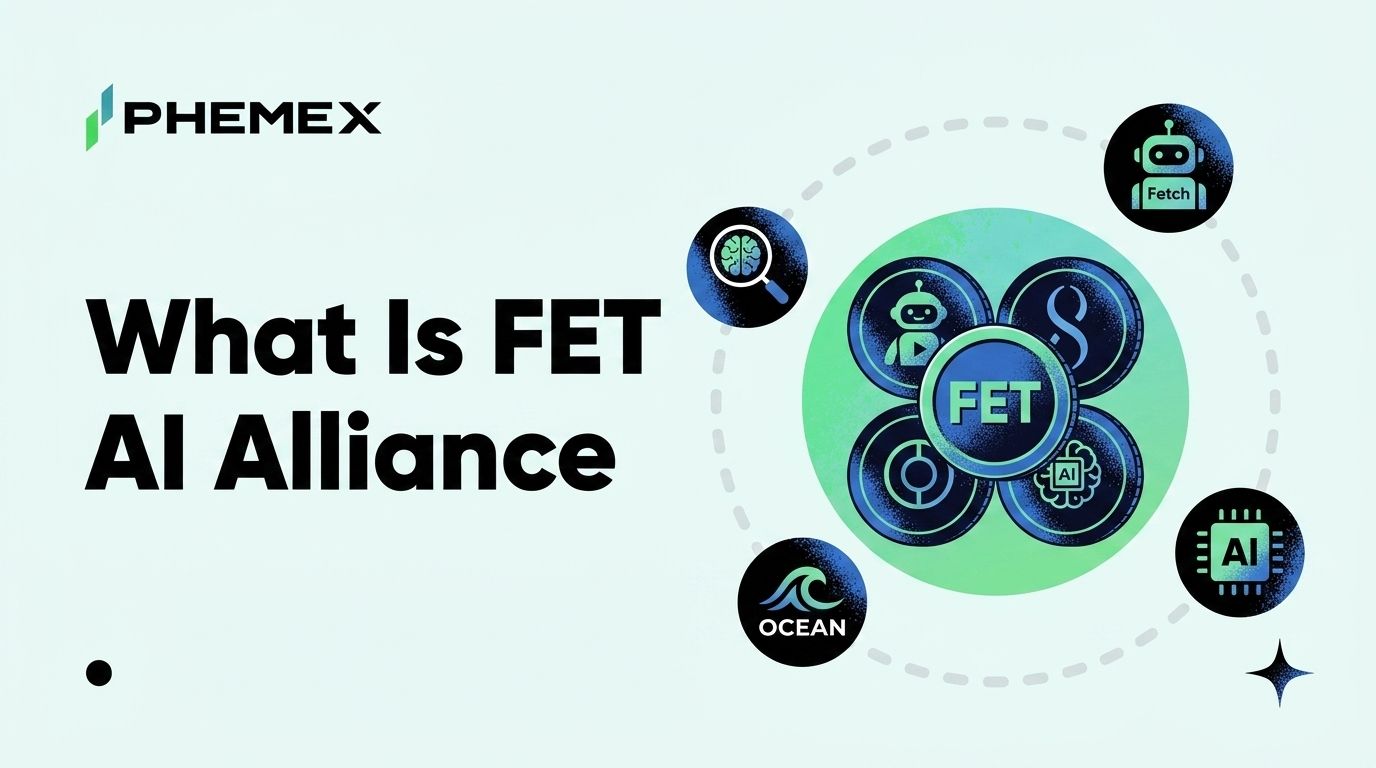
The Artificial Superintelligence Alliance (FET) is trading near $0.2105 as of May 24, 2026, up roughly 9.05% on the week as capital rotates back into AI tokens and the alliance pushes new agent infrastructure into production. FET is not a new project getting its first cycle. It is the merged ticker of four formerly independent AI-crypto teams that decided in 2024 that one token and one roadmap had a better shot at competing with closed-source AGI labs than four separate efforts did.
Most retail traders still recognize FET as "Fetch.ai," the autonomous-agent project from 2019. The token sitting under that ticker today is something larger. It absorbed AGIX from SingularityNET, OCEAN from Ocean Protocol (now partially unwound), and CUDOS as a compute partner. The 9% weekly move is real, but the structure underneath it is what makes this asset worth understanding before you size a position.
What the ASI Alliance Actually Is and How the Merger Got Built
The Artificial Superintelligence Alliance was announced in March 2024 and the token merger went live on June 13, 2024. Fetch.ai's FET became the base token. SingularityNET's AGIX and Ocean Protocol's OCEAN converted into FET at fixed rates, with the long-term plan being a full rebrand to a new ASI ticker. CUDOS joined later in 2024 as a compute partner at a predetermined rate of 112.427 CUDOS per FET, bringing the active membership to four teams under one banner.
The picture changed in October 2025. Ocean Protocol Foundation formally withdrew from the alliance, citing a preference to control its own tokenomics. Roughly 270 million OCEAN tokens across about 37,000 wallets had not converted by the withdrawal date, and Ocean said the conversion bridge stays open indefinitely. That left Fetch.ai, SingularityNET, and CUDOS as the active alliance members under the FET banner.
One detail traders keep getting wrong is the ticker. The full rebrand from FET to ASI was the original plan, but as of May 2026 it has not happened. Spot and perpetual markets continue to trade as FET on every major venue. If you see "ASI" quoted somewhere, assume it is the same asset.
What Each Constituent Actually Brings to the Table
The four original projects were not competing. They occupied different layers of the same stack, and the alliance argument is that those layers compose better as one network than as four separate ones.
Fetch.ai brings autonomous agents. Launched in 2019 with a platform for building autonomous AI agents that can negotiate, transact, and coordinate on-chain. The agent framework is the most mature piece of the alliance and the closest thing to a real product with paying enterprise users. ASI:Create, a closed-alpha platform for building agents at scale, launched in February 2026 and is the current focal point of the roadmap.
SingularityNET brings the AI services marketplace. Founded by Ben Goertzel, it runs a decentralized market where developers list AI services (vision, NLP, generative tools) that anyone can pay for in token. The long-term vision is that those services become the building blocks an autonomous agent calls out to when it needs a capability it does not have natively.
CUDOS brings distributed compute. CUDOS operates a network of GPU and CPU providers and lets an agent or a SingularityNET service rent compute without going to AWS. The April 2026 Matterhorn partnership for AI code-safety auditing applied that infrastructure to a specific enterprise use case.
Ocean Protocol brought tokenized data during its alliance period. Data, agents, services, and compute were the four primitives the alliance was assembled to combine. Three of the four are still inside the tent.
|
Member
|
Layer
|
Native contribution
|
Status
|
|
Fetch.ai
|
Autonomous agents
|
Agent framework, ASI:Create platform
|
Active
|
|
SingularityNET
|
AI services marketplace
|
Decentralized model and service market
|
Active
|
|
CUDOS
|
Distributed compute
|
GPU and CPU compute network
|
Active
|
|
Ocean Protocol
|
Tokenized data
|
Data marketplace and access tokens
|
Withdrew Oct 2025
|
Why FET Is Climbing This Week
The 9% weekly move has three drivers, and the order matters because it tells you how much of the move is narrative versus delivery.
The first is the AI-token rotation. Capital that spent the last six weeks chasing meme tokens and DePIN names started moving back into AI-narrative tokens in mid-May, and FET is the largest-cap AI-merger asset most desks already have on a watchlist. When AI is bid as a basket, FET catches a flow smaller AI-agent tokens cannot absorb at size.
The second is the alliance roadmap. The ASI:Create closed alpha launched in February 2026 and the Matterhorn AI code-safety partnership announced in April 2026 are concrete, datable shipments. There has been a measurable uptick in large-wallet accumulation since the Matterhorn news.
The third is the unfinished ticker change. Anytime the ASI rebrand crosses the wire, FET spikes on the assumption that a new ticker and fresh exchange listings reset the asset's narrative. As of late May 2026 the rebrand is still pending phase 2, and speculators front-run any official update.
Chart context matters more than any one driver. FET is trading at roughly $0.2105 with a circulating supply just over 2.3 billion tokens, ranked near 100 by market cap. The 2024 cycle high was near $3.50 in March 2024 when the merger was first announced, so the $0.21 print is a discount of roughly 94% from that peak. A 9% weekly move inside a long base looks like a base, not a breakout. That distinction matters for how you size.
Risk Framing and How to Evaluate FET as an Asset
The bull case is the cleanest AI-crypto thesis still standing in 2026. If autonomous AI agents become a real layer of the internet, they will need to coordinate, transact, rent compute, and pay for services without humans in the loop. FET is one of the few networks with all four primitives under one token and a five-year head start on the agent framework. The current valuation prices in almost none of that.
The bear case gets less airtime in bullish threads but is just as real. Token mergers are operationally hard, and Ocean's exit is a reminder that "one alliance, one token" is a coordination problem the alliance has not fully solved. The pending FET-to-ASI rebrand has been "pending" for over a year. Most of the AI-agent excitement in 2025 and early 2026 happened around newer, smaller-cap projects (elizaOS, Virtuals, World3, Talus), so FET tends to lag the smaller tokens during euphoric moves and outperform during the gut-check pullbacks.
The metrics worth tracking are weekly active agents deployed via the Fetch.ai framework, paid inference volume on the SingularityNET marketplace, GPU-hours rented through CUDOS, and any concrete date for the ASI ticker rebrand per the ASI governance process. Price-action traders should also watch the $0.18 to $0.20 zone as the line below which the current base would break.
Frequently Asked Questions
Is the FET ticker changing to ASI soon?
The rebrand from FET to ASI is the second phase of the original merger plan and as of May 2026 it has not been executed. Spot and perpetual markets all continue to quote FET, and the alliance has not announced a firm date. Anyone telling you the swap happens by a specific date is guessing.
Why did Ocean Protocol leave the alliance and does it affect FET holders?
Ocean Protocol withdrew in October 2025 to regain independent control over its tokenomics and direction. For FET holders the practical impact is small because the converted OCEAN supply is already inside the merged token, and Ocean's withdrawal does not unwind those conversions. The conversion bridge for the remaining unconverted OCEAN stays open indefinitely.
How is FET different from newer AI agent tokens like Virtuals or elizaOS?
FET represents an alliance of four mature projects with a combined five-plus years of shipping product, while newer agent tokens are typically a single team building a single framework. FET trades like an AI-sector index inside one ticker. Newer tokens trade like high-beta bets on one specific framework winning. Different risk profiles, different sizing.
Can FET realistically recover its 2024 high of $3.50?
The honest answer is nobody knows, and anyone promising a specific price is guessing. The path back would need a successful ASI rebrand, measurable adoption of the agent framework by enterprise users, and the broader AI-token category catching another sentiment cycle. Each of those is plausible alone. None of them is priced in at current levels.
Bottom Line
FET sits at roughly $0.2105 on May 24 with a 9.05% weekly move, and the catalysts (AI-token rotation, ASI:Create alpha shipping, Matterhorn partnership) are real rather than pure narrative. The structure underneath the move is a merged alliance of Fetch.ai, SingularityNET, and CUDOS, currently valued at roughly 6% of its 2024 cycle high. The line that matters is $0.18 to $0.20 on the downside and any concrete rebrand date on the upside. If agent metrics climb and a rebrand date lands, the long base under $0.25 looks like accumulation rather than dead money. If the rebrand keeps slipping and AI-token sentiment cools, the same chart looks very different. Size for the version of this story where the rebrand takes another six months, not the version where it lands tomorrow.
This article is for informational purposes only and does not constitute financial or investment advice. Cryptocurrency trading involves substantial risk. Always conduct your own research before making trading decisions.
