
You already trade on what you think will happen. Every long position is a conviction that price climbs. Every short is a conviction that it drops. You analyze data, form a view, and put money behind it.
Prediction markets take that same logic and apply it to everything else.
Will the Fed cut rates in June? Will BTC close above $100K this month? Will a ceasefire hold? Instead of trading an asset's price, you trade the probability of an outcome. And as of April 2026, this segment of crypto has exploded from niche experiment to one of the fastest-growing markets in the industry.
What Is a Prediction Market?
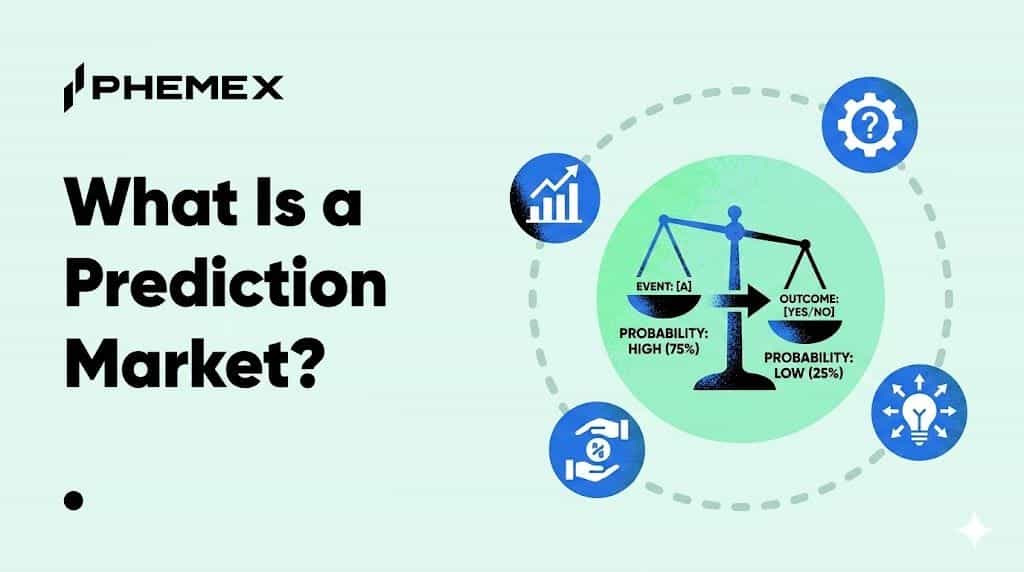
A prediction market is a platform where you buy and sell shares in the outcome of future events. Each market poses a question with defined outcomes. The price of each outcome reflects the crowd's probability estimate.
Take a simple example. A market asks: "Will BTC close above $90,000 on April 30?" Two outcomes exist. Yes and No. If the Yes share trades at $0.65, the market prices a 65% chance that BTC finishes above that level by month-end.
You buy Yes at $0.65. BTC closes above $90,000. Your share pays $1.00 and you pocket $0.35 per share. BTC closes below? Your share pays $0.00 and you lose your $0.65.
The mechanics are straightforward. Buy outcomes you believe are underpriced. Sell outcomes you believe are overpriced. The market resolves based on the actual result, and payouts settle automatically.
This applies to any event with a verifiable outcome. Elections, economic data releases, geopolitical developments, sports, entertainment, corporate earnings. If it produces a definitive result, it can become a prediction market.
$7 Billion in One Month. How Did That Happen?
Prediction markets existed before crypto. The Iowa Electronic Markets have run since 1988. Platforms like Intrade operated for years before regulatory pressure shut them down.
What changed is scale.
Polymarket, the largest prediction market platform globally, processed over $7 billion in trading volume in February 2026. That single month exceeded the platform's entire 2023 annual volume. By March 2026, cumulative notional volume surpassed $28 billion, with over 450,000 active traders participating across thousands of live markets.
The 2024 U.S. presidential election lit the fuse, generating over $3.3 billion in election-related volume alone. But instead of fading afterward, the user base diversified. Geopolitical markets absorbed the momentum. Tariffs, military conflicts, diplomatic negotiations. A single market asking "Will the US strike Iran by Feb 28, 2026?" attracted $73 million. Economic indicators, cultural events, and sports followed.
Then institutions showed up. Google Finance began embedding Polymarket odds directly in search results. Goldman Sachs assigned an internal team to the category. Intercontinental Exchange, the parent company of the New York Stock Exchange, committed up to $2 billion in Polymarket at an $8 billion valuation.
This stopped being a niche a long time ago.
Why "Information Markets" and Not "Gambling"?
The distinction matters, and it comes down to incentives.
In a traditional poll, respondents face no consequence for being wrong. They can answer based on hope, social pressure, or incomplete information. In a prediction market, every position costs money. Get it wrong and you lose that money. Accuracy pays. Bias costs.
The result is a form of distributed intelligence. Thousands of participants, each with their own data, expertise, and analytical frameworks, express their views through trades. The market price aggregates all of that into a single probability estimate that updates in real time as new information surfaces.
Polymarket reports accuracy exceeding 94% on outcomes priced a full month before resolution. Throughout 2025 and into 2026, prediction markets consistently front-ran traditional media on corporate actions, political outcomes, and economic data releases, sometimes by days. Goldman Sachs and JPMorgan's leadership have both publicly discussed entering the space, which tells you how seriously Wall Street treats the signal.
Gambling is wagering on an outcome with no informational edge. Prediction markets reward information gathering, analysis, and judgment. The mechanics are closer to futures trading than to a sportsbook.
How Do Prediction Markets Actually Work?
The structure is simpler than most crypto trading instruments.
A market is created. A question with two or more outcomes. Example: "Will the Federal Reserve cut rates at the June 2026 meeting?" Outcomes: Yes / No.
You trade shares. Each share trades between $0.00 and $1.00. The price represents implied probability. If Yes trades at $0.40, the crowd estimates a 40% chance of a rate cut.
The market resolves. When the event occurs, the correct outcome pays $1.00 per share. All others pay $0.00. Settlement is automatic.
Your profit or loss is the difference between your entry price and the payout. Buy Yes at $0.40, the Fed cuts, you receive $1.00. Profit: $0.60 per share. They don't cut? You receive $0.00 and lose $0.40.
One detail that changes how you think about these positions: you don't have to hold until resolution. Shares are tradable. If you bought Yes at $0.40 and breaking news pushes the price to $0.65, you can sell right there, lock in $0.25 per share profit, and move on without waiting for the meeting.
That flexibility means prediction markets function less like binary bets and more like event-driven trading positions.
What Can You Trade?
The range is broad and growing fast. Major categories as of April 2026:
Crypto. Will BTC hit a specific price by a specific date? Will ETH outperform SOL this quarter?
Politics and elections. Who wins a national election? Will a specific policy pass?
Economics and macro. Fed rate decisions, CPI prints, unemployment thresholds.
Geopolitics. Ceasefire outcomes, sanction timelines, diplomatic meetings. One Iran-related market on Polymarket crossed $73 million in volume during February 2026.
Sports. Match outcomes, tournament winners, player milestones.
Culture and entertainment. Award shows, box office performance, product launches.
The diversity matters for one specific reason: prediction markets are not correlated to crypto prices. When BTC trades sideways and spot volume drops, prediction markets stay active as long as events keep happening. The drivers are global headlines, not token price action.
Why Should Crypto Traders Care?
If you already trade crypto, prediction markets offer four things your current setup doesn't.
Uncorrelated returns. Crypto markets move in lockstep. When BTC drops, most altcoins drop harder. A Fed rate decision market has zero correlation to whether BTC is in a bull or bear cycle. Adding prediction markets to your activity creates genuine diversification across return drivers.
Trade your knowledge, not just your charts. You follow macro closely. You have a view on whether the Fed will cut. In spot or futures markets, translating that view into a position requires constructing a complex trade. In prediction markets, you just buy Yes or No on the rate cut. Direct expression, defined risk.
Asymmetric setups. Prediction market outcomes are binary with known payouts. If you find an outcome priced at $0.15 that you believe carries a 40% probability, the expected value is strongly in your favor. You risk $0.15 to potentially make $0.85. That kind of defined-risk asymmetry is rare in spot or futures.
Active when crypto isn't. In March 2026, prediction market volumes hit $23.7 billion even as spot crypto trading weakened across the industry. Previous crypto downturns offered exchanges no real answer to falling volumes. Prediction markets change that equation because event-driven trading doesn't need a bull market to generate activity.
How Phemex Fits In
Phemex is launching its Prediction Market powered by Polymarket, bringing event-driven trading to the same platform where you already trade spot, futures, and trading bots.
One account, full access. No separate wallet. No gas fees. No USDC bridging. You use your existing Phemex account and trade in USDT. If you already have a funded account, you can access prediction markets without additional setup.
Polymarket liquidity. You're trading into Polymarket's order books, the deepest in the prediction market space, not a separate, low-liquidity pool. Deeper liquidity translates directly to tighter spreads and lower slippage on your fills.
CEX execution quality. Prediction trades run on the same infrastructure that handles Phemex's futures engine, recently upgraded to 40K TPS with 500ms settlement. The execution layer processing your prediction trades is the same one processing your perpetual contracts.
Hundreds of live markets. Access Polymarket's full library across crypto, politics, economics, sports, and culture. New markets launch continuously as events develop.
The traditional exchange model revolves around asset prices: buy BTC, sell ETH, go long SOL. Prediction markets add a fundamentally different dimension. You're no longer limited to trading what an asset is worth. You can trade what happens next.
FAQ
Is prediction market trading legal?
Legality varies by jurisdiction. Polymarket received an Amended Order of Designation from the CFTC in November 2025, allowing it to operate as a fully regulated exchange in the United States through intermediated access via futures commission merchants. In most jurisdictions where crypto trading is legal, prediction market trading is also permitted. Check your local regulations.
Is this just gambling with extra steps?
No. You can buy and sell positions at any time, exit before resolution, and manage risk the same way you manage any trading position. The mechanics reward informed probability assessment, not luck. Wall Street institutions don't assign internal teams to gambling products.
How much capital do you need?
Shares trade between $0.00 and $1.00. You could start with $10 to learn how the mechanics work and scale from there.
Can you lose more than your initial investment?
No. The maximum loss on a Yes share is the price you paid. There is no leverage, no margin calls, and no liquidation risk. Prediction market positions have fully defined downside.
What if you want to exit before the event?
Sell your shares at the current market price whenever you want. If probability has moved in your favor since you bought, you take profit without waiting for resolution. If it moved against you, you can cut the loss early.
When does the Phemex Prediction Market launch?
April 21, 2026. A pre-launch Mystery Box event runs from April 14-20 with BTC and XAUT rewards celebrating the Polymarket partnership.
Bottom Line
Prediction markets are not replacing crypto trading. They're expanding what it means to trade crypto.
The same skills that make you profitable apply directly. Information analysis, probability assessment, risk management, timing. The difference is the underlying market. It's no longer just asset prices. It's the future itself.
People argue about the future every day. Prediction markets turn those arguments into prices. Now, on Phemex, you can trade them.
Phemex is a user-first crypto exchange trusted by over 10 million traders worldwide. The platform offers spot and derivatives trading, copy trading, trading bots, and wealth management products. The Phemex Prediction Market is powered by Polymarket.
Prediction market trading involves risk. Outcomes are binary and positions can lose their full value. Past event probabilities do not indicate future outcomes. Users are responsible for all trading decisions.