


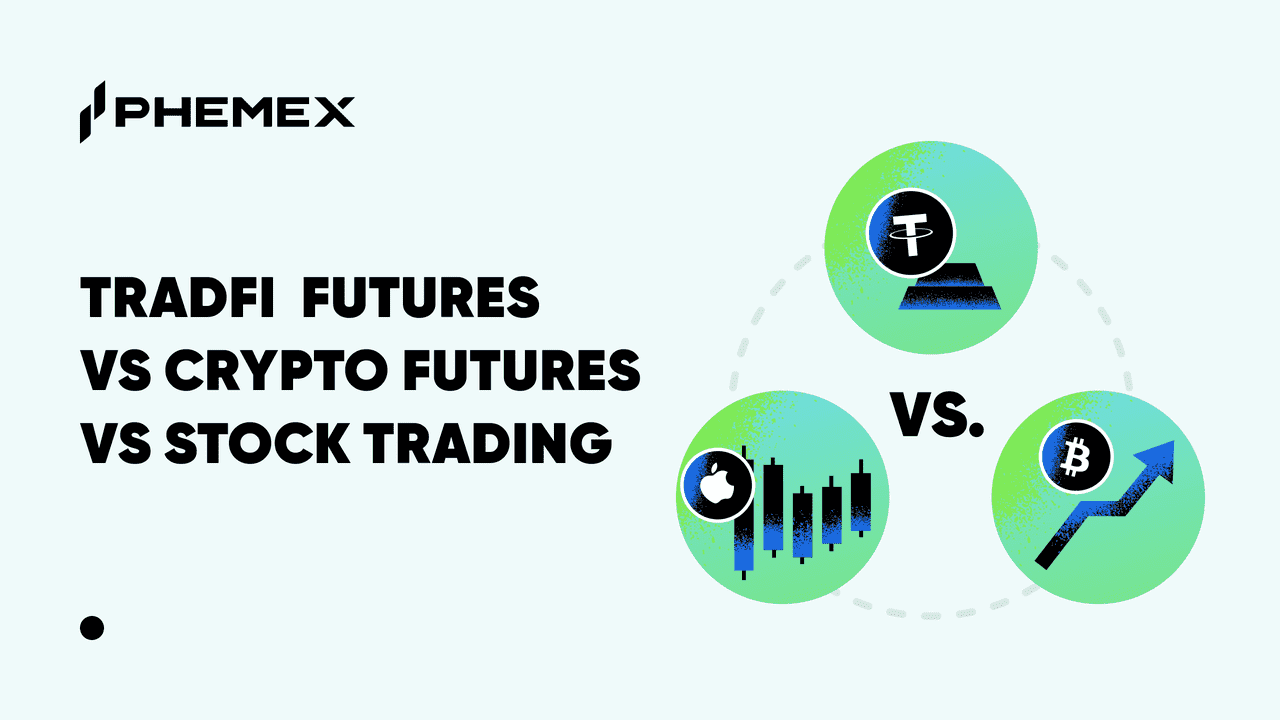
Understanding the difference between TradFi futures, crypto futures, and traditional stock trading is important before choosing how to gain market exposure. While all three allow you to profit from price movements, they operate under very different mechanics, risk profiles, and constraints.
This guide breaks down how each option works, what you actually gain exposure to, and where the main tradeoffs sit.
Quick Comparison: TradFi Futures vs Crypto Futures vs Stocks
Feature | TradFi Futures | Crypto Futures | Stock Trading |
What you get | Price exposure to stocks/gold | Price exposure to crypto | Ownership in a company |
Underlying assets | Stocks, precious metals, indices | BTC, ETH, altcoins | Company shares |
Ownership | ❌ None | ❌ None | ✅ Yes |
Dividends | ❌ No | ❌ No | ✅ Yes (if paid) |
Voting rights | ❌ No | ❌ No | ✅ Yes |
Trading hours | 24/7 on crypto platforms | 24/7 | Limited (market hours) |
Leverage | ✅ Yes (up to 50x+) | ✅ Yes (up to 100x+) | Limited or none |
Short selling | ✅ Easy | ✅ Easy | Restricted |
Expiration | Perpetual (no expiry) | Perpetual (no expiry) | None (hold forever) |
Settlement | USDT | USDT/crypto | Fiat currency |
Best for | Active trading, diversification | Active trading, speculation | Long-term investing |
What Is Stock Trading?
Stock trading involves buying and selling shares of publicly listed companies through regulated stock exchanges. When you purchase a stock, you own a portion of the underlying company.
What you get with stocks:
Ownership — You own a piece of the company
Dividends — If the company pays dividends, you receive them
Voting rights — You can vote on company matters at shareholder meetings
Long-term growth — Your shares appreciate if the company grows
Example: You buy 10 shares of Tesla at $250 each. If Tesla rises to $300, your shares are now worth $3,000. You've made $500. If Tesla pays a dividend, you receive that too.
Limitations of stock trading:
Limited trading hours — Stock markets are only open during business hours (typically 9:30 AM - 4:00 PM EST for US markets)
No leverage (or very limited) — You need to pay the full price to buy shares
Short selling restrictions — Shorting stocks requires borrowing shares and comes with restrictions
Higher capital requirements — Building a diversified portfolio requires significant capital
Stock trading is generally favored by long-term investors who prioritize ownership, dividends, and lower volatility.
What Are Crypto Futures?
Crypto futures are derivative contracts that track the price of cryptocurrencies such as Bitcoin or Ethereum. You do not own the underlying asset, instead you speculate on price movements.
On platforms like Phemex, crypto futures are typically perpetual futures — meaning they have no expiration date and can be held indefinitely.
What you get with crypto futures:
Price exposure — You profit (or lose) based on price movements
Leverage — Control larger positions with less capital (up to 100x on some pairs)
Long and short — Profit from both rising and falling markets
24/7 trading — Markets never close
USDT settlement — No need to handle the underlying crypto
Example: BTC is trading at $100,000. You believe it will rise, so you open a long position with 10x leverage using $1,000 margin. If BTC rises 5% to $105,000, your position gains $500 (50% return on your margin). If BTC falls 5%, you lose $500.
What you DON'T get:
❌ You don't own any Bitcoin
❌ No staking rewards
❌ No airdrops or forks
Key mechanics:
Funding rates — Periodic payments between longs and shorts to keep futures prices aligned with spot
Liquidation — If the market moves against you and your margin is depleted, your position is closed automatically
Mark price — Liquidations are based on mark price, not last traded price, to prevent manipulation
Crypto futures are typically used by active traders who are comfortable managing leverage and short-term volatility.
What Are TradFi Futures?
TradFi futures are derivative contracts tied to traditional financial assets such as stocks, indices, or commodities like gold and silver. These products mirror the mechanics of futures trading while tracking non-crypto markets.
On Phemex, TradFi futures let you trade assets like Tesla, Apple, Nvidia, gold (XAU), and silver (XAG) using the same interface, tools, and USDT margin as crypto futures.
What you get with TradFi futures:
Price exposure to traditional assets — stocks and precious metals
24/7 trading — Trade Tesla at 3 AM if you want
Leverage — Same margin-based trading as crypto futures
Long and short — Profit from rising or falling prices
Unified margin — Use your existing USDT balance across crypto and TradFi
Example: Tesla stock is trading at $250 on the NYSE. You believe it will rise after earnings. You open a long TradFi futures position on Phemex with 10x leverage. If Tesla rises to $270, you profit from the $20 move (adjusted for position size and leverage), even though you never owned a single share.
What you DON'T get:
❌ You don't own Tesla stock
❌ No dividends
❌ No voting rights
❌ No shareholder protections
Important distinction: TradFi futures provide price exposure, not investment exposure. You're speculating on price direction, not investing in a company.
TradFi futures are commonly used by traders who want access to traditional markets with futures-style flexibility.
Deep Dive: Key Differences Explained
1. Ownership vs. Speculation
This is the fundamental difference.
Product | What You Have |
Stocks | Ownership — you own part of a company |
Crypto Futures | A contract — you're betting on price direction |
TradFi Futures | A contract — you're betting on price direction |
With stocks, you're an investor. With futures (crypto or TradFi), you're a trader. The distinction matters for tax treatment, holding periods, and your relationship with the underlying asset.
2. Trading Hours
Product | Trading Hours |
Stocks | Limited — NYSE is open 9:30 AM - 4:00 PM EST, Monday-Friday |
Crypto Futures | 24/7/365 |
TradFi Futures | 24/7 on crypto platforms |
One of the biggest advantages of TradFi futures is that you can trade traditional assets around the clock. News breaks at 2 AM? You can react immediately instead of waiting for the stock market to open.
Note: Liquidity for TradFi futures may be lower during off-hours when traditional markets are closed. Spreads can widen and price discovery is less active.
3. Leverage and Capital Efficiency
Product | Typical Leverage |
Stocks | None (or 2x with margin accounts) |
Crypto Futures | Up to 100x+ |
TradFi Futures | Up to 50x+ |
Futures allow you to control larger positions with less capital. This amplifies both gains AND losses.
Example comparison:
Stocks: To buy $10,000 worth of Tesla, you need $10,000
TradFi Futures: To control $10,000 worth of Tesla exposure, you might need only $500-$1,000 margin (depending on leverage)
This capital efficiency is why futures are popular with active traders — but it's also why risk management is critical.
4. Short Selling
Product | Short Selling |
Stocks | Restricted — requires borrowing shares, uptick rules, hard-to-borrow fees |
Crypto Futures | Easy — just click "short" |
TradFi Futures | Easy — just click "short" |
With futures, shorting is as simple as going long. You don't need to borrow anything. This makes futures more flexible for traders who want to profit from falling prices or hedge existing positions.
5. Dividends and Corporate Actions
Product | Dividends | Voting Rights | Stock Splits |
Stocks | ✅ Yes | ✅ Yes | Affects your shares |
Crypto Futures | ❌ No | N/A | N/A |
TradFi Futures | ❌ No | ❌ No | Price adjusts, no shares |
If you hold Apple stock and Apple pays a $0.25 dividend, you receive $0.25 per share. If you hold Apple TradFi futures, you receive nothing. The dividend announcement might affect the futures price, but you don't get a separate payment.
6. Settlement and Margin
Product | Settlement | Margin Type |
Stocks | Fiat (USD, EUR, etc.) | Cash or margin account |
Crypto Futures | USDT (or crypto) | Cross/isolated margin |
TradFi Futures | USDT | Cross/isolated margin |
On Phemex, both crypto and TradFi futures use the same USDT margin system. Your existing balance works across all products with no transfers required.
7. Risk Profile
Product | Risk Level | Key Risks |
Stocks | Moderate | Company performance, market downturns |
Crypto Futures | High | Leverage, volatility, liquidation, funding rates |
TradFi Futures | High | Leverage, liquidation, off-hours liquidity |
Futures trading is inherently riskier than stock investing because of leverage. A 10% move against a 10x leveraged position wipes out your entire margin. With stocks, a 10% drop means your portfolio is worth 10% less.
When to Use Each Product
Use Stocks When:
You want to own part of a company
You're focused on long-term wealth building
You want to receive dividends
You prefer lower risk and don't need leverage
You're comfortable with limited trading hours
Use Crypto Futures When:
You want to speculate on crypto prices with leverage
You want to profit from falling prices (shorting)
You need 24/7 market access
You want to hedge existing crypto holdings
You understand and can manage liquidation risk
Use TradFi Futures When:
You want exposure to stocks and gold without a brokerage account
You want to trade traditional assets 24/7
You want to use leverage on traditional assets
You want to diversify your crypto-focused portfolio
You're an active trader, not a long-term investor
How to Trade TradFi Futures on Phemex
Log in to your Phemex account
Navigate to Futures → TradFi
Select a trading pair (stocks or precious metals)
Choose Long or Short
Set your leverage, order type, and quantity
Place your order and manage your position
Your existing USDT balance works for both crypto and TradFi futures. No separate account or funding required.
Frequently Asked Questions
What's the main difference between TradFi futures and stocks?
Stocks give you ownership in a company, including dividends and voting rights. TradFi futures give you price exposure only — you're speculating on price direction without owning anything.
Can I receive dividends from TradFi futures?
No. Dividends are paid to shareholders. TradFi futures traders don't own shares, so they don't receive dividends.
Are TradFi futures available 24/7?
Yes. Unlike traditional stock markets, TradFi futures on Phemex can be traded at any time. However, liquidity may be lower when traditional markets are closed.
Which is riskier: crypto futures or TradFi futures?
Both carry similar risks due to leverage and liquidation. Crypto futures may have higher volatility on the underlying assets, while TradFi futures may have lower liquidity during off-hours. Both require strong risk management.
Should I use TradFi futures or buy actual stocks?
It depends on your goals. Use TradFi futures for short-term trading and speculation with leverage. Buy actual stocks for long-term investing, dividends, and ownership.
Can I hedge my stock portfolio with TradFi futures?
Yes. If you own stocks in a brokerage account and expect a short-term decline, you could open short TradFi futures positions to hedge. However, this requires careful position sizing and understanding of both products.
Key Takeaways
If you want... | Consider... |
Long-term wealth building | Stocks |
Dividends and ownership | Stocks |
24/7 trading with leverage | Crypto or TradFi Futures |
Exposure to crypto price moves | Crypto Futures |
Exposure to stocks/gold without a brokerage | TradFi Futures |
Easy short selling | Crypto or TradFi Futures |
Lower risk, simpler experience | Stocks |
Understanding the differences between these three products helps you choose the right tool for your strategy. Stocks are for investors. Futures are for traders. And TradFi futures bridge the gap between crypto platforms and traditional markets — giving you access to stocks and gold with the tools you already know.
Futures trading involves substantial risk of loss. Leverage amplifies both gains and losses. This article is for educational purposes only and does not constitute financial advice. Always evaluate your risk tolerance before trading.