


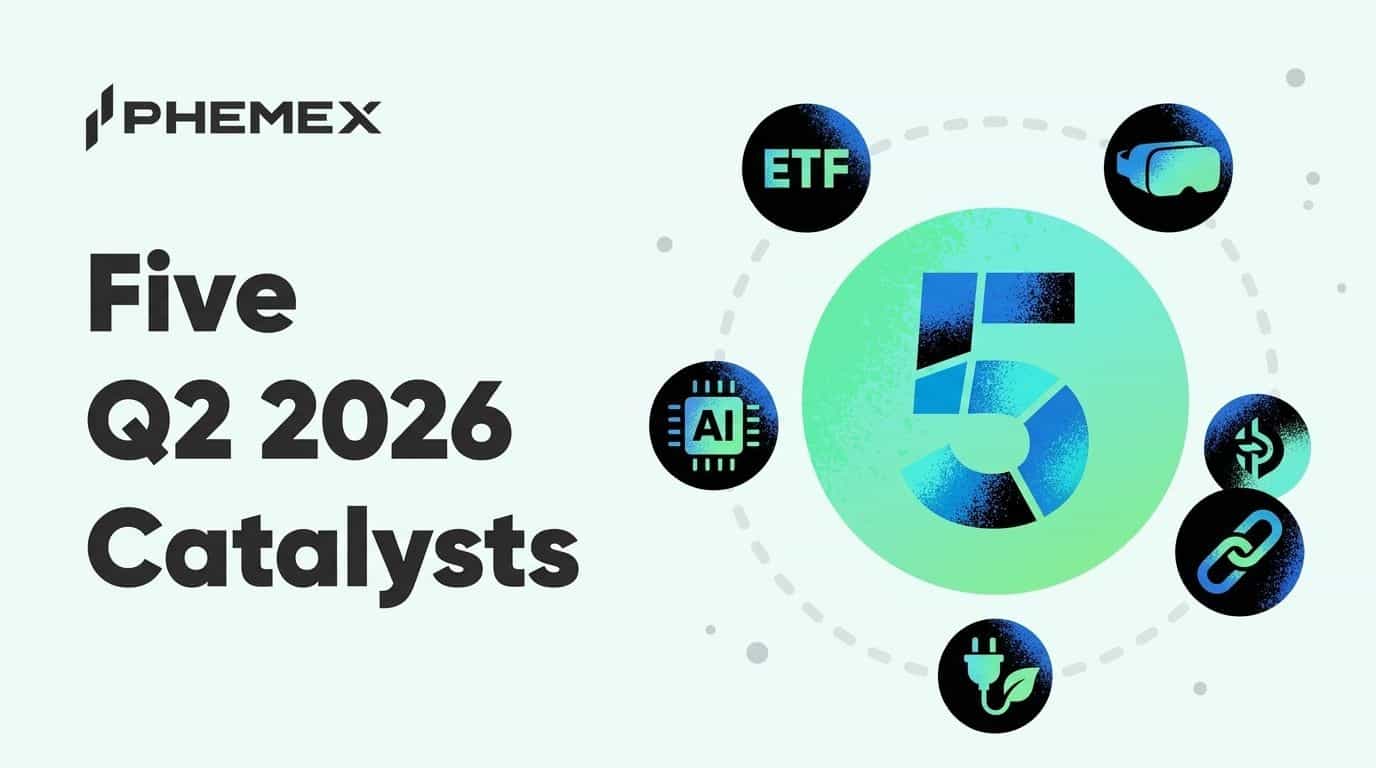
Q2 2026 has more structural catalysts concentrated into a single quarter than anything since the spot Bitcoin ETF approvals in early 2024. A new Federal Reserve Chair takes the seat for the first time in eight years, Congress is racing to pass crypto legislation before the midterm window closes, Ethereum is shipping its biggest upgrade since The Merge, and altcoin ETFs are pulling institutional capital into assets that were legally untouchable 12 months ago. All five landing between April and June creates a quarter where positioning matters more than it has in over a year.
Here is what each catalyst is, when it hits, and how it changes the setup for traders.
Kevin Warsh Replaces Jerome Powell as Fed Chair on May 15
The Federal Reserve gets its first leadership change since February 2018, when Kevin Warsh officially replaces Jerome Powell. Trump nominated Warsh on January 30 and BTC dropped 14% over the following 10 days, with gold crashing 9% in its worst single session in over a decade and XRP falling more than 15% in the same week. The market's initial read was simple. Warsh is a known hawk who favors tighter policy, higher real rates, and a smaller Fed balance sheet.
But the picture is more complicated than that first reaction suggested. J.P. Morgan expects Warsh to push for rate cutsafter he takes the chair, driven by his "AI productivity" thesis that technology-driven efficiency gains allow rates to come down without reigniting inflation. He has personal investments in Bitwise Asset Management and has called Bitcoin "the new gold" for younger investors, though he has also labeled most crypto projects "software, not money."
The practical implication is that the May 15 transition creates a policy vacuum. Powell's last FOMC is April 28-29, Warsh's first is June, and the weeks between will be filled with speculation about how his views translate into actual rate decisions. If Warsh signals any openness to cuts in his early public remarks, the reaction in risk assets could be fast and aggressive.
The CLARITY Act Senate Markup Could Make or Break Crypto Legislation for Years
Senator Cynthia Lummis confirmed this week that the Senate Banking Committee markup is targeted for the second half of April, after Easter recess ends on April 13. The CLARITY Act is the first real attempt at a unified federal framework for digital assets, and its stablecoin yield provisions have dominated the debate.
The core substantive disputes are largely resolved. The stablecoin yield compromise prohibits exchanges from offering yield on stablecoin balances in any manner economically equivalent to bank interest, while DeFi protocols operating without intermediaries appear to be carved out. The remaining friction is political. Ethics language, a community bank deregulation rider, and a crowded Senate calendar all threaten the timeline.
Senator Bernie Moreno has been direct about the deadline. If the bill does not reach the full Senate floor by May, digital asset legislation may not move again before midterms make major bills politically untouchable. Polymarket shows roughly 72% odds of the CLARITY Act being signed into law in 2026, but the April markup is the bottleneck. If it clears committee on schedule, the path to a floor vote before summer is real. If it stalls, the entire legislative timeline resets to 2027, and that delay alone would remove a catalyst the market has been pricing in since Q1.
Ethereum's Glamsterdam Upgrade Targets 10,000 TPS and 78% Lower Gas Fees
Glamsterdam is Ethereum's most ambitious upgrade since The Merge, and it is tentatively scheduled for June 2026, though developers have stressed the date depends on testnet validation and could slip to Q3. Vitalik Buterin outlined eight Ethereum Improvement Proposals in late February that define the scope, with the gas limit rising from 60 million to 200 million per block and throughput targeting roughly 10x what Ethereum handles today.
Two EIPs carry the most weight. EIP-7732 (ePBS) moves proposer-builder coordination from off-chain relays into the protocol, reducing MEV extraction. EIP-7928 introduces Block-Level Access Lists that enable parallel transaction processing for the first time on Ethereum's execution layer. The Foundation's DevOps team has already tested three EIPs on Devnet-4 and is transitioning to Devnet-5, so a June mainnet deployment is plausible if testing stays on schedule.
The reason this matters beyond the technical details is fee economics. A 78% reduction in gas fees could pull activity back to mainnet from L2s, and for ETH holders, that means higher fee burn supporting the deflationary case that has struggled since Dencun moved most activity to rollups. The honest answer is that upgrades of this magnitude have historically been "sell the rumor, buy the news" events for ETH, so the trade setup may be less obvious than it looks.
Altcoin ETF Expansion Brings Institutional Capital to New Assets
The March 17 SEC-CFTC joint ruling classifying 16 crypto assets as digital commodities removed the primary legal barrier for spot ETF approvals. The first wave already landed in late 2025, with SOL, LTC, DOGE, and HBAR ETFs all going live, and spot XRP ETFs pulling in $1.4 billion in Q1 2026 inflows across seven products.
Over 90 additional crypto ETF applications remain pending with the SEC, spanning individual token funds, staking ETFs, and multi-asset baskets.
|
Asset
|
ETF Status
|
Key Detail
|
|
SOL
|
Live since Oct 2025
|
23 filings from major issuers
|
|
LTC
|
Live since Oct 2025
|
Canary Capital LTCC on Nasdaq
|
|
XRP
|
Live, 7 products
|
$1.4B Q1 2026 inflows
|
|
ADA
|
Pending, 75% odds
|
CME futures eligibility Aug 2026
|
|
DOGE
|
Live since Sep 2025
|
REX-Osprey DOJE ETF trading
|
|
HBAR
|
Live since Oct 2025
|
Canary Capital HBR ETF
|
The structural shift is that institutional money managers now have compliant vehicles to allocate across the altcoin space for the first time. Previous altcoin rallies were driven almost entirely by retail rotation, but this cycle, 401(k)s and wealth management platforms can participate directly, which changes both the scale and the speed of capital flows.
Two FOMC Meetings Mark the Powell-to-Warsh Transition
The April 28-29 FOMC meeting is Powell's last as Chair, and the June meeting will be Warsh's first, creating a two-meeting arc that spans an entire leadership transition in real time. The rate decision at the April meeting is almost fully priced as a hold, with CME FedWatch showing negligible probability of a cut. The dot plot from March held steady at one cut for 2026, with seven committee members projecting zero cuts this year.
But the rate decision is not the event. The event is what Powell says about the transition and what Warsh signals in his first public remarks as Chair. Powell has been cautious and data-dependent to the point of paralysis, while Warsh's track record as a Fed governor from 2006-2011 suggests he favors decisive action in either direction.
BTC has dropped after 8 of the last 9 FOMC meetings in the sell-the-news pattern that has become almost mechanical. If the April meeting follows the same script, the dip could be amplified by uncertainty around the leadership change. And if Warsh's early June comments hint at rate cuts later in the year, that could trigger one of the sharper risk-on moves in recent memory.
Frequently Asked Questions
What is the biggest crypto catalyst in Q2 2026?
The Kevin Warsh Fed Chair transition on May 15 carries the most weight because it affects every asset class simultaneously, from equities to bonds to crypto. Warsh's views on rates, the balance sheet, and digital assets will be dissected by every macro trader on the planet within his first week.
Will the CLARITY Act pass in 2026?
Prediction markets give it roughly 72% odds, but the April Banking Committee markup is the critical gate. If it clears committee by early May, the path to a floor vote before summer is viable. If it stalls, Senator Moreno's warning that legislation may not move again until 2027 becomes the base case.
How will Ethereum's Glamsterdam upgrade affect ETH price?
Major Ethereum upgrades have historically produced mixed short-term price action, often following a "sell the rumor, buy the news" pattern. The longer-term case is stronger. A 78% gas fee reduction could pull activity back to mainnet from L2s, increasing fee burn and supporting ETH's deflationary mechanics. If Glamsterdam ships on time and adoption follows, the supply-side impact could take months to show up in price.
Which altcoin ETFs are launching in Q2 2026?
SOL, LTC, XRP, DOGE, and HBAR ETFs are already live. The Q2 pipeline includes additional filings from major issuers plus new ADA applications, though ADA's CME futures eligibility does not arrive until August. Multi-asset basket ETFs and staking ETFs could receive decisions during Q2.
Bottom Line
Q2 2026 is the most catalyst-dense quarter since early 2024, and the sequencing matters as much as the events themselves. The CLARITY Act markup in late April sets the regulatory tone, Powell's final FOMC on April 28-29 establishes the macro baseline, the Warsh transition on May 15 introduces a new policy regime, altcoin ETF expansion continues pulling institutional capital into previously untouchable assets, and Glamsterdam represents the most significant Ethereum infrastructure event since The Merge. The traders who map these dates on a calendar and plan entries around each window will have a structural edge over those who react after the headlines hit. And if three or more of these catalysts break bullish simultaneously, the compounding effect could define the second half of 2026.
This article is for informational purposes only and does not constitute financial or investment advice. Cryptocurrency trading involves substantial risk. Always conduct your own research before making trading decisions.