

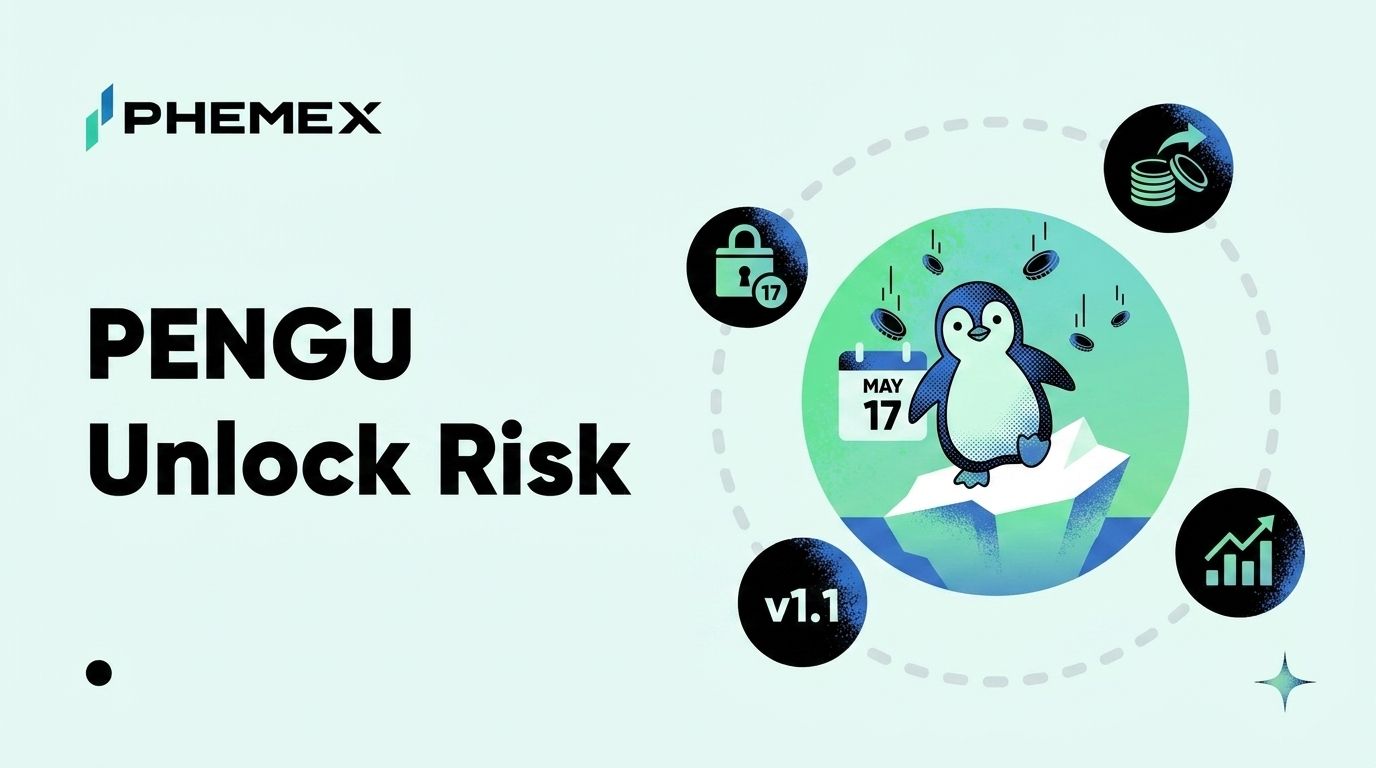
PENGU, the Solana token tied to the Pudgy Penguins NFT brand, jumped 17% to $0.0102 on April 27 with 24-hour volume up 210% to $385 million, putting its market cap near $719.9 million. That move slotted PENGU into the top three memecoins traders are watching in May 2026 alongside DOGE and SkyAI, with the broader memecoin market cap up 4.5% in 24 hours to roughly $51.1 billion as DOGE printed +20%, SHIB +18.9%, and PEPE +65.6%.
Here is the problem. The same April 27 rally that pulled PENGU into the spotlight coincided with the approach of a 703 million token release landing on May 17, and CoinDesk reported analysts flagging the price action as a textbook "exit liquidity" pattern where insiders mark price up ahead of supply hitting the float. The vesting cadence continues monthly through July at the same 703 million size each cycle. If you are trading the rally, the calendar is the trade.
What PENGU Actually Is and Why This Token Is Different From Most Memecoins
PENGU is the native token of the Pudgy Penguins ecosystem, one of the few NFT collections from the 2021-2022 cycle that survived the bear market with an actual business attached to it. The token launched in December 2024 on Solana with a total supply of 88.88 billion. Most memecoins are pure narrative trades where the joke is the product, but PENGU sits on top of a brand that ships physical toys to Walmart, Target, and Amazon through Pudgy Toys, runs one of the most successful PFP NFT collections on Ethereum, and now offers a branded debit card through a Kast partnership accepted at 150 million merchants across 170 countries.
That distribution channel matters because it gives PENGU something almost no other meme-adjacent token has. A revenue-generating real-world product line. The original Pudgy Penguins NFT collection floor still trades, the Lil Pudgy and Pudgy Rod sub-collections remain active, and the PENGU airdrop sent roughly 1.7 million tokens to each flagship NFT holder, anchoring a real holder base rather than rotating bot wallets.
The token's job inside the system is governance and ecosystem rewards. Holders vote on Pudgy Penguins ecosystem decisions and receive distributions tied to brand activity. CBOE has even filed for a PENGU and Pudgy Penguins ETF listing, a regulatory milestone no other memecoin has crossed in 2026. The fundamental story underneath PENGU is real, but the supply story is what makes the next 60 days dangerous for anyone treating this as a long-term hold rather than a tactical one.
The Rally Context: Why Memecoins Are Trading Again After a Brutal Drought
Memecoin dominance hit a historic low in December 2025 at roughly 3.2% of the altcoin market cap, the floor of a year-long bleed where the category was effectively left for dead. The rotation back started in early 2026 and accelerated through April. As of late April the total memecoin market cap had reclaimed $51.1 billion with daily moves like DOGE +20% and PEPE +65.6% pulling broader retail attention back into the category.
The macro driver is straightforward. BTC has been printing all-time highs through Q1 and Q2 of 2026, and the higher BTC trades the more retail starts looking down the risk curve for higher-beta plays. Memecoins are the highest-beta corner of crypto and AI tokens are the second-highest. Capital is rotating into both at once, with SkyAI up 106% on the same week PENGU printed its 17% session.
PENGU specifically caught the rotation because it is one of the few names with a sentiment score above 4.4 out of 5 across major social tracking platforms. That kind of social engagement is what drives retail follow-through buying, and it shows up in volume spikes long before it shows up in price. But sentiment scores tell you what the crowd is doing right now and they do not tell you what hits the order book on May 17.
The May 17 Token Release and Why "Exit Liquidity" Is a Real Concern Here
On May 17, 2026, approximately 703 million PENGU tokens vest and become available to early investors, team allocations, and ecosystem partners. The June and July tranches are the same size each. That is roughly 2.1 billion tokens of fresh supply entering the float across a 60-day window, on top of the existing circulating amount.
At PENGU's current $0.0102 price, the May 17 release alone represents roughly $7.2 million in newly liquid supply. That is not a market-shattering number in absolute terms. It becomes a problem when you stack it against current daily volume and the patterns that have repeated across other Solana-launched tokens in 2025 and 2026.
The CoinDesk analysis that broke on April 27 made the exit liquidity case explicitly. The argument runs like this. Insiders or whale wallets with knowledge of the upcoming vest have economic incentive to mark price higher ahead of the date so that their newly liquid tokens hit a richer market. The 17% rally on rising volume two and a half weeks before the cliff is the exact footprint that pattern leaves on a chart.
This is not unique to PENGU. The same pattern shows up in dozens of token vesting events across the past 18 months, where price rallies into the cliff date and then reverses on or shortly after as supply hits and the marked-up bid disappears. The reversal timing varies, sometimes happening the day of the vest and sometimes lagging by a week as newly liquid holders distribute over time. The structural setup stays the same and it is what makes "buy the rally, hold through vest" one of the worst trades in altcoin land.
Where PENGU Sits in the Broader Memecoin Rotation
The memecoin trade right now is not a single trade. It is a basket of correlated names with different risk profiles, and the differences matter more than the headline moves suggest. Here is how PENGU compares to the other names traders are running.
|
Token
|
24h move
|
Market cap
|
Distinguishing risk or edge
|
|
[DOGE](https://phemex.com/margin/trade/DOGE-USDT?group=8288&referralCode=CUFKP8)
|
+20%
|
~$30B
|
No major supply overhang. Liquidity king of memecoins.
|
|
[SHIB](https://phemex.com/margin/trade/SHIB-USDT?group=8288&referralCode=CUFKP8)
|
+18.9%
|
~$15B
|
Burn mechanics provide partial supply offset. Older holder base.
|
|
[PEPE](https://phemex.com/margin/trade/PEPE-USDT?group=8288&referralCode=CUFKP8)
|
+65.6%
|
~$5B
|
Highest beta of the group. Pure narrative trade.
|
|
PENGU
|
+17% (Apr 27)
|
~$719.9M
|
Strong fundamentals via Pudgy brand. Heavy vesting schedule May-July.
|
DOGE and SHIB are the lowest-risk memecoin exposures in the basket because they have either no significant supply overhang or active burn mechanics that partially offset emissions. PEPE is pure narrative trade with no fundamental tether but also no scheduled vesting cliffs of comparable size. PENGU is the only one of the four where the calendar carries a concrete supply event in the next 30 days, and it is the only one with real-world brand revenue underneath it.
That asymmetry is the actual setup. PENGU has the strongest fundamental story in the basket and the worst near-term supply story. The trade depends entirely on which one the market prices.
Risk-Reward and How to Think About PENGU Right Now
PENGU is still trading roughly 80% off its all-time high from the December 2024 launch period, which means the upside case is large in percentage terms if the brand story actually compounds. The downside case is also large because three consecutive monthly tranches of 703 million tokens represent a meaningful percentage of float and there is no burn mechanism to offset them.
The bull case in one paragraph. Pudgy Penguins is one of the few NFT brands with real-world retail distribution, a CBOE-filed ETF, and a debit card product. If memecoin dominance keeps recovering toward its 2024 highs and the brand story attracts institutional attention via the ETF pathway, PENGU has a structural reason to outperform pure-narrative memes over a 6-12 month horizon.
The bear case in one paragraph. The next three monthly tranches add roughly 2.1 billion tokens to the float between May 17 and July. The April 27 rally has the structural footprint of an exit-liquidity move ahead of supply hitting. If the new supply does not get absorbed by genuine demand, the post-vest reversal could erase the entire rally and revisit pre-rally support. Memecoin rallies are notoriously short-lived and PENGU has the supply schedule that punishes holders who do not respect calendars.
The honest read for traders is that PENGU is a tactical trade right now, not a position trade. The May 17 date is the line in the sand. Holding through it without size discipline assumes the new supply gets absorbed, which is the opposite of the base rate for tokens with vesting cliffs of this size. Phemex published a detailed take on the broader NFT-backed token category and PENGU's place in it that is worth reading if you want context on why this asset class is different from pure memecoins in the first place.
Frequently Asked Questions
Why is PENGU rallying right now?
Two things are driving it. The broader memecoin rotation pulled the entire category higher with DOGE +20%, SHIB +18.9%, and PEPE +65.6% in 24 hours, and PENGU rode that wave alongside the rest. The second factor is structural, with analysts at CoinDesk flagging the move as potential pre-vest positioning where price gets marked up ahead of token supply hitting the market on May 17.
What happens to PENGU price when the May 17 vesting tranche hits?
Historical precedent across token vesting events suggests a high probability of price reversal on or shortly after the cliff date, especially when the rally into the date looks driven by speculative positioning rather than organic demand. The reversal can be immediate or lag by days as newly liquid holders distribute over time. The exact magnitude depends on how much fresh supply gets absorbed by buyers versus dumped to market.
Is PENGU a good long-term hold despite the vesting schedule?
It depends on if you believe the Pudgy brand business compounds faster than the supply schedule dilutes. The brand has real revenue via toys, retail distribution, and the Kast debit card, plus a CBOE-filed ETF in the pipeline. But the next three months bring 2.1 billion tokens of fresh float. The honest answer is that the long-term story is real and the short-term math is brutal. Most disciplined approaches treat PENGU as a satellite allocation, not a core hold.
Which memecoin has the cleanest setup right now?
DOGE and SHIB carry the least supply-side risk because neither has a comparable vesting cliff in the next 30 days and SHIB has active burn mechanics. PEPE has no fundamentals but also no near-term supply event of meaningful size. PENGU has the strongest fundamental story but the heaviest vesting schedule. There is no single right answer, and the cleanest setup depends on if you are trading narrative beta or trying to build a position with reasonable supply expectations.
Bottom Line
PENGU is trading at $0.0102 with a $719.9 million market cap and a calendar that drops 703 million fresh tokens on May 17, with two more 703 million tranches following monthly through July. The April 27 rally produced the textbook chart pattern of pre-vest positioning, and CoinDesk analysts have already named it. The brand story underneath PENGU is real and the ETF pathway via CBOE is unique among memecoins, but neither of those facts changes what 2.1 billion tokens of supply does to price action over a 60-day window if demand does not match it.
The actionable read is the date itself, and May 17 is the test that decides which side of the setup actually plays out. If the new supply gets absorbed and price holds, the bull case for the brand has empirical support and the rally has room to extend. If price reverses on or shortly after the cliff and revisits pre-rally levels, this was an exit liquidity event and the next two tranches become harder, not easier, to digest. Either way the calendar tells you when you find out.
This article is for informational purposes only and does not constitute financial or investment advice. Cryptocurrency trading involves substantial risk. Always conduct your own research before making trading decisions.