


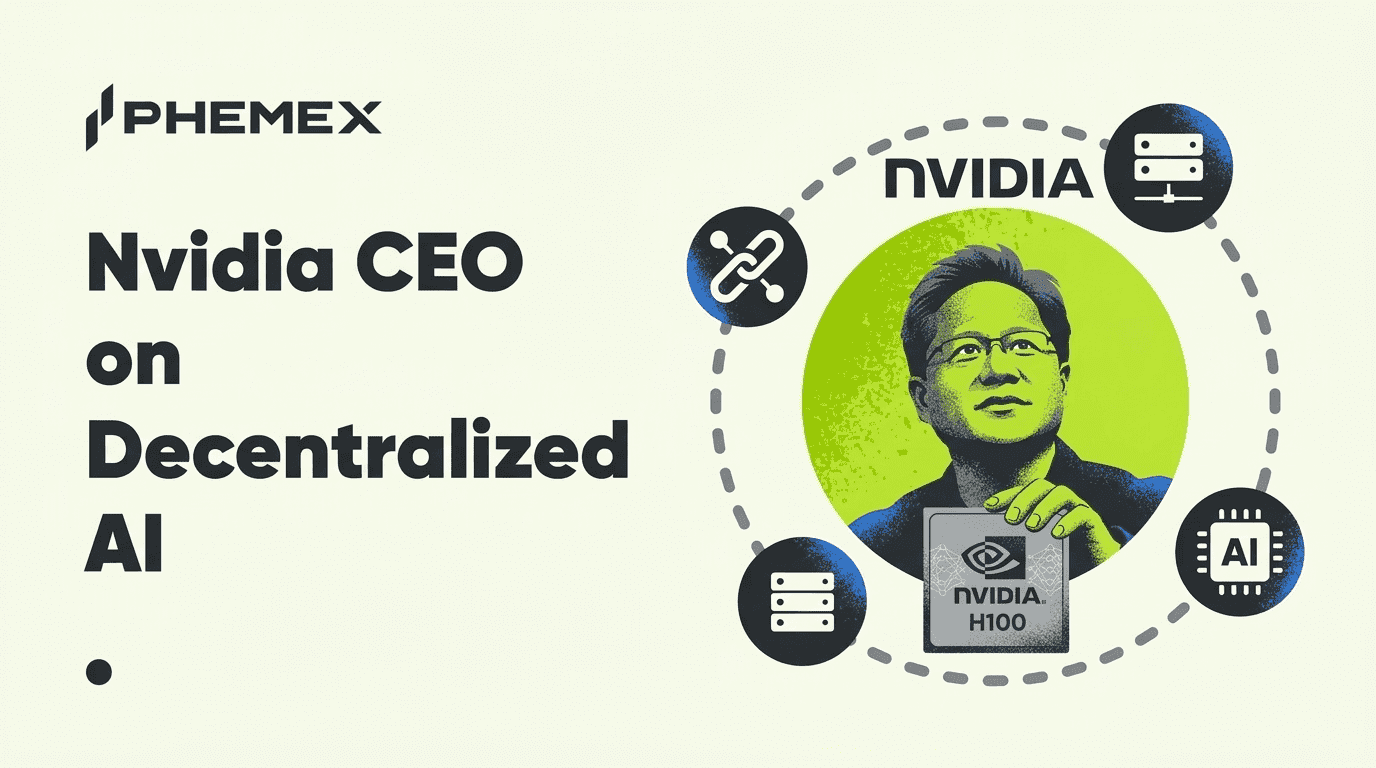
Jensen Huang, CEO of a $3 trillion company that manufactures the GPUs powering virtually every AI model on Earth, just compared Bittensor's decentralized training network to "a modern version of folding@home" during a conversation with Chamath Palihapitiya on the All-In Podcast. The comment came after Palihapitiya described Bittensor's Covenant-72B, the largest permissionless LLM pre-training run on record, where 70+ independent contributors used commodity GPUs and home internet connections to process 1.1 trillion tokens. Within 48 hours of that episode airing, the AI token sector jumped 40.9% in a single day, with TAO, FET, and NEAR leading the charge.
That kind of endorsement from the most important person in AI hardware changes the risk calculus for an entire crypto sub-sector. Here is what Huang actually said, which tokens moved, and what the rally tells you about where institutional attention is heading next.
What Jensen Huang Actually Said and Why It Matters
The specific exchange happened when Palihapitiya brought up Bittensor's Subnet 3 training run, describing how participants used distributed excess compute to train a Llama model "totally distributed" while managing the process statefully. Huang's response was measured but unmistakably positive, comparing the project to folding@home, the Stanford-originated distributed computing project that used volunteers' idle computer power to simulate protein folding for over two decades.
The comparison matters because folding@home is one of the few examples of decentralized volunteer computing that the traditional tech world respects without reservation. By drawing that parallel, Huang framed Bittensor's experiment as legitimate distributed coordination rather than crypto speculation layered on top of AI buzzwords.
This wasn't a paid sponsorship or a token shill. The CEO of the company whose H100 and Blackwell chips sit inside every major AI data center on the planet acknowledged, unprompted, that decentralized AI training works. For a sector that has spent years trying to prove it isn't vaporware, that single comment carried more weight than any whitepaper ever could.
Which Tokens Moved and by How Much
The market's response was fast and concentrated. On March 21, AI tokens topped every crypto market category, with the sector posting a 40.9% single-day gain.
|
Token
|
7-Day Move
|
Monthly Move
|
Market Cap
|
Why It Moved
|
|
TAO (Bittensor)
|
+26%
|
+102%
|
~$2.6B
|
Directly named by Huang, Covenant-72B milestone
|
|
FET (ASI Alliance)
|
+15.5% daily surge
|
Rally ongoing
|
~$1.8B
|
Broad AI narrative lift, derivatives data bullish
|
|
+12.86%
|
Steady climb
|
~$1.6B
|
AI + infrastructure dual narrative
|
|
|
Strong rally
|
Sector leader
|
Mid-cap
|
GPU rendering for decentralized AI
|
TAO's breakout past $300 for the first time since November was the headline move. But the rally wasn't just about one token. Derivatives data across TAO and FET showed rising open interest alongside price, which signals fresh capital entering positions rather than a short squeeze. That distinction matters if you're trying to figure out if this rally has legs or is already exhausted.
The Bittensor Covenant-72B Breakthrough
Covenant-72B is a 72-billion parameter large language model pre-trained entirely through decentralized coordination on Bittensor's Subnet 3. Over 70 independent contributors used everyday GPUs connected through commodity internet to process 1.1 trillion tokens, scoring 67.1 on the MMLU benchmark, documented in a March 2026 arXiv paper and confirmed as the largest decentralized LLM pre-training run ever completed.
This matters for traders because it removes the strongest bear argument against decentralized AI tokens. Critics have spent years saying distributed training couldn't match centralized data centers at any meaningful scale. Covenant-72B doesn't match GPT-4, but it proved that permissionless contributors can coordinate to train a production-grade model without a central authority directing the process. That shifts the conversation from "can this even work?" to "how fast can it scale?"
And Grayscale filing for a spot TAO ETF on March 14 suggests institutional players already have their answer.
The Broader AI Agent Ecosystem Is Growing Faster Than Most Traders Realize
Huang's GTC 2026 keynote went further than decentralized training. He pushed the "agentic AI" thesis hard, describing a future where autonomous AI agents handle inference tasks at scale and raising Nvidia's AI hardware opportunity forecast to at least $1 trillion through 2027. That framing maps directly onto what crypto's AI agent platforms have been building.
Virtuals Protocol hosts thousands of AI agents on its platform, though its token VIRTUAL has pulled back to a $467 million market cap from a $5 billion peak in early 2025. AIXBT, the crypto-focused AI agent that monitors 400+ influencers, hit $500 million market cap at its peak before correcting alongside the broader sector.
Most AI agent tokens are still early-stage experiments with volatile price action. But when Nvidia's CEO describes a future built on inference and autonomous agents, and crypto protocols are the ones actually deploying those agents at scale, the narrative alignment becomes harder for institutional capital to ignore.
What This Means for the AI Crypto Narrative in 2026
Three catalysts are stacking on top of each other right now, and traders who only see one of them are missing the bigger picture.
The Nvidia endorsement creates institutional permission. Before Huang's comments, decentralized AI was a crypto-native thesis that traditional finance largely dismissed. A $3 trillion company's CEO publicly validating the approach gives allocators and fund managers cover to take positions in the sector without looking reckless.
Grayscale's TAO ETF filing creates a regulated access point. If approved, it gives American institutions compliant exposure to the leading decentralized AI protocol. The ETF filing came on March 14, before Huang's comments, which means institutional interest was building independently of the Nvidia catalyst.
The Covenant-72B milestone creates technical proof. The arXiv paper, the MMLU score, the 70+ contributors. This is peer-reviewable evidence that decentralized AI training works at scale, and unlike previous AI token rallies driven almost entirely by narrative, this one has verifiable data backing it up.
The risk is straightforward, though. AI tokens have pumped and dumped repeatedly since 2023. The sector is still dominated by low-liquidity projects where a single whale exit can erase 30% in hours. And Nvidia sells GPUs to everyone, including centralized AI labs, so Huang's endorsement of decentralized AI costs him nothing. He can be bullish on both because both buy his hardware.
How to Position Around This Narrative
The reason most traders lose money on narrative trades is timing, buying after the 40% daily candle instead of before it. If you missed the initial surge, chasing TAO at $300+ after a 102% monthly run carries obvious risk.
A more measured approach would be watching for pullbacks in the tokens with the strongest fundamental catalysts. TAO has the Nvidia name-drop, the Covenant-72B proof point, and the Grayscale ETF filing all in its corner. FET has the Artificial Superintelligence Alliance merger creating broad ecosystem exposure, and NEAR has the AI narrative layered on top of a functioning Layer-1 with real developer activity.
The derivative market is telling you something useful here. Rising open interest alongside rising price across TAO and FET means new money entering rather than existing shorts getting liquidated. That pattern tends to produce sustained trends rather than one-day spikes. But if open interest starts dropping while price holds flat, that's your signal the rally is running out of new buyers.
Frequently Asked Questions
What did Jensen Huang say about Bittensor?
Huang compared Bittensor to "a modern version of folding@home" during a conversation with Chamath Palihapitiya on the All-In Podcast, after hearing about the Covenant-72B decentralized training run. The comment was significant because it framed decentralized AI training as legitimate distributed computing rather than crypto speculation.
Why did AI crypto tokens rally 40% in one day?
The surge combined multiple catalysts hitting simultaneously. Nvidia's GTC 2026 keynote pushed agentic AI as a trillion-dollar opportunity, Huang's podcast comments validated decentralized AI specifically, and Bittensor's Covenant-72B provided technical proof that the approach works at scale. All three catalysts landed in the same week.
Is TAO a good investment after the 100% rally?
TAO has the strongest fundamental catalyst stack of any AI token right now, with the Nvidia endorsement, a peer-reviewed training milestone, and a Grayscale ETF filing. But it has already gained 102% in a month, and AI tokens historically give back 30-50% of narrative-driven gains once momentum fades. Position sizing matters more than entry timing in a sector this volatile.
What is Covenant-72B?
It is a 72-billion parameter large language model pre-trained entirely through decentralized coordination on Bittensor's Subnet 3. Over 70 contributors used consumer-grade GPUs to process 1.1 trillion tokens, achieving a 67.1 MMLU score. It is the largest permissionless LLM training run ever documented, confirmed in a March 2026 arXiv paper.
Bottom Line
The CEO of the company that supplies the hardware for virtually all AI development just publicly validated the thesis crypto's decentralized AI sector has been building on for three years. The Covenant-72B milestone, the Grayscale ETF filing, and Nvidia's own trillion-dollar AI forecast all landed in the same two-week window, creating a catalyst stack this sector has never had before.
The tokens that benefit most will be the ones with verifiable technical milestones behind them, not narrative exposure alone. TAO has the endorsement and the proof, FET has the ecosystem consolidation, and NEAR has the infrastructure play. Watch the derivatives data for confirmation that fresh capital continues entering, and size your positions for a sector where 30% drawdowns are normal even in an uptrend. The smart money is no longer asking if decentralized AI works. They are asking how much of the inference market it can capture.
This article is for informational purposes only and does not constitute financial or investment advice. Cryptocurrency trading involves substantial risk. Always conduct your own research before making trading decisions.