




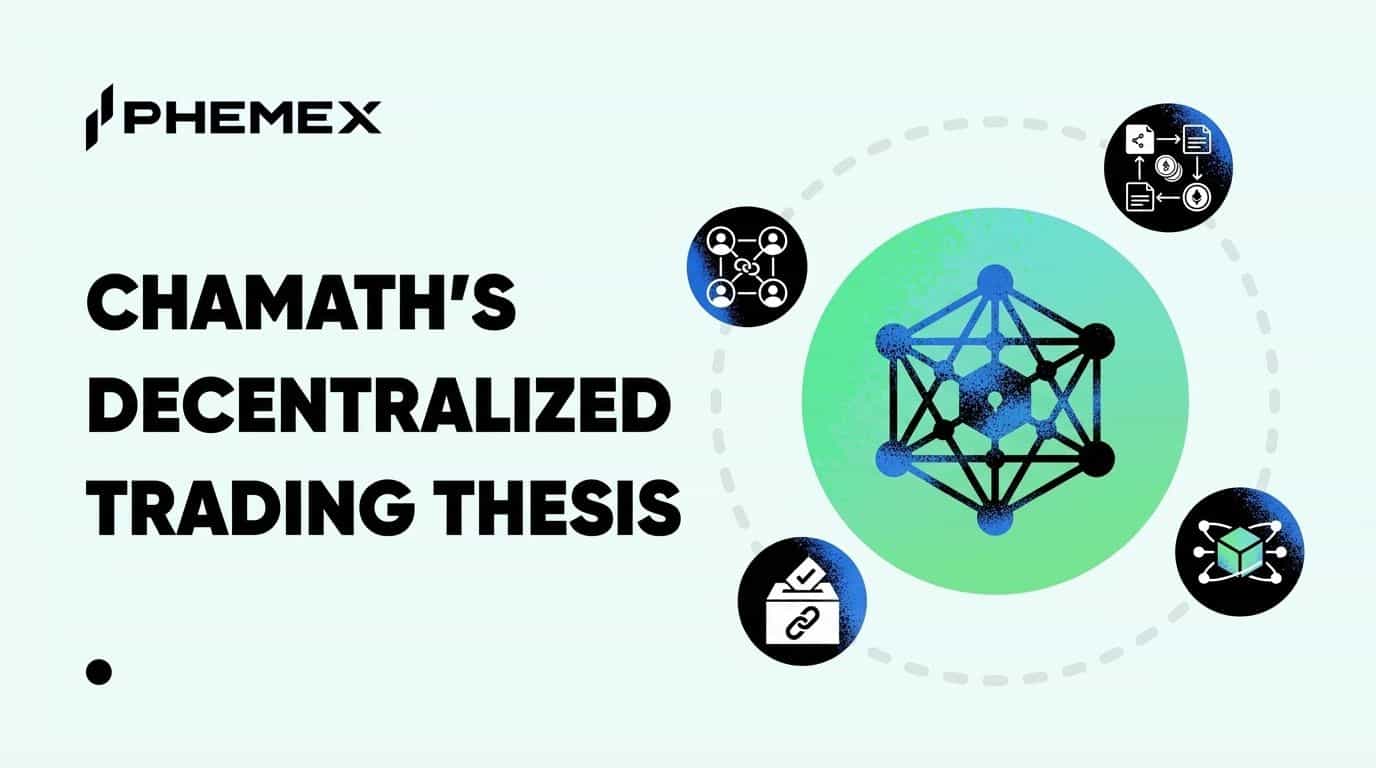
Chamath Palihapitiya just put his money where his thesis is. In March 2026, the billionaire investor and All-In podcast co-host launched a $250 million SPAC targeting DeFi, AI, defense, and energy, with decentralized finance listed as one of four core investment verticals. The same week, he published a detailed breakdown on equity tokenization arguing that the $150 trillion global stock market is ripe for disruption by blockchain-based trading infrastructure. And on the All-In Podcast, he praised Bittensor's decentralized AI training alongside Nvidia CEO Jensen Huang, calling the distributed model "a pretty crazy technical accomplishment."
This is the same investor who bought Bitcoin at $80 in 2012, was early to Facebook, and once held roughly 1 million BTC. When Chamath starts allocating capital to a thesis, the market pays attention. Here is what his decentralized trading conviction means for the crypto market, why the timing matters, and where the real opportunity sits right now.
What Chamath Actually Said About Decentralized Markets
Chamath's argument boils down to rent extraction. Traditional exchanges, clearinghouses, and brokers take a cut at every layer of the trade lifecycle. Stock markets close at 4 PM and settlement still takes T+1 at best. And access to the highest-growth companies is gated behind accreditation rules that lock out most retail investors.
On his Substack, Chamath laid out three specific pain points. Trading hours are artificially limited, settlement depends on intermediaries that add cost and delay. And the best investment opportunities are restricted to a small group of qualified buyers. His conclusion is that tokenized, decentralized trading infrastructure can solve all three simultaneously, and the total addressable market is the entire $150 trillion global equity market.
Source: chamath.substack.com
This is not theoretical optimism from the sidelines. Chamath's new "American Exceptionalism" SPAC explicitly lists DeFi as a target sector alongside AI and defense. He is raising $250 million specifically to acquire companies building this infrastructure. That is a bet you write checks for, not one you talk about on podcasts and forget.
The DEX Market Is Already Proving His Thesis
The numbers back Chamath up more than most people realize. Decentralized perpetual futures exchanges now process over $1.2 trillion in monthly trading volume, and their share of the total crypto derivatives market surged from 2.7% in 2023 to roughly 26% by late 2025, according to BlockEden research.
Hyperliquid is the clearest proof of concept. The decentralized perpetual exchange hit $208 billion in 30-day trading volume, commands over 50% of the DEX derivatives market, and surpassed Coinbase International in derivatives volume with roughly double the throughput. Its weekly fees alone topped $14 million in March 2026. Three years ago, this market barely existed.
|
Metric
|
2023
|
March 2026
|
|
DEX share of crypto derivatives
|
~2.7%
|
~26%
|
|
Hyperliquid monthly volume
|
Near zero
|
$208B+
|
|
Total DEX perp monthly volume
|
<$10B
|
$1.2T+
|
|
Hyperliquid weekly fees
|
Negligible
|
$14M+
|
The trajectory is not slowing down. New entrants like Lighter, Aster, and Paradex are competing for the remaining market share, which means liquidity is deepening and spreads are tightening across the entire DEX derivatives space. Competition is doing exactly what Chamath predicted it would. It is compressing the rent that centralized intermediaries used to extract.
Why Jensen Huang's Endorsement Matters Here
The timing of Chamath's push is not coincidental. On the same All-In episode, Nvidia CEO Jensen Huang discussed Bittensor's milestone of training a 72-billion-parameter language model entirely on a decentralized network using commodity hardware. Huang acknowledged this as a legitimate technical achievement, which is significant because Nvidia sells the centralized GPU infrastructure that dominates AI training today.
When the CEO of the company that profits most from centralization says decentralized training "works," it validates the broader thesis that distributed networks can compete with centralized ones at scale. Chamath connected the dots explicitly, arguing that if decentralized networks can train AI models, they can certainly handle financial transactions, which are computationally simpler by orders of magnitude.
This convergence of decentralized AI and decentralized finance is not a coincidence. Both are driven by the same underlying force. Infrastructure costs have dropped to the point where distributed networks can match centralized performance while cutting out the middlemen. The AI token sector jumped over 40% in the week following Huang's comments, suggesting the market is pricing in this convergence already.
Chamath's Track Record and Why It Adds Weight
Chamath is not a crypto tourist. He bought Bitcoin at $80 in 2012 and wrote a Bloomberg Op-Ed advocating that every person on Earth put 1% of their net worth into BTC. At his peak, he held roughly 1 million Bitcoin, approximately 5% of the total circulating supply at the time. He was one of Facebook's earliest senior executives, joining as VP of Growth in 2007. His venture fund, Social Capital, made early bets on Slack, Box, and several other companies that became worth billions.
But his track record is not spotless, and that honesty is part of what makes the current thesis credible. He sold most of his Bitcoin and later admitted on the All-In Podcast that the decision cost him "$3 or 4 billion, and it's still increasing." He also took a hit on several SPACs that underperformed in 2021-2022. The fact that he is back in the SPAC market with DeFi as a core vertical tells you he sees something specific in this cycle that warrants the reputational risk of re-entering a format that burned him before.
His recent pivot is also nuanced. At the World Government Summit, Chamath questioned Bitcoin's ability to serve as a central bank reserve asset, pointing to the public ledger as a structural limitation for state-level privacy. He is not a Bitcoin maximalist, and his capital allocation makes that clear. He is betting on the infrastructure layer, the trading and settlement rails, rather than any single token.
What This Means for Traders Right Now
Chamath's thesis is a macro framework, not a trade signal. But it points toward specific sectors that are gaining momentum.
DEX infrastructure tokens are the most direct play. Hyperliquid's HYPE token, along with competitors building on-chain derivatives platforms, are positioned at the center of the trend Chamath is describing. The market share data shows this category is growing faster than any other segment in crypto right now.
Tokenized equities and RWA protocols represent the longer-term opportunity. If Chamath is right that the $150 trillion equity market migrates to blockchain rails, then protocols building tokenization infrastructure are early-stage bets on that migration. This is a multi-year thesis, not something that plays out in a single quarter.
DeFi broadly benefits from the attention. When a billionaire investor with mainstream media reach starts talking about decentralized finance as a trillion-dollar opportunity, it shifts the Overton window for institutional allocators who have been waiting for permission to take DeFi seriously. Capital follows narratives, and Chamath is very good at creating narratives.
The risk is execution. DEX platforms still face regulatory uncertainty in most jurisdictions, smart contract risk remains real, and centralized exchanges are not standing still. Coinbase, Binance, and others are building their own on-chain products. The trillion-dollar opportunity Chamath describes requires infrastructure that does not fully exist yet, and the competition to build it will produce losers alongside winners.
Frequently Asked Questions
Did Chamath Palihapitiya actually call decentralized trading a trillion-dollar opportunity?
Chamath framed the global equity market ($150 trillion) as the addressable market for tokenized, decentralized trading infrastructure. He backed this with a $250 million SPAC explicitly targeting DeFi as one of four investment sectors. The "trillion-dollar" framing comes from his own analysis of how much value intermediaries currently extract from traditional markets.
What is Chamath Palihapitiya's current position on Bitcoin?
He remains a Bitcoin holder but has grown more skeptical about its role as a government reserve asset, citing the public ledger as a privacy limitation for state-level use. He sees the bigger opportunity in the infrastructure layer, specifically decentralized trading and settlement systems, rather than in holding BTC itself.
How big is the decentralized derivatives market in 2026?
DEX perpetual futures platforms now process over $1.2 trillion in monthly volume, up from near zero in early 2023. That represents roughly 26% of all crypto derivatives trading. Hyperliquid alone handles over $208 billion per month and has surpassed Coinbase International in derivatives volume.
Is Chamath investing in DeFi directly?
Yes, and he is putting serious capital behind it. His new "American Exceptionalism" SPAC lists DeFi as one of four target sectors alongside AI, defense, and energy. He is raising $250 million specifically to acquire companies in these areas, making this one of the largest single-vehicle institutional bets on decentralized finance to date.
Bottom Line
Chamath's conviction on decentralized trading is not a podcast soundbite. It is backed by $250 million in SPAC capital, a published investment thesis on equity tokenization, and a track record of being early to major technology shifts even when he has not always held on long enough. The DEX derivatives market has grown from near zero to 26% of all crypto derivatives in roughly two years, and Hyperliquid alone now processes more volume than Coinbase International. That trajectory validates the core thesis before Chamath's capital even deploys.
The question for traders is not if decentralized trading grows from here, because the data already answers that. The question is which protocols capture the value and at what pace regulatory clarity accelerates institutional adoption. If Chamath's equity tokenization thesis plays out even partially, the addressable market for on-chain trading infrastructure dwarfs everything crypto has priced in so far. And the week that both Chamath and Jensen Huang publicly endorsed decentralized infrastructure as viable at scale was the week the narrative stopped being theoretical.
This article is for informational purposes only and does not constitute financial or investment advice. Cryptocurrency trading involves substantial risk. Always conduct your own research before making trading decisions.