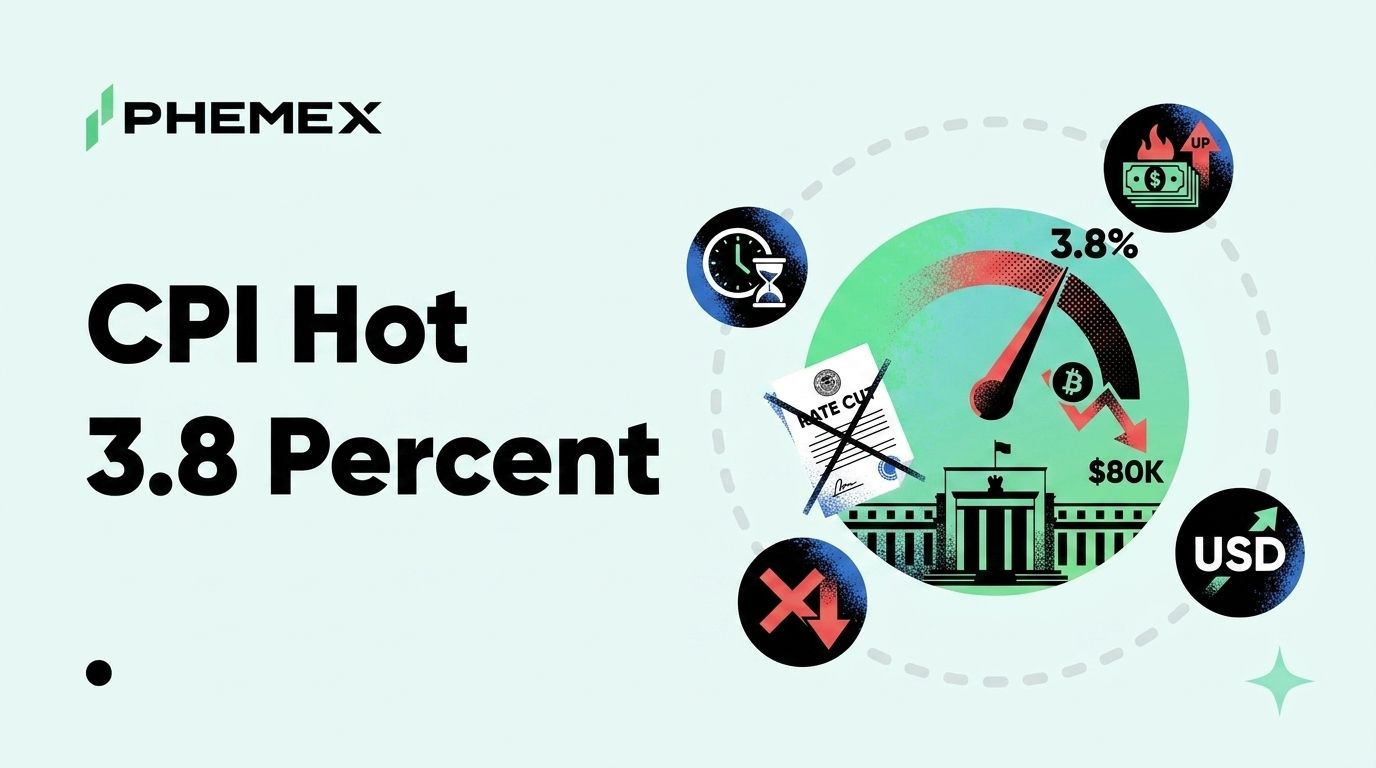
The April CPI print landed at 3.8% year over year this morning, May 12, hotter than the 3.7% consensus and hotter than every major nowcasting model expected. Core CPI ran 2.8% YoY and 0.4% month over month, also above forecasts. Two-year Treasury yields jumped roughly 12 basis points within minutes, S&P 500 futures sold off, and the probability of a June 17 rate cut went from a coin flip to near zero on CME FedWatch by the time the dust settled.
Bitcoin did something unusual. It dipped briefly to $80,600 on the print, then held the $80,000 floor and stabilized while equities kept bleeding. Ethereum gave up about 2%, the dollar firmed, and gold ticked higher on the inflation read. What follows is what actually moved, why crypto held the line despite a clearly hawkish data point, and what the Warsh handover later this week changes about the setup.
What the April CPI Report Actually Said
The Bureau of Labor Statistics release showed headline CPI at +0.6% month over month and +3.8% year over year, both running a tenth above the 3.7% consensus survey. The acceleration from March's 3.3% headline reading was driven by shelter, transportation services, and food away from home, with energy contributing a smaller share than the March spike that came from the Iran oil disruption.
Core CPI, which strips out food and energy, printed +0.4% MoM and +2.8% YoY. That is the metric the Fed actually watches. Core has now been stuck in a 2.6% to 2.9% band for nine consecutive months, refusing to drift toward the Fed's 2% target. Shelter inflation alone added roughly 0.2 percentage points to the monthly core number, and services ex-shelter (the so-called supercore) ran +0.45% MoM, the firmest reading since January.
Bond markets reacted immediately. The 2-year yield, the most rate-sensitive part of the curve, jumped to 4.32% from 4.20% in the half hour after release. The 10-year added about 7 basis points to 4.55%. Stock futures gave back overnight gains and the dollar index pushed higher against the euro and yen. CoinDesk noted that the print "pours cold water" on the rate cut narrative the market had built since the February pause.
Why June Rate Cut Odds Just Collapsed
Before the print, CME FedWatch showed roughly a 48% probability of a 25 basis point cut at the June 17 FOMC meeting. Within two hours of the release that number dropped under 8%, and traders pulled their first-cut expectations to September at the earliest, with the larger weight on November or December.
The math is straightforward. The Fed has been telling markets for six months that it needs "greater confidence" inflation is heading sustainably back to 2% before easing. Two consecutive monthly headline prints in the high 3% range and core stuck near 2.8% do not provide that confidence. They do the opposite. Several FOMC participants, including Schmid, Bowman, and Hammack, have already publicly leaned toward zero cuts in 2026, and this print hands them their argument.
There is also the political layer to consider here. Kevin Warsh takes over as Fed Chair from Powell on May 15, which is three days from now. Warsh has been openly hawkish on stagflation risk and skeptical of the dovish pivot the market wanted in early 2026. His first public remarks as chair will come during a moment when the data is screaming "do not cut," which conveniently lines up with the message he was likely to deliver anyway.
Why Bitcoin Held $80K When Stocks Did Not
This is the part that matters for traders. Hot CPI prints have historically been bad for BTC. The August 2022 hot print sent BTC down 9% in 48 hours. The September 2023 surprise sent it down 5%. Yet today BTC absorbed a clearly hawkish data point, dipped to $80,600, and parked itself above $80,000 while the S&P shed 1.2% and the Nasdaq lost 1.6%.
Three structural reasons explain the divergence between BTC's resilience and the equity weakness today.
ETF flows have become the dominant marginal buyer. Spot Bitcoin ETFs have absorbed roughly $9.4 billion in net inflows over the past 45 days according to flow trackers. That structural bid does not pause for a CPI print. Pension funds, RIAs, and family offices that allocate to IBIT or FBTC on a programmatic basis rebalance monthly or quarterly, not intraday. As long as that pipe stays open, dip-buying is mechanical rather than discretionary.
BTC supply is in a post-halving squeeze. The April 2024 halving cut new issuance to roughly 450 BTC per day, while spot ETFs alone have been absorbing more than that on positive days. Combine that with the long-term holder cohort sitting on their lowest sell pressure reading since early 2023 and you have a market where macro shocks find shallow sellers. The Coin Republic flagged the $80K hold as evidence of the structural floor that has been forming since the February low.
Warsh transition optimism. This is the contrarian piece of the setup and the one most likely to surprise traders. Crypto traders broadly view Warsh as more hawkish on inflation but also more friendly to the dollar reserve narrative and to private digital asset markets. His prior writings have argued that the Fed should be more comfortable letting risk assets price independently of policy. The thesis may or may not survive contact with reality, but the positioning into his first week is clearly not panic.
How CPI Prints Typically Move Bitcoin
For traders building a playbook, the 24-hour reaction pattern around CPI releases has been consistent enough to study. BeInCrypto's recap of today's reaction is a useful single-day snapshot, but the longer pattern matters more.
The table below covers BTC's reaction to the last six CPI prints relative to expectations.
|
CPI date
|
Headline surprise
|
BTC 1-hour move
|
BTC 24-hour move
|
BTC 7-day move
|
|
Nov 2025
|
In line
|
+0.4%
|
+1.1%
|
+3.2%
|
|
Dec 2025
|
Cooler (-0.1%)
|
+1.8%
|
+4.6%
|
+7.9%
|
|
Jan 2026
|
Hotter (+0.1%)
|
-2.1%
|
-3.4%
|
-6.8%
|
|
Feb 2026
|
In line
|
-0.3%
|
+0.6%
|
+2.1%
|
|
Mar 2026
|
Hotter (+0.2%)
|
-3.2%
|
-5.1%
|
-2.4%
|
|
Apr 2026
|
Hotter (+0.1%)
|
-1.1%
|
TBD
|
TBD
|
The pattern is clear. Cooler prints produce sustained 7-day rallies. Hotter prints produce immediate drops that often recover within a week if no follow-on macro shock arrives. Today's reaction is unusually muted on the 1-hour timeframe relative to January and March, which suggests either the market had partially front-run the result or the structural ETF bid is genuinely cushioning the move. For a deeper framework on positioning around these prints, the Phemex playbook on trading CPI day walks through the position sizing, stop placement, and timing rules that apply to volatile macro releases.
Why 3.8 Percent Is Stickier Than the Headline Suggests
The Fed's 2% target is more than a round number on a policy chart. It is calibrated against a model of the economy that assumes inflation expectations stay anchored, wage growth tracks productivity, and the labor market does not generate persistent second-round price pressure. Three readings out of the last four are now suggesting that model is breaking down at the margin.
The Cleveland Fed's nowcasting model had been pointing to a May CPI print around 3.5%, which would have been a clear cooling step. After today's data, the same model is likely to revise that May forecast higher because shelter and services inflation showed virtually no deceleration. Shelter, which carries the largest weight in core CPI, is running at an annualized 4.4% pace based on the past three months. Services ex-shelter is even worse.
The honest read is that the path back to 2% requires either a meaningful labor market loosening or a goods deflation cycle that none of the leading indicators are flagging. Neither is happening at the moment, and the Fed clearly knows this. Markets are beginning to accept the same conclusion. The question for risk assets is not when the first cut arrives but if the policy holding pattern itself is enough to keep liquidity conditions tight without breaking something.
Crypto's behavior over the past three months suggests it is increasingly trading as a separate risk-on/risk-off vehicle from equities, anchored more to ETF flow data and the regulatory environment than to short-end rate expectations. That decoupling is not permanent, but it is real enough today that a 12-basis-point move in the 2-year yield did not produce the BTC drawdown the playbook would have predicted twelve months ago. For broader context on how previous CPI shocks rippled through the market, the Phemex blog covering the March CPI surge walks through the energy-driven dynamics that made that print less threatening than today's broad-based reading.
Frequently Asked Questions
Why did Bitcoin hold $80K when CPI came in hot?
The structural ETF bid is the main reason. Spot Bitcoin ETFs have absorbed roughly $9.4 billion over the past 45 days, and that flow is largely programmatic rather than discretionary. Post-halving supply is also limited at 450 BTC per day, so even a softer marginal buyer base can keep prices supported. Add the Warsh transition optimism and you have a setup where macro shocks find shallow sellers.
Will the Fed actually skip a rate cut in June 2026?
Based on the current data, yes. The CME FedWatch tool moved June cut odds from roughly 48% to under 8% within hours of the print, and the first cut probability shifted to September at the earliest, with most weight on November or December. Several FOMC participants were already leaning toward zero cuts in 2026, and the April CPI gives them firmer ground to argue against easing.
Does Kevin Warsh becoming Fed Chair change the crypto outlook?
Probably yes, though direction is contested. Warsh is hawkish on inflation, which is bad for risk assets, but he has also written favorably about letting private markets price risk without Fed intervention. The crypto market has tentatively priced in the transition as net neutral to mildly positive, which is why BTC absorbed today's data better than a pure macro framework would have predicted.
How does CPI actually move Bitcoin compared to other assets?
Bitcoin reacts to CPI through the rate cut probability channel, not through inflation directly. A hot print pushes cut expectations further out, which firms the dollar and lifts yields, which is risk-off for crypto. The reaction has historically been faster and sharper in BTC than in equities, but that pattern has been weakening in 2026 because of the structural ETF bid that does not exist for the S&P 500.
Bottom Line
June is off the table. The Fed will hold at 4.00% to 4.25% on May 1 and again on June 17, and the conversation now moves to the question of September being realistic or the first cut slipping into Q4. The structural setup for BTC is that ETF flows and the post-halving supply squeeze are absorbing macro shocks that would have produced 5% to 8% drawdowns in prior cycles. As long as $80,000 holds on weekly closes, the path of least resistance stays sideways to higher.
The numbers to watch over the next ten days are simple. May 14 retail sales prints Wednesday, and a hot read on top of hot CPI would compound the rate cut delay. Warsh's confirmation remarks on May 15 will set the tone for the rest of Q2. ETF flow data for May 12 and May 13 tells you if the structural bid is still showing up at this price level. If flows stay net positive and the $80K floor holds through Warsh's first week, the next leg likely targets $85,000 to $87,000. If flows turn net negative and $79,500 breaks on a daily close, the next real support is $76,800 from the late-March consolidation. The setup is binary in either direction, and the trigger is the data, not the narrative.
This article is for informational purposes only and does not constitute financial or investment advice. Cryptocurrency trading involves substantial risk. Always conduct your own research before making trading decisions.