










Key Takeaways
-
Unibase is a decentralized infrastructure project focused on giving AI agents persistent memory, cross-platform identity, interoperability, and autonomous payment capabilities.
-
The project is built around four main modules: Membase, AIP Protocol, Unibase Pay, and Unibase DA.
-
Its core thesis is that AI agents need more than models. They also need long-term memory, shared identity, permissionless communication, and machine-native commerce.
-
The AIP Protocol is one of the most important parts of the ecosystem, combining on-chain identity, decentralized memory, and x402-compatible agent payments.
-
Unibase is positioning itself as infrastructure for the open agent internet rather than just another AI token.
-
The UB token is associated with protocol fees, governance, staking, and knowledge-mining incentives, but investors still need to weigh token-supply expansion and execution risk carefully.
Unibase is one of the more interesting crypto-AI infrastructure projects because it is not trying to be just another chatbot token or AI narrative trade. Instead, it is building around a very specific idea: if AI agents are going to become useful, autonomous participants on the internet, they need their own native infrastructure stack.
That stack, according to Unibase, includes four major things. First, agents need persistent memory so they can retain knowledge across sessions instead of starting from zero every time. Second, they need a verifiable identity layer so they can interact with users, tools, and other agents in a trustworthy way. Third, they need interoperability so they can work across platforms instead of staying trapped inside isolated frameworks. And fourth, they need payment rails so they can autonomously search, purchase, and pay for resources without relying on human checkout flows. That is the problem Unibase is trying to solve.
What Unibase Actually Is
Unibase describes itself as the decentralized memory layer for AI agents. It is not trying to compete directly with large language models. It is not trying to be the next inference marketplace. And it is not mainly positioning itself as an agent frontend. Instead, Unibase is building the infrastructure that agents would need to become more persistent and more autonomous over time.
Unibase gives agents persistent long-term memory, on-chain identity, permissionless interoperability, and autonomous payments. That combination is what makes the project distinctive. Many AI-agent protocols focus on one piece of the puzzle. Unibase is trying to connect several of them into one architecture. In other words, Unibase is not just about helping agents think. It is about helping them remember, identify themselves, collaborate, and transact.
Why AI Agents Need Something Like Unibase
Most AI agents today still have a basic limitation: they are often stateless, fragmented, and highly dependent on the platform they run on. An agent might be able to answer questions or trigger tools in one environment, but it often cannot retain durable memory across long periods, cannot easily move across ecosystems, and cannot independently pay for resources it needs.
In practice, this means many so-called “autonomous” agents are still heavily constrained.
Unibase’s thesis is that this limitation is structural, not cosmetic. If agents are going to become real digital actors, they need infrastructure similar to what humans already rely on online:
-
memory to keep context,
-
identity to build trust,
-
protocols to communicate,
-
and payments to participate in commerce.
That is why the project talks about the open agent internet, because it is aiming at the layer beneath the apps.
The Four Core Modules of Unibase
The easiest way to understand Unibase is by looking at its four main modules.
Membase
Membase is Unibase’s long-term memory layer. The project describes it as a zero-knowledge-verified memory system for autonomous agents.
The basic idea is straightforward: agents should be able to persist and synchronize conversations, knowledge bases, and task coordination across time. Instead of losing context every time a session resets, an agent built on Membase can retain a more durable memory layer.
This matters because memory is one of the biggest weak points in many AI systems. An agent may sound intelligent in a single interaction, but it becomes much more useful if it can accumulate context, remember prior actions, and build knowledge over time.
Unibase is therefore making memory a first-class primitive rather than treating it as an afterthought.
AIP Protocol
The AIP Protocol may be the most important part of the stack. Unibase describes it as a Web3-native multi-agent communication standard.
According to the project, AIP combines:
-
ERC-8004 identity
-
decentralized memory
-
and x402-compatible payment support
The protocol is meant to let agents establish on-chain identities, share memory, and collaborate across platforms with built-in permissioning and security.
Unibase also makes a point of comparing AIP with MCP and A2A-style agent standards. Its argument is that existing agent communication standards still leave major gaps around decentralized memory, on-chain identity, and verifiable authorization. AIP is supposed to fill those gaps with a more complete stack.
If this works, AIP could become one of the more interesting attempts to standardize how agents communicate and coordinate in Web3 environments.
Unibase Pay
Unibase Pay is the project’s machine-commerce layer. It is built around x402 and is designed to let AI agents search, purchase, and pay onchain autonomously. AI agents may become much more useful if they can not only call tools, but also pay for memory, APIs, and services in a machine-native way.
Unibase Pay currently emphasizes:
-
x402 V2 compatibility
-
micropayments
-
payment gating
-
payment verification
-
and support for ERC-20 assets via Permit2 and EIP-3009-style flows
The project positions this as infrastructure for agent-to-agent commerce rather than ordinary human checkout. That fits the broader Unibase vision well. Agents are not just supposed to remember and communicate. They are also supposed to act economically.
Unibase DA
The fourth module is Unibase DA, which the site describes as a high-performance data availability layer purpose-built for AI. If agents are constantly writing memory, reading shared state, and synchronizing across workflows, then the ecosystem also needs scalable data access.
Unibase frames DA as the storage and throughput foundation for agent workloads. In other words, if Membase is the memory logic, Unibase DA is part of the performance layer that helps make that memory usable at scale.
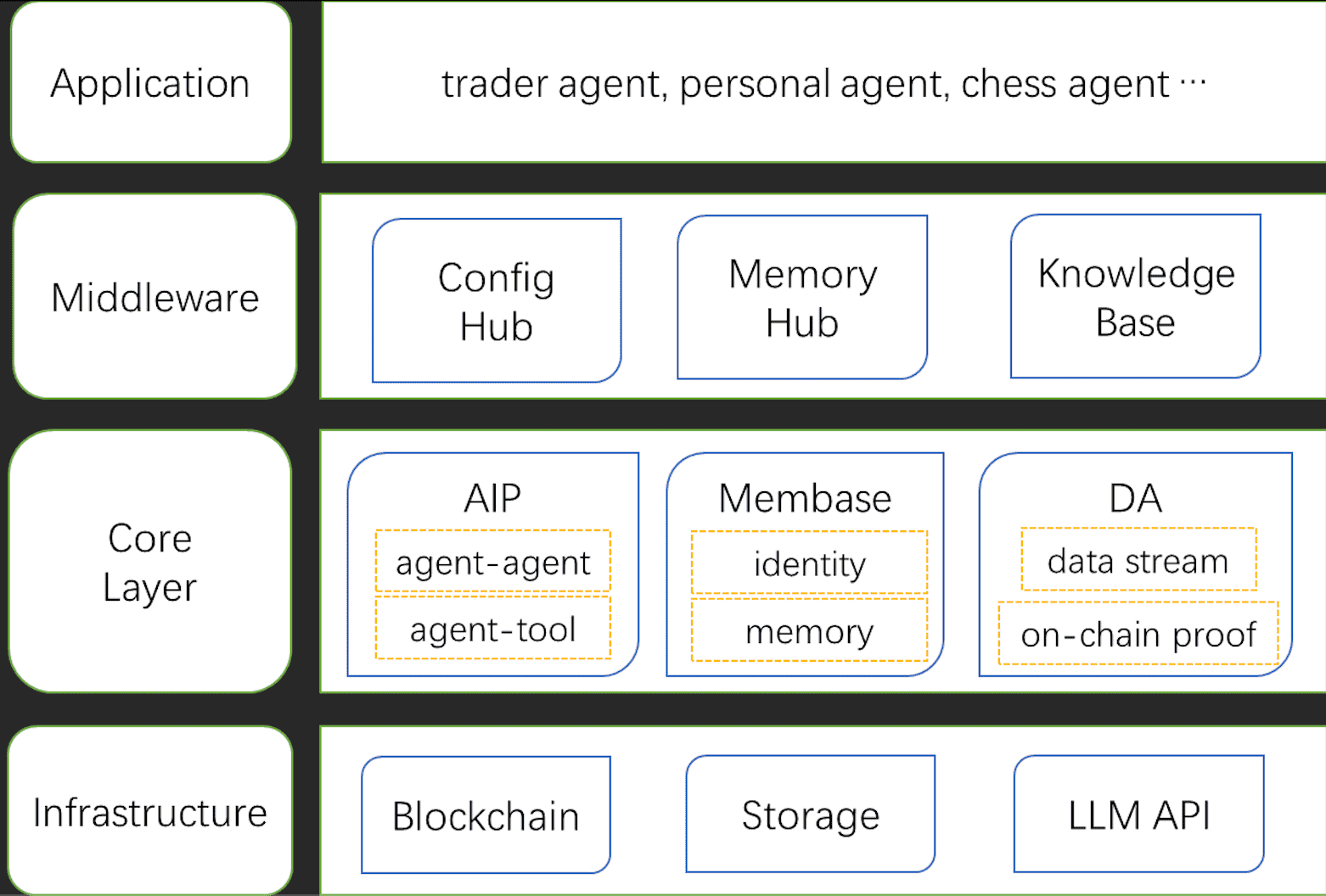
Unibase Agent Structure
What Makes Unibase Different
There are a lot of AI-agent projects in crypto now, so the obvious question is what makes Unibase different. The answer is that Unibase is not centered on the model itself. It is centered on the agent substrate.
Many competing projects focus on agents as applications, social personalities, or tokenized narrative objects. Unibase is more infrastructure-heavy. It is trying to solve the lower-level problems that serious agents would face, such as where memory lives, how identity is established, how agents communicate, and how they pay.
Unibase Use Cases
The Unibase site highlights several use cases that show where the infrastructure could matter. One is autonomous agent workflows, where multiple agents collaborate across games, DAOs, and broader digital workflows using shared memory and interoperability.
Another is agent-to-agent commerce, where agents discover, pay for, and access resources through x402-compatible payment rails.
A third is decentralized RAG and knowledge systems, where long-term memory and verifiable retrieval create a stronger foundation for self-evolving agents across platforms.
The AIP page also points to additional examples such as:
-
knowledge mining and sharing
-
multi-agent gaming and simulation
-
and personalized DeFi agents
That last point is especially relevant to crypto audiences. If agents can retain user preferences and secure memory while optimizing onchain actions, then the project could have a meaningful role in future DeFi tooling.
The UB Token
The UB token sits at the center of the Unibase economy. UB is tied to protocol fees, governance, agent staking, and knowledge-mining incentives. There is a 10 billion max supply with around 2.5 billion currently circulating, which means only about a quarter of the eventual supply is already in circulation.
That is important because the token story has two sides. On the positive side, UB is tied to a real protocol thesis. It is not just a decorative governance asset. It is supposed to help coordinate fees, staking, and incentives across a decentralized agent infrastructure stack. On the negative side, supply expansion matters. If only 25% of supply is circulating, then future unlocks and emissions can affect valuation materially. Investors need to care not only about product quality, but also about token-distribution pressure.
The Bull Case for Unibase
The strongest bull case for Unibase is that it is solving real infrastructure problems in a category that is still early. If AI agents become more important over the next few years, they will likely need persistent memory, interoperable standards, on-chain identity, and autonomous payment rails. Unibase is one of the few projects trying to connect all four.
A second bullish point is narrative alignment. The project fits directly into several strong themes at once:
-
AI agents
-
Web3-native interoperability
-
decentralized memory
-
and machine-native commerce
A third bullish point is ecosystem positioning. The site already shows integrations or ecosystem proximity with names like Virtuals, ElizaOS, CARV, and Anthropic-related branding context, which at minimum suggests the team understands where agent infrastructure needs to connect.
If the market begins to value the “infrastructure layer for agents” more than the “meme layer for agents,” Unibase could benefit from that shift.
The Risks and Weaknesses
The biggest risk is execution. Unibase is building a lot at once: memory infrastructure, communication standards, payments, and data availability. Each of those is hard on its own. Together, they make the product vision impressive, but also difficult to execute cleanly.
A second risk is competition. The AI-agent sector is crowded, and many projects are trying to own some part of the future agent stack. Unibase will need to prove that developers actually adopt AIP, that Membase is useful in practice, and that Unibase Pay becomes more than a niche integration.
A third risk is token pressure. With a 10 billion max supply and only 25% circulating, dilution and unlock dynamics are not a minor issue.
A fourth risk is that the concept may simply be ahead of the market. The project may be building infrastructure for a future that is real, but not yet large enough to reward the platform economically in the near term.
So, What Is Unibase in One Sentence?
Unibase is a decentralized AI-agent infrastructure project that gives agents long-term memory, on-chain identity, cross-platform interoperability, and machine-native payment rails.
Conclusion
Unibase is one of the more serious infrastructure plays in the AI-agent sector because it is focused on what agents actually need to become durable digital actors: memory, identity, communication, and payment.
Its four-module architecture — Membase, AIP Protocol, Unibase Pay, and Unibase DA — gives it a clearer systems-level story than many AI tokens that rely mostly on branding. That does not guarantee success, but it does make the project easier to take seriously.
For investors and users, the key question is not whether the idea is interesting. It clearly is. The question is whether Unibase can turn that idea into real developer adoption, real agent activity, and sustainable token demand. If it can, Unibase could become an important part of the infrastructure layer behind the open agent internet. If not, it may still be remembered as one of the more thoughtful attempts to build it.
