









Key Takeaways
Spectral is building infrastructure for what it calls the agentic economy, where autonomous software can transact and collaborate across onchain and offchain systems.
Its flagship live product is Spectral Syntax, a platform that lets users create and use AI agents, including onchain and image-generating agents.
SPEC is Spectral’s governance token and is used for staking, fee discounts, creator incentives, and broader ecosystem alignment.
Spectral’s long-term product direction now includes The Grid, an inference market, and autonomous systems such as hedge-fund agents and prediction-market agents.
As of today, Spectral appears best understood as an AI-agent infrastructure ecosystem, not just a token or a single app.
Artificial intelligence in crypto is moving beyond chatbots and into something more ambitious: software agents that can build, trade, reason, and act onchain. But for that world to scale, agents need more than raw intelligence. They need infrastructure, markets, execution rails, and economic coordination. That is the core problem Spectral is trying to solve. Spectral’s official website says it is building “intelligent infrastructure for the agentic economy,” where autonomous systems can reason, transact, and collaborate across chains, networks, and domains.
That makes Spectral more than just another AI token. The project has evolved from early tooling around onchain code generation into a broader platform for agent creation, monetization, staking, and autonomous systems research. Its public product stack includes Spectral Syntax, a live platform for creating and running agents, and a broader research direction around inference markets, autonomous hedge funds, prediction-market agents, and agent-native company structures.
At the center of this ecosystem is SPEC, Spectral’s governance token. Spectral’s tokenomics blog says SPEC is used as the “self-sustaining mechanism for value distribution across the network,” while the live product site shows SPEC-based staking and rewards tied to agent activity.
What Is Spectral?
Spectral is a crypto-AI infrastructure project focused on building the rails for autonomous software systems. Its official site says agents will eventually run companies, trade markets, allocate capital, and negotiate on behalf of users, but that today they live in a fragmented world with closed APIs, isolated systems, and no shared economic fabric. Spectral’s stated mission is to build the “primitives, protocols, and markets” that let autonomous software interact with the world as reliably as electricity moves through a grid.
That language matters because Spectral is not presenting itself as just an AI assistant or a single-purpose agent app. It is positioning itself as a broader infrastructure layer for agent creation, execution, coordination, and monetization. In other words, Spectral is trying to build the underlying system that lets agents do useful economic work, not just talk.
Spectral highlights projects including a real-time inference market, an autonomous hedge fund on Hyperliquid, autonomous content agents, prediction-market agents, a framework for autonomous companies, and a Solidity-generating coding model. Taken together, these point to a platform strategy rather than a single AI product.
How Spectral Started
Spectral’s earlier public identity was more tightly tied to Syntax, its initial onchain AI product. In May 2024, Spectral described Syntax as a platform where users could generate and deploy smart contracts and fully orchestrated AI agents from natural-language prompts. It highlighted early agents such as MoonMaker, which performed onchain operations, and TestMachine, which checked Solidity vulnerabilities.
Later that year, Spectral introduced Syntax V2, describing it as a platform where users could bring autonomous, intelligent agents to life without writing code. The company framed those agents as systems that could interpret events, reason, trade onchain, and evolve through community influence.
This history matters because it shows how Spectral evolved. It did not suddenly appear as a hedge-fund or inference-market project. It started from agent creation and smart-contract generation, then expanded outward into a larger vision of agent-native markets and infrastructure.
What Problem Is Spectral Trying to Solve?
Spectral is trying to solve a coordination problem in the AI-agent economy.
Today, AI agents can be smart, but that alone is not enough. An agent also needs:
a way to be created and customized,
a way to transact,
a way to access tools and services,
a way to earn or distribute value,
and a way to be trusted and coordinated with other agents.
Spectral says the biggest problem is not whether the agentic economy will arrive, but what foundation it will stand on. That is the core Spectral pitch: intelligence alone is not sufficient; agents need infrastructure.
This is why the project spans more than one product. Spectral Syntax tackles agent creation and usage. The Grid tackles price discovery and routing across inference tasks. The autonomous hedge fund and prediction-market systems test whether agents can actually make financial decisions in live conditions. These are all different answers to the same broad question: how do autonomous agents become usable economic actors?
What Is Spectral Syntax?
Spectral Syntax is the most visible live product in the Spectral ecosystem. The current Syntax site says users can create their own agents, browse existing agents, explore staking and rewards, and build an “onchain empire” with a personal swarm of AI agents. It also says Syntax lets users craft “sentient memes” — AI agents that can operate onchain and answer to token holders.
While the “sentient memes” language is intentionally playful, the underlying functionality is real. The platform is structured around:
creating agents,
browsing and using existing agents,
monetizing or launching agents,
and staking SPEC for ecosystem rewards.
Earlier Spectral materials also explain how Syntax works in a more technical way. In its tokenomics paper, Spectral described Syntax as a two-sided marketplace made up of:
Creators, who build and publish agents,
Users, who initiate jobs for those agents,
and Agents, which interpret requests and execute tasks, potentially through code and onchain actions.
How Spectral Syntax Works
Spectral’s 2024 tokenomics article provides the clearest official explanation of Syntax’s core mechanics.
According to Spectral:
users pay transaction fees and usage fees when they use agents,
creators earn creator earnings whenever their agents are used,
and agents use those funds to carry out jobs on behalf of users.
The same article says Syntax V2 introduced several key features:
a natural-language AgentBuilder,
a secure and private Agent Wallet,
and a dedicated Gas Tank that users can fund so agents can pay gas, transaction fees, and usage fees.
This matters because it shows Spectral is thinking beyond simple AI interaction. It is building the financial and operational rails agents need:
wallets,
fee logic,
gas abstraction,
and monetization.
That makes Spectral much more relevant to current 2026 themes like AI agent wallets, autonomous onchain trading, and machine-native payments.
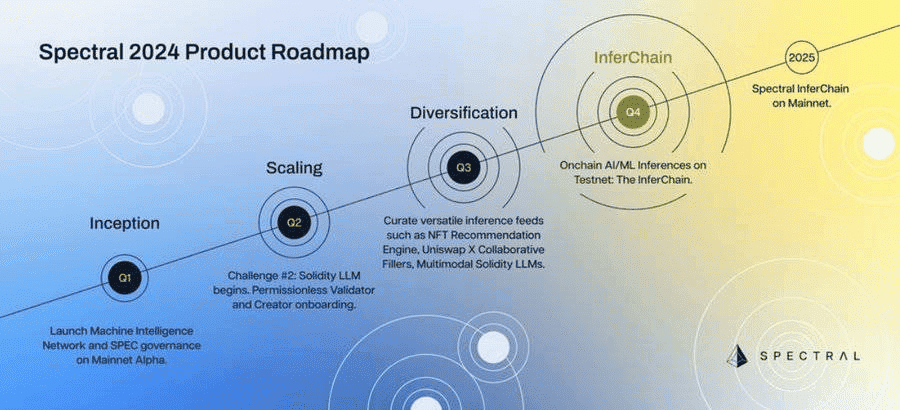
Spectral 2024 Roadmap
What Is SPEC?
SPEC is Spectral’s governance token. Spectral’s tokenomics paper says SPEC is used as the mechanism for value distribution across the network. The live Spectral site links official contract addresses for SPEC on both Ethereum and Base, which confirms the token’s active multi-chain presence in the current ecosystem.
The 2024 tokenomics post explains SPEC’s main current functions in Syntax:
Users can stake SPEC to receive discounts on transaction fees.
Agent creators can stake SPEC to gain higher percentages of creator earnings from transactions made by their agents.
This is a meaningful utility model because it ties SPEC directly to network participation. It is not just a passive governance token. It gives users and creators economic reasons to hold and stake it if they are active in the Syntax ecosystem.
Earlier third-party explanations also described SPEC as a token used across staking and operational mechanisms within the Spectral network, especially for creating and monetizing agents on Syntax. While secondary sources should be treated more cautiously, that description is broadly consistent with Spectral’s own tokenomics write-up.
What Does SPEC Do?
Based on Spectral’s official tokenomics materials, SPEC currently serves several important roles.
Governance
Spectral explicitly describes SPEC as the governance token of the network. The token-claim page even states that “SPEC governance is live,” reinforcing that governance is not just theoretical.
User Fee Discounts
Users who stake SPEC can receive discounts on transaction fees when using agents on Syntax. Spectral’s tokenomics paper presents this as a way for active users to increase yield from engagement.
Creator Earnings Boosts
Creators who stake SPEC can earn higher percentages of creator earnings from the activity of their agents. This is one of the clearest creator-economy mechanics in the ecosystem.
Staking Rewards
The live Syntax site lists a number of SPEC-denominated staking rewards, including portions of swap fees from agent pairs and image-generating agents, token allocations from newly launched agents, and a share of returns tied to Spectra’s hedge-fund vault.
This reward structure suggests Spectral is trying to turn SPEC into the coordinating asset across both user activity and agent monetization.
Spectral’s Product and Research Direction in 2026
One of the most interesting aspects of Spectral today is how far the project has expanded beyond Syntax alone.
On its current Product and Research page, Spectral highlights several systems:
The Grid
Spectral describes The Grid as a “real-time inference market” and the first live market for intelligence, where liquidity becomes actionable across inference use cases and models can be compared through a unified market.
Autonomous Hedge Fund on Hyperliquid
This is one of the most striking examples. Spectral describes it as a fully autonomous trading system that allocates and manages capital with zero human intervention, demonstrating agent-led financial decision-making in live markets. The description says agents assume roles inside an autonomous company, including CEO, trader, and researcher roles.
Prediction Market Agents
Spectral also says it has agents that autonomously trade, hedge, and provide liquidity across decentralized prediction markets.
Lux Framework for Autonomous Companies
Spectral describes Lux as a framework for software-native organizations composed entirely of autonomous agents.
These examples matter because they show Spectral’s 2026 direction very clearly: it is no longer just “an agent builder.” It is trying to create the infrastructure for an agentic economy, including markets, companies, and financial systems driven by autonomous software.
Why Spectral Matters in the AI-Agent Sector
Spectral matters because it represents a more infrastructure-heavy version of the AI-agent narrative.
A lot of agent tokens focus on consumer-facing characters, meme communities, or simple automation layers. Spectral is trying to build the more difficult but potentially more valuable substrate:
agent creation,
agent wallets,
monetization rails,
inference markets,
and autonomous capital allocation systems.
That makes it one of the more interesting “AI agent economy” projects, because it is explicitly targeting:
autonomous finance,
agent marketplaces,
agent infrastructure,
machine-native value exchange.
It is also notable that Spectral has stayed close to real product iteration. Syntax launched in March 2024, Syntax V2 followed later that year, and the 2026 site now centers a broader infrastructure-and-research portfolio. That gives the project a clearer product arc than many AI-agent tokens have.
Risks and Limitations
Spectral is ambitious, but it comes with real risks.
Execution Risk
The project is now spanning many fronts at once:
agent creation,
agent monetization,
inference markets,
autonomous hedge funds,
prediction markets,
and autonomous company frameworks.
That breadth creates upside, but it also makes execution harder. This is an inference based on Spectral’s current product scope.
Token Value-Capture Risk
SPEC has clear utility in Syntax, especially through staking and fee mechanics. But as Spectral expands into broader infrastructure like The Grid and autonomous finance, the long-term question is how much of that ecosystem value will reliably accrue to SPEC itself. This is a standard risk for infrastructure tokens and should be stated honestly. The current official materials support direct utility, but future value capture still depends on adoption.
Complexity Risk
Spectral’s vision is technically sophisticated. The more it leans into autonomous systems managing capital and running companies, the more it must solve difficult problems around security, reliability, trust, and policy enforcement. This is an inference from the nature of the systems Spectral is describing.
Market Risk
Like many AI-agent tokens, SPEC operates in a volatile narrative sector. Even a project with meaningful infrastructure can see its token price move independently of progress. Public market trackers show that SPEC has experienced large historical drawdowns, which is common in emerging sectors but still important to note.
Conclusion
Spectral is one of the more serious infrastructure plays in the crypto-AI sector because it is not just trying to create another agent app. It is trying to build the market structure, execution rails, and incentive systems that let agents actually function inside an economy. Its official site says the real challenge is not whether the agentic economy arrives, but what foundation it will stand on. That is the best one-line summary of Spectral’s ambition.
The project’s flagship product, Spectral Syntax, gives users and creators a live platform for building and monetizing agents, while SPEC provides governance and staking-based economic alignment. Beyond that, Spectral is now also experimenting with inference markets, autonomous hedge funds, prediction-market agents, and autonomous company frameworks.
As AI agents, autonomous trading systems, and machine-native markets continue to evolve, projects like Spectral show how crypto can provide the coordination layer for intelligent software economies. For traders looking to stay ahead of emerging narratives—from AI agents and autonomous finance to RWAs, PayFi, and chain abstraction—Phemex offers a secure and user-friendly platform to explore the market, monitor new opportunities, and sharpen your trading edge.
