










Key Takeaways
-
Sentient is an open-source AGI project focused on building a community-owned intelligence network rather than a closed corporate AI platform.
-
The project combines a nonprofit governance layer through the Sentient Foundation with a product and research arm through Sentient Labs.
-
Its core product vision centers on GRID, a large open intelligence network that connects agents, models, data, tools, and compute into a unified system.
-
Sentient is also building infrastructure such as ROMA, an open-source meta-agent framework, and fingerprinting, a system designed to help open-source model creators prove ownership and support monetization.
-
The SENT token acts as the coordination layer for the ecosystem, powering staking, governance, fees, and incentive flows across the network.
-
Sentient’s biggest long-term bet is that AGI will emerge from open, modular, multi-agent systems rather than a single closed model controlled by one company.
Sentient is one of the more ambitious projects at the intersection of crypto and artificial intelligence because it is not simply trying to launch another AI-branded token. It is trying to build an open-source AGI ecosystem.
That distinction matters. Many crypto-AI projects focus on narrow layers of the stack, such as compute marketplaces, agent tokens, or inference access.
Sentient’s pitch is much broader. The project argues that the future of advanced intelligence should not be controlled by one corporation, one model provider, or one closed research lab. Instead, it should be built in the open, owned by communities, and coordinated through shared infrastructure.
In practical terms, Sentient is building toward a world where intelligence is modular and networked. Its products and research suggest a future in which agents, models, data providers, tools, and compute are stitched together into a larger open intelligence system rather than locked inside one black-box model. That is the role of GRID, and it sits at the center of the Sentient story.
The Core Mission of Sentient
The easiest way to understand Sentient is through its mission. Across its Foundation and Labs materials, the project consistently argues that AGI should be open-source, decentralized, aligned with humanity, and never controlled by a single entity. That gives Sentient a very different tone from traditional AI companies. It is not mainly promising a better chatbot or a slightly cheaper model endpoint. It is making a philosophical and infrastructural claim: the future of intelligence should be shared, not owned.
This is why the Sentient Foundation exists as a nonprofit steward of the broader ecosystem. The Foundation’s stated role is to support open-source AGI through research coordination, governance frameworks, developer support, and public advocacy. At the same time, Sentient Labs acts as the technical and product engine, building systems such as Dobby, ROMA, Open Deep Search, and other components of the ecosystem.
Sentient Foundation vs. Sentient Labs
A lot of people get confused because “Sentient” refers to both a broader movement and a product organization. The Sentient Foundation is the nonprofit layer. Its job is to act as a neutral, transparent steward of the open AGI ecosystem. It focuses on mission, governance, outreach, community-building, grants, and the broader case for keeping AGI open rather than captured by corporate interests. Sentient Labs is the builder side. It is the research and product organization creating the actual tools and systems inside the ecosystem. This includes products and frameworks such as GRID, ROMA, Dobby models, Open Deep Search, and fingerprinting systems.
This structure is strategically important. Many open projects struggle because there is no clear distinction between a mission-driven public narrative and a product-driven commercial engine. Sentient is trying to have both.
What GRID Is
If Sentient has one flagship concept, it is GRID. Sentient describes GRID as the Global Research and Intelligence Directory, and more broadly as the world’s largest network of intelligence. The core idea is that AGI will not come from one giant monolithic model alone. Instead, it will emerge from a network of specialized models, agents, tools, data sources, and compute providers that can work together.
In that design, a user query does not just go to one model and return one answer. It gets decomposed, routed to the right specialized intelligence components, enriched with external tools or search, and then recombined into a final output. That is a big conceptual shift. It means Sentient is betting that the future of advanced intelligence is compositional rather than monolithic.
This also gives Sentient a better answer to the open-source scaling problem. Closed AI companies have enormous resources and can train huge centralized models. Sentient’s counterargument is that open-source systems may compete better by becoming a coordinated network rather than trying to copy the exact same centralized model strategy.
Why GRID Matters
GRID matters because it is Sentient’s answer to one of the biggest challenges in open AI: how do you make open-source intelligence sustainable? The project’s answer is that open intelligence needs discoverability, distribution, coordination, and monetization.
GRID is designed to help solve those problems. It acts as a network where specialized artifacts — agents, models, data providers, infrastructure services, and Sentient-native products — can all be found and used. Sentient Chat serves as one user-facing gateway into that network, while builders get a path to distribution and, eventually, revenue. This makes GRID more than just a directory. It is supposed to be the economic and coordination layer of an open intelligence marketplace.
Sentient also says GRID already includes more than 110 partners across agents, data sources, models, compute, and infrastructure. That gives the project a much more ecosystem-oriented structure than a typical single-product AI startup.
Sentient Chat and the User Experience
For most users, the easiest way to interact with Sentient is through Sentient Chat. That product is part of the GRID and the gateway to a unified world of intelligence. Instead of asking users to manually choose between many specialized systems, the platform aims to route requests across the intelligence network and expose those capabilities through one hub.
This is important because infrastructure alone is not enough. If Sentient wants to compete with closed AI systems, it also needs a usable front end where people can actually experience the benefits of the networked approach. So Sentient Chat is doing more than providing a UI. It is acting as the visible face of the GRID thesis.
ROMA and the Meta-Agent Thesis
Another major part of the Sentient ecosystem is ROMA, which stands for Recursive Open Meta-Agent. ROMA is an open-source meta-agent framework designed for long-horizon, multi-step tasks. The idea is that difficult tasks often fail not because the base model is weak, but because the system architecture is weak. Errors compound, context gets lost, and complex tasks break down across many steps.
ROMA tries to solve that by structuring multi-agent workflows as a recursive task tree. Parent nodes break large goals into subtasks, child nodes solve smaller pieces, and the system aggregates results back up. This makes reasoning more transparent, more traceable, and easier to debug. The project explicitly argues that reasoning under distributional shift is what matters for AGI, and that this kind of reasoning requires architecture and memory, not just larger models.
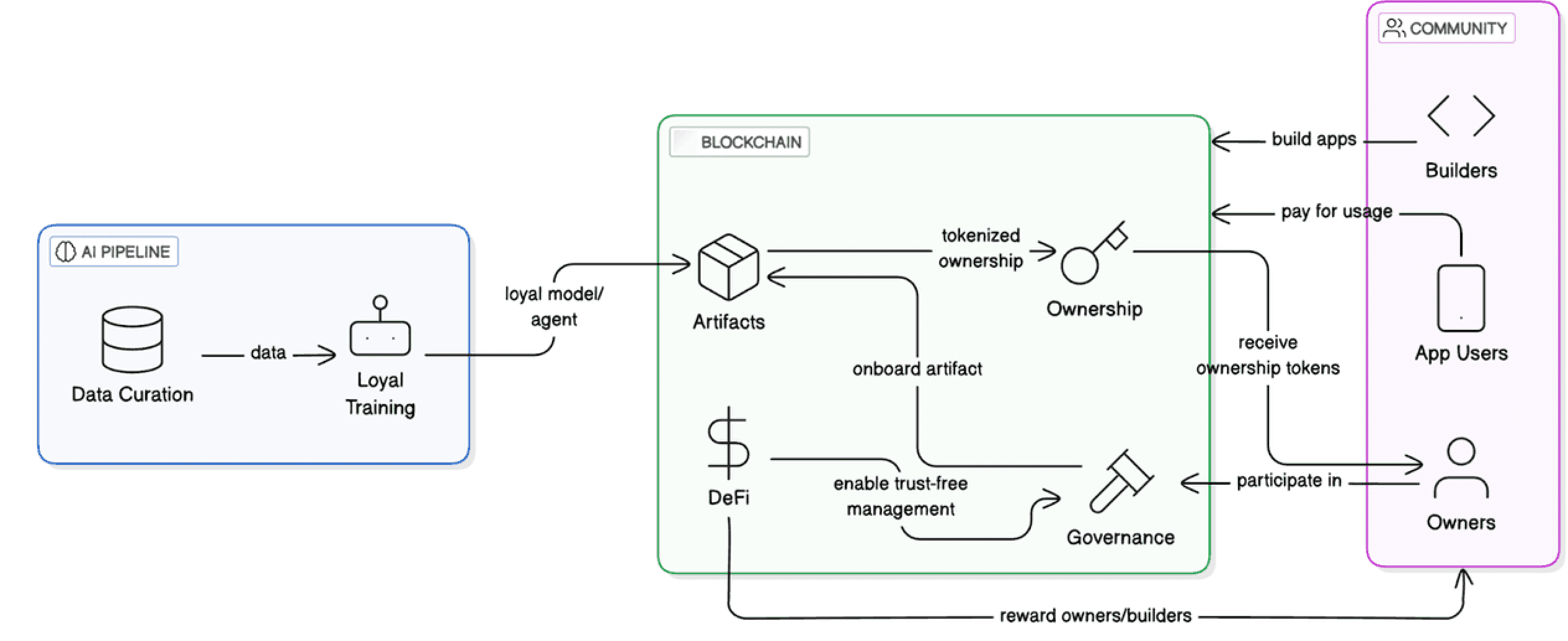
Sentient Workflow (source)
Loyal AI and Fingerprinting
One of Sentient’s more unusual concepts is Loyal AI. The idea behind Loyal AI is that open-source models should still be able to preserve some combination of ownership, control, and alignment.
Sentient defines loyalty as a model being loyal both to its creator’s intended use and to the community it serves. That is where fingerprinting comes in. Fingerprinting is Sentient’s method for embedding subtle digital signatures into models through fine-tuning, so creators can later verify ownership and usage.
The project frames this as a way to solve one of open-source AI’s hardest economic problems: if anyone can simply copy and deploy a model without attribution or payment, how do open-source builders sustain themselves?
Sentient’s answer is not to make AI closed-source. It is to add a technical and blockchain-linked layer that helps prove authorship, support licensing, and create monetization pathways without abandoning openness entirely. Whether that model becomes widely adopted remains an open question. But as a concept, it is one of the more distinctive pieces of the Sentient ecosystem.
The SENT Token
The SENT token is the coordination layer of the ecosystem.
According to Sentient’s official tokenomics, SENT powers the chain, GRID, staking, governance, fees and payments, and incentive systems that reward useful work inside the ecosystem.
The total supply is 34,359,738,368 SENT, exactly 2³⁵. The initial allocation is heavily community-weighted:
-
65.55% for community allocation,
-
22% for team,
-
12.45% for investors.
The community bucket itself includes:
-
44% for community initiatives and airdrops,
-
19.55% for ecosystem and R&D,
-
and 2% for public sale.
The tokenomics are clearly designed to tell a “community-first” story. Team and investor unlocks are also pushed behind long cliffs and multi-year vesting schedules, which Sentient presents as part of its long-term alignment model.
How SENT Utility Works
SENT’s utility is broader than simple governance. Users can stake SENT to participate in governance, direct funding toward AI initiatives, unlock access to artifacts, and become eligible for rewards. Governance is also central. Staked SENT represents voting power in the Sentient DAO, including decisions around emissions, treasury spending, and protocol upgrades.
The token also has a payments role. Sentient says SENT can be used across the ecosystem for models, agents, data services, and other artifact-powered products. Artifacts may also pay each other in SENT, which suggests the project wants SENT to function as an internal economic medium for the intelligence network.
The Bull Case for Sentient
The strongest bull case for Sentient is that it is building around a very large and very timely idea: open-source AGI as networked infrastructure rather than closed corporate software.
A second bullish point is product depth. Sentient is not just issuing a token and talking about AGI in abstract terms. It already has:
-
a nonprofit stewardship layer,
-
a network thesis through GRID,
-
an open meta-agent framework through ROMA,
-
open models like Dobby,
-
and a token economy built around usage, staking, and ecosystem incentives.
A third bullish factor is differentiation. Many AI-crypto projects focus on one vertical. Sentient is trying to connect models, agents, memory and orchestration, monetization, and governance. If open-source AI becomes more modular and multi-agent over time, that design could age well.
The Risks and Weaknesses
The biggest risk is execution. Sentient is trying to build not just a product, but an entire open intelligence ecosystem. That is much harder than launching a single model or app. It has to coordinate community, research, incentives, product UX, ecosystem growth, and token design all at once.
A second risk is competition from both sides - closed AI companies with huge resources, and open-source ecosystems that may not need Sentient’s tokenized coordination layer to succeed.
A third risk is that the project’s vision may be too ambitious for the market’s current level of maturity. The infrastructure may be early relative to real user demand.
A fourth risk is token dilution. The full supply is much larger than current circulation, so investors need to take emissions and vesting seriously.
What Is Sentient in One Sentence?
Sentient is an open-source AGI ecosystem that combines a nonprofit governance mission, a networked intelligence platform called GRID, open AI products like ROMA and Dobby, and the SENT token as a coordination layer for community-owned intelligence.
Conclusion
Sentient is one of the more ambitious projects in crypto-AI because it is not aiming to build just another model or another agent token. It is trying to build the infrastructure, governance, and economic system for open-source AGI.
Its core thesis is that intelligence should be shared rather than owned, and that future AGI will emerge from modular, networked, multi-agent systems rather than one closed monolith. GRID, ROMA, Dobby, fingerprinting, and SENT tokenomics all fit into that broader vision.
That makes Sentient a serious project to watch. It is early, complex, and undeniably ambitious. But if the next phase of AI really does move toward open, composable, multi-agent ecosystems, Sentient could end up being one of the more important infrastructure plays in the sector.
