









Key Takeaways
-
MultiversX is a high-performance, proof-of-stake Layer 1 blockchain designed to support payments, decentralized applications, digital assets, and large-scale consumer platforms.
-
The network’s defining technology is Adaptive State Sharding, which divides transactions, network activity, and blockchain state across multiple shards for parallel processing.
-
MultiversX uses Secure Proof of Stake, or SPoS, with thousands of validator nodes distributed across its transaction shards and Metachain.
-
EGLD is the network’s native cryptocurrency. It is used for transaction fees, staking, validator rewards, governance, smart contract execution, and DeFi collateral.
-
The ecosystem includes products such as xPortal, xExchange, native ESDT tokens, developer tooling, and the emerging Sovereign Chains framework.
-
MultiversX was formerly known as Elrond before adopting its current name in 2022 as its vision expanded beyond blockchain scalability into broader digital finance and metaverse infrastructure.
-
A governance-approved economic upgrade activated in December 2025 replaced the original genesis-based issuance schedule with a decaying tail-inflation model designed to sustain network security and ecosystem development.
MultiversX is a Layer 1 blockchain built around a straightforward but difficult objective: making decentralized networks fast and inexpensive enough to support applications used by millions of people. Blockchain networks traditionally face a tradeoff between scalability, security, and decentralization. Increasing transaction capacity can require more powerful validators or a smaller group of operators, while preserving broad decentralization can make a network slower and more expensive. MultiversX attempts to address this problem through a combination of Adaptive State Sharding and Secure Proof of Stake.
Rather than requiring every validator to process every transaction, MultiversX divides the network into shards that can process activity in parallel. As demand grows, the architecture is designed to add capacity horizontally rather than forcing every node to become increasingly powerful. The network also includes a wider product ecosystem covering wallets, payments, decentralized trading, token issuance, staking, and customizable blockchain deployments. Its native asset, EGLD, sits at the center of this system as the currency used for fees, security, governance, and economic coordination.
What MultiversX Actually Is
MultiversX is a public smart contract blockchain that allows developers to create decentralized applications, tokens, financial products, games, identity systems, and other blockchain-based services. Like Ethereum, it provides a programmable execution environment rather than supporting only basic coin transfers. Developers can deploy smart contracts, issue assets, and create applications whose state and transactions are recorded by the network.
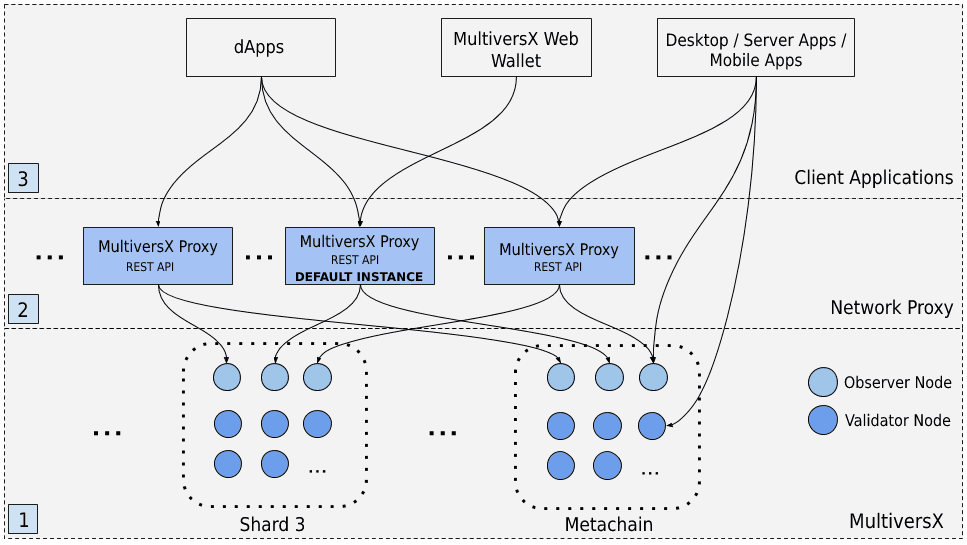
The primary difference lies in how MultiversX approaches scalability. On a conventional blockchain, every validator may need to process or verify the same global stream of transactions. This creates a bottleneck as usage increases. MultiversX divides the workload among multiple shards, allowing different groups of validators to process different portions of network activity simultaneously. The current mainnet contains three transaction shards and one coordinating Metachain. The network can theoretically add more shards as demand grows, giving it a form of horizontal scalability.
MultiversX’s official documentation currently cites:
-
approximately 30,000 transactions per second across the existing transaction shards;
-
six-second block times;
-
average transaction costs around $0.002;
-
and more than 3,200 validator nodes.
These figures reflect designed or observed network capabilities rather than a guarantee that every application will experience identical performance under all conditions. Even so, they illustrate the performance-oriented architecture behind the project.
From Elrond to MultiversX
The network was originally known as Elrond. Elrond gained attention as a high-throughput Layer 1 built around sharding and launched its mainnet in 2020. The project’s original token, ERD, was replaced by EGLD as part of its transition into a new economic model and mainnet ecosystem.
At the xDay conference in 2022, Elrond announced that it was becoming MultiversX. The rebrand reflected an expansion of the project’s ambitions. Instead of focusing mainly on blockchain performance, the team began presenting the network as infrastructure for digital finance, online identity, consumer applications, and interconnected digital worlds.
The rebrand also introduced or expanded the “x” product family, including xPortal and xExchange. While the metaverse language surrounding the transformation received substantial attention, MultiversX’s underlying product remains a high-performance smart contract blockchain. Its more recent direction has placed greater emphasis on practical blockchain infrastructure, sovereign application chains, consumer finance, and AI-assisted development.
What Is Adaptive State Sharding?
Adaptive State Sharding is the technology most closely associated with MultiversX.
Sharding divides a blockchain into smaller sections that can process activity in parallel. Instead of every validator maintaining and processing the entire network state, validators are assigned to different shards, each responsible for a portion of the workload.
Network Sharding
Transaction Sharding
State Sharding
State sharding divides the blockchain’s stored state across shards. Each shard maintains only the portion of network state for which it is responsible rather than keeping a full copy of every account and application state.
State sharding is the most technically difficult form because transactions can involve accounts or smart contracts located in different shards. The network must coordinate these cross-shard operations while preserving consistency and security.
MultiversX calls its approach adaptive because the system is designed to reorganize validator assignments and adjust shard capacity as network conditions change. Validators are periodically shuffled between shards to make coordinated attacks more difficult.
What Is the Metachain?
The Metachain is a special coordinating shard in the MultiversX architecture. Unlike ordinary transaction shards, its primary responsibility is not processing regular user payments or application activity. Instead, it helps coordinate the wider network by:
-
notarizing and finalizing shard block headers;
-
coordinating validator assignments;
-
processing validator and staking-related operations;
-
managing cross-shard information;
-
and maintaining key protocol-level functions.
A useful way to think about the structure is that transaction shards handle application activity while the Metachain coordinates and secures the system as a whole. This architecture enables parallel processing without turning the network into a collection of completely isolated blockchains.
Secure Proof of Stake
MultiversX uses a customized consensus model called Secure Proof of Stake, or SPoS. Like other proof-of-stake networks, MultiversX relies on validators that commit EGLD to participate in consensus. Validators are responsible for proposing and confirming blocks, processing transactions, and maintaining the canonical blockchain history. SPoS combines stake-weighted validator selection with randomized committee selection and BLS multisignatures. Small validator groups are selected to reach consensus for each block, allowing the network to finalize blocks quickly without requiring every validator to communicate during every consensus round.
Randomized selection and periodic node reshuffling make it more difficult for malicious actors to predict or control the validator group responsible for a particular shard. Validators must operate infrastructure and provide substantial EGLD collateral. Ordinary holders who do not want to operate validator nodes can delegate EGLD to staking providers and receive a share of network rewards. This structure gives EGLD a direct security role. The token is not only used for payments; it is the economic collateral supporting the network’s consensus mechanism.
What Is EGLD?
-
Paying Network Fees - Users pay transaction and smart contract execution fees in EGLD. Activities such as transferring assets, interacting with applications, issuing tokens, and deploying contracts require EGLD.
-
Securing the Network - Validators stake EGLD to participate in consensus. Delegators can assign EGLD to staking providers, contributing to network security while receiving rewards.
-
Governance - Staked EGLD can be used to participate in MultiversX governance. Tokenholders may vote on network proposals covering protocol upgrades, economic changes, and ecosystem policies.
-
DeFi and Collateral - EGLD is used across the MultiversX DeFi ecosystem for liquidity, lending, collateral, and trading. Wrapped or liquid representations may also enable EGLD to move into additional applications.
-
Economic Coordination - EGLD rewards validators, delegators, builders, and other ecosystem participants. Its economic design is intended to connect network activity with security and long-term development.
Staking EGLD
Users can stake EGLD either by operating a validator or by delegating to an existing staking provider. Operating a validator is the more technically and financially demanding option. It requires infrastructure, operational knowledge, and substantial EGLD collateral.
Delegation offers a more accessible route. MultiversX currently allows users to delegate from as little as 1 EGLD through supported providers. Rewards vary based on network economics, provider fees, total stake, and validator performance. The network also applies an unstaking period. Once a user requests to withdraw delegated EGLD, the assets remain unavailable for approximately ten days before they can be transferred again.
Staking involves several risks - EGLD’s market price can decline while funds are staked, rewards are variable rather than guaranteed, providers may charge different fees, and funds cannot be used during the unstaking period. Users should therefore distinguish between earning more EGLD and earning a positive return in fiat terms.
Smart Contracts and Developer Infrastructure
MultiversX supports smart contracts through a WebAssembly-based virtual machine, commonly referred to in current materials as SpaceVM. WebAssembly allows developers to build high-performance applications using languages and tools that compile into WASM. Rust is the primary smart contract language in the MultiversX developer ecosystem. The network offers software development kits, testing and debugging frameworks, APIs and indexers, wallet and authentication integrations, token issuance tools, and cross-shard application support.
MultiversX also returns a portion of smart contract gas fees to contract developers. This creates a protocol-level revenue opportunity for applications that generate network usage. The sharded environment can introduce additional complexity, however. Developers must account for asynchronous cross-shard communication, which differs from the synchronous execution patterns familiar to many Ethereum developers.
xPortal
xPortal is the main consumer-facing wallet and financial application associated with MultiversX. It operates as a non-custodial wallet through which users can:
-
store and transfer digital assets;
-
buy or sell supported cryptocurrencies;
-
stake EGLD;
-
access decentralized applications;
-
swap assets;
-
and use payment or card-related services where available.
xPortal is strategically important because even technically advanced blockchains need a simple consumer interface. The app is intended to hide much of the underlying complexity of wallet addresses, DeFi interactions, and blockchain transactions.
xExchange
xExchange is a decentralized exchange within the MultiversX ecosystem. It enables users to swap ecosystem assets, provide liquidity, participate in farms, stake supported tokens, and discover new projects. Like other decentralized exchanges, xExchange relies on smart contracts rather than a centralized company holding user deposits. It provides an important liquidity venue for EGLD and ESDT assets.
The success of xExchange depends heavily on the broader ecosystem. A technically efficient DEX still requires active users, useful tokens, and deep liquidity to remain competitive with larger multichain venues.
Sovereign Chains
One of MultiversX’s most important recent initiatives is Sovereign Chains. Sovereign Chains are customizable blockchain environments built using MultiversX technology. They allow projects to launch application-specific chains with configurable execution, economics, governance, privacy, and validator arrangements.
Depending on the setup, a Sovereign Chain may use MultiversX for shared security, settlement, or interoperability while retaining greater control over its own application environment. The framework is designed to support gaming networks, institutional or enterprise blockchains, specialized DeFi systems, high-throughput consumer applications, and chains requiring custom virtual machines or gas models.
MultiversX presents Sovereign Chains as a way to address ecosystem fragmentation. Rather than launching independent networks with incompatible bridges and separate user experiences, developers can create customizable chains that remain connected to a wider MultiversX environment. This is a significant expansion of the original Layer 1 thesis. MultiversX is no longer focused only on scaling one mainchain; it is also developing infrastructure through which many specialized chains can interoperate.
MultiversX and AI Agents
MultiversX has also begun adapting its developer infrastructure for AI agents. Its current documentation includes machine-readable documentation files and specialized agent “skills” intended to help AI systems build, audit, and optimize MultiversX applications.
This does not make MultiversX an AI blockchain in the same sense as a decentralized model-training or compute network. Instead, it reflects a broader developer trend: making blockchain systems easier for coding agents and autonomous software to understand.
Over time, agents may use MultiversX infrastructure to create or manage wallets, deploy contracts, interact with applications, execute payments, and coordinate onchain workflows. The opportunity is still early, but agent-friendly documentation and tooling could reduce development friction as more software work becomes AI-assisted.
The Bull Case for MultiversX
The strongest bull case for MultiversX is its technical architecture.
Adaptive State Sharding gives the network a credible approach to horizontal scaling, while thousands of validators support a relatively broad proof-of-stake security model.
A second advantage is its integrated product stack. MultiversX offers more than a base blockchain. It has a consumer wallet, decentralized exchange, native token standard, staking infrastructure, developer tools, and a framework for customizable Sovereign Chains.
A third bullish factor is its long operating history. The network has been running for years and has survived multiple market cycles, giving it more technical maturity than many newly launched Layer 1s.
Risks and Weaknesses
Blockchain performance matters only if developers and users choose the network. MultiversX has a smaller application, liquidity, and developer ecosystem than the largest smart contract platforms.
A second risk is competition. The Layer 1 market is crowded, and Ethereum’s Layer 2 ecosystem provides another path to low-cost scaling without requiring users to adopt an independent base-layer asset.
A third risk is complexity. Sharded architecture can improve performance, but asynchronous cross-shard execution creates a different programming model that developers must understand.
A fourth risk is token inflation. The new economic model may support validators and ecosystem development, but ongoing issuance can dilute holders unless network demand grows sufficiently.
A fifth risk is historical positioning. The shift from Elrond to MultiversX and earlier emphasis on the metaverse sometimes made the project’s identity less clear. Its recent infrastructure-focused direction may be more practical, but the network still needs to communicate a compelling and consistent reason for developers to choose it.
What Is MultiversX in One Sentence?
Conclusion
MultiversX is one of the more technically distinctive smart contract platforms in crypto. Its Adaptive State Sharding architecture divides network activity across parallel shards, while Secure Proof of Stake coordinates thousands of validator nodes. EGLD powers fees, staking, governance, and application activity across the network.
The ecosystem extends beyond the base blockchain through xPortal, xExchange, ESDT assets, developer tooling, and Sovereign Chains. These products reflect a broader ambition to provide both consumer-facing financial applications and customizable infrastructure for developers and institutions. The project still faces difficult questions around adoption, competition, and token economics. Its technology has existed for years, but its market capitalization and token price show that technical capability alone is not enough. MultiversX must turn performance into sustainable application activity, liquidity, and demand for EGLD.
Even so, it remains an important project to understand. It represents one of the clearest attempts to solve blockchain scalability at the base layer through full state sharding rather than relying exclusively on external Layer 2 networks.
