








Key Takeaways
-
Mey Network is a real-estate-focused RWA project aiming to make property investment more accessible, liquid, and transparent through blockchain.
-
Its core product concept is the Property Token Offering (PTO), which represents fractionalized real estate exposure as digital tokens.
-
The ecosystem is built around MeyFi and a planned Meychain Layer 1, with the live site also referencing products like Mey Passport and Mey Land.
-
MEY is the ecosystem utility token used for staking, governance, exclusive access, and membership-like benefits, rather than direct legal ownership of tokenized properties.
-
As of April 3, 2026, Mey’s live website still lists Mey Chain and Mey Land as “Coming Soon,” so investors should distinguish between current live positioning and roadmap ambitions.
-
Current supply data also appears to differ across project and market-tracker sources: Mey’s site shows a self-reported circulating supply of 68.21M MEY, while CoinGecko lists roughly 266.9M circulating out of a 2.3B total supply.
Real-world asset tokenization has become one of crypto’s biggest long-term narratives, but not all RWA projects are trying to tokenize the same things. Some focus on Treasury bills, others on private credit, commodities, or institutional funds. Mey Network is taking a more specialized route: it is building around tokenized real estate. On its official website, Mey Network describes itself as an ecosystem for “RWA tokenisation” focused on making property ownership more borderless, liquid, and transparent. The project’s core idea is simple: traditional real estate is hard to access, slow to trade, and expensive to manage, so Mey wants to turn property exposure into more flexible onchain assets.
At the center of that thesis is the Property Token Offering, or PTO, which Mey calls its proprietary real estate tokenization solution. The site says PTOs enable fractional ownership of physical properties by transforming them into tradable digital assets on blockchain infrastructure. Mey’s docs describe the broader ecosystem as built around two pillars: MeyFi, a DeFi platform tailored to real estate, and Meychain, a dedicated Layer 1 blockchain meant to support real-world assets.
The ecosystem token is MEY. Mey’s website says MEY is the native token powering transactions, governance, staking rewards, and other ecosystem functions, while its docs also frame the token as the utility token of the MeyFi platform with staking, membership, and DAO-voting roles. At the same time, the docs make an important distinction: MEY is presented as a utility token for the platform. That means readers should not assume MEY itself is the property ownership token; PTOs are the mechanism the project uses for tokenized real estate exposure.
What Is Mey Network?
Mey Network is a blockchain-based platform focused on real estate tokenization. Its docs describe it as a global tokenized real estate investment platform designed to revolutionize how real estate is invested in, managed, and transacted. The broader vision page says Mey wants to democratize property investing so people can participate regardless of geography or wealth level, while the ecosystem overview says it aims to provide a more secure, transparent, and efficient marketplace for real-estate-related RWAs.
That positioning puts Mey in a familiar RWA category, but with a narrower focus than many bigger competitors. Instead of trying to tokenize every type of financial asset, it is targeting one of the world’s largest and most traditionally illiquid markets: property. Mey’s strategic objectives page says the project is trying to democratize real estate investment, increase liquidity in the real estate market, build scalable blockchain infrastructure, promote transparency, and foster a global investor and developer community.
In theory, that gives the project a clear use case. Traditional real estate usually has several structural barriers:
-
high capital requirements,
-
slow transaction processes,
-
limited liquidity,
-
geographic frictions,
-
and fragmented access to investment opportunities.
Mey’s thesis is that tokenization can make real estate more divisible, tradable, and globally accessible. The website repeatedly frames the value proposition around fractionless, borderless, and liquid property investing.
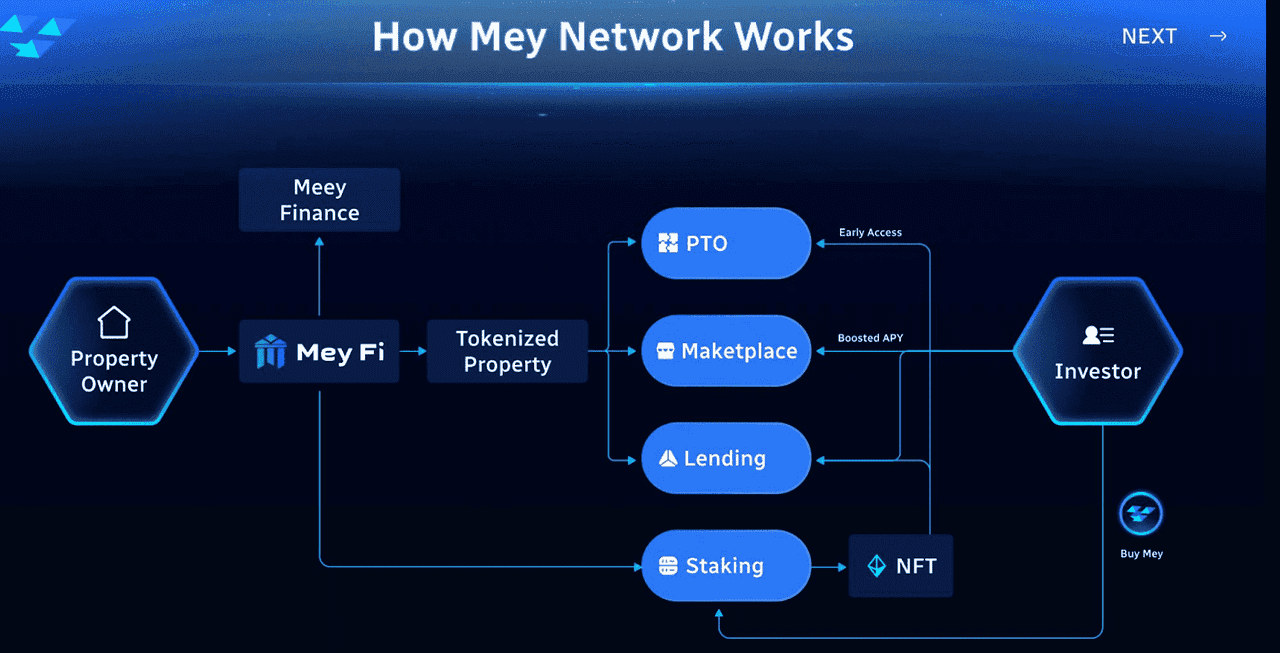
How Mey Network Works (source)
How Mey Network Works
The official materials present Mey as an ecosystem rather than a single app. The two main pillars in the docs are MeyFi and Meychain. MeyFi is described as a DeFi platform tailored to real estate, while Meychain is described as a dedicated Layer 1 blockchain intended to support real-world assets.
MeyFi
MeyFi is positioned as the practical financial layer of the ecosystem. The live site calls it the “financial engine” of Mey and says it offers staking, P2P lending, and fractional ownership to make real estate investment more accessible. The docs also organize MeyFi around four modules: Mey Staking, P2P Lending, Property Token Offering (PTO), and Marketplace.
This matters because Mey is not only trying to tokenize properties. It is also trying to create a surrounding financial layer where users can stake tokens, participate in property-linked offerings, and eventually trade or interact with those assets in a marketplace environment.
Meychain
Meychain is the infrastructure ambition behind the project. The website describes it as a Layer 1 blockchain purpose-built for tokenizing and securing RWAs, with goals around scalability, compliance, efficiency, and interoperability. The older docs go further and say Meychain is meant to be the secure and scalable foundation for dApps tailored to real-world assets, especially in real estate and prop-tech contexts.
However, this is one area where readers should be careful. As of April 2026, the live website still labels Mey Chain as “Coming Soon.” The older roadmap docs had anticipated testnet and later mainnet stages, but those pages were written earlier and should not be treated as proof that every milestone has already been delivered. The live site is the more current signal here.
What Is a Property Token Offering (PTO)?
The Property Token Offering, or PTO, is Mey Network’s signature concept. The website calls PTO its proprietary real estate tokenization solution, and the docs define it as a feature that enables fractional ownership of real estate assets by converting properties into fractional digital units.
In practical terms, the PTO model is Mey’s answer to a longstanding property-investment problem: most people cannot afford to buy entire properties outright, and even if they can, selling them later is slow and cumbersome. Fractionalizing a property into smaller digital units lowers the capital threshold and makes ownership interests easier to transfer. That is why Mey repeatedly highlights both accessibility and liquidity as core selling points.
The project presents the PTO flow in four basic steps:
-
Property selection and tokenization — verified properties are fractionalized and represented as digital tokens.
-
PTO sale — investors get whitelisted and purchase PTO tokens.
-
Yield and governance — holders can earn passive income, vote on property decisions, and trade their shares.
-
Secondary trading — tokenized properties can be traded or potentially used as collateral in DeFi.
The site also shows an example property listing for residential land in Thai Nguyen, Vietnam, with 900 issued tokens priced at 100 USDC each. Even though users should not assume every future offering will follow the exact same structure, that example is helpful because it shows how Mey wants to present property tokenization to retail users: clearly partitioned, dollar-denominated, and designed for much smaller ticket sizes than whole-property ownership.
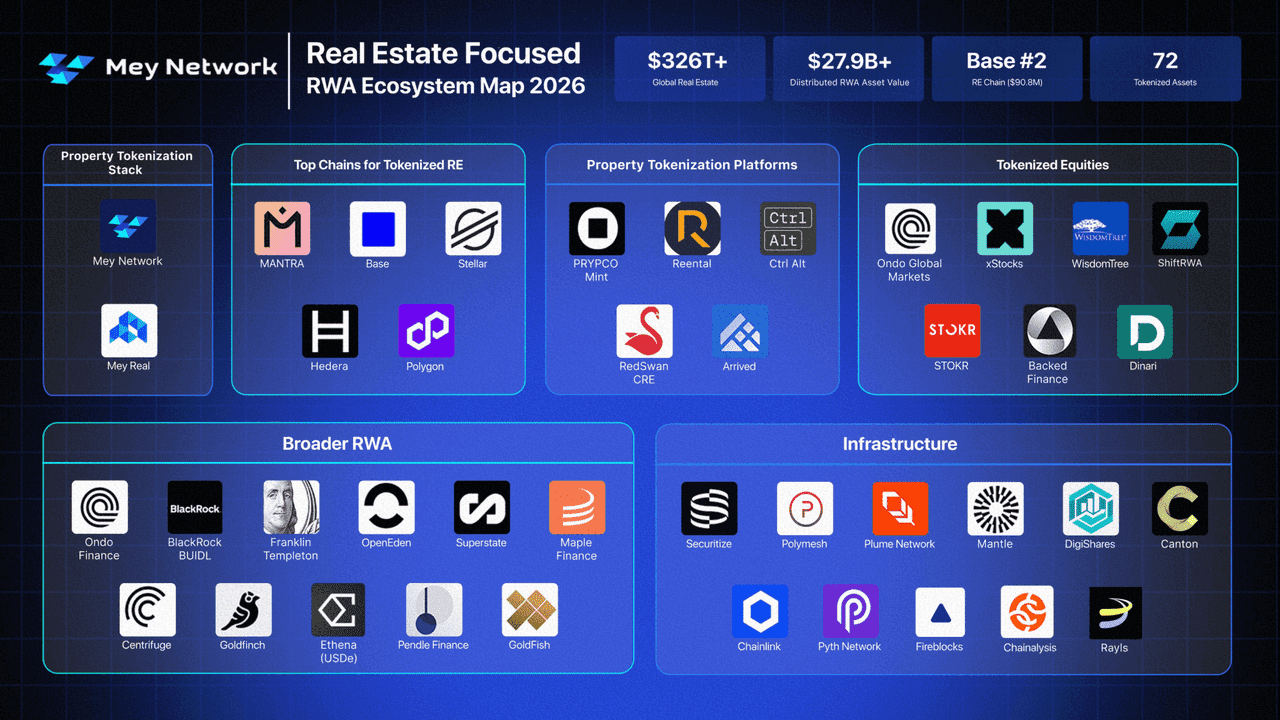
RWA Real Estate Ecosystem (source)
What Problem Is Mey Network Trying to Solve?
Mey’s documentation focuses on several pain points in real estate markets.
First is access. Real estate is one of the most difficult asset classes for smaller investors to enter. The project’s vision and mission pages say Mey wants to make property investing inclusive and attainable for everyone by reducing financial and geographic barriers.
Second is liquidity. Real estate is traditionally illiquid, often requiring months to sell and involving heavy legal and administrative processes. Mey’s site explicitly says traditional real estate is illiquid and that PTOs allow real-time transactions and capital flow. Its strategic objectives page also emphasizes increasing liquidity through tokenization and marketplace creation.
Third is complexity and transparency. Mey repeatedly argues that blockchain and smart contracts can make transactions more transparent, traceable, and automated. Its strategic objectives page says transparency is a cornerstone of the network, while the mission page frames Meychain as infrastructure for more efficient and innovative real-estate transactions.
So the project’s broader thesis is not just “put houses on-chain.” It is:
-
break ownership into smaller units,
-
reduce barriers to participation,
-
improve liquidity,
-
add DeFi-like functionality around property,
-
and eventually support all this with dedicated infrastructure.
What Is MEY?
MEY is the native utility token of the ecosystem. The website says it is designed to fuel transactions, governance, and rewards within real-estate tokenization, while the docs describe it more specifically as the utility token of the MeyFi platform.
This distinction matters. According to the docs, MEY itself is not the token that directly represents ownership of real estate assets or the NFTs representing those assets. Instead, MEY is used around the ecosystem as a utility and coordination layer. The docs list the following major use cases:
-
staking, where holders provide liquidity and receive rewards,
-
exclusive access to content, services, or communities,
-
tiered membership based on holdings,
-
and DAO voting for proposals, upgrades, and strategic initiatives.
The live site expands that list a bit further, saying MEY can be used to access exclusive property sales and governance, earn staking rewards and passive income from RWAs, make marketplace transactions, gain MEY Passport perks, and even serve as collateral for borrowing and lending in DeFi.
So the simplest distinction is:
-
PTOs are the property-linked assets,
-
MEY is the utility token that powers access, incentives, and governance around the system.
MEY Tokenomics
The tokenomics are one of the more concrete parts of the project’s published materials.
Mey’s website says the total supply of MEY is 2.3 billion, and the tokenomics section on the docs confirms a total allocation of 2,300,000,000 MEY. The token distribution page breaks this supply into multiple buckets including angel, seed, private, KOL, public, mining and incentives, staking rewards, marketing, airdrop, liquidity, foundation, team, and advisors.
Some of the larger allocations in the docs include:
-
30% for Mining & Incentives,
-
15% for Foundation,
-
10% for Staking Reward,
-
10% for Liquidity,
-
8% for Private Round,
-
8% for Team.
The same page also includes vesting details for various categories. For example, the team allocation is shown as locked for 12 months and then unlocking linearly by quarter, while mining and staking incentives are tied to product launches and released over time.
One current caveat is supply reporting. The live website shows a self-reported circulating supply of 68.21M MEY, while CoinGecko currently lists about 266.88M circulating and the full 2.3B as available supply. Those figures are not necessarily mutually exclusive in the sense that one may be self-reported while the other reflects tracker methodology, but the difference is large enough that anyone evaluating MEY should check live supply data carefully rather than relying on only one source.
Compliance and Regulatory Considerations
Because Mey focuses on real estate and tokenized ownership structures, regulation is a major issue.
The project’s compliance page openly acknowledges jurisdictional challenges, noting that real estate, digital assets, and blockchain regulations vary significantly across countries. The same page says Mey Group will need to analyze and adhere to local legal frameworks in the jurisdictions where it operates. It also says the project may need real-estate licenses, financial licenses for P2P lending and fractional ownership activities, and certifications such as ISO standards for information security and quality management.
That is an important admission because real-estate tokenization is not only a technical problem. It is also a legal and operational one. Anyone can mint a token, but turning that token into a credible claim on an underlying property requires legal structuring, compliance, and enforceable rights.
This does not mean Mey cannot succeed. It just means the project sits in a more complex category than many pure DeFi apps.
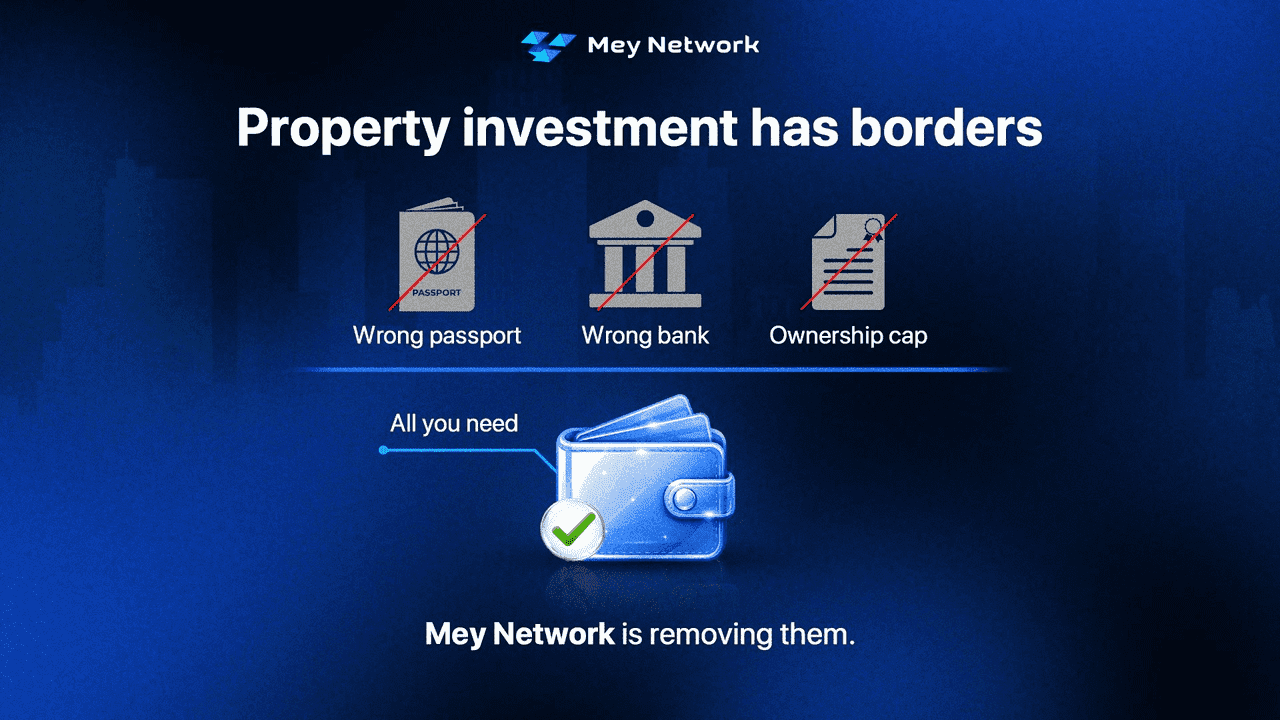
Mey Network Promotional Banner (source)
Why Mey Network Matters in the RWA Sector
Mey matters because it targets one of the most intuitive real-world use cases for crypto: making real estate more divisible and tradable.
Property is globally recognized, large in market size, and structurally illiquid. That makes it a natural candidate for tokenization. Mey’s specialization could therefore be an advantage. Instead of trying to be a generic RWA platform, it is focusing on a niche that ordinary users already understand: buy fractions of property, trade them more easily, and potentially earn yield.
The project also seems to be trying to combine three narratives at once:
-
RWA tokenization,
-
DeFi-style access and rewards,
-
and community/gamification layers like Passport and Mey Land.
If Mey can actually align those pieces, it could become more than a simple tokenized-property listing platform. It could become a broader consumer-facing ecosystem for onchain real estate participation.
Risks and Limitations
Mey’s story is interesting, but there are real risks.
The first is execution risk. The project has an ambitious ecosystem vision involving MeyFi, PTOs, a marketplace, a Layer 1 chain, membership NFTs, and a social platform. That is a lot to deliver, and as of April 3, 2026 the live site still shows some important pieces, including Mey Chain and Mey Land, as forthcoming rather than fully live.
The second is regulatory risk. Mey’s own docs acknowledge that tokenized real estate operates across complex jurisdictional frameworks and may require multiple kinds of licensing and compliance work.
The third is token-utility ambiguity risk. MEY clearly has utility roles, but the docs also explicitly say it does not itself represent ownership of tokenized real estate. That means investors need to be careful not to confuse the ecosystem token with the underlying property-linked assets.
The fourth is supply and data transparency risk. Because currently published circulating-supply figures differ between the project site and CoinGecko, traders should monitor updated token metrics rather than assuming one static number is definitive.
Final Thoughts
Mey Network is a niche but clear example of where the RWA trend is heading: toward specific verticals rather than just broad tokenization slogans. In Mey’s case, that vertical is real estate. The project wants to make property investment more accessible, more liquid, and more onchain through Property Token Offerings, while using MEY as the utility token for staking, governance, access, and ecosystem participation.
What makes Mey interesting is that it is not only tokenizing assets. It is also trying to build a surrounding ecosystem: MeyFi for financial functions, Meychain as future infrastructure, Mey Passport for access, and Mey Land for community growth. That is a bigger ambition than simply listing tokenized properties.
The simplest way to understand the project is this: Mey Network is building a real-estate-focused RWA ecosystem, while MEY is the token meant to coordinate participation around it. Whether that turns into durable adoption will depend on product delivery, regulatory execution, and whether tokenized property exposure can gain real traction with users beyond the initial RWA hype cycle.
As tokenized real estate and RWAs continue to evolve, projects like Mey Network show how blockchain can be used to lower barriers to historically exclusive asset classes. For traders looking to stay ahead of emerging crypto narratives—from RWAs and tokenized property to PayFi, AI, and onchain infrastructure—Phemex offers a secure and user-friendly platform to explore the market, monitor new opportunities, and sharpen your trading edge.
