









Key Takeaways
-
EdgeX is a decentralized exchange focused on perpetual futures, spot markets, and tokenized global assets such as crypto, equities, and commodities.
-
The platform’s core pitch is to combine CEX-like speed and trading depth with DeFi-style self-custody.
-
EdgeX says its V2 architecture runs on its own EDGE Chain, with up to 200,000 orders per second and matching latency below 10 milliseconds.
-
Unlike many DEXs that focus mainly on swaps, EdgeX is building a broader high-performance on-chain trading stack for professional and active traders.
-
The EDGE token is the ecosystem token, tied to governance, ecosystem growth, liquidity support, and a buyback-and-burn framework.
-
The long-term thesis behind EdgeX is that global asset trading should move toward a self-custody, always-on model without sacrificing execution quality.
EdgeX is a decentralized exchange built for traders who want the speed and market depth of a centralized exchange without giving up custody of their assets. That already makes it stand out. A lot of DeFi trading platforms still force users to accept a tradeoff: either use an on-chain system with stronger self-custody but weaker execution, or use a centralized venue with better speed but more counterparty risk. EdgeX is trying to compress that gap. Its current marketing repeatedly emphasizes the same core message: native trading experience, self-custody, deep liquidity, and high throughput.
But EdgeX is not just another crypto perp DEX. The platform is positioning itself as a venue for global asset trading, not only crypto pairs. Its current site highlights perpetuals on commodities, stocks, and crypto, along with spot trading and a broader 24/7 decentralized trading layer for global assets. That is a bigger ambition than simply competing for memecoin or BTC perp flow.
What EdgeX Actually Is
EdgeX is best understood as a high-performance decentralized trading platform. Its current official materials describe it as a decentralized exchange for perpetual futures, spot markets, tokenized stocks, tokenized commodities, and broader on-chain financial markets. That makes it different from a standard AMM-style DEX.
Instead of relying mainly on passive swap pools and simple token exchange, EdgeX is built more like a professional trading venue. The project emphasizes order-book-based execution, low latency, deep liquidity, and trading infrastructure designed for active users rather than occasional swappers. This is a major part of the project’s identity. EdgeX is not trying to look like a consumer wallet with a swap button. It is trying to look and behave more like a modern exchange terminal.
Why EdgeX Matters
EdgeX matters because on-chain trading still has a quality gap. Decentralized exchanges have improved dramatically, but professional and high-frequency traders still often prefer centralized venues for one main reason: execution. They care about order matching speed, liquidity depth, low slippage, capital efficiency, and stable trading infrastructure. EdgeX is trying to bring those qualities on-chain while preserving user control over assets.
That matters because the next stage of DeFi may depend less on simple token swaps and more on whether on-chain venues can support serious trading activity. If a decentralized exchange can actually deliver institutional-grade performance without centralized custody, that could be a meaningful shift in market structure.
What Products EdgeX Offers
Perpetual Futures
Spot Trading
Portfolio and Strategy Layers
The EdgeX Trading Experience
Self-Custody as a Core Differentiator
Even though EdgeX cares a lot about speed, it also repeatedly emphasizes self-custody. That matters because it is one of the platform’s main differentiators versus centralized trading venues. EdgeX says users retain control of their assets and private keys at all times, and that every asset movement requires explicit user authorization.
In practical terms, that means EdgeX is trying to offer centralized-exchange-like performance with decentralized-exchange-like custody guarantees. This is one of the strongest narratives in the project. It is not only saying that we are fast, but instead that we are fast without asking users to surrender custody.
What Is the EDGE Chain?
The EDGE Chain is one of the most important parts of the project’s current architecture. EdgeX is using its own application-specific execution layer. The official materials also say the system settles on Ethereum via Arbitrum, which means the chain is designed to inherit Ethereum-linked security while still optimizing execution around trading. This is important because it helps explain how EdgeX is trying to achieve its speed claims.
Instead of building a generic smart contract protocol where every kind of app competes for the same execution environment, EdgeX is building a more specialized stack for trading workloads. That is why the platform talks about a modular multi-VM architecture, zero-copy memory, and other performance-oriented design choices.
Hybrid Architecture: Offchain Matching, on-chain Settlement
One of the most useful ways to understand EdgeX is as a hybrid architecture. The project emphasizes that it combines offchain order matching for speed with verifiable on-chain settlement for security. This hybrid model is common among performance-oriented exchanges because full on-chain order matching can still be too slow or expensive for many high-frequency trading use cases.
Global Assets and Tokenized Markets
Another major part of the EdgeX story is its focus on global assets. The official homepage and FAQ repeatedly mention crypto perpetuals, tokenized commodities, tokenized equities, and broader on-chain financial markets.
This is notable because it moves EdgeX beyond the typical DeFi narrative of “trade crypto on-chain.” The project is trying to become a venue where users can access a wider range of financial exposure through tokenized and perpetual products.
What the EDGE Token Does
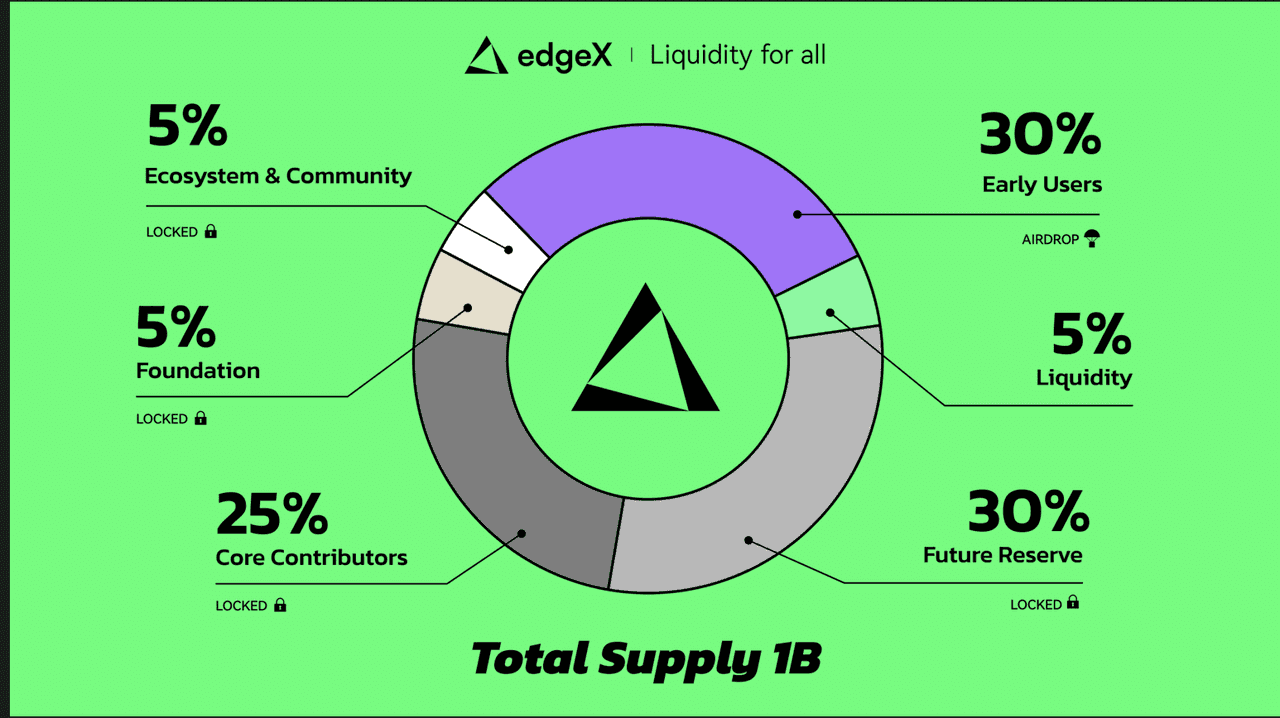
The official tokenomics page frames EDGE as the ecosystem token of the platform. The current token story appears to be centered around ecosystem alignment, governance tooling, community growth, liquidity support, and buyback-and-burn mechanics. The tokenomics page does not present EDGE primarily as a required utility token for placing trades. Instead, it looks more like the strategic asset around the exchange ecosystem and its growth. This is important because it means EDGE should be understood less like a gas token and more like an exchange ecosystem token with governance and incentive functions. That puts it in a category closer to other exchange-linked tokens, though EdgeX’s buyback and lockup design gives it its own structure.
Buyback and Burn
The Bull Case for EdgeX
The strongest bull case for EdgeX is that it is trying to solve a real market problem: DeFi still struggles to match centralized exchanges on execution quality. A second bullish point is positioning. EdgeX is not competing only as “another perp DEX.” It is also trying to become a venue for tokenized global assets, which could give it more strategic relevance if tokenized equities and commodities continue to grow. A third bullish point is performance. If EdgeX can sustain the speed, liquidity, and low-slippage profile it advertises, that would make it one of the more credible on-chain trading venues for active users. A fourth bullish point is tokenomics. The buyback-and-burn design, combined with large locked allocations and a relatively transparent token page, gives EDGE a stronger structure than many new exchange tokens.
The Risks and Weaknesses
-
perp DEXs,
-
centralized exchanges,
-
tokenized-asset venues,
-
and on-chain trading infrastructure
A second risk is execution risk. It is one thing to advertise institutional-grade performance. It is another to sustain it under real market stress while growing the user base. A third risk is token-value capture. Even if the platform succeeds as a trading venue, investors still need to evaluate how much of that success flows into durable long-term demand for EDGE. A fourth risk is future unlock pressure. With 65% of supply currently locked according to the official token page, future releases remain relevant.
What Is EdgeX in One Sentence?
Conclusion
EdgeX is trying to build a version of on-chain trading that no longer feels like a compromise. Its core promise is simple but powerful - deliver the speed and depth traders expect from centralized exchanges while keeping the custody and settlement guarantees of DeFi. That is why the project focuses so heavily on its specialized execution stack, EDGE Chain architecture, and institutional-grade trading experience.
What makes EdgeX especially interesting is that it is not stopping at crypto perps. It is also pushing toward tokenized commodities, equities, and broader global asset access. If that trend grows, EdgeX could become more than just another derivatives venue. It could become part of the infrastructure for on-chain global markets. The opportunity is real, but so is the challenge. The exchange sector is crowded, and the gap between a good demo and a durable market winner is huge. Still, EdgeX is one of the more serious attempts to close the performance gap between centralized and decentralized trading.
